Table of Contents
- Home
- content hub
- Standard Size Postcard: A Quick Guide to USPS & Design
 Share and earn
Standard Size Postcard: A Quick Guide to USPS & Design

Dec 2, 20251019 views
Dec 2, 20251019 views
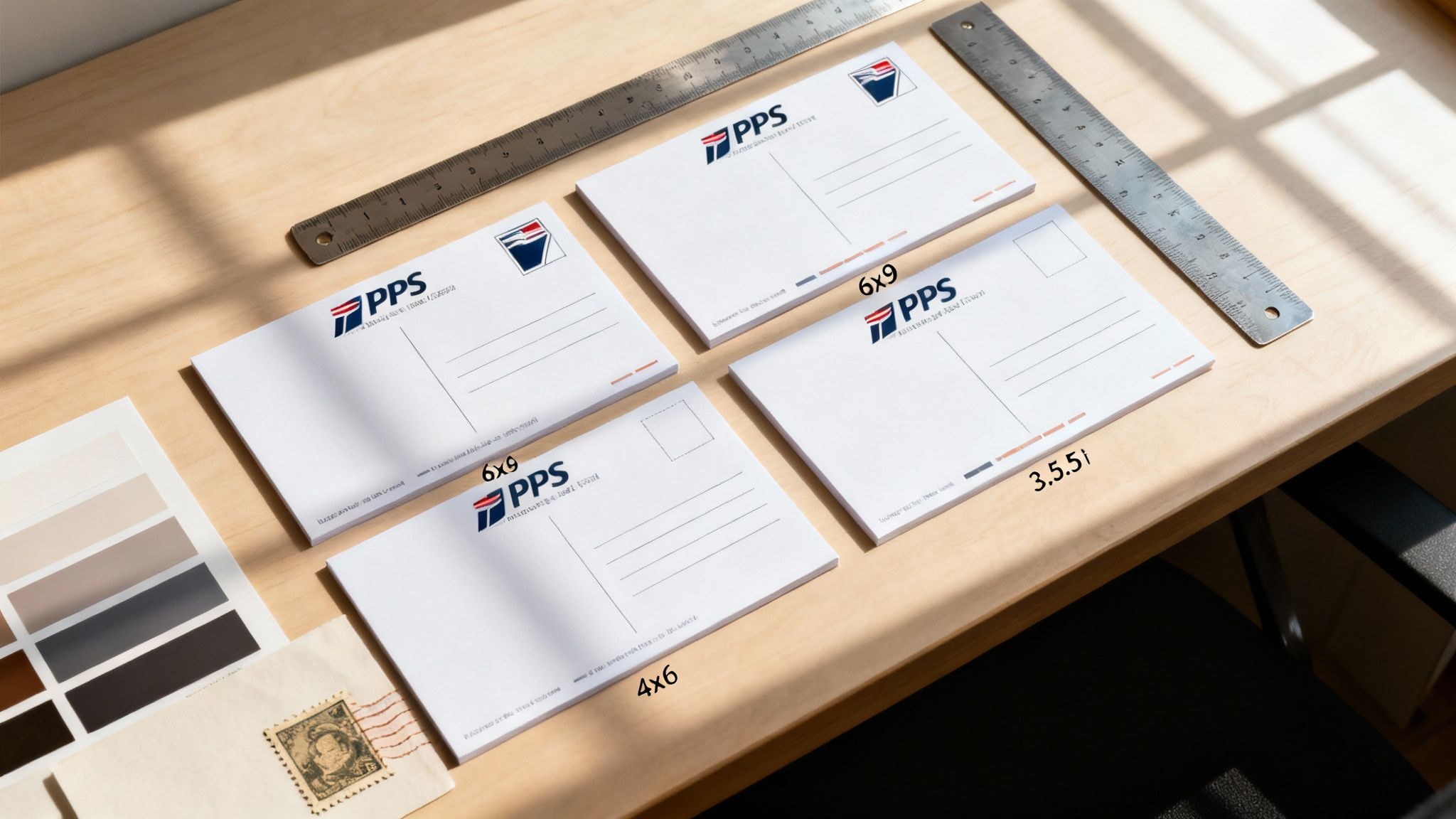
When you hear "standard size postcard," your mind probably jumps to the classic 4" x 6" postcard. There’s a good reason for that. It’s the perfect blend of affordability and impact, giving you just enough space for a powerful message while qualifying for the lowest USPS First-Class postage rates. It's the trusty workhorse of the direct mail world.
Your Quick Guide to Postcard Sizes
While 4" x 6" is the crowd favorite, the term "standard" actually covers several different dimensions that the post office will happily mail. Think of postcard sizes like tools in a toolbox. The little 4" x 6" is your reliable screwdriver—it gets most jobs done perfectly. But sometimes, you need a bigger tool, like a 6" x 9" postcard, to really make a statement and grab someone's attention.
Picking the right size isn't just about aesthetics; it's a strategic move. Your choice will hinge on your goals, your message, and of course, your budget. Each size gives you a different canvas to play with and completely changes how your audience will see your brand when it lands in their mailbox.
Understanding the Most Common Dimensions
Let’s get down to brass tacks and look at the most common postcard sizes you'll see out in the wild. These are the go-to options for everything from marketing campaigns and event invites to special announcements because they're designed to stand out without being a hassle to mail.
A few key things set them apart:
- Mailing Cost: Size really does matter to the USPS. Smaller postcards that fit their specific guidelines get a sweet discount on postage. Go bigger, and you’ll pay the same rate as a standard letter.
- Design Space: More real estate means bigger photos, more compelling copy, and more creative layouts. This is a game-changer if you’re showcasing a detailed product or promoting a can't-miss event.
- Visual Impact: Let's be honest, a massive 6" x 11" jumbo postcard is impossible to ignore in a stack of bills and envelopes. It immediately screams, "Look at me!"
To make this crystal clear, here’s a simple breakdown of common USPS postcard sizes and what you can expect to pay for postage. This table is your cheat sheet for planning your next direct mail campaign and understanding how a few inches can impact your budget.
USPS Postcard Sizes and Rates at a Glance
This table sums up the common postcard size tiers recognized by the USPS, their dimension rules, and the postage you'll pay for First-Class Mail.
| Postcard Name/Size | Minimum Dimensions | Maximum Dimensions | Typical Postage Rate |
|---|---|---|---|
| First-Class Postcard | 3.5" x 5" | 4.25" x 6" | Postcard Rate |
| Medium Postcard (Letter) | 4.25" x 6.01" | 6.125" x 11.5" | First-Class Letter Rate |
| Large/Jumbo Postcard (Flat) | 6.126" x 11.51" | 12" x 15" | Large Envelope (Flat) Rate |
Understanding these tiers is crucial. A tiny shift in size can bump you into the next postage category, which can have a big effect on your total campaign cost. A little planning goes a long way in keeping your marketing budget happy.
Once you know the rules, you can find the perfect fit for your project. Whether you need something small and efficient or big and bold, you can explore a full range of high-quality postcards printing options to bring your idea to life. It’s all about making sure your message isn’t just seen, but felt.

Navigating USPS Postcard Mailing Rules
Think of the United States Postal Service (USPS) postcard rate as the express lane for your mail. It’s a faster, cheaper way to get into your customer's mailbox, but you have to follow a very specific set of rules to get access. If you stray even a little from these guidelines, you'll get bumped into the more expensive "letter" traffic, which can throw a real wrench in your campaign budget.
Honestly, understanding these rules isn't optional for anyone planning a direct mail campaign. The savings you get from qualifying for the First-Class postcard rate are huge, especially when you’re mailing hundreds or thousands of pieces. A simple mistake in size or thickness can literally double your postage costs overnight.
The Dimensions That Define a Postcard
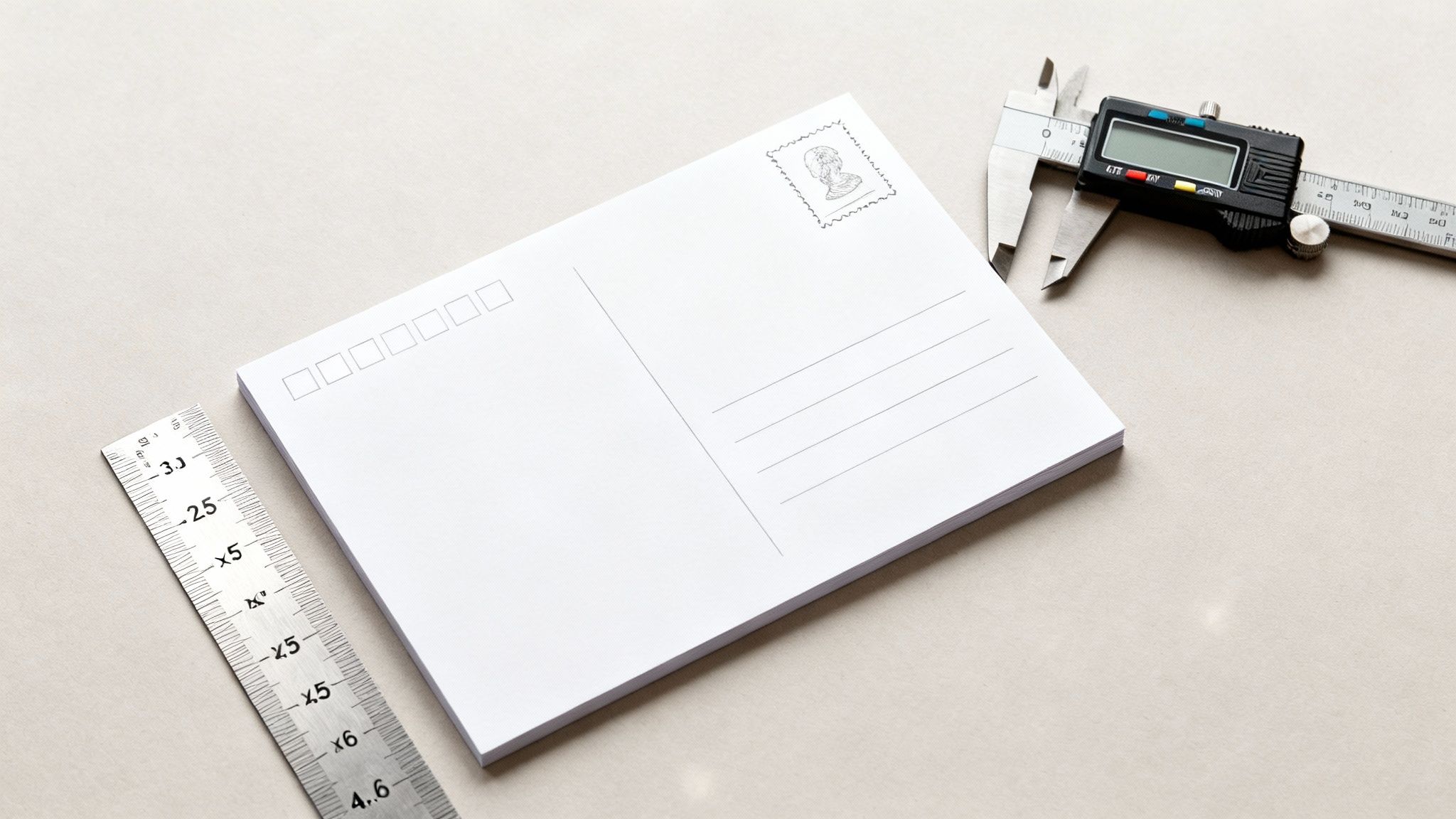
The USPS is extremely precise about what it considers a "postcard" for its best mailing rate. To qualify, your mailer must be rectangular and fit within a very specific size window.
Here are the hard and fast rules for the First-Class Mail postcard rate:
- Height: Must be between 3.5 inches and 4.25 inches.
- Length: Must be between 5.0 inches and 6.0 inches.
A standard size postcard of 4" x 6" fits perfectly within these limits, which is why it's the go-to choice for marketers looking for the most cost-effective option. On the other hand, a slightly larger 5" x 7" greeting card is too tall and will automatically be charged the higher First-Class Letter rate.
Key Takeaway: Even a quarter-inch makes a massive difference. Always double-check your dimensions before you print to make sure you're not accidentally designing a "letter" when you want to pay for a "postcard."
Why Paper Thickness Matters
Beyond just length and height, the USPS also cares about the thickness and sturdiness of your postcard. Flimsy paper can easily get chewed up or jammed in their high-speed sorting machines, so there are minimum and maximum thickness requirements to keep everything moving smoothly.
Your postcard must be at least 0.007 inches thick. To give you a real-world example, a standard index card is usually thick enough to pass. If your card is too thin, the USPS might reject it or just charge you the letter rate.
The thickest a postcard can be is 0.016 inches. Anything beefier than that is, you guessed it, classified and priced as a letter. Most professional postcard paper stocks, like a 14 pt. or 16 pt. cardstock, are specifically made to fall right into this approved range.
Maintaining the Right Shape and Aspect Ratio
The USPS also has rules about the shape of your mail. To get those sweet postcard or letter rates, your mailer has to be rectangular. This means any square, circular, or custom-shaped postcards will cost more to mail and often need to be sent in an envelope.
On top of that, the USPS looks at the aspect ratio, which is just the length divided by the height. For a mailpiece to fly through its automated machines, the aspect ratio has to fall somewhere between 1.3 and 2.5.
Let’s take a look at a 4" x 6" standard size postcard:
- Calculation: 6 inches (length) ÷ 4 inches (height) = 1.5
- Result: The aspect ratio is 1.5, which is comfortably within the acceptable 1.3 to 2.5 range.
An oddly shaped piece—one that's super long and narrow, or nearly a perfect square—might fall outside these machine-friendly dimensions. This could get it flagged as "nonmachinable," which tacks a surcharge onto your postage cost. Juggling all these details can feel like a lot, but working with professional direct mail services ensures your campaign follows every USPS rule right from the start.
Ever wonder why a postcard from halfway across the world feels so familiar in your hand? That's no accident. The consistent size and shape we take for granted are the result of a global agreement made over a century ago, a smart solution to connect the world with a simple piece of paper. This shared format is what turned the humble postcard into a worldwide sensation.
Before this standard was set, international mail was a mess. Every country had its own rules, sizes, and postage rates. Sending a simple message across a border was a gamble, and postal workers faced a logistical nightmare trying to sort a chaotic jumble of different shapes and sizes. Something had to change.
Forging a Universal Language for Mail
The fix came from the Universal Postal Union (UPU), an organization created to bring order to the chaos of international mail. You can think of the UPU as the air traffic control for the world's postal systems—they create the rules that let mail travel smoothly from one country to another. In an era without email or instant messages, this was a massive undertaking.
The goal was simple but ambitious: create a single, predictable format that every postal service could handle without a headache. This would kill the sorting chaos, make postage calculations a breeze, and open up affordable international communication for everyone. The postcard was the perfect candidate for the job.
By setting a uniform size, the UPU turned the postcard from a local novelty into a reliable tool for global connection. It meant that a card sent from Paris could be processed just as easily in New York or Tokyo, creating a truly interconnected network.
The Birth of the International Standard
This forward-thinking idea became a reality in 1878 when the Universal Postal Union officially established the first international standard size for postcards. They landed on 3.5 inches by 5.5 inches (89 mm × 140 mm)—a size that was compact but still offered enough room for a picture and a short note. This decision laid the foundation for the modern postcard, and you can dive deeper into these foundational postcard dimensions and their history.
The choice of size was a masterclass in practicality. It was just large enough not to get lost in the shuffle but small enough to be sorted and handled efficiently in huge volumes. Its adoption by countries across the globe was a turning point in the history of communication.
Of course, things have evolved since then. The 4" x 6" postcard has become the modern favorite in the U.S. thanks to its cost-effectiveness with USPS. But the spirit of that original UPU standard is still very much alive. It’s the reason why, no matter where your travels take you, the postcard rack is filled with pieces of a shared global story. Knowing this history gives real context to the standard size postcard we use today, reminding us it was designed not just to carry a message, but to cross borders and bring people a little closer.
How to Prepare Your Design for Printing
Getting a brilliant design from your screen to a perfectly printed postcard involves more than just hitting "save." The printing process is a physical one, with massive machines cutting paper at incredible speeds. To make sure your final product looks exactly as you imagined, you need to set up your file with a few key concepts in mind.
Think of your postcard design like a stage production. All your most important content—the text, logos, and key images—is the main performance. You need to keep it front and center where everyone can see it. This is your safe zone.
The edge of the stage is the trim line, which marks where the postcard will be cut to its final size. Then you have the backstage area, which the audience never sees but is critical for a smooth show. This is the bleed, an extra margin of your background that extends past the trim line.
Understanding Bleed, Trim, and Safe Zone
Let’s break down these three critical components. Honestly, ignoring them is the number one reason for printing disasters, like text getting sliced off or weird white borders showing up on a full-color design.
- Safe Zone: This is the heart of your design. All your vital information—your headline, contact info, QR codes, and call to action—must live inside this boundary. Keeping it here is your guarantee it won't get accidentally chopped off.
- Trim Line: This is the final, finished edge of your postcard. For a standard 4" x 6" postcard, this line marks the exact 4" x 6" dimensions where the blade will fall.
- Bleed Area: This is a 0.125-inch (or 1/8 inch) border that extends beyond the trim line on all four sides. If your postcard has a background color or an image that you want to go right to the very edge, it absolutely has to fill this entire area.
The bleed is your secret weapon for a professional finish. Paper can shift ever so slightly during the high-speed cutting process, and the bleed acts as a safety net. Without it, even a tiny misalignment could leave a sliver of unprinted white paper along the edge of your finished postcard.
For a standard 4" x 6" postcard, this means your final design file should actually be 4.25" x 6.25". That extra space accounts for the 0.125" bleed on every side. The printer will then trim off that extra edge, leaving you with a perfectly crisp, edge-to-edge design.
Choosing the Right Paper and Finish
Once your design file is ready to go, the next big decision is choosing the material that brings it to life. The paper stock and finish you select can completely change the look and feel of your postcard, impacting everything from its durability to how valuable it seems. It's the difference between a flimsy flyer and a premium invitation.
This infographic shows the global journey of the standard postcard, from its establishment by the Universal Postal Union in 1878 to today's universally recognized dimensions.
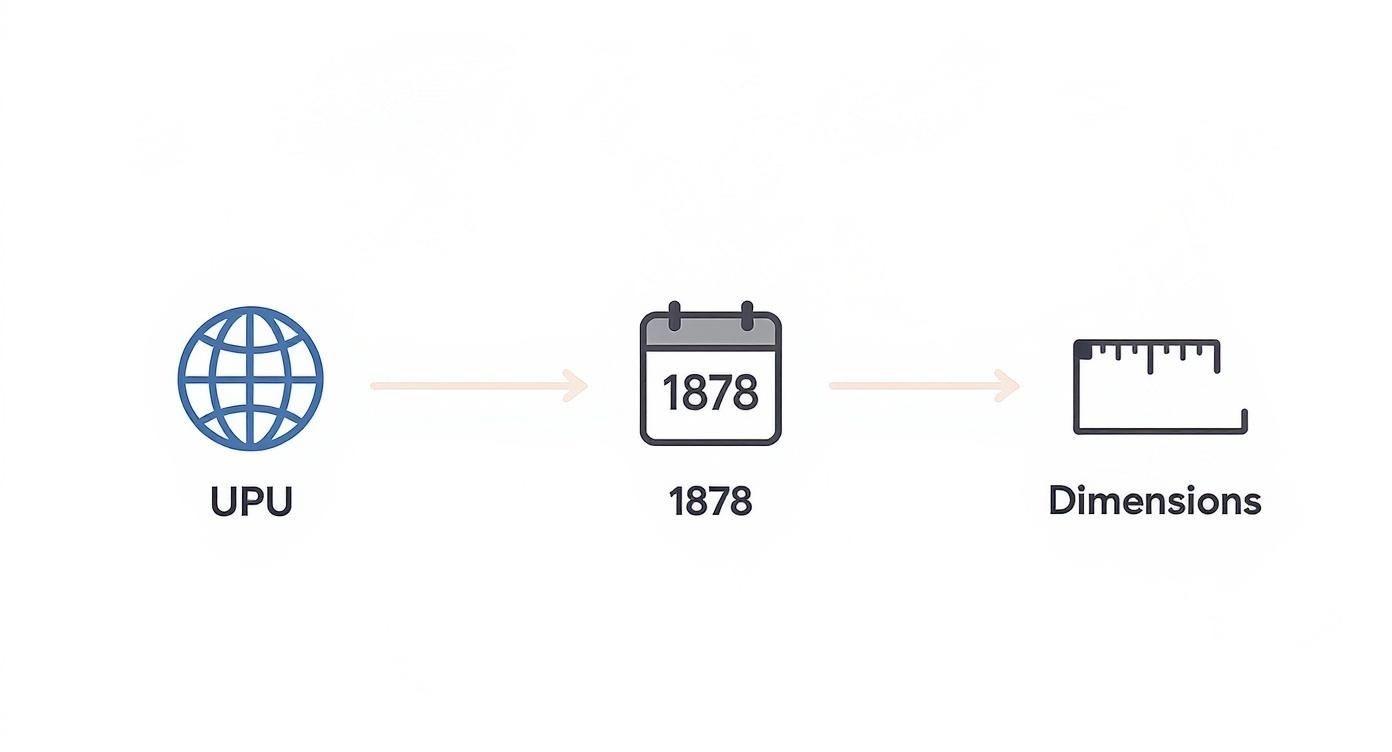
This visual is a great reminder of how a single agreement standardized mail worldwide—a principle that still guides the paper and printing choices we make today for sending messages across the globe.
Let's look at some popular options to help you decide what's right for your project.
Choosing the Right Paper and Finish for Your Postcard
The right combination of paper and finish can make your design truly stand out. Here’s a quick comparison to help you select the best option based on your project's goals, budget, and overall vibe.
| Paper Stock / Finish | Typical Use Case | Feel and Appearance | Best For |
|---|---|---|---|
| 14 pt. Gloss Coated | High-volume marketing mailers, coupons, event promos | Shiny, vibrant, and slick. Makes colors pop. | Eye-catching designs with bold photos and bright colors. |
| 16 pt. Premium Matte | Invitations, art prints, luxury brand marketing | Smooth, non-reflective, and elegant. | Sophisticated designs where a subtle, high-end feel is desired. |
| 14 pt. Uncoated | Thank you notes, appointment cards, reply cards | Natural paper texture, easy to write on. | Postcards that require a handwritten message or a rustic look. |
| Soft Touch Lamination | High-end business cards, premium marketing pieces | Velvety, suede-like texture. Fingerprint-resistant. | Creating a memorable tactile experience that communicates luxury. |
The finish you choose adds another layer of personality. A UV coating, for instance, adds an ultra-shiny, protective layer that makes colors leap off the page, while lamination offers superior durability and a unique feel. You can explore a variety of laminating options for printed materials to find that perfect protective and aesthetic touch.
Making the right choice here ensures your postcard not only looks fantastic but also holds up in the mail and makes a truly lasting impression.
Matching Postcard Size to Your Marketing Goal
Picking a postcard size isn't just a technical detail—it's a strategic move that can make or break your campaign. Think of it like choosing a microphone. A small, intimate one is perfect for a personal, direct message, while a giant arena speaker is built to grab the attention of a massive crowd. The size you land on should be a direct reflection of what you're trying to accomplish.
Your marketing goal really sets the stage for the canvas you need. Are you just sending a quick appointment reminder or a simple coupon? Or are you trying to unveil a luxury product that needs a grand entrance? Each goal calls for a different size and a different approach to get your message across effectively.
Small But Mighty: The 4" x 6" Postcard
The classic 4" x 6" postcard is the undisputed champ of budget-friendly, high-volume marketing. Its biggest selling point? It qualifies for the lowest USPS First-Class postcard rate, which makes it the go-to choice when your mailing list is long and your budget is tight.
This compact size is perfect for campaigns that have a single, crystal-clear call to action.
- Mass-Market Coupon Drops: A local pizza shop can blanket a five-mile radius with a "Buy One, Get One Free" offer without spending a fortune on postage.
- Appointment Reminders: Dentists, salons, and mechanics love this size for sending quick, professional reminders that are pretty much impossible to ignore.
- Simple Announcements: A small boutique can announce a flash sale with a bold headline and a QR code, driving people straight to their door.
The 4" x 6" standard postcard shines when the message is straightforward and the goal is to reach as many people as possible. It's the smart play for building brand awareness and getting quick responses from a wide audience.
Making a Statement With Larger Postcards
When your goal is to really captivate, inform, and impress, you're going to need more space. Larger formats like 5" x 7" or 6" x 9" postcards immediately stand out in a crowded mailbox. They just feel more substantial, and that extra room gives you the space for stunning visuals and more detailed information, positioning your brand as a cut above.
These bigger sizes are fantastic for telling a story. A real estate agent, for instance, can use a jumbo 6" x 11" postcard to show off gorgeous, high-resolution photos of a luxury home. The larger format allows for multiple images, detailed property specs, and even a map, creating a much more immersive experience for potential buyers. In the same way, a new restaurant could use a big postcard to announce its grand opening, featuring mouth-watering photos of its best dishes and a snippet of the menu.
Your postcard’s size is a direct reflection of your message’s perceived importance. A larger card signals that what’s inside is significant and worth a closer look, making it a powerful tool for high-value offers and major announcements.
To get the most out of your campaign, it helps to look at the bigger picture. Exploring broader direct mail marketing strategies can give you valuable insights into how postcards fit into a successful plan. At the end of the day, aligning your postcard dimensions with your marketing objective ensures every dollar you spend on printing and postage is working as hard as possible. Whether you're aiming for broad reach or deep impact, picking the right size is your first step, and our guide on using postcards for local marketing can help you nail down that strategy.
Your Top Postcard Questions, Answered
Jumping into postcard printing and mailing can bring up a lot of questions. Getting the details right from the start is the key to a smooth, successful campaign and helps you avoid some common—and costly—mistakes.
We get these questions all the time, so let's walk through the specifics that matter most.
What Is the Most Popular Standard Postcard Size?
The hands-down winner for the most popular and budget-friendly postcard size in the US is the classic 4 inches by 6 inches. This little workhorse hits the sweet spot because it qualifies for the USPS First-Class postcard rate, which is a good bit cheaper than a regular letter stamp. For big marketing sends or personal mailings, it's the go-to choice.
Can I Mail a 5x7 Card with a Postcard Stamp?
Unfortunately, no. A 5x7 card is just a little too big to qualify for that special postcard postage rate. The USPS will classify it as a letter because its height is over the 4.25-inch maximum. That means you'll need to pop a standard First-Class letter stamp on it instead.
What Does Full Bleed Mean for My Design?
"Full bleed" is a print shop term you’ll hear a lot. It simply means that your design's background color or image needs to stretch 0.125 inches past the final trim line on all four sides. This tiny extra margin is crucial because it gets trimmed off after printing.
Why does it matter? This process is the secret to getting that clean, professional look where your artwork runs perfectly to the edge. It prevents any accidental, thin white borders from showing up on your finished cards.
Is an EDDM Postcard Different from a Standard One?
Yes, they're two different tools for two different jobs. A standard postcard is sent to a specific list of addresses you've already put together. An Every Door Direct Mail (EDDM) postcard, on the other hand, is sent to every single address along a mail carrier route you select, no names or individual addresses needed.
EDDM also comes with its own set of size requirements dictated by the USPS, and these are usually larger than a standard postcard. Hitting these specific dimensions is what lets you take advantage of EDDM’s special bulk postage rates. Learning more about how EDDM works can help you figure out if it's the right move for reaching a local audience.
At 4OVER4, we make it simple to bring your postcard designs to life, no matter the size or finish. Explore our wide range of customizable options and get started on your next project today at https://4over4.com.
More from

13
When you’re ready to invest in an A-frame sign, the first question you'll ask is, "What size do I need?" It usually comes down
 Emma Davis
Mar 13, 2026

113
The real secret to mastering your direct mail budget isn't complicated. It comes down to one simple fact: a standard 4" x 6&q
Emma Davis
Mar 12, 2026

63
Tear-off flyers are a classic for a reason. They’re a tangible marketing tool, designed with perforated, removable tabs at the bottom. Each
Emma Davis
Mar 11, 2026

110
Printing stickers at home is a seriously fun and rewarding project. It boils down to four main parts: designing your image, picking the right
Emma Davis
Mar 10, 2026

103
Ever seen a logo that seems to float right on the glass of a jar or bottle? That’s the work of transparent label stickers.
Emma Davis
Mar 9, 2026

59
Picture this: your product’s beautiful label gets smudged and runny during shipping, or a gorgeous event banner fades to nothing after just
Emma Davis
Mar 8, 2026

58
In a sea of options, your product's packaging and labeling are its first, and often only, chance to make a real connectio
Emma Davis
Mar 7, 2026

89
Ever tried to print a hundred high-quality flyers on your home office printer? You probably ran out of ink, dealt with paper jams, and ended u
Emma Davis
Mar 6, 2026