


Print Posters in Bulk A Pro's Guide

    user icon

    Emma Davis

    Content Writer

    Oct 24, 2025653 views

    Oct 24, 2025653 views

    Print Posters in Bulk A Pro's Guide

    Going big with your poster printing isn't just about ordering a lot—it's a strategic play that can seriously pay off. When we talk about printing posters in bulk, we mean placing a single order for a large quantity, usually 100 or more, to slash the cost of each individual poster.

    This approach is a game-changer for anyone running a large-scale marketing campaign, promoting a major event, or trying to maintain brand consistency across multiple business locations. It's the move you make when you're ready to shift from one-off prints to a more impactful and budget-friendly strategy.

    Why Bulk Poster Printing Is a Smart Move

    Choosing to print posters in bulk is less about the single transaction and more about the long-term vision. The most obvious win? A massive drop in the cost-per-poster. A single poster might run you $20, but ordering 500 could bring that price down to just a couple of dollars each. It’s this economy of scale that makes ambitious marketing goals actually affordable.

    Stacks of freshly printed posters ready for distribution

    This cost-efficiency comes down to how commercial printing works. Setting up a large offset press involves initial costs for labor and materials. But once that press is fired up and running, the expense to produce each additional poster is tiny. The setup cost gets spread thin across hundreds or thousands of posters, which means huge savings for you.

    To put it into perspective, here’s a quick look at how bulk printing stacks up against smaller runs.

    Bulk vs Small Run Poster Printing At a Glance

    Factor Bulk Printing (500+ Units) Small Run Printing (1-50 Units)
    Cost Per Poster Very low, significant savings per unit High, reflecting individual setup and print costs
    Best For Large campaigns, events, multi-location businesses, product launches Prototypes, one-off events, personal use, limited-time offers
    Consistency Perfect for ensuring brand consistency across all materials Can vary slightly between different print runs
    Turnaround Time Longer initial setup, but fast production once running Faster for very small quantities, ideal for urgent needs
    Logistics Plan ahead, one large delivery to manage Frequent reordering, more administrative work over time

    As you can see, when volume is part of your strategy, bulk is the clear winner.

    Achieving Scale and Consistency

    Picture this: you're rolling out a new franchise or prepping for a nationwide product launch. Ordering in bulk ensures every single location gets the exact same high-quality promotional materials, reinforcing your brand identity without a single flaw. That kind_of consistency is what builds brand recognition and trust.

    A large order also streamlines your marketing logistics. Forget placing small, frequent orders. One bulk purchase can set your team up for months, cutting down on administrative headaches and the stress of last-minute reprints.

    By planning ahead and ordering in bulk, you shift from a reactive marketing mindset to a proactive one. You'll always have top-notch materials ready to go, empowering you to seize any opportunity that comes your way.

    The commercial printing world, which powers bulk production, is a massive global industry. It was valued at a staggering $501.36 billion in 2024 and is on track to hit nearly $600 billion by 2030, largely driven by the demands of retail and other growing sectors. It’s a testament to the power of print.

    Real-World Scenarios for Bulk Orders

    The practical uses for bulk poster printing are all around us. Here are just a few situations where it’s the only way to go:

    • Event Promotion: A major music festival or conference needs to plaster a city with thousands of posters to create that can’t-miss buzz.
    • Retail Campaigns: A retail chain launching a big seasonal sale needs identical in-store advertising across all of its locations to create a unified customer experience.
    • Political Campaigns: Candidates need to get their message out far and wide. Bulk posters are a proven, cost-effective tool for reaching voters in every neighborhood.
    • Product Launches: When introducing a new product, you need a coordinated marketing blitz. Posters are a crucial piece of that puzzle.

    By exploring our range of online posters, you can get a feel for the different options perfectly suited for these kinds of large-scale projects. At the end of the day, printing posters in bulk is an investment in efficiency, consistency, and pure, unmissable impact.

    Creating Your Bulk Poster Project Blueprint

    Every successful bulk poster run I've ever been a part of started long before anyone opened up design software. It begins with a solid plan. Think of it as your blueprint—the guide that helps you sidestep those all-too-common pitfalls like last-minute rush fees or, even worse, getting your posters the day after the big event.

    Before you get lost in the fun stuff like colors and fonts, you’ve got to define the mission.

    A person using a ruler and pencil to plan a project on a large sheet of paper

    This whole process really boils down to locking in two critical numbers: your exact quantity and your final poster dimensions. Guessing here can get expensive, fast. Order too few, and you'll find that a small second print run costs a lot more per poster. Order too many, and you’ve just wasted marketing budget on materials that are going to collect dust in a storage closet.

    Nailing Down the Numbers

    Start by asking the right questions. Are these posters for a single event or a sprawling multi-location campaign? A local music festival might only need 500 posters to blanket the city, while a retail chain launching a new product could easily need 5,000 to cover every single one of their stores.

    When it comes to size, you have to think practically about where these posters are going to live.

    • 11" x 17" Posters: These are perfect for indoor spots. Think community centers, coffee shop bulletin boards, and local libraries where wall space is at a premium.
    • 18" x 24" Posters: This is your versatile workhorse. It’s big enough for window displays and event venues but still manageable for general outdoor advertising.
    • 24" x 36" Posters: Go big or go home. This is your maximum impact size, made for high-traffic areas like storefronts, trade show booths, or as the main signage for an event.

    Here’s a pro tip: stick with a standard size if you can. Going with custom dimensions often leads to material waste during the cutting process, which drives up your cost per poster. Printers like 4OVER4 have their workflows totally optimized around these standard sizes, and that’s how you get the best price.

    One of the most critical mistakes I see people make is underestimating their timeline. Always work backward from your "in-hand" date—the day you absolutely, positively need the posters. I always recommend adding at least a 5-day buffer to your schedule. It’s a simple trick that can save you from the stress of shipping delays or unexpected revisions.

    Budgeting Beyond the Print Cost

    Your budget is more than just the price you see per poster on a website. A realistic budget has a few key components that are surprisingly easy to forget.

    The initial print quote is obviously the biggest piece of the puzzle. But don't forget to factor in shipping costs, which can be pretty significant for large, heavy orders of posters. And if you're not a designer yourself, you'll need to budget for professional design fees. It's these often-overlooked costs that can quickly turn an affordable project into a financial headache.

    Once you have your dimensions and quantity locked in, it's much easier to explore your options. If you're thinking about posters larger than the standard sizes I mentioned, it's worth learning more about online large format printing to see what’s possible for those truly high-impact displays. A little planning upfront prevents a lot of surprises down the road and ensures your project runs smoothly from start to finish.

    Designing Posters That Work at Scale

    I’ve seen designs look stunning on screen only to fall flat when printed in large quantities. When you roll out thousands of posters, every tiny detail becomes critical—and a weak element can dilute your entire message.

    The non-negotiable first rule is that high-resolution imagery is a requirement, not a suggestion. Web-sourced photos at 72 DPI may shine on your monitor but will blur and pixellate in print. For sharp, professional results, every image and graphic in your poster file must be at least 300 DPI at the size you plan to print.

    Mastering Visual Hierarchy

    You’ve got about three seconds—the “three-second glance test”—to capture someone’s attention as they walk by. Nail your visual hierarchy, and you’ll guide their eye straight to your core message.

    • Headline First: Make it the biggest, boldest text on the poster.
    • Key Details Next: Date, location or special offers should follow in clear, prominent type.
    • Fine Print Last: Contact info and social handles belong in smaller text, tucked away but still legible.

    A common mistake is trying to say too much. When everything is bold, nothing is bold. A successful bulk poster design is an exercise in ruthless editing—strip away everything that isn't absolutely essential to your primary goal.

    Color And Typography Choices

    Your color palette and font selection do more than decorate—they set the mood and ensure readability from a distance. A messy palette or ornate type can turn viewers away.

    • Use 2–3 Primary Colors to keep your design clean and focused.
    • Prioritize high contrast between background and text for maximum legibility.
    • Design in CMYK mode so printed colors match your expectations.

    When it comes to type, clarity wins every time. A bold sans-serif like Helvetica or Futura makes for an impactful headline, paired with a simple, readable body font. If you’re working on educational materials, check out the principles of graphic design for education for extra inspiration.

    A thoughtfully crafted design is the backbone of any large-scale poster campaign. It guarantees that every dollar you spend on printing truly resonates with your audience. For ideas on different applications, explore our displays printing options.

    Prepping Your Print Files Like a Pro

    The single most critical handoff in the entire printing process is submitting a flawless print file. I’ve seen it happen time and again: a great design gets completely undermined by poor technical prep, leading to delays, unexpected costs, and posters that just don't pop.

    Think of this as your professional cheat sheet to ensure the posters you envision are the ones you actually get.

    Submitting a press-ready file means you're speaking the printer's language. It's all about translating your on-screen design into a format that commercial presses can interpret perfectly, ensuring every single poster in a bulk run looks exactly the same. When it’s done right, your design sails through production without a hitch.

    And this matters, especially in the large-format printing sector which is booming. This market is expected to be worth over $16 billion by 2030, largely driven by the massive demand for promotional displays and event signage.

    Getting Your Colors Right

    One of the most common pitfalls I see is color space. Your computer monitor uses the RGB (Red, Green, Blue) color model, which is based on light. But commercial printers? They use CMYK (Cyan, Magenta, Yellow, Key/Black), which is based on ink.

    If you design in RGB and convert to CMYK at the last minute, you're in for a surprise. That vibrant, electric blue on your screen might turn into a duller, almost purplish hue in print. To avoid this, always set up your design document in CMYK mode from the very beginning.

    Pro Tip: For a deep, rich black, don't just use 100% K (black). A "rich black" mix, like C:40 M:30 Y:30 K:100, will give you a much deeper, more saturated black on the final poster. It makes a world of difference and stops your blacks from looking washed-out.

    This simple infographic breaks down a few core design principles that are vital before you even think about file prep.

    Infographic about print posters in bulk

    As you can see, foundational elements like resolution and hierarchy have to be solid before you can ever call your file "print-ready."

    Setting Up Your Document for Success

    Beyond just color, the actual structure of your file is paramount. Commercial printing involves trimming huge sheets of paper down to your final poster size, and that cutting process isn't perfect down to the micrometer. This is where bleeds, trim lines, and safety margins save the day.

    • Trim Line: This is simply the final, intended dimension of your poster—where the paper will be cut.
    • Bleed: You need to extend your background colors or images 1/8th of an inch (0.125") beyond the trim line on all sides. This little bit of extra ink ensures no ugly white slivers appear if the cut is just slightly off.
    • Safety Margin: Keep all your critical text and logos at least 1/8th of an inch inside the trim line. This "quiet border" is a buffer zone that prevents anything important from getting accidentally chopped off.

    Before sending any design to print, it's a good idea to familiarize yourself with the key aspects of print quality to make sure your bulk posters come out looking professional and consistent.

    Finally, let's talk fonts. To prevent any font substitution nightmares (where the printer’s computer swaps your cool font for a generic one), you have two great options. You can either embed all fonts directly into your PDF, or—my personal preference—convert all text to outlines (or curves). This turns your text into vector shapes, locking them in place permanently.

    The final step? Export your work as a high-quality, press-ready PDF. It's the universal standard for a reason. And if you're exploring different printing methods, our guide on https://www.4over4.com/printing/category/digital-printing is a great resource for smaller, more customized runs.

    Choosing the Right Paper and Finish

    The material you choose can completely transform a poster’s impact, turning it from a simple announcement into a statement piece. When you're printing posters in bulk, the paper and finish aren't just minor details—they are critical components of your brand message and, of course, your budget.

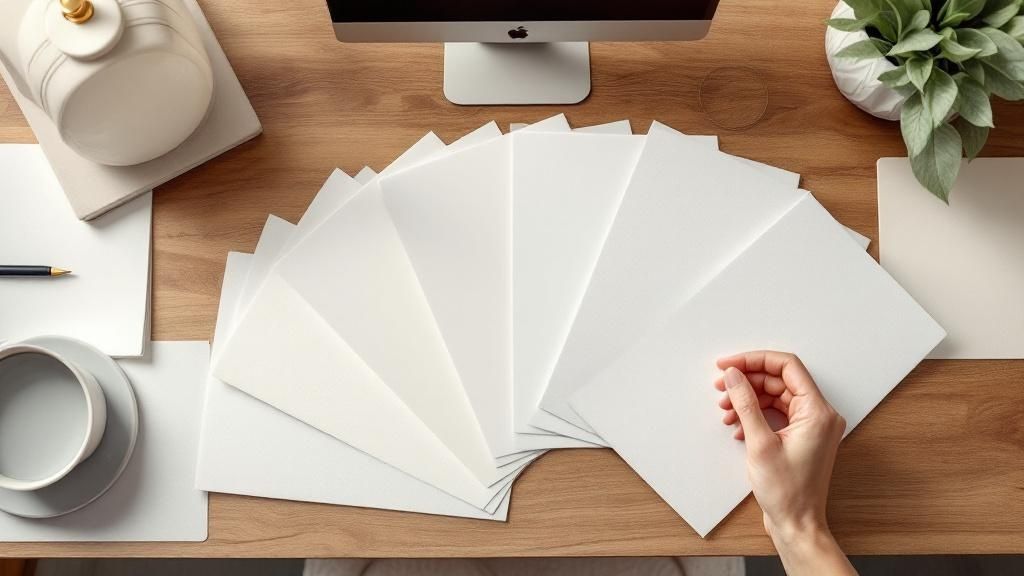
    A hand feeling different paper samples and finishes for poster printing.

    This choice goes way beyond pure aesthetics; it directly affects durability, readability, and the overall perception of quality. A thin, flimsy paper might work for a temporary flyer, but for a high-end retail campaign, a heavier stock communicates value and permanence right off the bat.

    Understanding Paper Weight

    Paper weight, measured in points (pt) or pounds (#), is all about its thickness and stiffness. Think of it as the foundation of your poster. A higher number means a thicker, more durable paper that feels more substantial in hand.

    • 100# Text Weight: This is a common, economical choice. It's flexible and lightweight, making it perfect for short-term promotional posters destined for indoor bulletin boards or event giveaways.
    • 10 pt. Cardstock: A definite step up in thickness, this option offers more rigidity and a more premium feel. It holds up much better to handling and is great for posters that need to last longer, like in-store displays or art prints.
    • 16 pt. Cardstock: Now we're talking about a substantially thick and sturdy option. Choosing a heavy cardstock like this screams quality and durability, making it ideal for high-end branding or posters that will be displayed without a frame.

    The global printing industry is still a powerhouse, with the market expected to hit approximately $960 billion in 2025. A lot of this growth comes from digital printing, which is becoming the go-to for custom short-run and bulk orders. This just proves that the demand for tangible, high-quality printed materials is stronger than ever.

    Selecting the Perfect Finish

    The finish is the final touch—it's the coating applied to the paper that determines its sheen and texture. This decision can dramatically affect how your colors appear and how the poster interacts with light.

    Your poster's environment is the best guide for choosing a finish. A glossy poster might look amazing indoors, but place it in a sunlit window, and the glare could make your message completely unreadable.

    Let's break down the most common options you'll encounter:

    • Glossy Finish: This high-shine coating makes colors absolutely pop with vibrancy and saturation. It’s a fantastic choice for photo-heavy designs and creates a modern, eye-catching look. The downside? It's highly reflective and can produce significant glare under direct light.
    • Matte Finish: With its non-reflective, smooth surface, a matte finish offers a more subtle, sophisticated feel. It's perfect for text-heavy posters or designs displayed in brightly lit areas, as it eliminates glare entirely.
    • Satin or Semi-Gloss Finish: This option strikes a beautiful balance between the two extremes. It has a slight sheen that enhances color without the intense reflectivity of a full gloss finish, making it an incredibly versatile choice for many applications.
    • UV Coating: This is a high-gloss, liquid coating that's cured with ultraviolet light. It provides a brilliant shine and a durable, protective layer, making it an excellent choice for posters that need to withstand handling or even some outdoor elements.

    For instance, a band promoting a concert might go for a glossy finish to make their artwork look vibrant and exciting. On the other hand, a fine art gallery printing reproductions would likely opt for a matte finish to give the prints a more classic, glare-free appearance.

    If you need an extra layer of protection and shine, you can explore options like our gloss laminated printed products, which are perfect for creating durable, high-impact visuals.

    Your Bulk Poster Printing Questions Answered

    When you're getting ready to place a big poster order, a few key questions always seem to pop up. Getting these details sorted out from the start is the secret to a smooth, cost-effective print run that looks exactly how you imagined.

    Let's walk through some of the most common questions we hear from clients. A little bit of know-how here goes a long way and helps you finalize your order with total confidence.

    What Is The Most Cost-Effective Poster Size?

    This is an easy one: the most budget-friendly sizes are almost always the industry standards—11x17, 18x24, and 24x36 inches. It’s not a coincidence; these dimensions are specifically designed to fit perfectly onto the large paper sheets used in commercial printing, which means virtually no paper goes to waste.

    When we can fit the maximum number of posters onto a single sheet, the whole process becomes more efficient. That efficiency translates directly into a lower cost-per-poster for you. Before you get too attached to a unique custom size, always check if a standard one will work. It’s the single fastest way to stretch your budget.

    How Can I Be Sure The Colors Will Print Correctly?

    To get the colors you see on your screen to match what comes off the press, you have to design your poster files in CMYK color mode, not RGB. This is non-negotiable. RGB is for digital screens that create color with light, while CMYK is the four-ink process (Cyan, Magenta, Yellow, Black) used for printing on paper. Converting a file from RGB to CMYK at the last minute can cause some pretty disappointing color shifts.

    What if color accuracy is an absolute dealbreaker, like matching a specific brand logo? Your best bet is to order a hard copy proof.

    A hard copy proof is a single printed sample of your poster. It shows you exactly how the colors will look on your chosen paper stock, letting you make adjustments before committing to the entire bulk run. This small step can save you from a very costly surprise.

    What Is A Bleed And Why Is It Important?

    Think of a bleed as a safety margin for your design. It's the part of your artwork that extends beyond the poster's final trim line, typically by 1/8th of an inch on all sides. Its purpose is to prevent any unprinted white slivers from showing up along the edges of your finished posters.

    Even with the most precise equipment, tiny shifts can happen when a massive stack of paper is being trimmed. By extending your background colors or images into the bleed area, you create a buffer that accounts for these minor variations. It’s what guarantees a clean, professional, edge-to-edge print on every single poster in your order.


    Ready to bring your large-scale poster campaign to life with confidence? At 4OVER4, we make it simple to get high-quality, consistent results for your bulk printing needs. Explore your options and start your order today.

    More from print posters in bulk

    The Definitive Guide to Table Tent Specs for Perfect Printing
    story
    The Definitive Guide to Table Tent Specs for Perfect Printing

    10

    When you hear "table tent specs," what we're really talking about are the foundational details for printing them correctly: the

    author avatarEmma Davis

    Jan 27, 2026

    Your Ultimate Guide to poster sizes inches: Standard Poster Sizes Explained
    story
    Your Ultimate Guide to poster sizes inches: Standard Poster Sizes Explained

    61

    When you're ready to print a poster, one of the first questions you'll face is, "What size should it be?" The industry has a

    author avatarEmma Davis

    Jan 26, 2026

    45+ Creative Ideas for the Back of a Business Card
    story
    45+ Creative Ideas for the Back of a Business Card

    88

    Picture this: you're at a networking event, and someone hands you their business card. You do the usual glance—name, title, company—an

    author avatarEmma Davis

    Jan 25, 2026

    How to Make a Card in Word for Pro Results
    story
    How to Make a Card in Word for Pro Results

    104

    Believe it or not, figuring out how to make a card in Word is surprisingly easy. You can knock out everything from slick, professional busines

    author avatarEmma Davis

    Jan 24, 2026

    Your Guide to Printing on Packaging That Captivates Customers
    story
    Your Guide to Printing on Packaging That Captivates Customers

    104

    Printing on packaging takes a simple container and turns it into one of your most powerful marketing tools. It’s the very first physical int

    author avatarEmma Davis

    Jan 23, 2026

    A Complete Guide to Flyer Size Dimensions for Perfect Printing
    story
    A Complete Guide to Flyer Size Dimensions for Perfect Printing

    326

    When you're getting ready to print a flyer, one of the first questions you'll face is, "What size should it be?" The most co

    author avatarEmma Davis

    Jan 22, 2026

    How Free Business Cards Actually Work (Updated for 2026)
    story
    How Free Business Cards Actually Work (Updated for 2026)

    332

    How Our Free Business Cards Program Works (Quick Overview) Free business cards are available through two different

    author avatarEmma Davis

    Jan 22, 2026

    Unlocking Networking with QR Code Business Cards
    story
    Unlocking Networking with QR Code Business Cards

    179

    A QR code business card does more than just share your name and number; it cleverly merges your physical card with your digit

    author avatarEmma Davis

    Jan 21, 2026

    Home
    Products
    Cart
    Account