Table of Contents
- Home
- content hub
- How to Print Business Envelopes That Get Opened
 Share and earn
How to Print Business Envelopes That Get Opened

Mar 22, 202613 views
Mar 22, 202613 views
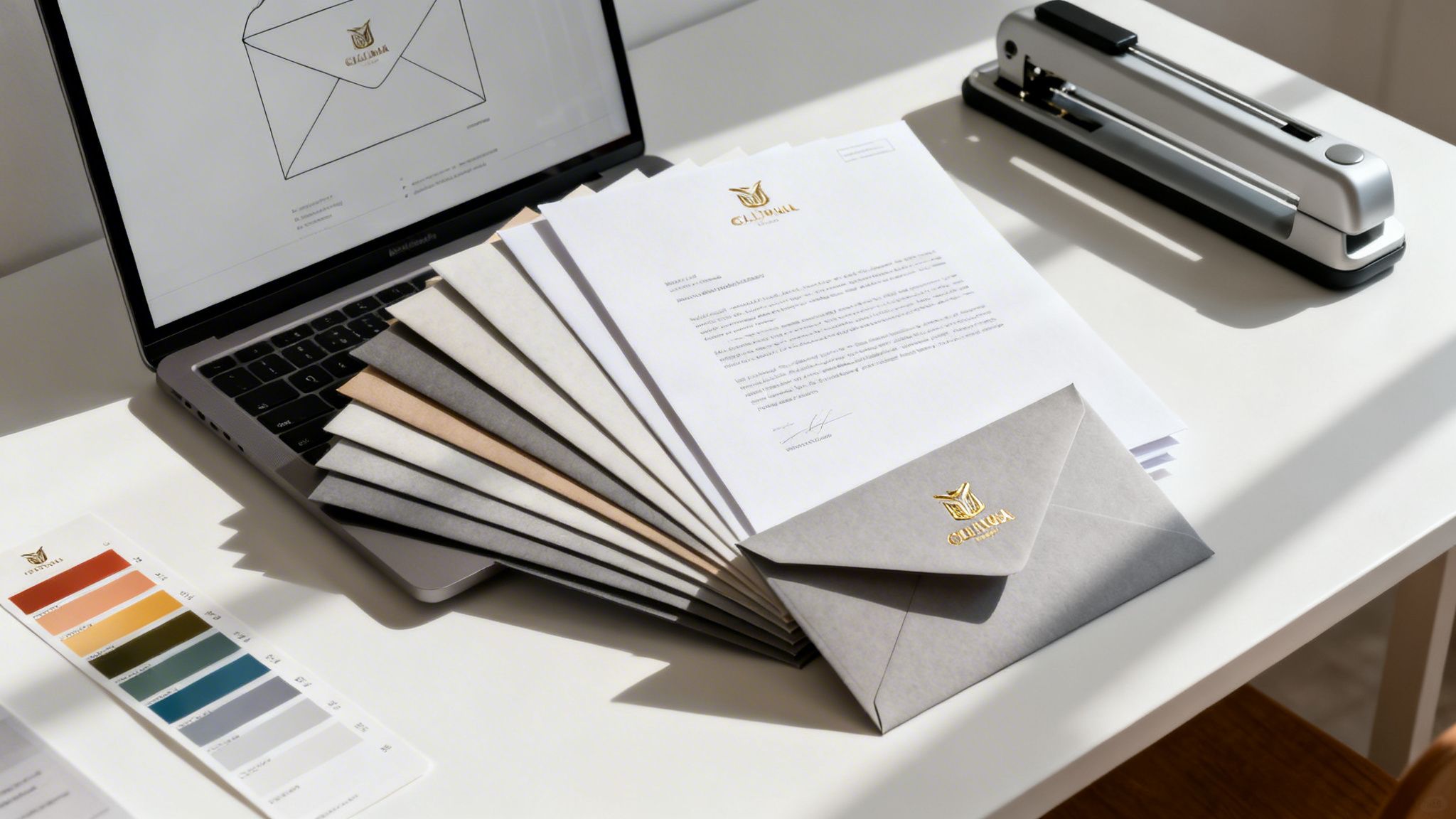
Printing a high-quality business envelope is simpler than you might think. It all starts with a solid design file using CMYK color settings, your logo, and a return address. Once you have that, you just upload it to a printing service like 4OVER4, pick your envelope size and paper, and give the final okay on a digital proof. That’s it. You get professional envelopes that are ready to make an impact.
Why Printed Envelopes Are Your Secret Marketing Weapon

With inboxes overflowing and digital ads everywhere, a physical piece of mail really cuts through the noise. It’s more than just a letter; it’s a tangible brand experience your customer can actually hold. A sharp, custom-designed envelope is your first—and often best—chance to make an impression that sticks.
Don't buy into the idea that print is some relic. For everyone from scrappy startups to established corporations, a professional envelope is a quiet powerhouse. It’s the handshake before the conversation even begins, signaling quality and attention to detail before your recipient even peeks inside.
The Undeniable Power of a Tangible First Impression
The second someone pulls your envelope from their mailbox, they're already forming an opinion about your brand. A plain, flimsy envelope might get lumped in with the junk mail. But an envelope with a crisp logo and quality paper feels important. That first impression is what decides if your mail gets opened or tossed.
Think about it. We delete emails in a split second, often without even reading the subject line. A physical envelope, on the other hand, requires a moment of real-world interaction. That brief moment is a golden marketing opportunity.
Your envelope isn't just a container; it's the opening line of your brand's story. It sets the expectation for the value held within and can dramatically increase the likelihood of engagement.
And this isn't just a gut feeling—the numbers tell the same story. The global envelope market was valued at USD 1.89 billion in 2022 and is on track to hit USD 2.54 billion by 2032. This growth comes from businesses that get it. Physical mail boasts an incredible 95% open rate, blowing email's average of 20-30% out of the water.
Boosting Brand Credibility and Open Rates
A custom-printed business envelope is more than just a delivery vehicle. It’s a miniature billboard for your brand, reinforcing your identity at every single touchpoint. Consistency is everything in branding, and carrying your visual identity over to your stationery shows you’re a polished, professional operation.
Here’s exactly how a professional envelope gives your brand a lift:
- Builds Instant Trust: A branded envelope just looks official. That’s vital when you’re sending out invoices, contracts, or other important documents.
- Increases Curiosity: A unique design or a high-quality paper stock makes people wonder what's inside. It’s an invitation they’re more likely to accept.
- Strengthens Brand Recall: Consistently seeing your logo and brand colors helps lodge your company in your customer’s memory.
Let's look at how these small details stack up against other communication methods.
Impact Comparison In 2026
This table gives a quick overview of how a custom envelope really performs against the alternatives.
| Attribute | Custom Printed Envelope | Plain White Envelope | Standard Email |
|---|---|---|---|
| First Impression | Professional, high-value | Generic, potentially junk mail | Fleeting, easily ignored |
| Open Rate | Extremely high (~95%) | Moderate, depends on sender | Low (~20-30%) |
| Brand Recall | Strong, reinforces identity | None | Weak, lost in the inbox |
| Tangibility | Creates a physical connection | Physical, but lacks impact | None |
| Perceived Value | High, suggests importance | Low to neutral | Very low, often deleted |
As you can see, the custom envelope consistently delivers a stronger, more memorable brand experience.
When you print business envelopes that reflect your brand’s quality, you’re not just sending mail—you’re delivering a statement. This commitment to detail can be the difference between being forgotten and being remembered. By focusing on these details, your envelopes become one of the most effective tools in your arsenal of marketing materials.
Choosing the Right Envelope Size and Stock

Before anyone even reads what you’ve sent, they feel it. The weight of the envelope, the texture of the paper—these are the very first signals your message sends. This isn't just a technical detail; it's the first handshake with your recipient.
Getting the size and stock right means your materials arrive looking sharp and professional, perfectly reflecting your brand’s image. Let's dig into how you can choose the right physical foundation for every piece of mail you send.
Matching Envelope Size to Your Content
One of the most common mistakes I see is a mismatch between the content and the container. Think of a tri-folded letter floating around in a giant catalog envelope—it just looks sloppy. The goal is to match the envelope to the job it’s meant to do.
Here’s a quick rundown of the go-to sizes and what they’re best for:
- #10 Envelope (4 1/8" x 9 1/2"): This is the workhorse of the business world. It’s built to hold a standard 8.5" x 11" letter folded in thirds, making it perfect for invoices, official correspondence, and most direct mail.
- A7 Envelope (5 1/4" x 7 1/4"): Sending invitations or greeting cards? The A7 is your friend. It’s sized for 5" x 7" cards and instantly gives off a more personal, celebratory vibe.
- 6" x 9" Catalog Envelope: When you need to send things that can't be folded—like small booklets, catalogs, or marketing packets—this size keeps everything flat and looking professional.
- 9" x 12" Catalog Envelope: This is the big sibling to the 6" x 9", designed to hold full 8.5" x 11" documents without a single crease. It's the right call for important contracts, annual reports, or any presentation where a pristine appearance is non-negotiable.
Remember, choosing the right size is about more than just fit. It’s about function and making the right impression.
Selecting Paper Stock to Reflect Your Brand
The paper stock is where you really get to dial in your brand's personality. It’s what separates an envelope that feels like another bill from one that feels like an exclusive invitation. The paper you pick directly impacts how your colors look and the all-important tactile experience.
This choice is a bigger deal than you might think. Paper envelopes dominate the market, holding a 69.5% share in 2024, largely because they print so well. In fact, when you print business envelopes with custom designs on high-quality paper, you can see up to a 25% higher response rate on direct mail. That's the power of a great first impression.
The weight and finish of your envelope paper communicate a non-verbal message. A heavier, textured stock says, "This is important," while a smooth, bright white stock says, "This is professional and modern."
Here are a few popular paper stocks and the message they send:
- 70lb Uncoated Text: This is your reliable, everyday standard. It's budget-friendly and perfect for high-volume mailings like invoices and statements where practicality is key.
- 80lb White Wove: A definite step up, this stock is brighter and smoother, which helps colors appear more vibrant. It's a fantastic middle-ground for marketing mail that needs to look sharp without a premium cost.
- Linen or Laid Finish: Textured stocks like these add an immediate touch of class. A linen finish has a subtle woven feel that signals quality, making it ideal for law firms, financial advisors, or luxury brands. If this aligns with your brand, exploring a premium collection can open up even more sophisticated options.
Functional Features: Windows and Seals
Finally, let’s talk about the little details that can make a big difference in your day-to-day operations. These functional choices might seem small, but they can save you a surprising amount of time and effort.
Window vs. Non-Window A window envelope is a massive time-saver if you’re sending invoices or statements. The window is perfectly placed to show the recipient's address from the letter inside, which means you don’t have to print addresses on the envelopes themselves. On the flip side, a non-window envelope offers a cleaner, more personal look that’s better suited for marketing, invitations, or any time a polished presentation is the goal.
Seal Type How the envelope seals also matters. Gummed seals are the traditional "lick-and-stick" kind, which are great for automated, high-volume mailings. For everyday office tasks, Peel & Seal envelopes are far more convenient. They have a simple tear-off strip that reveals a strong adhesive for a quick, mess-free seal. That small upgrade is often well worth it.
Designing Artwork That Demands Attention

An envelope is far more than just a functional mailer—it’s a powerful brand asset. Great design is what separates mail that gets opened from mail that gets tossed straight into the recycling bin.
This is all about strategic communication. Your envelope is the very first thing a recipient sees, and it sets the tone for everything inside. To make that memorable first impression, we need to apply principles of design and branding excellence that connect with your audience.
The Do's of Envelope Design
Getting the design right is a mix of smart branding and clean, simple execution. Think of the front of your envelope as prime real estate, where every single element needs to earn its spot.
We always start with the logo and return address, placing them in the top-left corner. It’s a standard for a reason: it’s where the eye naturally looks first.
Use your brand colors, but use them strategically. A full-color design can definitely make a splash, but even a pop of color in your logo or a simple graphic can build intrigue without looking busy. The goal is recognition and professionalism, not distraction.
One of my favorite touches is adding a well-placed tagline on the back flap. It’s one last, subtle chance to reinforce your brand message. This small detail, much like having well-designed business cards, makes your mail feel complete and considered.
The Don'ts to Avoid Common Pitfalls
Now, let’s talk about what to avoid. The single most common mistake I see is a low-resolution logo. A blurry, pixelated logo instantly screams unprofessionalism and completely undermines your brand’s credibility. Always, always use a high-resolution vector file (like an .AI or .EPS) for your logo to guarantee it prints sharp and crisp.
Another major pitfall is clutter. Resist the urge to fill every inch of space with text or graphics. White space is your best friend. It creates a clean, sophisticated look that helps the important elements stand out.
Finally, be smart about your font choices. Stick to clean, legible fonts for your return address. That creative script font might look cool, but if the post office can’t read it, you’ll never get your mail back if it’s undeliverable.
A great design is one that looks intentional. This means sharp logos, balanced layouts, and brand consistency. An envelope that appears thoughtfully designed suggests the contents within are equally important.
Getting Your Files Print-Ready
Once you’ve nailed down the design, the technical setup is what ensures it looks flawless in your hands. This step is your insurance against common printing errors like weird white borders on a color design or text getting chopped off.
Professional printers, including 4OVER4, offer free templates that are already set up with the correct specs. Honestly, using them is the easiest way to skip the guesswork.
Key Technical Settings:
- Bleed: If your design runs to the very edge of the envelope (a "full bleed"), you have to extend your artwork 1/8th of an inch (0.125") past the final trim line. This extra margin is the bleed, and it gets trimmed off to make sure your color goes perfectly to the edge with no white slivers.
- Safety Margin: This is the opposite of the bleed. We need to keep all critical elements, like your logo and return address, at least 1/8th of an inch (0.125") inside the final trim line. This "safe zone" guarantees nothing important gets accidentally sliced off during production.
- Color Mode: Your design files absolutely must be set to CMYK (Cyan, Magenta, Yellow, Key/Black). This is the industry standard for professional printing. If you design in RGB (which is for screens), your colors will shift during printing and likely look dull or just plain wrong.
Here’s a quick checklist to run through before you upload any file:
| Technical Check | Why It Matters | What to Do |
|---|---|---|
| Resolution | Ensures your images and logo are sharp, not pixelated. | All images should be at least 300 DPI (dots per inch). |
| File Format | Guarantees compatibility and print quality. | Save your final design as a press-quality PDF, JPG, or TIFF. |
| Template Use | Prevents alignment and sizing errors. | Download and design directly on the template provided for your chosen envelope size. |
Following these technical rules is the single best thing you can do to make sure the business envelopes you get back from the printer look exactly like you imagined them. It’s what bridges the gap between a great idea and a truly professional product.
Alright, you’ve got your envelope design dialed in. Now comes the fun part: deciding how to actually bring it to life. This is where we talk about printing methods and those special finishes that can make an envelope feel truly premium. These decisions are just as crucial as the design itself, impacting everything from your budget to the first impression you make when your mail lands in someone's hands.
The choice usually boils down to two main players in the printing world: digital printing and offset printing. Each has its place, and the best fit for you really depends on your specific needs, how many you're printing, and what you're willing to spend.
Digital vs. Offset Printing: Which Is Right for You?
Think of digital printing as the quick and nimble option. It functions a lot like a super high-end office printer, applying ink directly to each envelope. This makes it perfect for smaller runs, usually anything under 500 pieces, because the setup is fast and straightforward. It's also your only real choice if you need variable data printing—say, personalizing every single envelope with a different name and address for a highly targeted marketing campaign.
Offset printing, on the other hand, is the traditional workhorse. This method uses plates to transfer ink to a rubber blanket, which then rolls the image onto the paper. The setup is more involved, but once you’re running, it becomes incredibly cost-effective for large jobs—we’re talking 1,000 envelopes or more. The cost-per-envelope plummets as the quantity goes up. Plus, offset is famous for its impeccable color accuracy and consistency, making it the go-to for brands where hitting that exact Pantone color is non-negotiable.
Digital Printing is for speed and personalization on small runs. Offset Printing is for quality and cost savings on large runs. Choose the method that aligns with your project volume and branding needs.
Going Beyond Ink: Premium Finishes
Why stop with just ink on paper? Special finishes can turn a plain envelope into a tactile experience that demands attention and instantly signals quality. This is your chance to add a touch of luxury, a bit of modern pop, or a clear sign that what's inside is important.
Exploring these upgrades is a smart move. In fact, companies that invest in custom envelopes and polished mailings report 18% higher client retention. It just goes to show how much these small details matter. The North American market's dominance, holding a 41.69% revenue share in envelope paper, is fueled by this very demand for high-quality, memorable mail.
Here are a few of the most popular finishes that can really make an impact:
- Embossing and Debossing: Embossing creates a raised, 3D version of your logo or design, while debossing presses it into the paper. Both add a sophisticated, textured quality that people can't help but touch, making them perfect for high-end event invitations or client thank-yous.
- Foil Stamping: This process uses heat and pressure to apply a thin layer of metallic or colored foil. It's a fantastic way to add a flash of gold, silver, or even a holographic shine that catches the light and immediately draws the eye.
- Full-Bleed Printing: A full-bleed design is one that prints right to the very edge of the envelope, leaving no white border. It creates a bold, immersive look that feels completely custom and contemporary.
- Custom Die-Cut Windows: Forget the standard rectangular address window. A custom die-cut window can be made in any shape—maybe your logo?—to offer a unique and intriguing peek at the contents inside.
When you're ready to explore these options, you'll find a whole world of fantastic finishes that add texture and shine to make your project stand out. These aren't just decorative touches; they're strategic branding tools. When you print business envelopes, picking the right finish can be the final detail that makes your mail truly unforgettable.
How to Order Your Envelopes on 4OVER4
Alright, you've done the creative work. The design is locked in, and you know exactly the look you're going for. Now comes the exciting part: turning that digital file into a real, tangible envelope you can hold in your hand.
Placing your order is the final step, and getting it right is what ensures all your planning pays off. We’ve made the process on 4OVER4.com as intuitive as possible, so let’s walk through it and get your project ordered perfectly the first time.
Navigating the Product Page
First things first, you'll want to head over to the custom envelope product page. Think of this as your mission control for the entire order. On the right, you’ll immediately see an instant price calculator that updates in real-time as you build your envelope.

This tool is a game-changer for staying on budget. You can play around with different quantities, paper stocks, and turnaround times to see exactly how each decision impacts the final cost. It gives you the power to find that sweet spot between features and price.
Start by plugging in the basics you've already decided on:
- Size: Choose your envelope size from the dropdown, whether it's a standard #10 or a classic A7 for invitations.
- Paper Stock: Select the paper that matches your brand’s feel, like a sturdy White Wove or a sophisticated premium Linen.
- Ink Colors: Let us know if you need black ink only, full color on the front, or printing on both sides.
With every click, the price adjusts instantly. No hidden fees, no surprises at checkout. This transparency is crucial when you print business envelopes and need to keep a close eye on your marketing spend.
Fine-Tuning Your Order Details
With the core specs in place, it’s time to dial in the smaller details that will make your envelope uniquely yours. This is where you’ll specify any special finishes or add functional features.
For example, you’ll be asked to choose between a window or no window. If you're printing envelopes for invoices or statements, a window is a huge time-saver. You'll also select your preferred sealing method—many of our clients love the convenience of the Peel & Seal option.
This is also where you add those premium touches that make an impression. If you decided on a tactile finish like embossing or a flash of metallic foil stamping, you'll select those options here.
These finishing processes are applied in a specific order to create that polished, professional look.
As you can see, each layer builds on the last, transforming a simple piece of paper into a powerful branding tool.
Uploading Artwork and Finalizing Your Order
Once all your options are configured, the last major step is getting us your artwork. This is where your prep work really pays off. Make sure your design file is 100% print-ready, following the guidelines for bleed, safety margins, and CMYK color we covered earlier.
You’ll be prompted to upload your file directly on the page. We accept all the standard file types, like PDF, JPG, and TIFF. Honestly, using the free templates we provide is the single best way to guarantee your file is formatted perfectly for a flawless print. If you need more inspiration, you can always explore the full range of customizable envelopes available at 4OVER4 to see what’s possible.
Now for the final, most critical step before we hit the presses: proofing.
Always select the "Free Online Proof" option. This is your digital preview, showing you exactly how your finished envelope will look. It’s your last chance to catch a sneaky typo, a slight misalignment, or a color that’s not quite right.
Take your time and review it carefully. Once you approve that proof, your job is officially in the production queue. This simple check is your ultimate safety net and ensures the final product is exactly what you envisioned. After that, just complete the checkout, and your professionally printed business envelopes will be on their way.
You’ve got the vision for your envelopes, but a few questions might still be floating around before you finalize your order. That’s completely normal. We hear these questions all the time, so let's tackle them head-on to clear up any confusion.
What Is The Standard Business Envelope Size?
When it comes to business mail, one size truly reigns supreme: the #10 envelope. Measuring 4 1/8" by 9 1/2", it's the go-to choice for professionals everywhere.
Why is it so popular? It's perfectly sized to hold a standard 8.5" x 11" sheet of paper folded into thirds. This makes it the workhorse for all sorts of business communications.
- Invoices and official statements
- Contracts and business letters
- Direct mail campaigns and promotional flyers
Its universal fit means it always looks professional and works flawlessly with standard mailing equipment and processes.
Can I Print On Both Sides Of The Envelope?
Yes, absolutely! Printing on both the front and back of an envelope is a savvy way to make the most of your branding space.
The front is typically for the essential information—your logo, return address, and the recipient's details. But don't forget about the back. The back flap is prime real estate for a company tagline, your website URL, or even a subtle graphic that adds a memorable, professional touch.
What Is The Difference Between Digital And Offset Printing?
Choosing between digital and offset printing really comes down to the size of your order and what you need to accomplish. Each method has its own strengths.
Digital printing is your best bet for smaller runs, usually under 500 envelopes. The setup is fast and cost-effective for low quantities. It’s also the only way to do variable data printing, which is perfect for personalizing each envelope with a unique name and address.
Offset printing is built for volume, making it the standard for orders of 1,000 envelopes or more. While the initial setup costs a bit more, the price per envelope drops dramatically as your quantity goes up. Offset is famous for its exceptional color accuracy and image quality, making it ideal for large, static jobs where brand consistency is everything.
Think of it this way: Digital is for speed and personalization on small jobs, while Offset is for high-quality and cost savings on big jobs.
What Does Full Bleed Mean For An Envelope?
"Full bleed" is a print term you’ll hear often. It means your design stretches all the way to the very edges of the envelope, with no white border left behind. It’s a modern, premium look that really makes your artwork pop.
To get this effect, your design file needs to include an extra margin of your artwork—the "bleed"—that goes beyond the envelope's final dimensions. During production, we trim this excess area off, leaving you with a seamless design that covers the entire surface. It takes a little extra setup in your artwork, but the polished, high-impact result is well worth it.
Ready to create envelopes that make an impression? 4OVER4 offers a full range of sizes, stocks, and premium finishes to bring your vision to life. Start your project today and see the difference professional quality makes. Design your custom business envelopes now at 4over4.com.
More from

24
You might think sending an email or a text is all that matters these days, but don't underestimate the power of physical mail. It carries
 Emma Davis
Mar 21, 2026

51
Picture this: your business has a silent, tireless salesperson working for you 24/7 on the busiest street in town. That’s t
Emma Davis
Mar 20, 2026

55
Printing on ribbon is the art of transferring your custom design, logo, or text onto a roll of fabric. It’s what transforms a simple decorat
Emma Davis
Mar 19, 2026

155
If you've ever wondered about the standard gift card dimensions, there’s one number you need to know: CR80
Emma Davis
Mar 17, 2026

63
When you’re launching a product, your bottle label is often the first thing a customer sees. Think of it as your silent salesperson
Emma Davis
Mar 16, 2026

212
When you're brainstorming ideas for landscaping business cards, it helps to think beyond just contact information. Your c
Emma Davis
Mar 15, 2026

264
When you think of a yard sign, the classic 18"x24" is probably what comes to mind. It’s the industry workhorse fo
Emma Davis
Mar 14, 2026

211
When you’re ready to invest in an A-frame sign, the first question you'll ask is, "What size do I need?" It usually comes down
Emma Davis
Mar 13, 2026