Table of Contents
- Home
- content hub
- A Complete Guide to Outdoor Advertising Signs for Business Growth
 Share and earn
A Complete Guide to Outdoor Advertising Signs for Business Growth

Mar 20, 20269 views
Mar 20, 20269 views
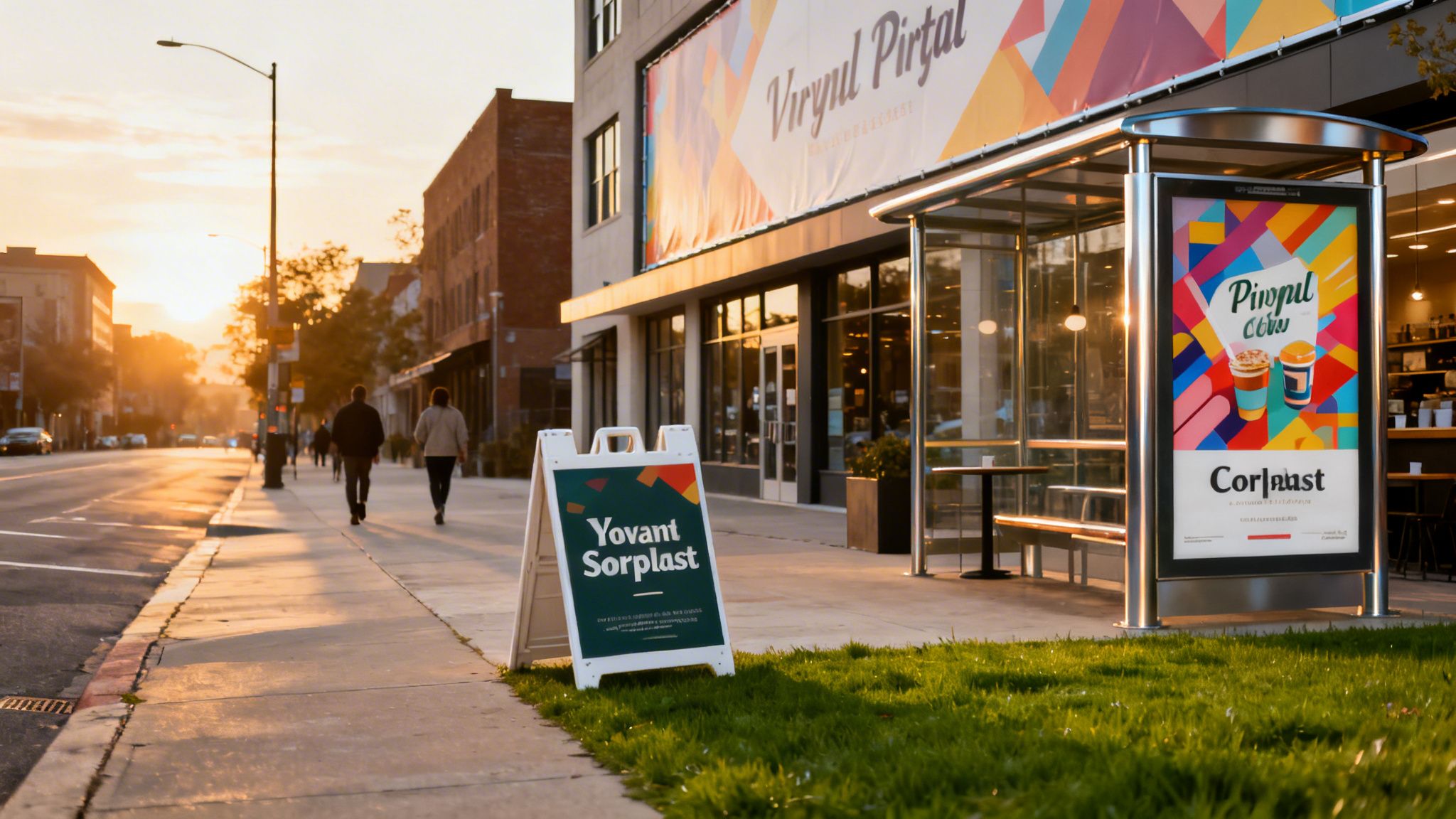
Picture this: your business has a silent, tireless salesperson working for you 24/7 on the busiest street in town. That’s the real power of outdoor advertising signs. In an age where digital ads flash by in an instant, these physical signs put your brand right in the middle of the real world, building a tangible presence and trust with your local community.
Why Outdoor Advertising Signs Still Matter

While we’re all fighting for a few seconds of screen time with pop-up ads and social media posts, outdoor signs create a constant, reliable presence. They’re like a permanent welcome mat for your business, working day and night to grab the attention of potential customers.
The best part? People can’t scroll past them or turn on an ad-blocker. Your signs exist in the physical spaces where your audience lives, works, and shops, making them an unmissable part of the scenery.
This real-world permanence is more powerful than it sounds. There's a certain psychology at play; seeing a brand in a physical context builds much stronger recall and a sense of legitimacy that digital-only campaigns often miss. When someone drives past your sign every day on their commute, it creates a familiarity that naturally turns into trust.
Anchoring Your Brand in the Community
Outdoor advertising signs aren’t just for shouting a message from the rooftops; they’re for weaving your brand into the very fabric of a neighborhood. They can become local landmarks that people use for directions, and in doing so, they make your business a recognized, trusted part of the local landscape.
This consistent visibility is a game-changer for any business that depends on local customers, whether you’re a coffee shop, a dental practice, or a law firm. It gives you a serious edge. In the never-ending debate over digital marketing vs traditional marketing, outdoor signs prove that nothing replaces a physical touchpoint for building local authority and driving immediate, location-based action.
A Growing Market with Proven Impact
You might think online marketing has taken over, but the market for out-of-home (OOH) advertising isn’t just hanging on—it’s booming. The global OOH market, which is driven largely by signs like these, hit $32.1 billion in 2022 and is projected to climb to an incredible $56.1 billion by 2030.
This growth is happening for a simple reason: businesses understand that reaching people in the real world is as crucial as it’s ever been.
The core strength of outdoor advertising is that it’s unskippable. It blends right into a consumer's environment, creating brand impressions that are both passive and powerful, reinforcing your message with every single glance.
This makes outdoor signs the perfect anchor for a modern marketing strategy. They don't replace your digital efforts; they make them stronger by providing a real-world connection point. When someone sees your billboard and then gets a targeted ad on their phone, the two channels work together to make your message stick.
This guide will walk you through exactly how to make this power work for you. We’ll cover everything from choosing the right format and designing for maximum impact to navigating permits and installation. By the end, you’ll have everything you need to turn simple outdoor signs into one of your most effective marketing tools.
You can also get a feel for what’s possible by exploring our huge range of customizable signs and banners.
Choosing the Right Sign Format for Your Marketing Goals
Picking the right outdoor sign is a lot like choosing the right tool for a job. You wouldn't use a sledgehammer to hang a picture frame, and you probably shouldn't use a massive highway billboard to advertise a daily lunch special.
Every sign format has its own unique strength. The secret to a successful campaign is simply matching the right sign to what you’re trying to accomplish. It all starts by getting crystal clear on your goals. Are you trying to pull pedestrians into your coffee shop right now? Or are you looking to build brand recognition across the entire city over the next year?
Your answer will point you to the perfect format and help you set a realistic budget. Let's break down the most popular options, from the hardworking sidewalk heroes to the giants of the industry that can’t be ignored.
For Immediate Foot Traffic and Local Promotions
When your goal is to influence customers who are just a few steps away, you need signs that are quick, direct, and affordable. These are the absolute workhorses of local business advertising.
- A-Frame Signs (Sandwich Boards) Think of these as your personal, daily messengers. A café can use an A-frame to shout out its "Soup of the Day," a boutique can announce a flash sale, and a pub can promote its happy hour. Their biggest perks are portability and immediacy, making them perfect for catching the eye of passersby and encouraging impulse decisions.
- Yard Signs These are the go-to for service businesses and events tied to a specific location. You see them everywhere: real estate agents use them for open houses, contractors show off their work in a neighborhood, and local politicians build name recognition block by block. Made from durable yet light materials like corrugated plastic, they offer a cheap way to get your message seen over and over in a concentrated area.
For Broader Reach and Targeted Awareness
When you need to cast a wider net and reach an audience beyond your immediate storefront, you need formats that command attention in high-traffic areas. These signs are all about building awareness and pulling customers in from further away.
A classic mistake is putting a sign designed for walkers in a spot where only drivers will see it. A driver has only 3-5 seconds to read a sign. Your message has to be incredibly short, the text has to be huge, and it should have one single, clear visual.
A great example is using bus shelter ads. A new gym could place ads along a popular commuter route, reaching hundreds of potential members twice a day, every single day. This kind of repeated exposure to a captive audience builds familiarity and keeps the brand top-of-mind. It’s a strategy that’s miles more effective for the gym than a small A-frame sign would be.
For Maximum Impact and Brand Dominance
When you’re ready to make a massive splash, announce a major launch, or position your brand as a market leader, you have to go big. These formats are less about an immediate sale and more about creating a brand statement that people won't forget.
Billboards are the undisputed champions of large-scale brand building. Placed strategically along major highways and busy city streets, they get your message in front of thousands of people daily. They are perfect for simple, bold branding that builds name recognition over time.
This format is also changing fast. Digital billboards are the fastest-growing segment in the entire outdoor advertising industry, with a projected 5.3% CAGR from 2025-2033. These signs, often driven by real-time data, are incredibly popular, as Gen Z is 35% more likely to engage with them. To see the full picture, you can read the complete research on the outdoor advertising market.
Building Wraps and Large Banners are the ultimate showstoppers. We're talking about massive graphics that can cover an entire side of a building, turning architecture into a canvas for your brand. They're typically used for high-profile product launches, huge corporate events, or when a brand wants to completely own a specific location. These large-format graphics are a powerful statement, and exploring professionally printed vinyl banners can give you an idea of the scale.
Designing Signs That Capture Attention in Seconds
Your outdoor sign is fighting a tough battle. It’s up against traffic, other signs, passing pedestrians, and all the noise of a busy day. In this world, you don’t have minutes to get your point across. You have about five seconds.
This is what we call the “5-second glance” rule in outdoor advertising, and it’s non-negotiable. If someone driving or walking by can’t figure out what your sign is about in five seconds flat, that opportunity is gone for good. Every choice you make—from the colors to the fonts—has to serve one purpose: instant clarity.
Think of your sign as a powerful headline. Its one and only job is to shout the most important information and make someone want to know more. Anything that slows a person down, like a swirly script font or a paragraph of text, is a mission failure.
Mastering the Art of High-Impact Readability
Creating a sign that passes the 5-second test isn’t about being the loudest or cramming in the most information. It’s about being the clearest. The secret to a readable sign comes down to three core principles that work together to deliver your message with speed and punch.
1. High-Contrast Color Palettes This is no time for subtlety. Your background and text colors need to be polar opposites to create a strong visual pop. Bold, classic combinations are your best bet here.
- Black text on a yellow or white background.
- White text on a black, blue, or red background.
- Yellow text on a black background.
These pairings create the sharpest possible contrast, making your text leap off the sign and stay readable from far away, even in bad weather or dim light.
2. Simple, Bold Typography Save the elegant, decorative fonts for a different project. When it comes to outdoor signs, you need typefaces that are thick, clean, and ridiculously easy to read at a glance. Sans-serif fonts like Helvetica, Futura, or Arial Black are industry workhorses for a reason—they were built for this kind of legibility.
As a rule of thumb, never use more than two different fonts on one sign. A great strategy is to use one big, bold font for your main headline and a simpler, clean font for any secondary details. This creates a natural visual hierarchy that tells the viewer’s eye exactly where to look first.
3. The Power of Three A truly effective sign almost always boils down to just three key pieces of information:
- A Compelling Headline: A short, punchy phrase like “Grand Opening” or “50% Off Sale.”
- Your Brand Name/Logo: Who you are.
- A Clear Direction: Your address, website, or a simple arrow pointing the way.
Anything else is just noise. Keep it clean, and your message will land every time.
Matching Your Design to the Right Material
The material you pick for your outdoor sign does more than just display your design; it sends a clear message about your brand's quality and staying power. Getting this choice right ensures your sign not only looks fantastic but also stands up to the elements.
This simple flowchart can help you connect your main goal directly to the best sign format for the job.

As you can see, your objective—whether you’re trying to drive foot traffic, announce an event, or build brand awareness—points you toward a specific type of sign.
Here’s a closer look at the most common materials we see:
- Coroplast: You know this one. It's the lightweight, corrugated plastic used for almost all yard signs. It’s super cost-effective and perfect for temporary use, like promoting a weekend sale or a local event.
- Vinyl: Weatherproof and incredibly durable, vinyl is the go-to for banners of all kinds. We can print it in brilliant, full color, and it’s tough enough for long-term outdoor display. It’s perfect for everything from “Now Hiring” signs to huge event backdrops.
- Aluminum: When you need a sign that looks permanent and professional, aluminum is the way to go. It’s rigid, completely rust-proof, and gives off a sleek, high-quality vibe. It's the ideal choice for storefront signs, directional signs, and real estate signs that have to look great for years.
Your design and your material are two sides of the same coin. A brilliant, easy-to-read design printed on a flimsy material will look cheap and fade fast. On the other hand, even the best material can't save a cluttered, unreadable message. To create an asset that truly works for your business, make sure your design is built for speed and your material is built to last.
How to Handle Sign Permits and Placement Legally
Putting up a great-looking outdoor sign is only half the battle. Making sure it’s legal is the part that truly protects your investment. It’s a step many business owners miss, only to get hit with costly fines, removal orders, and the pure frustration of watching their hard work get torn down. This isn't just about dodging penalties—it’s about making sure your sign can actually do its job without any interruptions.
Imagine this: you've just paid for a brilliant, can't-miss sign. You get it installed in what seems like the perfect spot, but a week later, a notice from the city arrives. The sign is two feet too close to the road, breaking a "setback" rule you never knew existed. Now you’re on the hook for a fine and the cost of moving it. It's a headache that was completely avoidable.
Understanding Your Local Sign Ordinances
Every town, city, and county has its own rulebook, often called ordinances or zoning codes, that spells out exactly what you can and can't do. These rules are there to ensure public safety, keep the community looking good, and prevent a chaotic mess of visual clutter. Before you even think about finalizing a design, your first move should be a call to your local municipal planning or building department.
Think of local sign codes as the "rules of the road" for advertising. Just as you wouldn't drive without knowing the speed limit, you shouldn't place a sign without understanding the specific regulations in your area. This proactive approach saves you time, money, and significant stress down the line.
A huge part of a successful, legal sign placement is navigating the various sign permit requirements. These documents can be dense and complicated, so going in with the right questions is key to getting clear answers.
Your Legal Placement Checklist
When you get in touch with your local officials, have a list of questions ready to go. It’s the best way to gather all the info you need in a single conversation.
- Size and Height Restrictions: What's the maximum square footage and height allowed for a sign at my business address?
- Setback Requirements: How far does my sign need to be from the street, sidewalks, and my property lines?
- Illumination Rules: Are lit-up or digital signs okay? If they are, are there limits on brightness or when they can be turned on?
- Permit Application Process: What paperwork do I need to fill out, what are the fees, and how long does it usually take to get approval?
Many cities also have specific rules for different kinds of signs. For example, the regulations for permanent storefront signs are usually much stricter than the ones for temporary, portable signs. If your business depends on catching the eye of people walking by, understanding the rules for sidewalk signs is critical, as they often have their own specific placement and time-of-day limits. Taking the time to sort this out upfront ensures your sign works as a powerful marketing tool and a compliant part of the community.
Bringing Your Sign to Life with Professional Production
A great design is just the first step. The real test is turning that digital file into a physical sign that looks polished and professional, not like a cheap, rushed job. This is where production and installation come in—the final, crucial stage where quality really makes or breaks your investment.

It can be tempting to find the cheapest option, but partnering with a professional printer is one of those non-negotiable things. They have the right equipment and know which materials will make your colors pop, keep your text sharp, and ensure the whole thing can survive a storm. That commitment to quality says a lot about your brand before a customer ever walks in the door.
The need for high-quality signs isn't just a hunch; it's a massive market. In fact, the global outdoor advertising production space is on track to hit $6.61 billion by 2025. This boom is driven by brands in competitive cities needing HD-quality signs to stand out. You can read more about the production market growth on archivemarketresearch.com to get a sense of just how important professional printing has become.
Preparing Your Design File for Printing
To get a perfect sign, you have to hand off a "print-ready" file. This isn't some complex technical step; it’s just about setting your printer up for success with the right specs.
- Color Mode (CMYK): Your computer screen uses RGB (Red, Green, Blue) light, but printers use CMYK (Cyan, Magenta, Yellow, Black) ink. If you send an RGB file, the colors will shift during printing, and not in a good way. Always convert your design to CMYK before you export.
- Resolution (DPI): Web images get away with low resolution (72 DPI), but print needs much more data to look sharp. For a sign that’s crisp and not blurry, your file needs to be at least 150-300 DPI (dots per inch) at its final physical size. This prevents that dreaded pixelated look.
- File Format: Printers love vector files (PDF, AI, EPS) because they can be scaled up to the size of a building without losing an ounce of quality. If you have to use a pixel-based image, send a high-resolution TIFF or JPG as a backup.
Working with a company that handles online large format print services can make this much easier, since they usually have templates and clear instructions to guide you.
Think of it like baking a cake. If you give a baker the wrong ingredients or fuzzy measurements, you can't be surprised if the final cake doesn’t look or taste right. A print-ready file is your recipe for a perfect sign.
A Practical Guide to Safe Installation
Once your sign is printed, the last thing you want is for it to be installed poorly. It can look sloppy, get damaged, or even become a safety hazard. While smaller signs are a simple DIY, larger ones need more attention.
Installation Checklist:
- For Yard Signs: Stick the H-stake firmly into soft ground, making sure you’re clear of any underground sprinklers or utility lines. Give it a once-over to ensure it’s straight and not leaning, which can cause it to catch the wind and snap.
- For A-Frames: Place them on a flat, even surface where they won’t trip up pedestrians. If it’s a windy day, a couple of sandbags over the bottom bar will keep it from blowing over.
- For Vinyl Banners: Use every single grommet. This distributes the tension evenly and prevents tearing. Pull it taut with strong rope or bungee cords—a tight banner not only looks better but also handles wind without flapping itself to shreds.
Proper installation isn’t just about aesthetics; it's about protecting your investment. A securely fastened sign will last longer and keep everyone safe, which is just good business.
Measuring the Real ROI of Your Outdoor Advertising
So, you've invested in outdoor advertising. The signs look great, but how do you know if they're actually working? It's the million-dollar question for any business owner. A billboard or A-frame doesn't have a "click" button or a neat little analytics dashboard like a digital ad. But that doesn’t mean its impact is a total mystery. With a bit of strategic thinking, you can make your signs just as accountable as any online campaign.
First things first, you need a clear picture of what you’ve spent. This isn't just about the printing cost. You have to look at the Total Cost of Ownership (TCO). To get a real sense of your investment, you need to add up every single expense.
- Design Fees: What you paid a graphic designer to create the artwork.
- Production and Printing: The cost of the physical sign itself from your print partner.
- Permit Costs: Any fees required by your local town or city for legal placement.
- Installation Labor: The price to have larger signs put up safely and professionally.
- Rental or Placement Fees: For formats like billboards or bus shelters, this is your recurring ad space cost.
Once you have that total, it's time to start tracking the return. This is where you can get creative with some smart, low-tech tactics that deliver clear results.
Clever Ways to Track Your Sign's Performance
The secret is to give your sign a unique "trigger"—something specific that links a customer's action directly back to that ad.
A huge mistake I see all the time is businesses putting their main website or phone number on a sign. A new lead comes in, and you're left guessing. Did they find you on Google? Was it a referral? Or was it that expensive banner? Unique trackers are the only way to know for sure.
Here are a few simple but incredibly powerful methods to measure how well your sign is performing:
- Sign-Specific Discount Codes: This one's a classic for a reason. Add a unique offer code like “SAVE20SIGN” to your creative. When customers use that code, you know exactly where they came from.
- Unique Website URLs: Instead of sending people to
YourSite.com, create a dedicated landing page for the ad, likeYourSite.com/deal. Just track the traffic to that specific page, and you’ll see how many people your sign drove to your website. - Dedicated Phone Numbers: Use a call-tracking service to get a unique phone number that forwards to your main business line. The analytics will show you precisely how many calls your sign generated.
Correlating Data for a Bigger Picture
Beyond direct tracking, you can connect the dots by looking at your other business data. Let's say you put a new banner on a busy intersection. Pull up your sales reports. Did you see a noticeable lift in foot traffic or revenue in the 2-4 weeks after it went up?
Another powerful tool is something surprisingly simple: just ask. Add the question, "How did you hear about us?" to your checkout process or have your cashiers ask customers directly. Tally up every time someone says "the sign on Main Street," and you'll get a real-world feel for its impact.
When you use these strategies, your outdoor advertising stops being a shot in the dark and becomes a measurable part of your growth engine. Knowing which signs bring in customers lets you double down on what works and cut what doesn’t, making every dollar in your marketing budget work that much harder. For more ideas on crafting compelling offers, check out our guide on creating effective marketing materials that get results.
Common Questions About Outdoor Advertising Signs
Diving into outdoor advertising always brings up a few key questions. As a business owner, you want to make sure you're spending your money wisely and avoiding the common mistakes we see all the time. Let’s walk through the questions we hear most often, so you can move forward with a clear plan.
How Long Do Different Outdoor Signs Actually Last?
This is one of the first things business owners ask, and the answer really comes down to two things: the material you choose and the weather it has to put up with. It's not all that different from choosing between a paper cup for a single event and a sturdy ceramic mug you’ll use for years.
A corrugated plastic yard sign, for example, is a fantastic, low-cost option for a seasonal promotion or a weekend event, and you can expect it to last a single season (3-6 months). Step up to a professionally printed vinyl banner, and you're in a different league. That material is far more resilient and can easily hold up for 3-5 years. If you’re looking for something that feels truly permanent, a rigid aluminum or composite sign can stay sharp for a decade or more.
A simple way to extend the life and vibrancy of nearly any sign is to add a UV-protective laminate finish. This clear coat acts like sunscreen for your sign, shielding the colors from fading and adding an extra layer of protection against scratches and moisture.
What Is the Biggest Mistake People Make with Sign Design?
Without a doubt, the single biggest mistake is clutter. It’s a classic trap: trying to cram every last detail onto one sign. We’ve seen it all—multiple phone numbers, a laundry list of services, a complicated logo, and a full street address, all fighting for space.
An effective sign has to pass the "5-second rule"—can someone driving by understand the core message in a flash? If not, the design has failed. The fix is to be ruthless with your message. Pick one thing to say. Focus on a bold headline, your brand name, and a simple call to action. Stick with large, clean fonts and colors that pop against each other. When it comes to signs meant to be seen from a distance, less is always more.
Can I Just Install a Large Sign Myself to Save Money?
While we’d encourage anyone to put up their own A-frames or yard signs, we strongly advise against a DIY approach for anything bigger. When you get into large banners or rigid storefront signs, it’s a job for a professional. Their work goes way beyond just hanging something on a wall; they make sure it’s secure, perfectly level, and safe.
A bad installation can cause a ton of headaches. You could damage the sign, the building, or worse, create a serious safety hazard if it comes loose. The potential liability from a falling sign is a far bigger bill than the cost of having it installed correctly the first time.
Are Digital Billboards Worth the Higher Cost?
For the right small business, a digital billboard can be a brilliant move, but it all hinges on your goal. Their biggest advantage is flexibility. You can swap out your message in an instant, target ads to run only during rush hour, and grab attention with eye-catching motion.
Yes, the initial cost is higher than a static sign. But they are incredibly powerful for time-sensitive offers, concert announcements, or for any business that wants to project a modern image. A smart way for small businesses to get their feet wet is to buy a slot on a shared digital screen. Your ad rotates with others, giving you a taste of this format without the massive expense of a 24/7 solo placement.
Ready to create outdoor advertising signs that get noticed? At 4OVER4, we offer a huge selection of high-quality, customizable signs for every business need. From durable banners to professional A-frames, we have the tools to bring your vision to life. Design your perfect sign today at 4OVER4.com.
More from

24
Printing on ribbon is the art of transferring your custom design, logo, or text onto a roll of fabric. It’s what transforms a simple decorat
 Emma Davis
Mar 19, 2026

102
If you've ever wondered about the standard gift card dimensions, there’s one number you need to know: CR80
Emma Davis
Mar 17, 2026

50
When you’re launching a product, your bottle label is often the first thing a customer sees. Think of it as your silent salesperson
Emma Davis
Mar 16, 2026

140
When you're brainstorming ideas for landscaping business cards, it helps to think beyond just contact information. Your c
Emma Davis
Mar 15, 2026

248
When you think of a yard sign, the classic 18"x24" is probably what comes to mind. It’s the industry workhorse fo
Emma Davis
Mar 14, 2026

164
When you’re ready to invest in an A-frame sign, the first question you'll ask is, "What size do I need?" It usually comes down
Emma Davis
Mar 13, 2026

1738
The real secret to mastering your direct mail budget isn't complicated. It comes down to one simple fact: a standard 4" x 6&q
Emma Davis
Mar 12, 2026

179
Tear-off flyers are a classic for a reason. They’re a tangible marketing tool, designed with perforated, removable tabs at the bottom. Each
Emma Davis
Mar 11, 2026