Table of Contents
- Home
- content hub
- Printing on Ribbon Your Ultimate Guide to Branding
 Share and earn
Printing on Ribbon Your Ultimate Guide to Branding

Mar 19, 20269 views
Mar 19, 20269 views
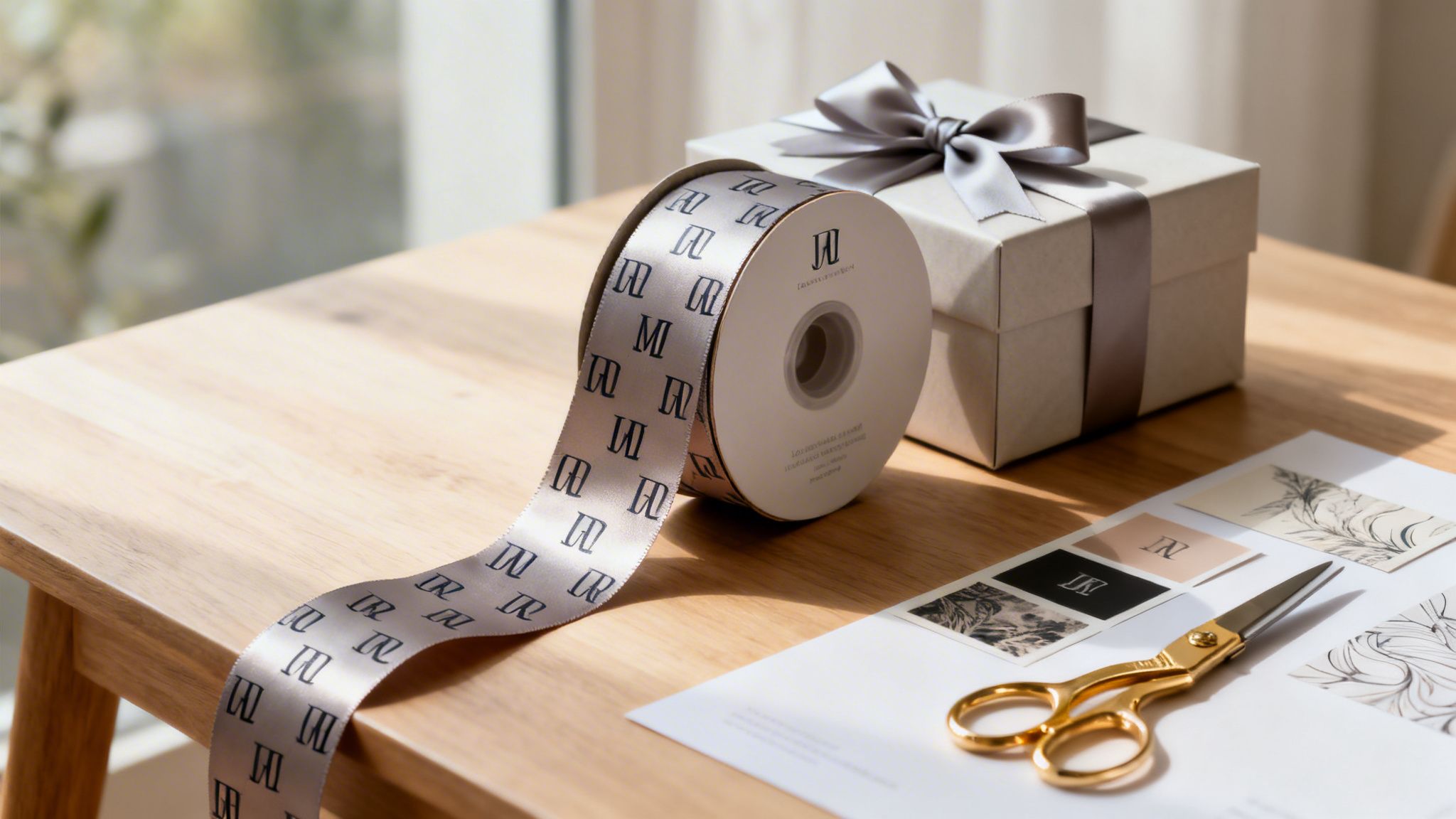
Printing on ribbon is the art of transferring your custom design, logo, or text onto a roll of fabric. It’s what transforms a simple decorative item into a powerful branding tool, adding a polished and unforgettable touch to packaging, gifts, and special events.
What Is Ribbon Printing and Why It Matters
Ever thought about how to make every gift, package, or event favor work for your brand? That's exactly where custom ribbon printing comes in. It takes what is often a simple decorative afterthought and turns it into a potent marketing tool, making every single interaction a chance to reinforce your brand.
Think of a blank ribbon as a tiny, empty billboard. When you add your custom print, you're filling that space with your logo, your message, or a unique design that speaks for you. This one small detail instantly boosts how people perceive your brand and creates a memorable unboxing experience that customers really notice. It’s a subtle way of communicating quality and attention to detail before they even see what's inside.
From Decoration to Brand Statement
In business, first impressions are absolutely everything. Printed ribbon acts as a natural extension of your brand identity, making your whole presentation feel cohesive and professional from the moment a customer gets your product. It’s not just about tying a pretty bow; it's about crafting an experience that speaks volumes.
The main benefits are pretty clear:
- Enhanced Brand Recognition: A repeating logo or brand name keeps your business at the front of your customer's mind.
- Premium Unboxing Experience: That custom touch makes customers feel special and is the kind of thing that gets shared on social media.
- Increased Perceived Value: High-quality, thoughtful presentation almost always suggests a high-quality product inside.
The true magic of printing on ribbon is its ability to communicate professionalism. It tells your customer you’ve thought through every part of their experience, turning a basic transaction into a genuinely delightful moment.
A Glimpse into Printing Methods
Bringing a design to life on fabric requires the right technique. We'll dive deeper into these later, but it helps to know the main players. Each method gives a different finish and is better suited for certain materials or design complexities.
Here’s a quick overview of what to expect when comparing different ribbon printing techniques.
A Quick Look at Ribbon Printing Methods
Compare common ribbon printing techniques to see which best fits your project's style, volume, and material.
| Printing Method | Best For | Key Characteristic |
|---|---|---|
| Hot Stamping | Luxurious, high-end looks | Creates a metallic, foil-like impression |
| Screen Printing | Bold, simple designs | Applies a thick, durable layer of ink |
| Thermal Transfer | Detailed logos & text | Delivers a crisp, sharp finish |
| Digital Printing | Full-color, complex artwork | Prints photorealistic images directly on fabric |
Understanding these options is the first step toward creating the perfect custom ribbon. This is just one of many custom options available for your brand's packaging products.
This level of detail really matters. Whether you're a small Etsy shop wanting to add a personal touch or a large company branding thousands of event giveaways, the right printed ribbon will make you stand out. It's an affordable yet incredibly impactful investment in your brand’s story.
A Look at Core Ribbon Printing Methods
To get the perfect custom ribbon for your brand, you first need to understand how it’s made. Think of it like cooking; different techniques can create wildly different results, even if you start with the same basic ingredients. Let’s break down the three main ways to print on ribbon, each with its own distinct advantages.
Thermal Transfer Printing: The Precision Workhorse
Imagine a high-tech typewriter that uses a heated printhead to melt specialized ink from a thin film—the "transfer ribbon"—directly onto the fabric. That’s thermal transfer printing (TTP) in a nutshell.
The result is an incredibly crisp, durable, and clean print. Because the ink is thermally bonded to the material, it resists smudging, fading, and moisture. This makes it the top choice for detailed logos, fine text, and even scannable barcodes. Its precision and durability are why you see it so often in professional product packaging and logistics.
This method's reliability has made it a cornerstone of modern labeling. The global thermal transfer ribbon market was valued at USD 2.47 billion in 2025 and is projected to reach USD 4.61 billion by 2034, which shows just how essential it is in any industry where clear, long-lasting prints matter.
There are two main ink types used in TTP, each for different jobs:
- Wax Ribbons: The most common and budget-friendly choice. They need less heat to transfer, making them great for general-purpose printing on satin ribbons where extreme durability isn't the number one concern.
- Resin Ribbons: When you need maximum durability, resin is the only way to go. These inks form a much stronger bond that holds up against harsh conditions, chemicals, and abrasion—perfect for care labels or outdoor use.
Hot Stamping: The Touch of Luxury
If thermal transfer is the precise workhorse, hot stamping is the artisan. This classic technique delivers a touch of unmatched elegance and a premium feel you can actually touch. Instead of ink, it uses a heated metal die, which is basically a custom stamp of your design.
The die presses a thin layer of metallic or colored foil onto the ribbon. That combination of heat and pressure transfers the foil, creating a design that is slightly debossed—or indented—into the fabric. This gives the print a stunning, three-dimensional quality you can both see and feel.
Hot stamping is the go-to for luxury brands, high-end gift wrapping, and special events like weddings. Its shimmering, metallic finish instantly signals quality and sophistication, making any item feel that much more special.
This method is perfect for simple, bold designs. Since it relies on a physical stamp, it's not the right fit for complex, multi-color images. But for a logo or a simple line of text, nothing can beat the opulent finish of a gold, silver, or colored foil on a deep-hued satin ribbon.
The infographic below shows how these printing applications are used for very different goals across branding, gifting, and events.

As you can see, each application uses ribbon printing to forge a specific emotional connection, whether that’s brand loyalty, a festive celebration, or professional identity.
Screen Printing: For Bold and Vibrant Graphics
Finally, we have screen printing, a method known for producing bold, opaque, and incredibly vibrant colors. The process uses a fine mesh screen stretched tightly over a frame. A stencil of your design is created on the screen, blocking out areas where ink shouldn't pass through.
Ink is then pushed through the open parts of the mesh onto the ribbon with a squeegee. This lays down a thick, rich layer of color that really pops, especially on darker ribbon materials.
This technique is incredibly versatile and works well on all sorts of fabrics, including those with more texture like grosgrain or cotton. While it’s best for designs with just one or two solid colors, screen printing is fantastic for creating high-impact graphics that need to be seen from a distance. It's an excellent choice for promotional lanyards, event wristbands, and any branding where a bold, graphic statement is the goal. Many of the same principles are at play in the wider world of digital printing, where technology makes it possible to get vibrant designs on all kinds of materials.
How to Choose the Right Ribbon Material

The ribbon material you pick is literally the foundation for your printed design. Think of it like an artist choosing between a smooth canvas for fine detail and a textured one for a more expressive look. The fabric’s texture, shine, and even its sturdiness all have a say in how your final print turns out.
A smooth, slick surface is going to capture every tiny detail, while a fabric with more texture will lend a rustic or organic feel. Getting the material right—making sure it works with your design and your printing method—is how you get a professional result that looks like it was meant to be.
Satin The All-Around Favorite
For custom printing, satin is the go-to for a reason. It has that signature smooth, glossy surface that acts as a perfect canvas for crisp, clear prints. That slickness is what allows methods like thermal transfer to lay down sharp lines and clean text without any smudging or bleeding.
It's also the ideal match for hot stamping. The heat and pressure from the metal die press cleanly into the flat surface, and the foil sticks perfectly. The result is a high-end, slightly debossed finish that just feels premium.
Satin ribbon is a great fit for:
- High-End Product Packaging: Tying a custom satin ribbon around a jewelry box or perfume instantly elevates its perceived value.
- Wedding Favors and Decor: Its elegant shine is a natural for sophisticated events.
- Detailed Logos: If your logo has fine lines or small text, satin's smoothness ensures every bit of it is readable.
Grosgrain For Durability and Texture
Then there's grosgrain (pronounced “grow-grain”), which you can spot immediately by its distinct ribbed texture. Those little crosswise ribs give the fabric a sturdy, durable feel and a more muted, matte finish compared to satin’s high shine. It also holds its shape incredibly well, making it a fantastic pick for bows that need to stay structured.
That texture, however, can be tricky for printing. Tiny details or delicate text can get a bit lost in the grooves of the fabric. Because of this, grosgrain really shines with simpler, bolder designs. Screen printing is a good pairing here since the thick ink can easily cover the ribbed surface. Simple logos or repeating patterns work perfectly on this material.
Think of grosgrain as the sturdy, everyday workhorse. It’s perfect for gift wrapping where you need something that won’t tear easily, or for brands aiming for a classic, preppy, or handcrafted vibe instead of a high-gloss luxury feel.
Sheer and Specialty Options
Beyond the two big players, other materials offer unique looks for more specific projects. Of course, each comes with its own printing quirks. Digging into a complete fabric collection can often spark some great new ideas.
Organza: This is a sheer, lightweight, and very delicate fabric that creates a soft, almost ethereal effect. Printing on organza is usually kept to simple, one-color designs, since the print itself will take on some of that sheerness. It's a beautiful choice for wrapping delicate items or adding a dreamy touch.
Cotton: For brands with a focus on sustainability or a rustic, earthy aesthetic, cotton ribbon is a fantastic option. Its soft, natural texture is a perfect match for simple, one-color prints. Screen printing is usually the best method here, creating a look that feels authentic and almost handmade.
Matching the material to your brand's personality and the technical needs of your artwork is what ties it all together. A sleek tech company might go for a sharp silver foil on black satin, while an organic soap brand would feel more at home with a simple logo on natural cotton. When you make a thoughtful choice, your ribbon does more than just decorate—it communicates.
Designing Artwork for Stunning Custom Ribbons
Designing for a custom ribbon isn't like designing for a poster or a webpage. You’re working with a very small, very narrow canvas. This isn't a limitation—it's an opportunity to get straight to the point and create something truly memorable.
The secret lies in simplicity and repetition. A complicated, busy design will just get lost on a one-inch strip of fabric. Instead, think about a clean logo, a simple motif, or a short, punchy phrase repeated down the length of the ribbon. It’s like the chorus of a great song; it’s the part that sticks in your head.
Technical File Setup for Flawless Printing
To get that sharp, professional look, your digital file has to be perfect. This is the non-negotiable step that ensures your design transfers from the screen to the fabric without a hitch. Getting this right means paying attention to a few key details.
First and foremost, you absolutely need to use vector files. Formats like AI (Adobe Illustrator), EPS, or SVG are your best friends here. They're built on mathematical equations, not pixels, which means you can scale them to any size—from a tiny ribbon to a giant billboard—and they’ll stay perfectly crisp. Trying to print a pixel-based file like a JPG or PNG on ribbon is a recipe for a blurry, unprofessional mess.
Here’s a quick checklist to run through before you send your file:
- Vector Format: Make sure every part of your design, from logos to text, is in a true vector format (.ai, .eps, .svg).
- Correct Color Mode: If you’re going for a full-color design with a digital printer, set your file to CMYK. For simpler methods like hot stamping or screen printing, you'll need to use solid spot colors.
- High Resolution: While vectors are the gold standard, if you must include a pixel-based element, it needs to be at least 300 DPI at its final print size. No exceptions.
Pro Tips for High-Impact Ribbon Design
With the technical side sorted, you can dive into the creative choices that will make your ribbon stand out. A few smart moves can elevate your design from just okay to truly eye-catching.
The best ribbon designs use negative space as an active element. The blank areas of the ribbon are just as important as the printed parts—they give your logo or text room to breathe and draw the eye where you want it to go.
Contrast is your most powerful tool. A dark print on a light ribbon, or a brilliant metallic foil on a deep, rich satin, creates an immediate pop that grabs attention and makes your message easy to read. This is especially true for any text you include. And speaking of text, steer clear of fonts that are too thin, ornate, or complex. A bold, clean sans-serif or a straightforward serif font will always print more clearly on fabric.
These same principles apply when creating items for special occasions. For instance, a detailed guide on designing a custom graduation stole highlights how vital fabric choice and logo placement are for a polished, ceremonial look.
This focus on high-quality, personalized finishes is a major trend. Even in adjacent industries like card printing, the demand for specialized ribbons is projected to climb from USD 888.6 million in 2025 to over USD 1.29 billion by 2035. This growth shows just how much customers value beautiful, durable design.
Finally, never forget to consider the ribbon's texture. A shimmering metallic design using a technique like foil stamping will have a completely different feel on smooth satin compared to a ribbed grosgrain ribbon. Always design with your final material in mind to get the result you're picturing.
Inspiring Ways to Use Printed Ribbon

Alright, now that we’ve covered the technical side of how ribbon printing works, let’s get to the fun part: seeing it in action. Custom ribbon is so much more than just a spool of fabric; it’s a powerful tool for crafting brand moments that people genuinely remember.
Across countless industries, businesses are finding that a simple strip of branded ribbon can completely change how a customer perceives them. It’s a small detail that tells a big story about care, quality, and thoughtfulness—a story your clients can literally feel in their hands.
Elevating the Retail and E-commerce Experience
In the crowded worlds of retail and e-commerce, the unboxing experience isn't just a trend; it's a vital marketing opportunity. A custom printed ribbon is often that perfect finishing touch that transforms a standard package into a high-end, gift-like delivery.
Just think of a jewelry brand that ties each box with a silky satin ribbon featuring its logo in shimmering gold foil. Or an online clothing boutique that secures its tissue paper with a grosgrain ribbon printed with a playful, on-brand pattern. These touches aren't just for show. They make the customer feel special and create an Instagram-worthy moment, boosting the chances they’ll share their experience online.
An unboxing experience is your brand’s final handshake with a customer. A custom ribbon makes that handshake firm, memorable, and personal, reinforcing their decision to choose you.
It's no surprise the demand for these kinds of details is growing. The global market for printing ribbons, valued at USD 1.37 billion in 2024, is on track to hit USD 1.86 billion by 2030. This shows just how essential these small but mighty branding tools have become.
Making Corporate Events and Special Occasions Memorable
Printed ribbon is a secret weapon for event planners and corporate marketers. It’s a simple, cost-effective way to tie an event together visually and reinforce a professional, cohesive atmosphere from start to finish.
Here are a few ways it makes a huge impact:
- Branded Lanyards: At conferences and trade shows, a screen-printed ribbon lanyard with the company logo or event name is both practical and a highly visible piece of branding.
- Sophisticated Gift Bags: Tying a custom ribbon around a gift bag for attendees or VIPs adds a layer of polish that instantly communicates a premium feel.
- Elegant Wedding Decor: Beyond just tying up favors, printed ribbons can be used for everything from chair sashes to bouquet wraps, weaving the couple's names or wedding date beautifully into the decor. Our wedding collection has plenty of other ideas for your big day.
If you're looking to create something truly personal, see how people design a custom graduation stole. The principles of personalizing textiles can spark some fantastic ideas for your own ribbon artwork.
Boosting Local Businesses and Creative Crafters
This isn't just a strategy for big corporations. Custom printed ribbon is an accessible way for small businesses, artisans, and crafters to add a professional finish that puts them on par with larger competitors. It’s an affordable investment that delivers a huge return in brand perception.
Picture these scenarios:
- A local florist wraps a gorgeous bouquet with a ribbon printed with their shop's name and phone number.
- A home baker seals a box of delicious macarons with a ribbon that says, "Handmade with Love."
- An Etsy seller ties a thank-you note to their product with a simple ribbon featuring their shop’s URL.
In every case, the ribbon is both decorative and a clever piece of marketing. It’s a tangible reminder of where that wonderful product came from, encouraging repeat business and word-of-mouth referrals. It's often this one tiny detail that turns a one-time buyer into a lifelong fan.
How to Order Your Custom Printed Ribbon
Ready to bring your vision to life? Ordering your custom ribbon should be an exciting step, not a confusing one. We’ve designed our process to be simple and transparent, guiding you from that initial idea to the finished product you can hold in your hands. It all starts with making a few key choices.
First up, you’ll pick your ribbon material and width. As we’ve covered, a smooth satin is perfect for intricate, detailed designs, while textured grosgrain offers a classic look with excellent durability. Next, choose your ribbon and print colors—remember, high contrast makes for the most readable and eye-catching results.
Navigating the Ordering Process
Once you’ve settled on the basics, the next steps are all about finalizing your design and quantity. This is where you’ll really see your project start to take shape.
- Upload Your Artwork: Use our online tools to upload your vector file. This is the best way to guarantee your logo or text will be perfectly crisp and sharp when printed.
- Define Your Order Size: Tell us the total yardage you need. This is a great time to play around with the numbers, as pricing is often affected by volume.
- Review Instant Pricing: Our system gives you a clear, immediate quote based on your selections. Feel free to adjust the ribbon type, width, or quantity to see how it changes the cost in real-time.
A couple of terms will pop up here, and knowing what they mean will make everything even smoother.
- Minimum Order Quantity (MOQ): This is simply the smallest amount of ribbon you can order. MOQs help cover the initial setup costs that come with any custom printing job.
- Turnaround Time: This is the time it takes us to produce your order, from the moment you approve the proof until it’s ready to ship. It can vary based on your order's complexity and size.
The All-Important Proofing Step
After you place your order, you’re not quite done. The single most important step to guarantee you’ll love the final product is the proofing process. You’ll get a digital proof from us, which is a mock-up showing exactly how your design will look on the ribbon you've chosen.
A digital proof is your final opportunity to check for any errors in spelling, color, or placement. Treat it as the final blueprint for your project; what you approve is exactly what gets printed.
Take your time with this. Look at every single detail. Once you give your approval, your order heads straight into production. This critical check is what ensures there are no surprises down the line and that the beautiful ribbon you imagined is the one that arrives at your door. By following these steps, ordering custom printed ribbon becomes a straightforward and rewarding part of your branding strategy.
Common Questions About Ribbon Printing
Ordering custom printed ribbon for the first time can feel a little daunting, even when you have a solid plan. A few questions always seem to pop up right as you're ready to go. We've been there, and we've heard them all.
To make things easier, we’ve put together answers to the most common queries we get. Think of this as your personal cheat sheet for getting incredible, professional-looking ribbon without any of the guesswork.
How Much Ribbon Should I Order?
This is easily the first question on everyone's mind, and the answer really boils down to your specific project. Start by figuring out how much ribbon you'll need for a single item. Are you tying a bow on a tiny jewelry box (around 18 inches) or wrapping a larger shirt box (closer to 36 inches)?
Once you have that measurement, multiply it by the total number of items. Here’s a pro tip: always add an extra 10-15% to your total. This little buffer covers you for any do-overs, practice runs, or last-minute additions. It’s always better to have a bit left over than to run out halfway through.
A great rule of thumb is to order slightly more than you think you need. The cost per yard often decreases with larger quantities, and having extra ribbon on hand for future use is a smart branding investment.
Can My Design Be Printed in Multiple Colors?
Whether you can print in multiple colors comes down to the printing method you choose. Each has its own strengths.
- Digital Printing: This is your go-to for full-color designs. If you have photos, intricate graphics, or gradients, digital printing is the answer. It works much like your office printer, applying ink directly to the ribbon for limitless color possibilities.
- Screen Printing: This method is perfect for designs with one or two solid colors. Each color needs its own screen and a separate pass, so while you can use multiple colors, it gets more complex and pricier with each one you add.
- Hot Stamping & Thermal Transfer: Think of these as single-color specialists. Hot stamping uses a single color of metallic or matte foil, while thermal transfer uses a single color of ink film. They are fantastic for creating bold, elegant, one-color designs.
What Is the Difference Between Desktop and Industrial Ribbon Printers?
While we handle all the printing for you here at 4OVER4, it’s interesting to know what’s happening behind the scenes. You might see small desktop ribbon printers for sale, which are great for very low-volume, on-demand jobs at home or a small shop. They’re compact and use small ribbon rolls, usually between 74 and 300 meters.
On the other hand, industrial printers are the workhorses of the printing world. These machines are built for high-volume, continuous production. They have rugged metal frames and can hold massive ribbon rolls of 450 meters or more. This huge capacity means fewer roll changes and less downtime, which is how we ensure perfect consistency across thousands of yards for large orders.
What If I Don't Have a Vector File?
This is a common worry, but don't let it stop you. A vector file (like an .AI or .EPS) is ideal because it guarantees a sharp, clean print. Pixel-based files like JPGs or PNGs can sometimes look blurry or have jagged edges, especially when printed on a narrow surface like a ribbon.
But if you don't have a vector file, we can often help. For simple logos or text-based designs, our team can frequently convert your file into a print-ready vector format. This step is crucial for making sure your final ribbon looks absolutely stunning and represents your brand perfectly.
Ready to create a custom ribbon that makes your brand unforgettable? At 4OVER4, our easy-to-use online tools and expert support make it simple to design and order the perfect ribbon for any occasion. Explore our options and start your project today at https://4over4.com
More from

64
If you've ever wondered about the standard gift card dimensions, there’s one number you need to know: CR80
 Emma Davis
Mar 17, 2026

41
When you’re launching a product, your bottle label is often the first thing a customer sees. Think of it as your silent salesperson
Emma Davis
Mar 16, 2026

100
When you're brainstorming ideas for landscaping business cards, it helps to think beyond just contact information. Your c
Emma Davis
Mar 15, 2026

231
When you think of a yard sign, the classic 18"x24" is probably what comes to mind. It’s the industry workhorse fo
Emma Davis
Mar 14, 2026

133
When you’re ready to invest in an A-frame sign, the first question you'll ask is, "What size do I need?" It usually comes down
Emma Davis
Mar 13, 2026

1451
The real secret to mastering your direct mail budget isn't complicated. It comes down to one simple fact: a standard 4" x 6&q
Emma Davis
Mar 12, 2026

167
Tear-off flyers are a classic for a reason. They’re a tangible marketing tool, designed with perforated, removable tabs at the bottom. Each
Emma Davis
Mar 11, 2026

293
Printing stickers at home is a seriously fun and rewarding project. It boils down to four main parts: designing your image, picking the right
Emma Davis
Mar 10, 2026