Table of Contents
- Home
- content hub
- Your Guide to Postcard Size for Mailing
 Share and earn
Your Guide to Postcard Size for Mailing

Sep 3, 2025992 views
Sep 3, 2025992 views
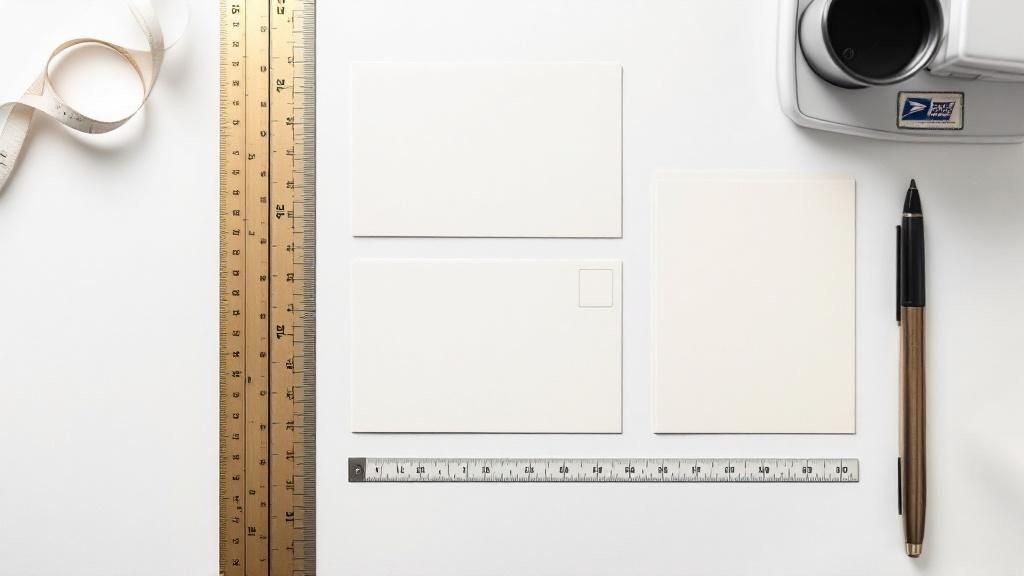
To get the absolute best postage rate from the USPS, your postcard has a very specific set of rules to follow. It needs to be rectangular and, more importantly, it has to fit within a tight size window. The smallest it can be is 3.5 inches high by 5 inches long, and it can’t be any bigger than 4.25 inches high by 6 inches long.
Honestly, nailing these dimensions is the single most important thing you can do to keep your postage costs down.
Decoding USPS Postcard Requirements
Think of the USPS postcard rules like the sizer bin for carry-on luggage at the airport. If your bag fits, you’re good to go at the standard price. If it’s too big, you’re forced to check it—and the price jumps. It’s the exact same idea with mail. Sticking to the official postcard size means you lock in that low First-Class Mail postcard rate.
If your mailpiece is even a fraction of an inch over the maximum size, it’s no longer a postcard in the eyes of the USPS. It gets bumped up to the "letter" category, and you'll be charged a higher postage fee. This small mistake can nearly double your mailing budget, quickly turning an affordable campaign into an expensive headache.
The Official Dimensions at a Glance
To make sure there's no confusion, let's break down the exact numbers. The USPS has a few key measurements you need to hit to qualify for that coveted postcard rate. These rules aren't just about your design; they're about the physical piece of paper itself.
Here’s a quick summary of what the USPS requires for a mailpiece to be considered a First-Class postcard.
| USPS First-Class Postcard Requirements |
| :--- | :--- | :--- |
| Dimension | Minimum | Maximum |
| Height | 3.5 inches | 4.25 inches |
| Length | 5.0 inches | 6.0 inches |
| Thickness | 0.007 inches | 0.016 inches |
That last one—thickness—is just as critical as the height and length. A card that’s too flimsy (less than 0.007 inches) or too stiff (more than 0.016 inches) can get rejected or up-charged because it can easily jam the high-speed sorting machines.
Why Postal Rules Exist in the First Place
Ever looked at a postcard and wondered why those specific dimensions matter so much? It’s not some random rule. The reason goes back more than a century, to a time when global mail was an absolute mess.
Before automated sorting machines, sending anything internationally was a gamble. Different countries, different rules, different sizes, different rates. It was pure chaos.
Imagine the headache of trying to send a simple postcard from Paris to Peoria when every postal system operated in its own little bubble. This frustrating reality is what led to the creation of the Universal Postal Union (UPU) back in 1874. Its mission was to untangle that web and create a unified set of rules for the whole world.
By creating a common framework, the UPU made international mail possible on a reliable scale. This foundational agreement paved the way for the standardized systems we rely on today.
From Global Agreements to Your Mailbox
The UPU's early work set the stage for standards we now take for granted, like a common postcard size that made sending mail across borders a breeze. Before this, postcard dimensions were all over the map, making any kind of efficient handling—even by hand—a logistical nightmare. You can actually dive deeper into this with the history of postcard regulations from the Smithsonian Institution.
Those early agreements are the direct ancestors of the USPS regulations we follow today. Modern mail processing centers are incredible feats of automation, capable of sorting thousands of pieces per hour. But those machines are finely tuned to handle specific sizes. If your postcard is too big, too small, or too flimsy, it gums up the works.
That’s exactly why sticking to the rules is so important. It ensures your postcard sails smoothly through the system, which helps keep postage costs down for everyone. For marketers, getting this right is crucial for a successful campaign. When your mailpiece fits the spec, you know it’s going to get delivered efficiently—a key principle behind services like those in our guide to Every Door Direct Mail.
How Postcard Size Impacts Your Mailing Costs
The connection between your postcard's size and how much you pay for postage is direct and, frankly, unforgiving. Think of it like checking a bag at the airport—if your luggage is just a little overweight, the fee skyrockets. The same rule applies here. A postcard that's just a fraction of an inch too big or too thick can get bumped from the cheap postcard rate into the much pricier tier for letters.
This isn't some new rule, either. The link between a postcard's size and its mailing cost goes all the way back to the 19th century. After the U.S. government issued its first official postal card in 1873 for a single penny, the Private Mailing Card Act of 1898 let private printers get in on the action at the same low rate—but only if they stuck to strict size regulations.
Understanding Mail Classes And Price Tiers
The USPS sorts mail into different classes, and each one comes with its own speed, features, and price tag. It's your postcard's dimensions that ultimately decide which class it belongs to.
- First-Class Mail Postcard Rate: This is your golden ticket, the most affordable way to send a postcard. To qualify, your mailer has to meet very specific size and thickness rules. In return, you get quick delivery, usually within 1-5 business days.
- First-Class Mail Letter Rate: If your postcard is too big for the postcard category, it automatically gets reclassified as a letter. This isn't a small jump; you're looking at a postage increase of 30% or more for every single piece you send.
The key takeaway here is simple: Sticking to the official postcard dimensions is the single best thing you can do to keep your campaign budget in check. A tiny measurement mistake can completely wipe out your profit margin on a large mailing.
For any business planning a direct mail campaign, getting these details right is absolutely critical. This is where professional printing and mailing partners can be a lifesaver, helping you navigate the rules to make sure your project is both effective and affordable. When you're ready to get started, exploring professional https://www.4over4.com/printing/category/direct-mail-services can save you from making some very expensive mistakes.
And if you really want to become an expert on all things direct mail, including how different dimensions can make or break your budget, resources like the Direct Mail Academy are invaluable. Knowing these rules isn't just trivia—it's the foundation of a successful and cost-effective direct mail strategy.
Choosing the Right Postcard Dimensions for Your Goal
Picking the perfect postcard size isn't just about saving a few bucks on postage—it’s a strategic move that can make or break your campaign's impact. The first question to ask yourself is: what am I trying to achieve? Your goal is what should drive your dimensions.
Are you blasting out a simple offer to the masses? Or are you trying to wow a smaller, niche audience with incredible visuals? The answer to that question will tell you whether to stick with a standard, budget-friendly size or go big with something that commands attention.
The classic 4x6 inch postcard is the undisputed workhorse of direct mail. It's cheap to print, qualifies for the lowest postcard postage rate, and is absolutely perfect for high-volume campaigns with a clean, simple message. Think of a local pizzeria announcing a weekly special or a dentist sending out appointment reminders. The name of the game is efficiency and reach.
On the flip side, you have the larger formats like 6x9 or 6x11 inches. These are often called "jumbo" postcards, and they are designed to make a statement. Sure, they cost more to mail because the USPS classifies them as letters, but the impact they deliver is hard to ignore. All that extra real estate is a game-changer for visually driven businesses.
Matching Size to Your Marketing Mission
Let's look at a few real-world examples of how size and strategy go hand-in-hand:
- Real Estate Agents: A jumbo 6x9 inch postcard is practically a necessity. It gives you the space to show off high-quality photos of a property, which instantly signals value and professionalism. Trying to cram those beautiful shots onto a smaller card just feels cheap and undersells the listing.
- Retail Store Grand Opening: A bold 5x7 inch card hits that sweet spot. It offers more creative breathing room than the standard 4x6, letting you use eye-catching graphics and a can't-miss call-to-action without blowing up your budget.
- Mass Discount Offer: For a local coffee shop sending a straightforward "50% off" coupon, the 4x6 inch size is the smartest play. It lets them reach thousands of households for the lowest possible cost per piece.
This graphic really puts into perspective how your mailing costs scale with different postcard dimensions.
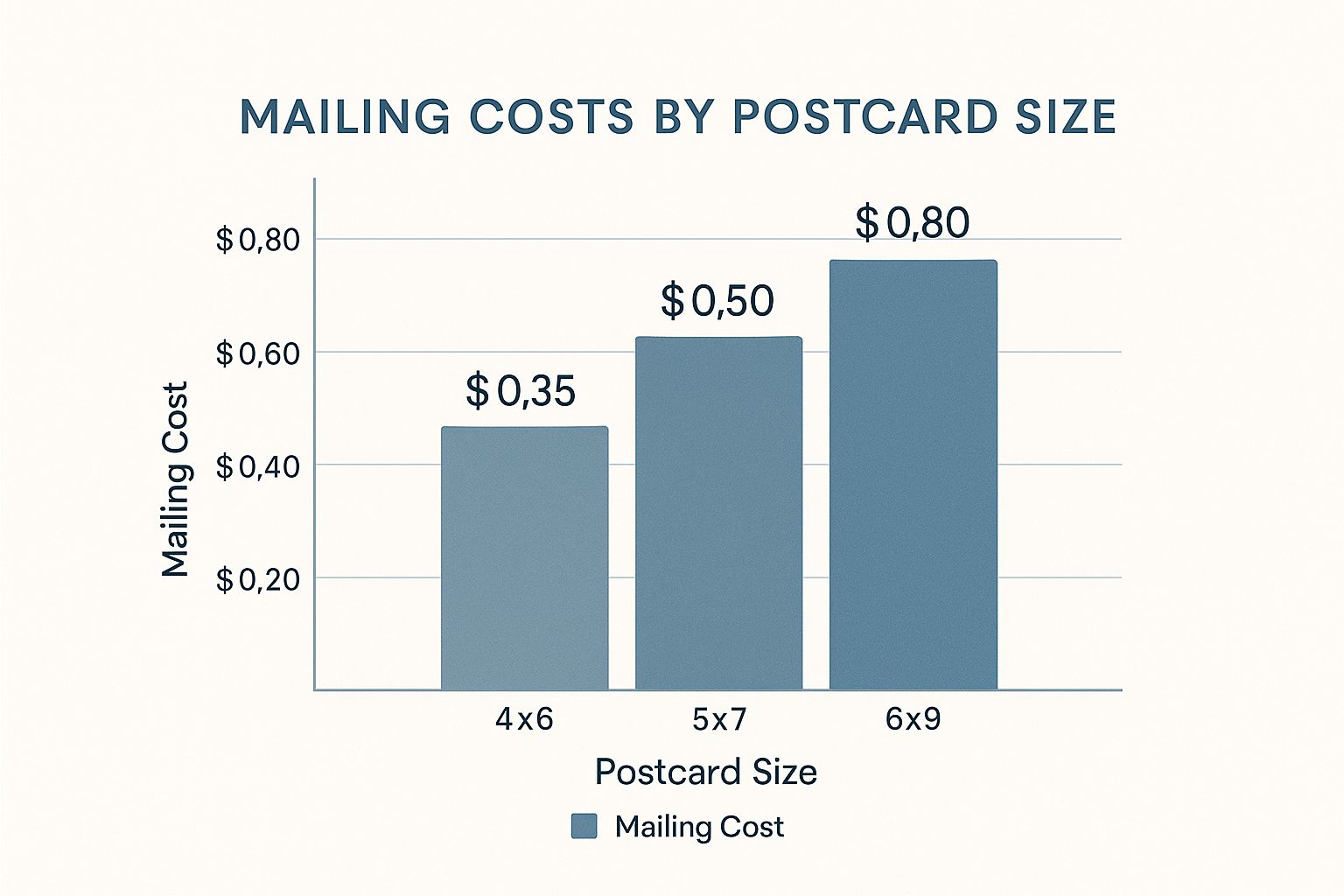
As you can see, that jump from a standard postcard to a jumbo size more than doubles your postage cost—a huge factor to consider when you're planning your budget. Exploring different custom postcard printing options can help you find that perfect balance between making an impact and keeping your campaign affordable.
Designing a Mail-Ready Postcard
Picking the right postcard size is a great start, but even a perfectly sized card can get rejected by the post office if the design ignores their rules. Think about it: the modern mail system runs on automated sorting machines, and these machines need clear, unobstructed zones on your postcard to do their job.
It helps to imagine the address side of your postcard as having restricted airspace. Certain areas are total no-fly zones for your graphics, logos, or any extra text. Keeping these areas clear isn’t just a suggestion—it’s essential for making sure your mailpiece is machine-readable and gets delivered at the lowest possible postage rate.
Mapping Out Essential Clear Zones
To create a design that sails through the postal system, you have to leave specific areas completely clear for the USPS. These zones are vital for automated processing and stop your creative flair from getting in the way of critical information.
Here are the key areas you need to protect:
- The Postage Area: This is almost always the top right corner where the stamp or postal indicia goes.
- The Address Block: The middle section where the recipient's address is printed needs to be free of any distracting backgrounds or images.
- The Barcode Clear Zone: This is a big one. You need to leave a 5/8-inch tall strip along the entire bottom edge of the postcard completely, totally blank.
The USPS even provides handy diagrams to help designers visualize these restricted areas, so there’s no guesswork involved.
This visual guide shows exactly where to put your return address, postage, and the recipient’s address, clearly marking the crucial empty space needed for the postal barcode.
Beyond these clear zones, the paper itself makes a huge difference. Postcard thickness, also known as paper weight, is just as important as the height and width. A flimsy card will jam the sorting equipment, which can lead to delays or extra charges. To make sure your postcard can handle the journey, you’ll need a card stock that’s at least 0.007 inches thick.
Finally, don’t forget that a clear and accurate delivery address is everything. Pairing it with professionally printed return address labels is a smart move to ensure any undeliverable mail makes its way back home to you.
Mailing Unconventional Postcard Shapes and Sizes
So what happens when you want to mail something that breaks the mold, like a circle-shaped postcard or one cut into a custom shape? Standard rectangular cards have a clear set of rules, but the world of unconventional mailers is a whole different ballgame.
The short answer is yes, you can absolutely mail these creative pieces. However, they won't qualify for that super-low postcard rate.
Instead, the USPS will treat these eye-catching mailers as non-machinable letters or even small parcels. That means you should be ready for a noticeable jump in postage costs. A uniquely shaped card can grab incredible attention in a crowded mailbox, but that creativity comes with a higher price tag.
Interestingly, this trade-off between impact and cost has been around for over a century. Novelty postcards with unique cuts first became popular in the late 1890s, with advertisers pushing the limits of standard dimensions. You can dive deeper into these early postcard trends and regulations on Postcard Peddler.
Understanding this balance is the key. Think of the extra postage for a non-standard shape as an investment in standing out. The real question is whether the marketing impact is worth the additional cost.
Exploring professional die-cutting services can open up a world of creative possibilities, letting you design a mailer that truly reflects your brand's unique identity.
Common Questions About Postcard Mailing
Once you’ve got the basics of postcard sizes down, a few more specific questions always seem to pop up. You start thinking about things like design orientation, how thick the paper needs to be, and if you need borders. Nailing these smaller details is just as crucial for making sure your campaign runs smoothly and stays on budget.
Let's clear up a few of the most common queries we hear.
Can I Use a Vertical Postcard Design?
Yes, you can absolutely get creative with a vertical design on the front of your postcard! The key thing to remember, though, is that the address side has to play by USPS rules.
No matter how the front looks, the recipient's address must be printed horizontally across the bottom half of the card. This is so the automated sorting machines at the post office can read it without a hitch. If you orient the address vertically, the machines will likely kick it out, flagging it as "non-machinable" mail and sticking you with a higher postage rate.
What Happens if My Postcard Is Too Flimsy?
If your postcard is thinner than the 0.007-inch minimum, it’s going to cause problems. Thin, flimsy paper can easily get chewed up and jam the high-speed sorting equipment the USPS uses.
Because of this risk, the post office will either reject the mailpiece outright or, more likely, charge you the higher letter rate to handle it manually. Using a sturdy, appropriately thick card stock isn't just about making a good impression—it's essential for getting your postcard delivered at the right price.
Ready to print postcards that check every USPS box and look fantastic doing it? 4OVER4 has a massive selection of sizes, paper stocks, and finishes to make sure your direct mail campaign is a home run. Create your custom postcards today!
More from

7
When you think of a yard sign, the classic 18"x24" is probably what comes to mind. It’s the industry workhorse fo
 Emma Davis
Mar 14, 2026

15
When you’re ready to invest in an A-frame sign, the first question you'll ask is, "What size do I need?" It usually comes down
Emma Davis
Mar 13, 2026

150
The real secret to mastering your direct mail budget isn't complicated. It comes down to one simple fact: a standard 4" x 6&q
Emma Davis
Mar 12, 2026

69
Tear-off flyers are a classic for a reason. They’re a tangible marketing tool, designed with perforated, removable tabs at the bottom. Each
Emma Davis
Mar 11, 2026

120
Printing stickers at home is a seriously fun and rewarding project. It boils down to four main parts: designing your image, picking the right
Emma Davis
Mar 10, 2026

105
Ever seen a logo that seems to float right on the glass of a jar or bottle? That’s the work of transparent label stickers.
Emma Davis
Mar 9, 2026

62
Picture this: your product’s beautiful label gets smudged and runny during shipping, or a gorgeous event banner fades to nothing after just
Emma Davis
Mar 8, 2026

58
In a sea of options, your product's packaging and labeling are its first, and often only, chance to make a real connectio
Emma Davis
Mar 7, 2026