Table of Contents
- Home
- content hub
- Essential Marketing Material for Business Growth
 Share and earn
Essential Marketing Material for Business Growth

Nov 1, 2025395 views
Nov 1, 2025395 views
Any tool a business uses to talk about its brand, products, or services is a piece of marketing material. Think of these as your brand's voice out in the wild. From the humble business card you hand someone to an in-depth online case study, every piece works together to tell your story and drive business forward.
What Are Your Brand Marketing Materials?
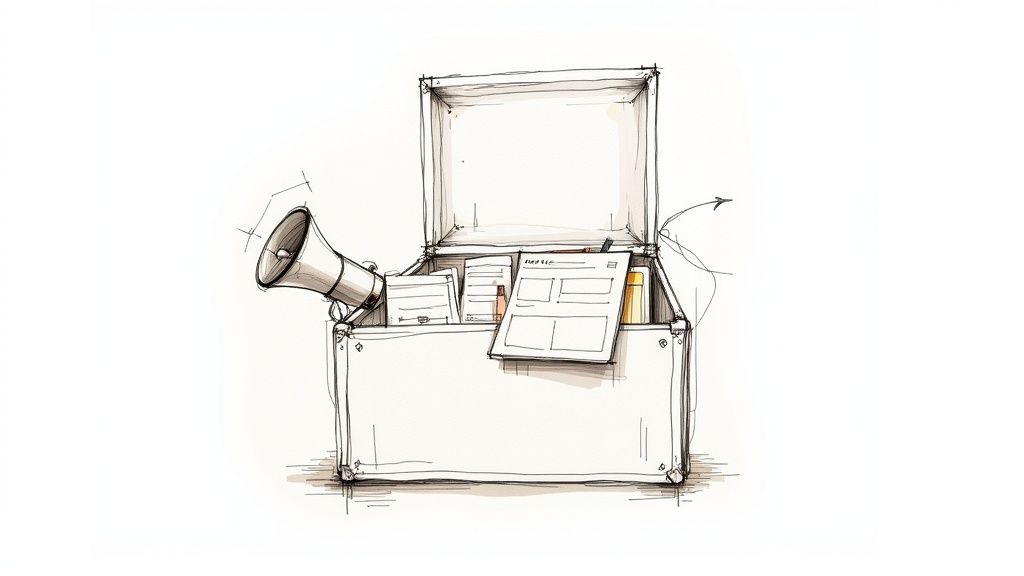
Imagine trying to build a house with only a hammer. You might get somewhere, eventually, but the process would be painfully slow and inefficient. To do the job right, you need a full toolkit—saws, drills, levels, the works. Each tool has a specific job.
Your marketing materials are that toolkit. They are the collection of assets you use to build your brand, connect with customers, and ultimately, grow your sales. You wouldn't rely on a single tool for construction, and you can't build a strong market presence with just one type of collateral, either. A smart strategy uses a mix of assets, each playing its own part in attracting, engaging, and converting your audience.
The Two Core Categories of Marketing Assets
At its heart, all marketing material for business falls into two main buckets. Understanding how they differ—and more importantly, how they work together—is the first step toward building a powerful strategy.
- Printed (Tangible) Materials: These are the physical items a customer can actually hold. Think business cards, brochures, flyers, and posters. Their power is in creating a memorable, physical connection to your brand.
- Digital Materials: These assets live online. This includes your website, social media content, email newsletters, and blog posts. They offer incredible reach, instant access, and the ability to track results.
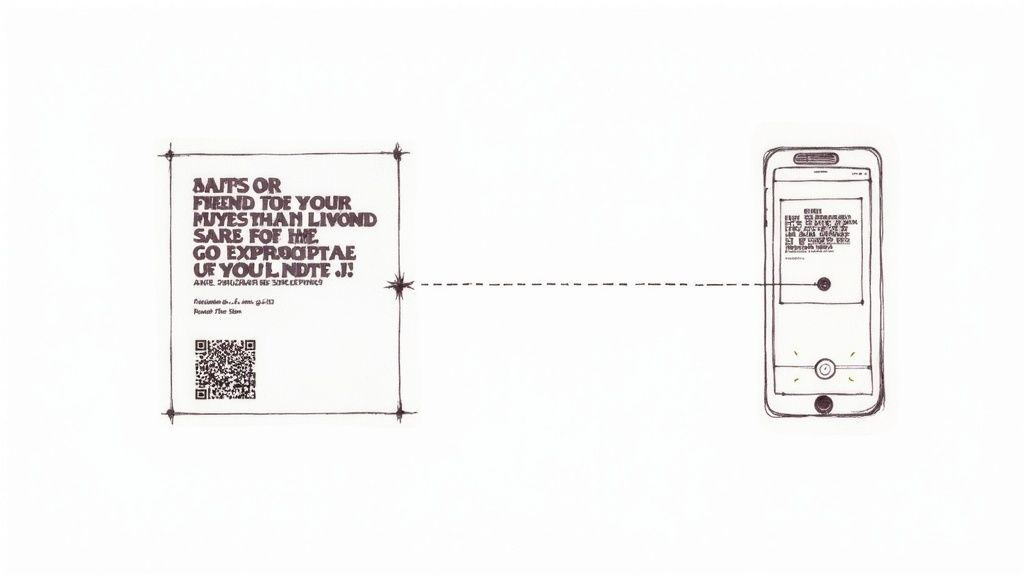
A truly well-rounded plan integrates both. For example, a QR code on a printed flyer can whisk a customer straight to a digital landing page, creating a seamless bridge between the physical and online worlds. This unified approach keeps your message consistent and effective, no matter where someone encounters it.
The most effective marketing doesn't feel like marketing at all. It feels like a helpful conversation, and your materials are the script. Each piece, whether a postcard or a pixel, should guide your customer smoothly from one point to the next.
Why Every Business Needs a Diverse Toolkit
Putting all your eggs in one marketing basket is a risky game. A diverse collection of assets insulates your business from sudden shifts in consumer behavior or the whims of platform algorithms. A strong print campaign can boost local foot traffic, while a compelling digital presence builds a global community.
For a comprehensive look at your options, exploring a variety of professionally printed marketing materials can spark some great ideas for building out your own toolkit.
Ultimately, these materials are the foundational blocks of your entire growth strategy. They aren't just promotional fluff; they are the tangible and digital representations of your brand's promise. By strategically creating and deploying them, you give your business the tools it needs to thrive.
The Lasting Impact of Print Marketing Materials
In a world overflowing with digital pings and pop-up ads, something you can actually hold in your hand cuts through the noise. A well-designed business card, brochure, or flyer doesn't just pass on information; it creates a physical connection. This is something a fleeting digital ad simply can't do.
Think about the last time someone handed you a really nice business card. You probably felt the weight of the paper, noticed the texture, and saw how crisp the printing was. That tactile experience sticks in your mind far longer than an email signature you barely glanced at.
That’s why print is still a heavyweight contender in any smart marketing plan. It provides a moment of real, focused engagement in an otherwise distracted world.
The Psychology of Touch in Marketing
The feel of your marketing material for business isn't just a nice little detail—it's a powerful psychological trigger. When a potential customer holds your brochure, they're physically interacting with your brand, and the quality of that interaction speaks volumes.
A flimsy, cheap-feeling flyer might quietly suggest a lack of care or professionalism. On the other hand, a brochure with a premium matte finish and a solid weight instantly communicates quality and an eye for detail. This sensory feedback builds a foundation of trust before you've even had a proper conversation.
A well-designed printed piece is more than just information; it's a physical handshake. It represents your brand's commitment to quality and leaves a tangible reminder of your value long after a digital ad has vanished from the screen.
Here’s why that physical connection matters so much:
- It Boosts Memory: Studies show we remember things we can touch more effectively. A physical item takes up space in the real world, making it harder to ignore and easier to recall later on.
- It Signals Value: High-end paper, along with finishes like embossing or foil stamping, shows you’ve invested in your brand. This bumps up the perceived value of both the marketing piece and the business behind it.
- It Commands Focus: A printed piece doesn't have to compete with a dozen open browser tabs or pop-up notifications. For a few moments, it has the reader's undivided attention, allowing your message to sink in much deeper.
Practical Applications That Drive Results
Beyond the psychology, printed materials are absolute workhorses in situations where digital just doesn't hit the mark. Think about a bustling trade show—a beautifully crafted brochure acts as a self-guided tour of your services, empowering potential clients to learn more at their own pace. You can find fantastic options by exploring a range of customizable brochure printing services to find the perfect fit.
Local flyers are another powerhouse. They can drive immediate foot traffic to a new cafe or promote a community event with a level of geographic precision that’s hard to beat. They land directly in the hands of the audience you want to reach, creating a personal and direct invitation.
This multi-channel approach is reflected in the broader marketing world. In 2022, total marketing spend in the U.S. shot past $481 billion, showing just how many different avenues businesses are using to connect with people. While digital gets a huge slice of that pie, the ultimate goal is creating a seamless brand experience. High-quality print is essential for bridging the gap between online interactions and real-world engagement. You can discover additional marketing statistics on Salesforce.com to see more on these trends.
Choosing Materials That Reflect Your Brand
The final piece of the puzzle is making sure your printed materials feel like your brand. The paper and finishing choices you make aren't small details; they're at the core of the impression you're trying to create.
- Paper Stock: The weight and texture are the foundation. A heavier cardstock for a business card feels substantial and important. A glossy paper stock for a flyer makes your images pop with color and energy.
- Finishes: A matte finish gives off a modern, sophisticated vibe. A high-gloss UV coating adds a layer of shine and durability. And for that extra "wow" factor, special touches like foil stamping or embossing can make a design unforgettable.
At the end of the day, every piece of printed marketing material for business you put out there is an ambassador for your brand. When you invest in quality and understand its unique power, you create assets that don't just inform—they impress, connect, and last.
Mastering Your Digital Marketing Assets
While a tangible flyer creates a physical connection, your digital assets are your round-the-clock sales team. They work tirelessly to attract, inform, and convert customers, even when your doors are closed. Building a powerful online presence is no longer optional; it's the hub from which all modern business growth radiates.
Think of your website as your brand’s home base—a non-negotiable central location where every other digital effort points back. From there, dynamic content like social media posts, blog articles, and video testimonials act as your ambassadors, venturing out to meet customers where they are. Each piece has a specific job in guiding a potential customer along their journey.
Building Your Digital Customer Journey
Every digital asset you create should be designed to move a person from one stage of awareness to the next. Engaging social media graphics might capture initial attention, acting as the first friendly hello. An insightful blog post then builds your authority, proving you understand a customer's problems and have the expertise to solve them.
Finally, a compelling case study or a collection of glowing video testimonials can be the final piece that seals the deal. They provide the social proof needed for a confident purchase. Maintaining strict brand consistency across all these platforms is crucial for building a recognizable and trusted digital identity. The goal is a seamless experience where your brand’s voice and values are clear at every single touchpoint.
This decision tree helps visualize how to choose the right marketing material based on your specific audience and goals.
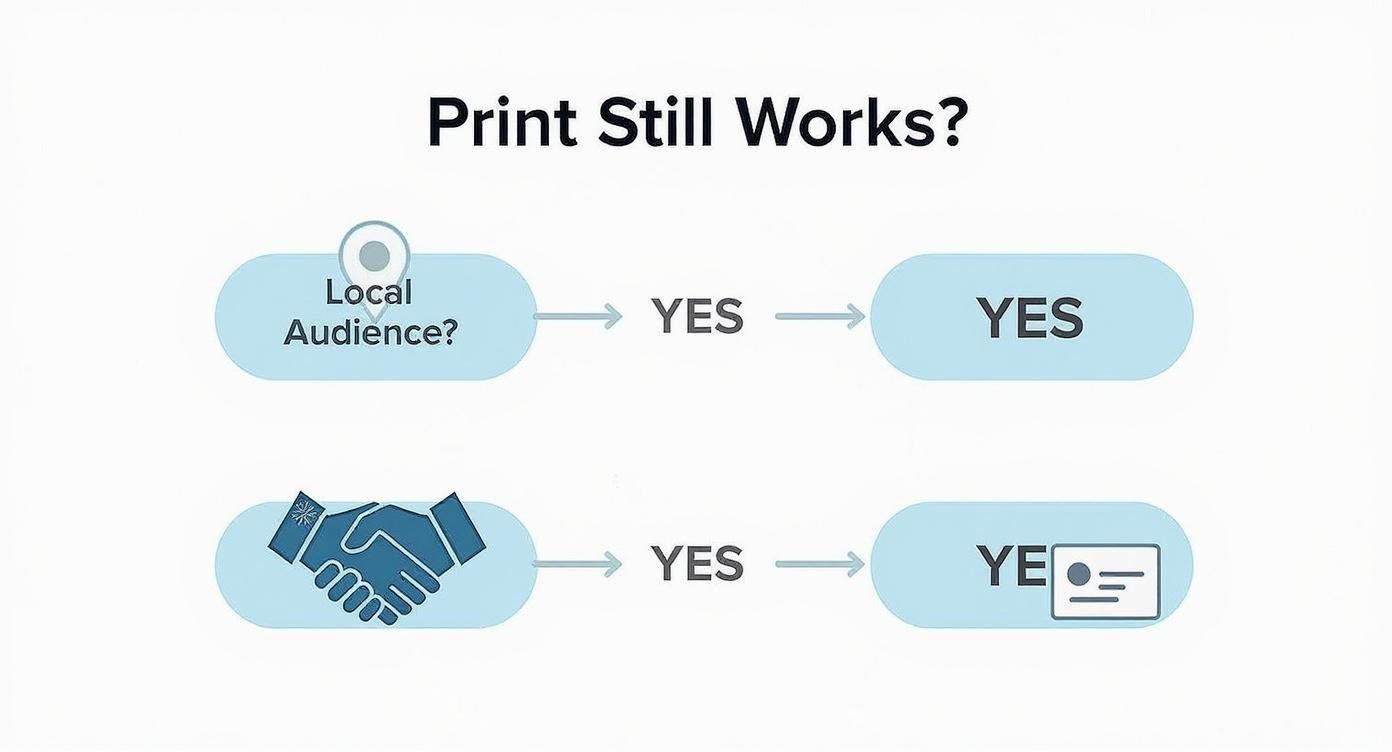
As you can see, even in a digital-first world, print materials remain powerful tools for specific, targeted goals like local outreach and in-person networking.
Navigating the Competitive Digital Space
Let's be honest: the online world is crowded, and the competition for attention is fierce. Worldwide digital ad spending is projected to soar past $740 billion, a testament to how aggressively businesses are pursuing online customers. This environment demands that every piece of digital marketing material for business is strategic, relevant, and visually compelling just to stand out.
Consider this: the average click-through rate for a Google Search ad is just 3.17%. If your campaigns are falling significantly short of that, it’s often a sign that the quality of your materials needs a serious re-evaluation. With privacy changes phasing out third-party cookies, the need for high-quality, engaging content will only intensify.
Your digital assets are more than just content; they are functional tools designed to achieve specific business outcomes. A beautiful graphic that doesn't drive action is just art. A successful marketing asset is one that moves a customer closer to a solution.
To help you decide which material best fits your immediate needs, here's a quick comparison table matching common goals to the right tools.
Choosing the Right Marketing Material for Your Goal
This table helps businesses match specific marketing goals with the most effective types of marketing materials, covering both print and digital options.
| Marketing Goal | Recommended Print Material | Recommended Digital Material | Primary Use Case |
|---|---|---|---|
| Increase Brand Awareness | Posters, Banners, Flyers | Social Media Ads, Display Ads | Reaching a broad audience and building name recognition. |
| Generate Local Foot Traffic | Direct Mail Postcards, Flyers | Local SEO, Google Business Profile | Driving customers to a physical store or service area. |
| Nurture Leads | Branded Brochures, Catalogs | Email Newsletters, Webinars | Building relationships with potential customers over time. |
| Close Sales | In-Store Signage, Proposals | Case Studies, Landing Pages | Providing the final push needed to convert a prospect into a customer. |
| Build Professional Network | Business Cards | LinkedIn Content, Direct Messages | Making personal connections at events and industry gatherings. |
This table serves as a starting point. The most effective strategies often blend both print and digital materials to create a cohesive and powerful marketing engine.
Key Digital Assets You Cannot Ignore
To build a robust digital presence, you need a balanced mix of assets that work together. Each one plays a unique role in attracting and nurturing leads.
Here are a few essentials you can't afford to skip:
- Your Website: This is the anchor of your entire digital strategy. It must be fast, easy to navigate, and clearly communicate what makes you valuable.
- Blog Posts and Articles: These are perfect for showing off your expertise, boosting your search engine rankings, and answering your customers' most pressing questions.
- Social Media Content: Use this for building a community, sharing timely updates, and driving traffic back to your website. Visually compelling assets like custom online posters can be adapted for digital use to grab attention on crowded feeds.
- Email Newsletters: This is your direct line to your most engaged audience, perfect for nurturing leads and announcing new products or services.
- Case Studies and Testimonials: Nothing builds trust faster than showing off real-world success stories from happy customers.
To take things a step further, a detailed guide to digital outdoor signage success offers great insights into bridging the gap between your online and offline worlds. By mastering these assets, you build a powerful, self-sustaining engine for growth that works for your business 24/7.
Designing Materials That Actually Convert
Great marketing material does more than just look professional; it has to spark a specific action. A beautifully designed flyer that doesn't get a single person to call is just a pretty piece of paper. The real magic happens when you blend smart design with a solid understanding of psychology to guide a potential customer from curiosity to commitment.
Think of it like building a clear path through a forest. If the trail is overgrown, confusing, and lacks signs, people will wander off and give up. A well-designed marketing piece is that clean, well-lit path. It tells your audience exactly where to go next, making the journey feel effortless and inviting.
Creating a Clear Visual Hierarchy
When someone glances at your brochure, their eyes should instinctively land on the most important information first. This is visual hierarchy in action. It's the art of arranging elements to signal their order of importance, and it's how you control your audience's attention.
Without it, your material becomes a cluttered mess. Everything screams for attention at once, which means nothing actually gets heard. You can build a strong hierarchy using a few straightforward techniques:
- Size and Scale: Make your headline the largest text on the page. Your key benefit should be bigger than the fine print. This is the most direct way to show what matters most.
- Color and Contrast: A bright, bold button on a muted background is a natural magnet for the eyes. Use color strategically to make key elements—like a special offer or a phone number—impossible to miss.
- Whitespace: Don't be afraid of empty space. Giving your design elements room to breathe makes the whole thing feel less intimidating and helps the important parts stand out even more.
The Psychology of Color and Typography
Colors aren't just for decoration; they're emotional shortcuts that can instantly set the tone for your brand. Blues often suggest trust and stability (think banks and tech companies), while a vibrant orange can create a sense of urgency or excitement. The first critical step is choosing a color palette that lines up with your brand’s personality.
Likewise, the fonts you pick say a lot about your business. A clean, modern sans-serif font like Helvetica can feel direct and professional. A classic serif font like Garamond might communicate tradition and reliability. But above all, the key is readability. If your audience has to squint to read your message, you've already lost them.
Great design is the silent ambassador of your brand. It communicates your value, professionalism, and attention to detail before a single word is read. It’s the difference between being memorable and being ignored.
Crafting an Irresistible Call-to-Action
Every single piece of marketing you create needs to have a clear purpose. What do you want the person holding your flyer or visiting your website to do next? That's your Call-to-Action (CTA), and it's arguably the most important element in your design.
A weak, passive CTA like "Learn More" is easy to ignore. A great CTA, on the other hand, is:
- Action-Oriented: Start with a strong verb. "Get Your Free Quote," "Download the Guide Now," or "Shop the Sale."
- Highly Visible: Use a contrasting color, put it inside a button, and give it plenty of space so it pops off the page.
- Specific and Clear: The user should know exactly what will happen when they click the button or call the number. Ambiguity is the enemy of conversion.
For printed materials like sales sheets, the CTA needs to be just as punchy. You can get some great ideas by looking over professional templates for printing sales sheets to see how they integrate effective calls to action. And it's not just about ads; your digital presence includes dedicated web pages, too. For businesses targeting specific areas, a key part of digital marketing is building winning location-based landing pages designed to convert local customers.
By mastering these core principles—hierarchy, color, typography, and the CTA—you can stop creating passive information and start designing active, results-driven tools for your business.
Unifying Print and Digital for Maximum Impact
It’s a huge, yet surprisingly common, mistake to treat your print and digital marketing like they’re in separate, competing corners. The brands that really get it right know these two worlds aren't rivals at all—they’re powerful partners. When you create a unified front, your message gets amplified, creating a seamless and unforgettable experience for your customers.
Think of your marketing as an ongoing conversation. If you switched up your tone and message every time you spoke to someone, they'd get confused and start to lose trust. It’s the exact same for your brand. That consistency across all your marketing material for business is what builds solid recognition and earns genuine trust.
Building Bridges Between Worlds
The secret is making your materials work together, creating little pathways that guide your audience from a physical interaction right over to a digital one, and sometimes back again. This isn't just a clever gimmick; it’s a smart strategy to deepen engagement and make every single marketing dollar work that much harder.
This kind of integration can be incredibly simple but wildly effective. A QR code on a poster is a classic example. A potential customer sees your poster at a local coffee shop, scans the code, and is instantly on your website watching a powerful video testimonial. Just like that, you've turned a passing glance into a meaningful brand interaction.
In the same way, a punchy headline on an in-store display should echo the exact same message you’re using in your social media ads. This isn't boring repetition; it’s reinforcement. It makes your core message stick. For anyone looking to create an impactful in-person experience, exploring options for custom marketing displays is a fantastic way to ensure your physical presence is strong, commanding, and perfectly in sync with your online brand.
The Power of a Cohesive Customer Journey
When your print and digital materials are all speaking the same language, you create a reliable and predictable world for your audience. It doesn't matter where they find you—whether it's a flyer in their mailbox or a targeted ad in their Instagram feed—the experience feels familiar, connected, and whole.
A truly integrated strategy means your brand feels complete. A customer doesn't see "print marketing" or "digital marketing"—they just see your brand, consistently showing up to solve their problems.
This unified approach delivers real, tangible benefits that siloed campaigns just can't touch.
- Stronger Brand Recognition: Consistent logos, colors, fonts, and messaging make your brand instantly recognizable, no matter the channel.
- Increased Trust: A cohesive experience sends a signal of professionalism and reliability, giving customers more confidence to choose you.
- Better ROI: Each channel lifts the other up, creating a compounding effect that drives far better results than either could on its own.
Navigating a Crowded Marketing Environment
Creating this unified front is more critical now than ever before. With consumers seeing an estimated 6,000 to 10,000 advertisements daily, cutting through that noise demands a message that is crystal clear and consistent. While the global digital advertising market is set to hit a staggering $715 billion, only about 60% of marketers feel their strategies are actually working. That number alone shows just how tough it is to capture attention.
This challenge is precisely why a disjointed strategy just won't cut it anymore. By unifying your print and digital marketing material for business, you create a powerful, multi-faceted campaign that meets customers right where they are, building a stronger and more resilient brand in the process.
Common Questions About Marketing Materials
Diving into the world of marketing always brings up a few practical questions. Let's walk through some of the most common ones I hear, so you can turn the ideas in this guide into real-world action.
How Do I Set a Realistic Budget?
There’s no magic number here, but a solid rule of thumb for a small business is to set aside 5-10% of your gross revenue for marketing. Before you spend a dime, though, figure out your main goal. Are you trying to boost local awareness, or are you focused on driving online sales? Knowing what you want to achieve is the key to spending your money wisely.
Start with the essentials. Every single business needs professional business cards and a solid, working website. Get those nailed down first. After that, you can start budgeting for more campaign-specific marketing material for business, like flyers for an upcoming local event or a digital ad campaign for a new product you’re launching.
Treat your marketing budget like an investment in your company's growth, not just another expense. Keep a close eye on your results and be ready to move funds to whatever’s bringing in the best returns, whether that's a high-performing direct mail piece or a killer social media ad.
How Can I Find a Good Designer and Printer?
Finding the right creative partners can make or break your marketing efforts. A great place to start is by looking at portfolios that vibe with your brand’s style. You can find tons of talented freelance designers on sites like Behance or Dribbble, while your local business networking groups are often a goldmine for recommendations on reliable print shops.
When you're talking to potential partners, keep a few things in mind:
- Ask for Samples: Any printer worth their salt will be happy to show you examples of their work. Get your hands on them. Feel the paper quality, check the color vibrancy, and see if it meets your standards.
- Check Reviews: Look for testimonials that talk about reliability, good communication, and, of course, the quality of the final product.
- Discuss the Process: A good designer won’t just start creating. They’ll ask you smart questions about your business, your audience, and what you’re trying to accomplish.
How Do I Measure the ROI of My Materials?
You've got to know if your money is actually working for you, and that’s where measuring your return on investment (ROI) comes in. The trick is to make your marketing materials trackable.
With digital stuff, it's pretty simple. Tools like Google Analytics can show you who's converting on your website, and social media platforms have built-in dashboards with tons of data. For print, you just have to get a little creative.
Try adding unique QR codes, dedicated landing page URLs (like yourwebsite.com/offer), or special discount codes to your flyers and brochures. By tracking how many people scan that code or use that specific discount, you can directly connect sales back to your printed marketing material for business and calculate a crystal-clear ROI.
Ready to create marketing materials that actually get noticed? 4OVER4 has a massive selection of high-quality, customizable printing solutions to bring your vision to life. From business cards to banners, we deliver professional results with a quick turnaround. Start designing today at 4OVER4.COM.
More from

13
When you think of a yard sign, the classic 18"x24" is probably what comes to mind. It’s the industry workhorse fo
 Emma Davis
Mar 14, 2026

18
When you’re ready to invest in an A-frame sign, the first question you'll ask is, "What size do I need?" It usually comes down
Emma Davis
Mar 13, 2026

189
The real secret to mastering your direct mail budget isn't complicated. It comes down to one simple fact: a standard 4" x 6&q
Emma Davis
Mar 12, 2026

70
Tear-off flyers are a classic for a reason. They’re a tangible marketing tool, designed with perforated, removable tabs at the bottom. Each
Emma Davis
Mar 11, 2026

122
Printing stickers at home is a seriously fun and rewarding project. It boils down to four main parts: designing your image, picking the right
Emma Davis
Mar 10, 2026

111
Ever seen a logo that seems to float right on the glass of a jar or bottle? That’s the work of transparent label stickers.
Emma Davis
Mar 9, 2026

63
Picture this: your product’s beautiful label gets smudged and runny during shipping, or a gorgeous event banner fades to nothing after just
Emma Davis
Mar 8, 2026

61
In a sea of options, your product's packaging and labeling are its first, and often only, chance to make a real connectio
Emma Davis
Mar 7, 2026