Table of Contents
- Home
- content hub
- Decals for Cars Your Guide to Mobile Branding
 Share and earn
Decals for Cars Your Guide to Mobile Branding

Apr 4, 20268 views
Apr 4, 20268 views
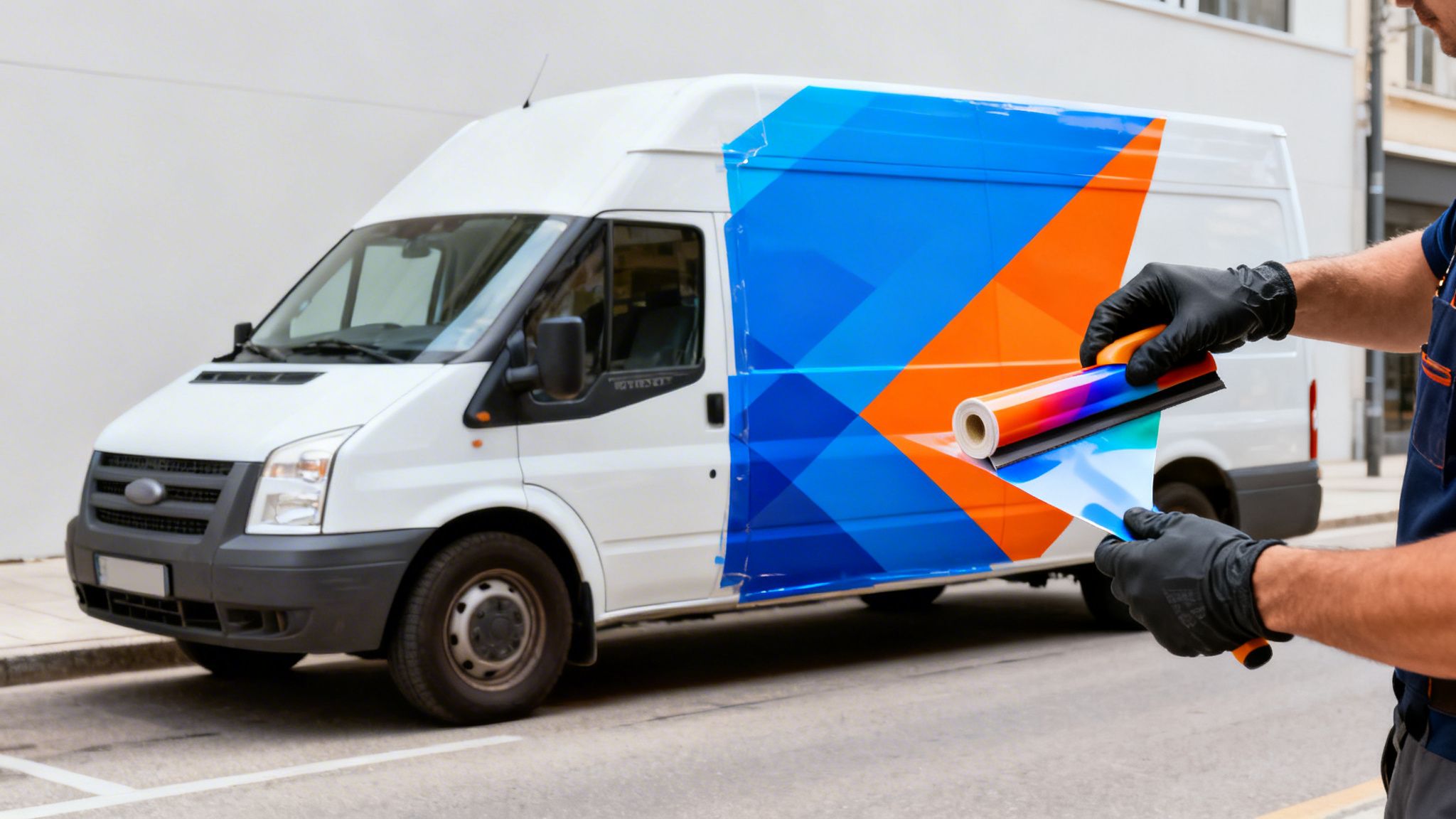
Think of your company car or van for what it really is: a billboard on wheels. Every time it hits the road, it's advertising your business. This is the simple, yet powerful, idea behind using decals for cars. These aren't just stickers; they're a way to turn any vehicle into a non-stop marketing asset that works for you 24/7.
Turning Your Vehicle into a Marketing Machine

Vehicle graphics are a smart investment in getting your name out there. It doesn't matter if you run a whole fleet of service vans or just use your personal car for business—every trip becomes a chance to attract new customers. Unlike online ads or radio spots that require constant payments, you pay for car decals once and they keep on advertising for you wherever you drive.
This is a game-changer for local businesses. Think about it: a plumber’s truck parked in a residential neighborhood, a catering van set up outside an event, or a real estate agent’s car cruising through a new development. Each one acts as a quiet but powerful referral for their services.
Why Car Decals Just Work
The magic of car decals is how they blend advertising into the background of everyday life. They aren't pushy or intrusive, which helps build brand recognition in a really natural way. Depending on your daily routes, a single wrapped vehicle can pull in anywhere from 30,000 to 70,000 impressions every single day.
This guide is here to walk you through exactly how to tap into that potential. We’ll cover everything you need to know to make your vehicle one of your best marketing tools.
The real secret sauce of car decals is their cost-per-impression. When you compare them to traditional billboards, radio ads, or even digital campaigns, vehicle graphics offer one of the best returns on your advertising dollars. This makes them a fantastic option, especially for smaller businesses on a tight budget.
What This Guide Will Cover
To get the most out of your vehicle graphics, you need to understand the whole process, from the initial idea to the final installation. We'll break down every stage so you can make smart decisions that match your business goals.
Here’s what we’ll dive into:
- Choosing the Right Decal: From simple lettering to a full-blown wrap, we’ll help you pick the best fit for your budget and what you want to achieve.
- Designing for Impact: You'll learn the key principles for creating graphics that are easy to read on the move, memorable, and get people to take action.
- Application and Maintenance: We’ll give you the steps for a perfect, bubble-free application and share tips to keep your decals looking sharp for years.
- Measuring Success: Find out how to see the real-world impact and tangible benefits these graphics bring to your brand.
By the time you're done with this guide, you’ll have a clear plan for turning your vehicle from just a way to get around into a machine that drives business growth. If you want a head start, check out the huge variety of custom decals printing options to see what’s possible.
The Evolution of Mobile Advertising
To understand just how powerful modern decals for cars are, it helps to see where the idea of mobile advertising came from. Long before our highways were filled with branded vehicles, businesses were getting creative about taking their message on the move. This journey—from simple, hand-painted signs to the high-tech vinyl graphics we use today—shows why vehicle advertising has always been such a smart play.
The story really begins in the 19th century. The original mobile billboards? Horse-drawn carts and wagons. Companies like Sears painted their logos and lettering on delivery wagons to build name recognition right where their customers lived and worked. It was advertising in its purest form.
Early Automotive Advertising Pioneers
As cars started replacing horses, advertising was quick to adapt. One of the earliest standout moments happened in February 1900, when Milton Hershey painted his chocolate company’s name from bumper-to-bumper on a car in Lancaster, PA. This was one of the first known times a car was used specifically for brand promotion, setting the stage for more than a century of innovation.
Another key moment was the invention of the self-adhesive bumper sticker in 1946. Created from surplus materials after WWII, these simple but effective tools became a massive hit for everything from political campaigns to tourist traps. They proved that small, affordable messages on cars could have an enormous reach.
The biggest leap toward the vehicle graphics we know today didn't even start with advertising. In 1993, a German law required all taxis to be beige. To get around the expensive process of constantly repainting their fleets, a company developed a vinyl film that could be applied over the original paint. Just like that, the modern vehicle wrap was born.
The Vinyl Revolution
That clever solution for German taxis was a game-changer. It proved that large vinyl sheets could completely transform a vehicle's appearance without any permanent changes. The technology quickly jumped from taxis to the commercial world, where businesses immediately saw the incredible marketing potential.
- From Paint to Print: Companies were no longer limited to simple, cut-out vinyl letters. They could now print full-color, photorealistic designs.
- Accessibility and Affordability: Vinyl wraps offered a much more cost-effective and flexible option than a custom paint job.
- Temporary by Design: Brands could now run short-term campaigns or update their branding without devaluing their fleet.
The roots of what we now call decals for cars stretch back over a century, from hand-painted wagons to a clever workaround for German taxi laws. That pivotal 1993 development of vinyl film by Kay Premium Marking Films (KPMF) was the true start of the modern vehicle wrap industry. This history really drives home the enduring value of mobile advertising.
Today, this long history of innovation has given us an incredible array of options, from simple lettering to stunning full wraps. Understanding this journey makes it clear why vehicle graphics are a smarter, more accessible marketing tool than ever before. Exploring today's online large format print solutions shows just how far this technology has come.
Choosing the Right Decal for Your Business Goals
 When it comes to vehicle marketing, one size definitely doesn't fit all. The sheer variety of decals and wraps means you can tailor your approach to perfectly match your brand’s personality and goals.
Think of it like dressing for an event. You wouldn’t wear a tuxedo to a backyard barbecue, and you wouldn't use a tiny bumper sticker when you’re trying to make a massive statement. The right choice hinges entirely on your budget, your message, and what you want to achieve on the road.
Let’s look at the options on a scale. On one end, you have simple, budget-friendly decals for clean, targeted branding. On the other, you have complete vehicle transformations that stop traffic and demand attention. We’ll break down the most common types so you can find the perfect fit.
For Targeted and Professional Branding
If your main goal is to add a clean, professional look to your company vehicles, die-cut vinyl and window decals are a fantastic place to start. They’re focused, affordable, and incredibly effective at communicating the essentials.
- Die-Cut Vinyl Lettering: This is the classic, go-to option for displaying your business name, logo, phone number, and website. The vinyl is cut precisely to the shape of your design, leaving no background and creating a sleek, paint-like finish. It’s the definition of minimalist, professional branding.
- Custom Window Decals: Using perforated vinyl for rear and side windows is a brilliant move. It lets you display a full-color graphic to the outside world, but from the inside, the driver can still see right through it. This is perfect for adding bold branding without compromising safety or visibility.
For Promotions and Mass Awareness
Need to spread a specific message to a huge audience, and fast? The humble bumper sticker is still an unbeatable tool. They are incredibly inexpensive, easy to hand out, and ideal for short-term promotions, events, or just getting your name out there.
Bumper stickers have a practical history. Ford’s Model A introduced bumpers back in 1927, but it wasn’t until 1946 that screen printer Forest P. Gill invented the modern bumper sticker, using leftover self-adhesive paper from WWII. Their affordability led to a massive boom in vinyl decals by the 1990s, cementing their place in car culture. Today, the global car decal sector is a huge industry, valued at USD 2.3 billion in 2023 and still growing, which just goes to show the lasting power of a simple graphic.
For Maximum Impact and Brand Transformation
For businesses ready to go all-in on their mobile advertising, partial and full wraps deliver the biggest punch. This is where you graduate from adding a logo to creating a genuine mobile billboard.
Think of it this way: a bumper sticker is like a branded t-shirt—casual and effective for broad reach. A partial or full wrap is like a custom-tailored suit—it’s a statement piece designed for maximum impression and authority.
A partial wrap typically covers anywhere from one-quarter to three-quarters of a vehicle, usually focusing on the sides or rear. It’s a fantastic middle-ground, offering a dramatic visual transformation that’s more budget-friendly than a full wrap.
A full wrap covers your vehicle’s entire painted surface in a printed vinyl graphic. This gives you total creative freedom, transforming your car or van into a rolling piece of art that’s impossible for anyone to ignore. When looking at different types of vehicle graphics, it’s also good to understand the difference between cosmetic vinyl wrap options and paint protection film.
Ultimately, choosing the right option is about aligning your budget with your branding goals. For a wide variety of customizable choices, you can explore different adhesive vinyls to see exactly what fits your next project.
Designing a Car Decal That Gets Noticed
A great decal starts with a great design. When your vehicle is moving, you have just a few fleeting seconds to grab someone's attention and make an impression. This is where the “3-Second Rule” of mobile advertising really matters: can a potential customer understand who you are, what you do, and how to contact you in a quick glance?
If the answer is no, your investment won't deliver the results you're hoping for. Designing effective decals for cars isn’t about cramming as much information as possible onto your vehicle. It’s about crafting a clear, bold, and memorable message that can be understood at a glance, even at 50 miles per hour.
Think of your decal as a quick, visual handshake. It needs to be firm and confident, not weak or cluttered. This means you have to be ruthless about prioritizing information and using design principles that work for a moving canvas. A design that looks fantastic on a computer screen might completely fail on the road.
Master the Visual Hierarchy
Visual hierarchy is the art of arranging elements to guide the viewer's eye where you want it to go. For car decals, this is non-negotiable. You have to decide what information is most critical and make it impossible to miss.
So, what should stand out most? In almost every case, it’s a simple, three-part message:
- Your Logo: This is your brand’s signature. It needs to be large, crisp, and instantly recognizable.
- Your Core Service: What do you do? "Plumbing & Heating," "Gourmet Catering," or "Residential Landscaping" should be the most legible text on the vehicle.
- Your Contact Info: A phone number or an easy-to-remember website URL is all you need. Pick your single best contact method and make it prominent.
Everything else—social media handles, a long list of secondary services, or that clever tagline—is just noise. If you try to make everything important, nothing will be.
Prioritize Readability and Color Contrast
The font you choose can make or break your decal. Stay away from decorative, script, or thin fonts that are tough to read from a distance. Stick to bold, clean, and simple sans-serif fonts for the best possible legibility.
Color is just as important. Your brand colors are a great starting point, but you have to ensure they have enough contrast against your vehicle’s paint. A dark blue logo on a black van will simply disappear, while a bright yellow or white design will pop.
A critical mistake is designing a decal with poor contrast. A recent study on road sign visibility found that high-contrast color combinations, like black on yellow or white on blue, can increase legibility distance by over 40%. The same principle applies directly to your vehicle graphics.
To make your design even more powerful, especially for vehicles on the road after dark, think about specialized materials. Learn more about how reflective collection options can keep your brand visible 24/7.
Design Dos and Don'ts for Car Decals
To help you sidestep some common design traps, here’s a quick guide to creating a decal that actually works:
| Do | Don't |
|---|---|
| Use a single, clean font | Use multiple competing fonts |
| Prioritize one contact method | List every social media handle |
| Embrace negative space | Clutter the design with too much text |
| Go big with your logo | Shrink your logo to fit more info |
| Check contrast against your car color | Assume your brand colors will work |
By following these design principles, you can create decals for cars that are more than just decoration. They become hardworking marketing tools, turning every mile you drive into an opportunity to grow your business.
How to Apply and Maintain Your Car Decals
So, your new car decals have arrived. You’re ready to turn your vehicle into a rolling billboard. But getting that perfect, long-lasting finish all comes down to proper application and care. We've all seen them—bubbly, peeling decals that look anything but professional. That’s an outcome we want to avoid.
The good news? Getting a flawless finish is totally achievable. It just takes a bit of preparation and patience. Rushing is the number one enemy of a good decal application.
Perfect Application in Three Simple Steps
Think of applying a large decal like putting a screen protector on a new phone—a clean surface and perfect alignment are everything. Before you even touch that backing paper, your vehicle’s surface needs to be spotless.
- Prepare the Surface: First things first, clean the area where the decal is going. A simple mix of isopropyl alcohol and water is perfect for cutting through any wax, grease, or road grime. A truly clean surface is crucial for a strong bond.
- Position with Precision: Lay the decal on the vehicle and use masking tape to create a temporary “hinge” along the top edge. This lets you step back, check the placement from a distance, and make adjustments without committing.
- Use the Hinge Method: Once you’re happy with the positioning, lift the decal up like a flap. Peel the backing paper away from the hinged edge down to about the middle. Grab a squeegee and apply the exposed adhesive to the surface, working from the center out to push away any air bubbles. Then, remove the rest of the backing and squeegee the remainder of the decal down.
The hinge method is the closest thing to a trade secret for bubble-free results. It gives you total control and stops the decal from sticking to itself or trapping those massive air pockets that are a nightmare to fix later.
This methodical approach is key to making sure your design looks just as good on your car as it did on the screen.

Maintaining Your Decal for Longevity
Now that your decal is on and looking sharp, a little maintenance will keep it that way for years.
- Wash with Care: Hand-washing is always the best bet. You’ll want to avoid high-pressure car washes, since the powerful jets can get under the edges and cause peeling. If you have to use an automatic wash, make sure it’s a touchless one.
- Avoid Harsh Chemicals: Stay away from abrasive polishes or waxes directly on the decal itself. These can scratch the surface, dull the finish, or even damage the vinyl over time.
- Sun Protection: Just like your car’s paint, vinyl can fade after years of constant sun exposure. Parking in a garage or even just a shady spot when you can will go a long way in extending its life. Thinking about overall vehicle care, it's worth knowing how various car paint protection products can coexist with your decals.
Safe and Clean Removal
When it’s time for a rebrand or you just want a change, you need to get the old decal off without hurting your car’s paint. The trick is to soften the adhesive.
Grab a heat gun or even a hairdryer on a low setting and gently warm the decal's surface. As the vinyl gets warm and pliable, you can start to slowly peel it back at a sharp angle. If you’re left with any sticky residue, a dedicated adhesive remover will clean it right up without harming the paint.
For projects that require serious resilience to the elements, you might also find our guide on waterproof labels printing helpful.
Measuring the ROI of Your Vehicle Graphics
Thinking about decals for cars as just a cosmetic upgrade is missing the point entirely. It’s a powerful marketing move, but how do you actually know if it’s working for you? Unlike a digital ad where you can track every click, the return on vehicle graphics is measured in something just as valuable: impressions, brand recognition, and a constant, powerful local presence.
When you start to unpack the numbers, the value becomes undeniable. Vehicle advertising is one of the most cost-effective channels out there. You make a single investment that then works for you around the clock, everywhere your car or truck goes. This nonstop exposure racks up an incredible number of views.
The Power of Daily Impressions
The most powerful metric for vehicle graphics is the sheer volume of eyes a single vehicle can attract. Industry data consistently shows that one branded car can pull in between 30,000 and 70,000 visual impressions every single day. The exact number depends on how much you drive and the density of the areas you travel through.
Just think about that impact. A local contractor driving to jobs across town isn't just commuting—they're running a high-visibility ad campaign that reaches thousands of potential customers right in their service area. Every traffic jam becomes a captive audience.
This level of exposure is a game-changer for small businesses, startups, and marketing agencies trying to make a splash. While the global car decal market was valued at USD 2.3 billion in 2023 and is set to grow, its real magic is how it makes high-impact advertising affordable. Generating tens of thousands of daily impressions gives smaller brands a way to compete with giants. You can read more about the evolution of vehicle graphics and its market expansion.
Calculating Your Cost Per Impression
To really get a handle on the ROI of decals for cars, you have to compare their cost-per-impression (CPM) to other ad methods. Traditional ads like billboards or radio spots demand constant payments to stay live. Vehicle graphics, on the other hand, keep on working long after you’ve paid for them.
Let's look at a quick comparison:
| Advertising Method | Estimated Upfront Cost | Estimated Impressions (Monthly) | Recurring Costs |
|---|---|---|---|
| Partial Vehicle Wrap | $1,500 | 900,000+ (at 30k/day) | $0 |
| Local Billboard | $2,000/month | 300,000 | Monthly |
| Radio Ad Spot | $800/month | Varies Widely | Monthly |
As the table makes clear, that one-time cost for a vehicle wrap can deliver way more impressions over time than a monthly billboard rental. When you spread the initial cost of the decal over its typical 3-5 year lifespan, the cost per thousand impressions often drops to mere pennies. It’s one of the most efficient ways to spend your marketing dollars.
Building Local Trust and Brand Recognition
Beyond pure numbers, the ROI of car decals also stems from something less tangible but just as critical: community trust. Unlike ads that interrupt someone's podcast or YouTube video, vehicle graphics blend right into the local scene. When people see your branded van in their neighborhood again and again, it builds a sense of familiarity and reliability.
This non-intrusive advertising reinforces that you're an active part of the community. For service businesses like plumbers, electricians, or landscapers, this consistent local presence is gold. It cements your brand as the go-to choice, creating top-of-mind awareness that pays off big time when a potential customer finally needs your services.
Ultimately, a well-designed set of decals for cars isn't an expense. It's a hard-working asset that drives visibility and delivers a remarkable return.
Frequently Asked Questions About Car Decals
Thinking about putting your brand on wheels? It's a smart move, but you've probably got some questions. When you're investing in turning your company vehicles into mobile ads, you want to get it right. Let's walk through the most common things business owners ask before they hit "order."
Are Car Decals Removable And Do They Damage Paint?
This is the big one, and the good news is you can relax. High-quality vinyl decals are specifically designed to come off cleanly without damaging your vehicle’s original factory paint. The process is straightforward—you just need a little heat from a hairdryer or heat gun to soften the adhesive, which lets you peel the decal off slowly.
Now, there is one small catch. If your car has a cheap aftermarket paint job, or if the clear coat is already peeling or failing, removing the decal might pull up some of that compromised paint. But for a vehicle with its original, factory-applied paint, damage is extremely rare.
What Is The Difference Between a Decal and a Sticker?
While most people use the words interchangeably, in the world of professional vehicle branding, the difference is pretty important. It all boils down to how they're constructed and applied.
- Stickers are typically what you think of: a design printed onto a single piece of material (usually vinyl). You just peel them off the backing and stick them on. They almost always have a background, even if it's transparent.
- Decals, specifically transfer decals, are different. They are cut directly from a sheet of solid-colored vinyl. All the background material is "weeded" away, leaving just your individual letters or logo. Transfer tape is laid over the top to hold the design together so you can apply it perfectly in one go, giving it a clean, "painted-on" appearance.
For professional branding, like putting your logo and phone number on a work van, you’re almost always looking for a transfer decal. For something like a full-color promotional giveaway or a bumper slogan, a printed sticker is the way to go.
How Long Do Car Decals Last?
The lifespan of your decal really comes down to three things: the quality of the vinyl, how much sun it gets, and how you take care of it. Generally speaking, a professionally made and applied decal will look great for anywhere from 3 to 7 years.
Premium cast vinyl will always outlast standard calendered vinyl, especially if you're in a climate with harsh sun or cold. To get the most life out of your investment, it's best to hand-wash your vehicle and avoid aiming a pressure washer directly at the decal's edges. Parking in a garage or shaded spot whenever you can will also go a long way in preventing fading over time.
Ready to turn your vehicle into a powerful marketing tool? At 4OVER4, we offer a huge range of high-quality, customizable decals and wraps to fit any business need. Explore our options and start designing today!
More from

26
In a world buzzing with digital property listings and endless social media ads, it’s easy to think the classic 'For sale' sign has g
 Emma Davis
Apr 3, 2026

44
Picture this: you need a massive, eye-catching banner for your grand opening next week. Not too long ago, that meant several trips to a local
Emma Davis
Apr 2, 2026

53
At its core, 10 pt cardstock is a versatile, lightweight paper perfect for a huge range of professional printing projects. Th
Emma Davis
Apr 1, 2026

77
Picking the right type of paper can feel like a secret language, full of strange terms like GSM, cover, and coated. It's
Emma Davis
Mar 31, 2026

131
A printing cost calculator is an online tool that gives you instant, real-time price quotes for custom print jobs. It takes all the guesswork
Emma Davis
Mar 30, 2026

370
Getting your flyer design from a digital concept into a customer's hands involves a few key stages. You’ll need to nail the design with
Emma Davis
Mar 29, 2026

84
A quick free label template download is often the single fastest way to get professional-looking packaging without needing to
Emma Davis
Mar 28, 2026

84
Eco-friendly packaging isn't some fringe trend anymore. It’s a core part of how smart businesses build their brand and earn customer loy
Emma Davis
Mar 27, 2026