Table of Contents
- Home
- content hub
- Your Guide to 10 pt Cardstock for Print Projects
 Share and earn
Your Guide to 10 pt Cardstock for Print Projects

Apr 1, 20266 views
Apr 1, 20266 views
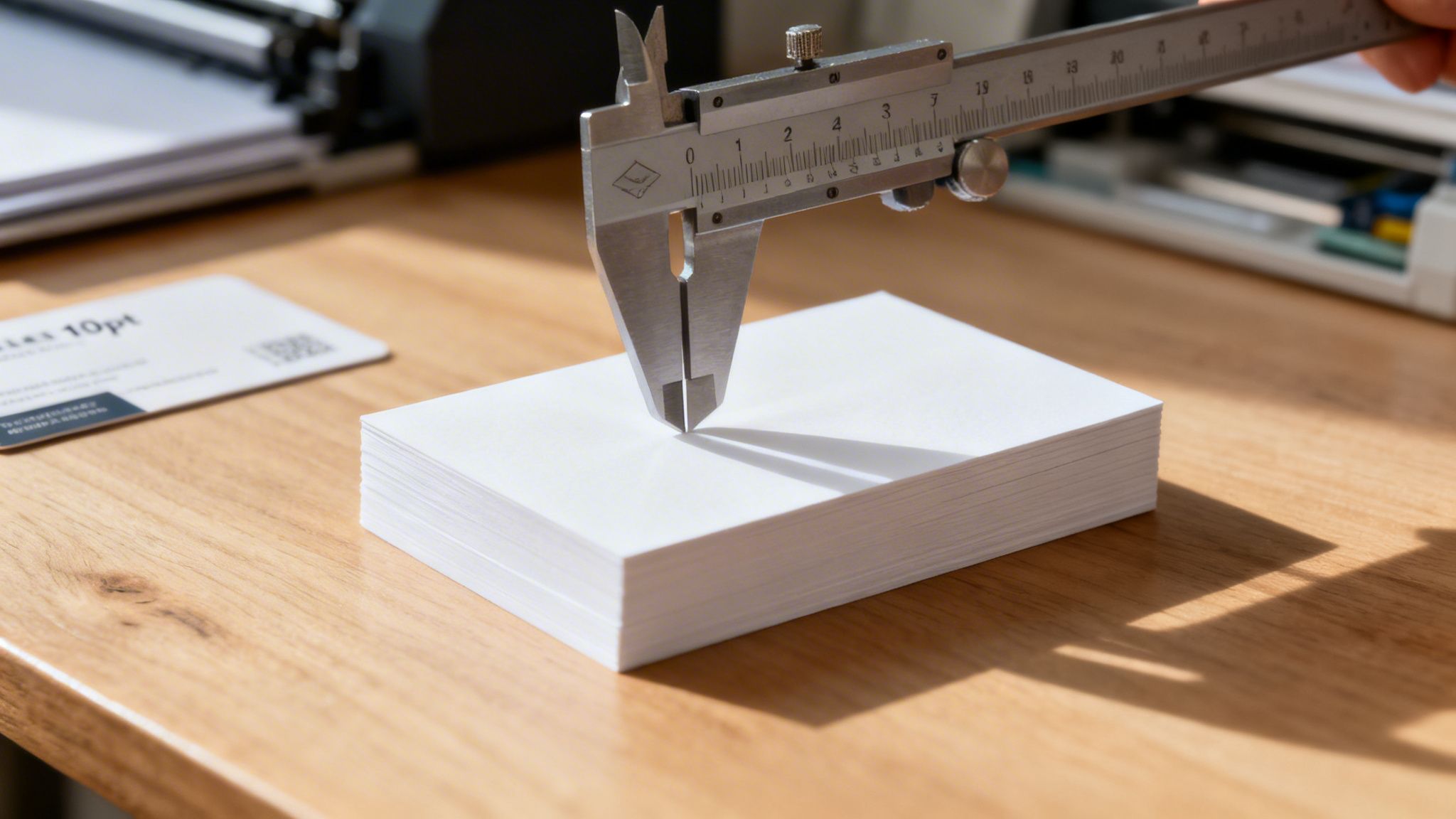
At its core, 10 pt cardstock is a versatile, lightweight paper perfect for a huge range of professional printing projects. Think of it as the multi-tool of the paper world—it’s noticeably sturdier than a standard flyer but more flexible than a heavy, luxury business card. The stiffness is a lot like a quality postcard you might pick up from a gift shop.
What Is 10 pt Cardstock Really
When you first hear terms like "10 pt cardstock," it can feel like you're trying to crack a secret code from the print industry. But the idea is actually pretty simple. The "pt" in 10 pt stands for "point," and it's a direct measurement of the paper's thickness, also known as its caliper.
One point is equal to exactly one-thousandth of an inch (0.001"). That means a 10 pt cardstock is exactly 0.010 inches thick. This system gives us a reliable, consistent way to know how stiff and substantial a paper will feel in your hand, cutting right through the confusion of other weight-based metrics.
Breaking Down the Measurements
To really get a feel for 10 pt cardstock, it helps to see how it stacks up against other common paper measurements. While the point system measures physical thickness, other systems measure weight. This is where things can get a bit confusing, since two papers with the same weight might have different thicknesses depending on their density.
Here are the key measurements you’ll run into:
- Point (pt): This measures the paper's caliper, or its physical thickness. It's the most straightforward indicator of stiffness.
- GSM (Grams per Square Meter): This measures the paper's density. A 10 pt cardstock usually lands around 270 GSM, making it a lightweight but durable choice.
- Cover Weight (lb): This is a US-based system that measures the weight of 500 sheets of a standard "basis" size (20" x 26" for cover stocks). 10 pt cardstock is roughly equivalent to 100 lb Cover.
Key Takeaway: While GSM and Cover Weight measure density, the 'point' (pt) value is the most accurate feel for a cardstock's actual thickness and rigidity. If you want to know how the paper will truly feel, always check its point value.
Understanding these different units helps you compare paper stocks much more effectively. For instance, if a printer only lists paper in GSM, knowing that 10 pt is around 270 GSM gives you a solid reference point. You can explore a variety of options within our Standard Collection to see these differences for yourself.
A Practical Analogy for Thickness
Picture a standard piece of office copy paper. It’s flimsy and flexible, usually around 20 lb bond weight. Now, think about a high-quality greeting card you’d buy from a specialty shop—that's much thicker and more rigid.
10 pt cardstock sits comfortably right in between these two. It has enough substance to feel professional and hold up to handling, but it still has a good degree of flexibility. It’s not as rigid as a premium 16 pt or 18 pt business card, but it’s significantly more substantial than any office paper. This balanced feel is exactly what makes it so useful for so many different projects, giving you a professional result without the cost or bulk of heavier stocks.
This quick table can help you visualize where 10 pt cardstock fits in.
10 pt Cardstock Conversion At A Glance
| Measurement System | Value | What It Means |
|---|---|---|
| Point (pt) Caliper | 10 pt | The paper is 0.010 inches thick. This defines its stiffness. |
| Grams per Square Meter | ~270 GSM | A standard measurement of paper density and weight. |
| US Cover Weight | ~100 lb Cover | An approximate equivalent based on the US basis weight system. |
| Inches | 0.010" | The direct conversion of points to a more familiar unit. |
Having this handy conversion helps you make the right paper choice, no matter how a supplier lists their stock.
How 10 pt Cardstock Stacks Up
Picking the right paper isn't just a technical choice—it's about feel. The paper you choose for a project can be the difference between something that feels cheap and something that feels professional. To really get a handle on where 10 pt cardstock shines, you have to know where it sits in the lineup of paper weights.
Think of it like this: on one end of the spectrum, you’ve got flimsy 80 lb text stock, which is basically your everyday office copy paper. On the far other end, you have incredibly rigid options like 32 pt cardstock, the kind reserved for high-end, luxury pieces. 10 pt cardstock lands right in that perfect sweet spot, giving you a noticeable step up in quality and durability without the cost or bulk of the really heavy hitters.
Feeling the Difference: A Paper Weight Comparison
The physical feel of paper sends a direct message about your brand before a single word is even read. A flimsy handout can scream "low budget," while a stock that’s too thick might feel like overkill for something like a simple mailer. Let’s break down the most common weights with some real-world examples to make these differences tangible.
- 80 lb Text Stock (~120 GSM): This is your standard office printer paper. It’s light, super flexible, and perfect for internal memos or basic flyers. It offers zero rigidity.
- 10 pt Cardstock (~270 GSM): Here’s where you start to feel a real professional difference. It has the satisfying weight of a quality postcard or a sturdy greeting card. It’s flexible enough to bend but holds its shape well.
- 14 pt Cardstock (~310 GSM): This is the go-to standard for business cards across the industry. It feels substantial and durable, signaling quality. It bends if you try, but it won't crease easily.
- 16 pt Cardstock (~350 GSM): A step up from the standard, this stock gives a premium, noticeably thicker impression. It feels distinctly more high-end and is great for making a memorable first impression.
This diagram helps decode the numbers behind the feel, breaking down the main ways cardstock is measured.

As you can see, whether you're talking in points, GSM, or cover weight, they're all just different ways of describing a paper's physical properties.
Beyond Thickness: The Role of Paper Size
Of course, thickness isn't the only thing that matters. To get the full picture of how 10 pt cardstock compares to other materials, it's also worth thinking about size. For instance, a great guide on A3 vs A4 paper sizes gives you context on how dimensions and weight work together to influence a project's final look, feel, and cost. Just like a thicker stock feels more premium, an unusual size can help a printed piece stand out.
This tactile experience is a powerful, unspoken part of your brand communication. While 10 pt cardstock is perfect for affordable mailers and product inserts, you might want something even more substantial for a high-stakes first impression. For projects that need to make a huge impact, you can explore a wide range of heavier stocks in our Ultra Thick Collection.
The weight you choose sends a message before a single word is read. 10 pt cardstock communicates practicality and professionalism, making it a smart choice for projects where you need quality at scale without overspending.
Ultimately, the right choice always comes back to your project's goals. Are you trying to convey accessible quality, or are you aiming for exclusive luxury? The table below gives you a quick reference for which weights align with different brand perceptions.
| Perceived Quality | Recommended Cardstock Weight | Best For |
|---|---|---|
| Economical & Functional | 10 pt Cardstock | Large-volume handouts, mailers, inserts |
| Professional Standard | 14 pt Cardstock | Everyday business cards, presentation folders |
| Premium & High-End | 16 pt - 18 pt Cardstock | Executive business cards, invitations |
| Luxury & Impact | 24 pt - 32+ pt Cardstock | High-value invitations, exclusive brand collateral |
By understanding this spectrum, you can select the perfect paper weight with confidence. You’re not just picking a number; you’re choosing the right messenger for your brand. For many businesses, the balanced profile of 10 pt cardstock makes it an incredibly valuable and versatile tool.
Putting 10 pt Cardstock to Work

Alright, we've covered the technical details. Now it's time for the fun part—seeing where 10 pt cardstock really shines in the real world. This is where it proves its worth as a secret weapon for smart businesses that need quality and durability without breaking the bank.
This stock’s magic is in its balance. It’s flexible and lightweight but still feels sturdy and professional in your hand. It’s not about just picking the thickest paper you can find; it’s about choosing the smartest paper for the job. And more often than not, 10 pt cardstock is the perfect fit.
The need for high-quality printed materials is as strong as ever. The global card stock market, valued at USD 4.01 billion in 2026, is even projected to hit USD 6.67 billion by 2035. A huge reason for this is that over 72% of consumers say they prefer physical printed items for things like branding and invitations. It just goes to show that investing in professional card stock is a proven way to create a memorable brand experience.
Ideal Uses for Lightweight Durability
The real strength of 10 pt cardstock is its incredible versatility. It’s the go-to for projects that need to feel professional and hold up to handling, but without the high cost and stiffness of heavier stocks.
Here’s where it really excels:
- Cost-Effective Business Cards: Need to order 5,000 business cards for a massive trade show or corporate event? This stock gives you a professional feel at a much lower price point, making it the perfect choice for high-volume orders.
- Direct Mail Postcards: It’s sturdy enough to survive a trip through the mail system but light enough to keep your postage costs from skyrocketing. It's the sweet spot for direct mail campaigns that need to reach a lot of people on a tight budget.
- Brochure and Folder Inserts: When you need a handout that feels more substantial than a basic flyer but won't make a presentation folder feel bulky, 10 pt is the answer. It adds a simple touch of quality that people notice.
Pro Tip: Because it’s so lightweight, 10 pt cardstock is a fantastic choice for any project requiring huge quantities. You’ll see significant savings on both printing and shipping, which lets you stretch your marketing budget that much further without looking cheap.
It’s an absolute winner for direct mail. If you're putting a campaign together, you can check out our full range of options for custom postcard printing to see how this stock can help you connect with your audience.
The Smart Choice for Packaging and Retail
Beyond the usual marketing materials, 10 pt cardstock is also a powerhouse for retail and product packaging. Since it can be scored and folded cleanly (especially when done professionally), it opens up a ton of creative ways to add value to your products.
Think about these high-impact uses:
- Product Hang Tags: Whether for clothing, accessories, or handmade goods, a 10 pt hang tag feels premium without being clunky. It's tough enough for a retail floor and gives off a clean, professional vibe.
- Sleeves and Belly Bands: Wrapping a product in a printed 10 pt sleeve or belly band adds instant brand appeal. It's an elegant way to secure items, add branding, or list important info like ingredients or instructions.
- Event Tickets and Vouchers: This stock’s sturdiness means tickets won't easily rip or get mangled in a wallet, giving your customers a better experience from the moment they buy.
Each of these uses plays to the unique strengths of 10 pt cardstock. It delivers a tangible sense of quality that customers can actually feel, elevating their perception of your brand while remaining an incredibly practical and budget-friendly choice. It’s the true workhorse of the paper world, always ready to make your brand look its best.
Getting Your Design Ready for Print

So you've got a fantastic design on your screen. Now, how do you make sure it looks just as amazing in print? It just takes a little prep work. Getting your files ready for 10 pt cardstock is pretty simple once you know what to look for.
Think of it like giving your printer a perfect blueprint. When you set up your files correctly, you take all the guesswork out of the equation. Let’s walk through the must-know tips to get a perfect print run every single time.
The Non-Negotiable Rule of Bleed
Ever get a batch of prints with those annoying, thin white slivers along the edge? That’s what happens when a design is missing a "bleed." A bleed is just a small, extra margin of your design that extends past where the final cut will be.
Paper can shift just a tiny bit during the cutting process, and this extra area acts as a safety net. When the cutting blade trims your piece to its final size, it cuts right through this bleed area. The result? Your color or image goes perfectly to the edge, with no white gaps.
For almost any print project, including those on 10 pt cardstock, you’ll need a standard bleed of 0.125 inches (or 1/8") on all four sides. Forgetting to add a bleed is one of the most common—and most avoidable—hiccups in printing.
Key Insight: A proper bleed isn't just a friendly suggestion; it's a core requirement for professional printing. It's what separates a project that looks amateur from one that has a clean, high-end, edge-to-edge finish.
Choosing Finishes That Work With 10 pt Cardstock
A finish, or coating, is a clear layer we apply after printing to protect the piece and give it a certain look and feel. While 10 pt cardstock is a versatile paper, not every finish is a great match. You'll want to choose one that works well with its lightweight and flexible feel.
Here are a couple of excellent choices:
- Gloss UV Coating: This high-shine finish really makes colors pop and gives your project a slick, vibrant feel. It's a great choice for postcards and brochure covers because it adds some scuff resistance and a look that gets noticed.
- Matte Coating: If you're going for a more understated, sophisticated vibe, a matte finish offers a smooth, non-glare surface. It’s perfect for designs with a lot of text because it makes everything easier to read.
You can learn more about how different coatings can completely change a project's feel by exploring our guide to fantastic finishes. Some of the really heavy-duty options, like lamination, are probably overkill for a flexible stock like 10 pt. Sticking with UV or matte coatings is usually your best bet.
Why You Must Score Before You Fold
This is one rule you absolutely cannot ignore: if your 10 pt cardstock project needs to be folded, it must be scored first. Scoring is simply the process of creating a crisp crease in the paper before it gets folded.
Cardstock is way thicker than regular paper. If you just try to fold it by hand, the paper fibers will break and the ink will crack right along the fold line. It creates a messy, unprofessional look that can totally ruin an otherwise beautiful design. A professional score creates a clean channel that lets the paper fold perfectly, every single time.
What Happens If You Don't Score:
- Ink Cracking: The ink will split and flake off along the folded edge.
- Ugly Creases: Instead of a sharp, clean line, your fold will be jagged and uneven.
- Damaged Fibers: The paper itself can look frayed and broken.
When you're ordering greeting cards, table tents, or any kind of folded brochure on 10 pt cardstock, always make sure scoring is included in your print order. It's a non-negotiable step for any folded piece and guarantees a polished final product that lives up to your brand's quality.
Ordering Your Project with 4OVER4
You’ve got the full scoop on 10 pt cardstock—what it is, what it’s good for, and how to design for it. Now for the exciting part: getting your project off the screen and into your hands.
The journey from a digital file to a physical print shouldn't feel like a chore. At 4OVER4, we've built our entire system to be simple, fast, and completely transparent, putting you in the driver’s seat. Let’s walk through just how easy it is to order your 10 pt cardstock prints.
Your Design, Your Way
Great design is the first step, but you don't need to be a pro graphic designer to create something incredible. We give you two clear paths to get it done.
- Use Our Online Designer: Have an idea but no design software? Our free Online Designer is exactly what you need. It’s a powerful browser-based tool that lets you build a design from scratch with a simple drag-and-drop interface. Add text, upload your logo, play with colors—it's a complete design studio right on our website.
- Explore Our Template Library: If you're short on time or just need a little inspiration, our library of over 10,000 design templates is the perfect starting point. These layouts are professionally designed and cover countless industries and styles. Just pick one you like, pop in your details, and you’re good to go.
Navigating the Ordering Process
Once you’ve nailed down your design, placing the order is just a few clicks away. We’ve designed our website to give you clear options and instant feedback every step of the way.
- Select Your Product: Start by choosing what you want to print—business cards, postcards, hang tags, you name it.
- Choose Your Stock: This is where you’ll find 10 pt cardstock in the list of paper options. You'll see it clearly marked, often with its GSM or Cover weight equivalents.
- Customize Your Options: Dial in the details. Select your size, quantity, and any finishing touches like a Gloss UV coating. You’ll see the price update in real time as you make your choices, so there are no surprises.
- Upload Your Artwork: If you already have a print-ready PDF, just upload it here. Our system will even run a quick check to flag any obvious issues before you proceed.
- Review and Approve: You'll get one last look at a final digital proof. This is your chance to make sure everything is perfect before your project hits the press.
The 4OVER4 Advantage: In business, speed is everything. That’s why we offer some of the fastest turnarounds you’ll find anywhere. Many of our popular products, including those on 10 pt cardstock, are available for same-day shipping. When you need prints in a hurry, we’re set up to make it happen.
This efficiency is a lifesaver for time-sensitive jobs, like prepping for a last-minute trade show or getting a new marketing campaign out the door. To see how we can manage and deploy your mailers, take a look at our direct mail services.
Why Businesses Choose 4OVER4
From startups printing their very first business cards to large corporations running national campaigns, businesses trust us because our platform is built around their needs. It's the combination of intuitive design tools, a no-nonsense ordering process, and a deep commitment to speed and quality.
We believe professional printing should be accessible to everyone. By giving you the tools to design, the options to customize, and the speed to hit any deadline, we help you make your great ideas a reality. With 10 pt cardstock and our easy ordering system, you’re just a few clicks away from making a real impact.
Common Questions About 10 pt Cardstock
As you start to narrow down your choices for a print project, it’s completely normal for a few questions to come up. Choosing the right paper is a big deal, and you want to feel confident before you hit that order button. We’ve been there.
This section is all about getting you clear, straightforward answers to the most common questions we hear about 10 pt cardstock. Think of it as a quick chat to iron out those final details, so you can move forward without any second-guessing.
Is 10 pt Cardstock Thick Enough for Business Cards?
It absolutely can be, especially when your priority is getting a large quantity on a tight budget. While it doesn't have the premium rigidity of a 14 pt or 16 pt stock, 10 pt cardstock offers a professional and lightweight feel at a fantastic price point.
It’s a perfect match for things like temporary event passes, inserts for product packaging, or cards for huge networking events where you need volume and cost-effectiveness more than anything. If you're trying to make a high-impact first impression on a key client, a thicker stock might be the way to go. But for many everyday business needs, 10 pt cardstock is a smart, suitable choice that gets the job done without breaking the bank.
Can I Use 10 pt Cardstock in My Home Printer?
This is a question we get all the time, and our honest answer is that it's risky and we generally don't recommend it. Most home and office printers—whether inkjet or laser—are built to handle standard, thin paper. They just don't have the heavy-duty feeding mechanisms needed to pull a stiffer material like 10 pt cardstock (around 270 GSM) through.
Trying to force it often leads to frustration and wasted materials. You might run into:
- Frequent Paper Jams: The printer’s rollers can’t grip or bend the stock properly, causing it to get stuck.
- Poor Ink Adhesion: The ink or toner might not fuse correctly to the surface, leading to smudges and flaking.
- Potential Printer Damage: In the worst-case scenario, you could cause permanent damage to your printer's internal parts.
Always check your printer's manual for its maximum supported paper weight (usually listed in GSM). For reliable, professional results without the headache, your best bet is always to use a dedicated printing service.
What Is the Difference Between 10 pt and 100 lb Cover?
This is a common point of confusion, but it's an important one. Think of it like this: '10 pt' measures the paper's physical thickness (0.010 inches), which tells you how stiff and rigid it will feel. '100 lb Cover', on the other hand, measures its basis weight—what 500 sheets of that paper weigh at a standard size.
While a 10 pt cardstock often feels similar to a 100 lb cover stock, the terms aren't interchangeable and can vary quite a bit between paper manufacturers. One company's 100 lb stock might be denser and feel thinner than another's. Because of this, the 'pt' measurement is a much more reliable indicator of how thick the paper will actually feel in your hand. When you want to be sure about stiffness, trust the point value.
Is 10 pt Cardstock an Eco-Friendly Choice?
It certainly can be! The sustainability of any paper, including 10 pt cardstock, really comes down to its source and what it’s made of. More and more businesses and consumers are making environmentally conscious choices, and the print industry has stepped up with some great sustainable options.
At 4OVER4, we’re committed to responsible printing. We offer 10 pt cardstock made with recycled content, which helps reduce landfill waste and conserve natural resources. When you choose a stock made with post-consumer waste, you're actively making a greener choice for your marketing. Look for certifications like the Forest Stewardship Council (FSC) when you order to ensure your paper comes from responsibly managed forests. It’s a great way to create beautiful print projects that also align with your brand's values.
Ready to bring your ideas to life on high-quality, versatile 10 pt cardstock? The team at 4OVER4 is here to help you get professional results with fast turnarounds. Start your next print project today!
More from

27
Picking the right type of paper can feel like a secret language, full of strange terms like GSM, cover, and coated. It's
 Emma Davis
Mar 31, 2026

50
A printing cost calculator is an online tool that gives you instant, real-time price quotes for custom print jobs. It takes all the guesswork
Emma Davis
Mar 30, 2026

152
Getting your flyer design from a digital concept into a customer's hands involves a few key stages. You’ll need to nail the design with
Emma Davis
Mar 29, 2026

56
A quick free label template download is often the single fastest way to get professional-looking packaging without needing to
Emma Davis
Mar 28, 2026

68
Eco-friendly packaging isn't some fringe trend anymore. It’s a core part of how smart businesses build their brand and earn customer loy
Emma Davis
Mar 27, 2026

58
So you need a custom banner printed. The first question that pops into your head is probably, "Where do I even go for this?" You’v
Emma Davis
Mar 26, 2026

137
Ever wondered what are carbonless forms and how they create perfect copies without that messy blue paper? Think of them as th
Emma Davis
Mar 25, 2026

107
To design your own flyers effectively, you need to focus on a few key things: a strong visual hierarchy, a call-to-action that people can'
Emma Davis
Mar 24, 2026