
TABLE OF CONTENTS
- Home
- content hub
- what is a poly mailer bag: A quick guide to smart shipping
 Share and earn
what is a poly mailer bag: A quick guide to smart shipping

Nov 24, 2025332 views
Nov 24, 2025332 views
So, what exactly is a poly mailer bag? In the simplest terms, it’s a tough, tear-resistant envelope made from durable plastic, built specifically for shipping items that aren’t fragile. It's the secret weapon for countless eCommerce brands that need to protect their products without the weight and cost of a traditional box.
Unpacking the Power of Poly Mailers
If you've ever ordered clothes, accessories, or other soft goods online, you've almost certainly received your purchase in a sleek, lightweight plastic bag. That’s a poly mailer.
At its core, a poly mailer is a shipping envelope made from polyethylene—a remarkably tough, flexible, and water-resistant plastic. This construction makes it the perfect shield against moisture, dust, and punctures during the often chaotic journey through the postal system.
Unlike a rigid cardboard box that demands tape, void fill, and a bit of assembly, a poly mailer is an all-in-one solution. Most come with a built-in peel-and-seal adhesive strip, creating a permanent, tamper-evident closure in just a few seconds. This feature alone is a game-changer for businesses, drastically speeding up the packing process and cutting down on labor costs.
Why Poly Mailers Dominate Ecommerce Shipping
The explosion of online shopping has made smart packaging more critical than ever. Poly mailers quickly became an industry staple because they hit on the three things modern sellers need most: cost savings, product protection, and speed. Their lightweight design is key, as it often keeps packages under important weight thresholds for shipping carriers, leading to some serious savings on postage.
The market numbers tell the story. Poly mailer bags are now fundamental to global eCommerce, with a market value hitting around USD 30.9 billion. Projections show this growing at an impressive 16.1% annually from 2025 to 2034, all fueled by the unstoppable growth of online retail.
In essence, a poly mailer is more than just a bag; it's a strategic tool. It helps businesses deliver products securely and affordably, improving the customer experience from the moment they click "buy" to the second it lands on their doorstep.
To give you a quick overview, here's a simple breakdown of what makes these mailers so effective for online sellers.
Poly Mailer Bags at a Glance
| Characteristic | Description | Primary Benefit for eCommerce |
|---|---|---|
| Material | Made from durable, lightweight polyethylene plastic. | Reduces shipping weight, leading to lower postage costs. |
| Construction | Flexible, tear-resistant, and waterproof. | Protects non-fragile items from moisture, dirt, and handling damage. |
| Closure | Features a self-sealing adhesive strip for a quick, tamper-evident closure. | Speeds up the packing process and enhances security. |
| Cost-Effectiveness | Generally less expensive to purchase and ship than cardboard boxes. | Lowers overall packaging and operational expenses for higher margins. |
| Storage | Lays flat and takes up minimal warehouse space compared to bulky boxes. | Maximizes storage efficiency, especially for small businesses. |
| Customization | Easily printed with custom logos, branding, and designs. | Creates a memorable unboxing experience and strengthens brand identity. |
This guide will walk you through every aspect of these essential shipping supplies, from materials and sizes to branding and sustainability. We’ll arm you with the knowledge to level up your shipping strategy, helping you choose from the wide array of custom packaging products available to make your brand unforgettable.
A Closer Look at Poly Mailer Materials and Construction
Ever wonder what makes a poly mailer so tough yet incredibly light? It’s not magic, but it is some pretty clever material science. The secret ingredient is polyethylene (PE), a type of plastic that has become a true workhorse in modern packaging.
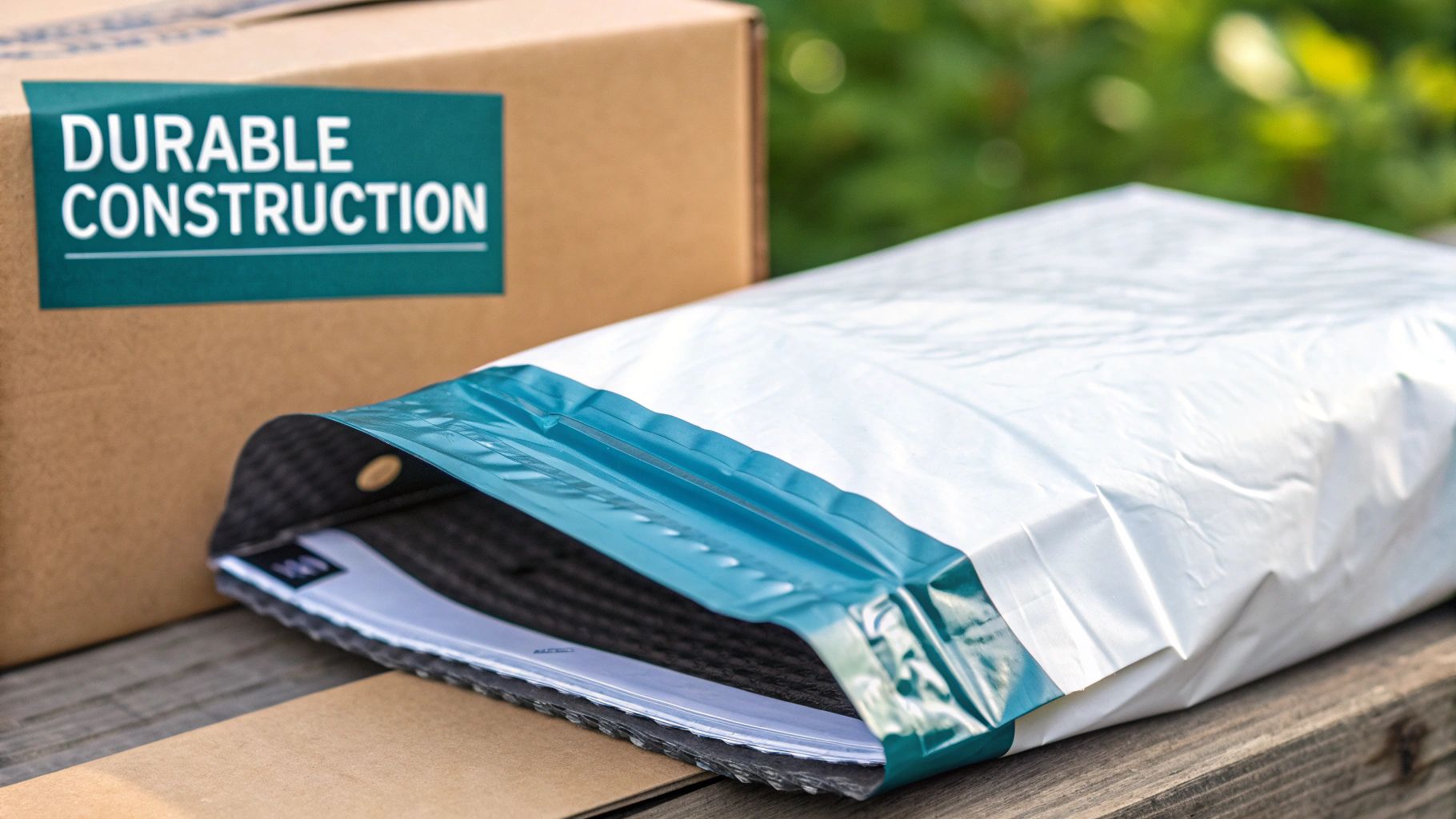
At a molecular level, you can think of polyethylene as a massive chain made of thousands of interlocking links. This long, chain-like structure is what gives the material its signature strength and flexibility. When these chains are formed into a thin film, they create a barrier that’s remarkably resistant to tearing, punctures, and—most importantly for shipping—water.
This built-in durability is a huge reason why the polyethylene mailer market is booming. The global market was valued at around USD 4.5 billion in 2023 and is on track to hit USD 7.8 billion by 2032, all thanks to the endless demand from eCommerce businesses for reliable, cheap shipping. You can find more insights on the polyethylene mailer bags market growth on dataintelo.com.
The Co-Extrusion Manufacturing Process
To make a poly mailer, manufacturers don't just use a single sheet of plastic. They rely on a process called co-extrusion, where multiple layers of polyethylene film are melted and fused together. This technique allows them to combine different properties into one superior material.
Think of it like making a sandwich. You wouldn't use the same bread for the inside and outside. One layer might be tough and scuff-resistant for the exterior, while another is smooth and gentle for the inside. This layered approach is what makes a poly mailer perform so well.
This multi-layer design typically includes:
- An Outer Layer: This is the first line of defense, engineered for maximum toughness to handle the bumps and scrapes of transit.
- An Inner Layer: Usually made of a different color (often gray or black), this layer creates opacity, making sure nobody can see what's inside.
- A Smooth Interior: The surface touching your product is designed to be gentle, preventing snags or scratches on delicate items like clothing.
This smart construction results in a shipping solution that’s far more than a simple plastic bag—it's an engineered protective shield for your products.
Key Design Features That Matter
Beyond the material itself, a few key features are built into every poly mailer to make it a secure and efficient tool for shippers. These aren't just add-ons; they're critical to how the bag works.
One of the most important is the self-sealing adhesive strip. This isn't your average glue. It’s a permanent, high-tack adhesive designed for a single use.
Once a poly mailer is sealed, you can't open it without visibly damaging the bag. This built-in security feature provides a tamper-evident closure, giving both you and your customer peace of mind that the package hasn't been messed with on its journey.
Another crucial element is that opaque inner lining. Privacy is a big deal for online shoppers, and this feature guarantees the contents are completely hidden from prying eyes. While these bags are plastic, businesses looking for plastic-free options can always explore alternatives like our Kraft paper collection for certain products.
Finally, the seams of the bag are heat-sealed, creating a bond that is often stronger than the film itself. This stops the bag from splitting at the sides, even when it's carrying something with a bit of weight, like a pair of jeans or a hardcover book. Each of these details works in harmony to create a reliable, secure, and user-friendly way to ship.
Choosing the Right Type and Size for Your Products
Picking the right poly mailer is a lot like choosing the right tool for a job—you wouldn't use a sledgehammer to hang a picture frame. Not all poly mailers are built the same, and getting the perfect one for your products is a game-changer for both protection and shipping costs. It all boils down to two key things: the type of mailer and its size.
Get this right, and your items arrive safely without wasting money on extra bulk. This versatility is exactly why poly mailers are taking over eCommerce. The global market for these bags is expected to jump from an estimated USD 6.24 billion in 2025 to a whopping USD 9.87 billion by 2034, all because they can adapt to just about anything you need to ship. You can find more details about the growth of the polybag mailers market on cognitivemarketresearch.com.
Let's break down the main categories so you can match your products with their perfect mailer.
The Three Main Types of Poly Mailers
Understanding the basic types of poly mailers makes the whole decision process way simpler. Each one is designed with a specific job in mind, whether you're shipping durable clothes or something that needs a little more TLC.
1. Standard Lay-Flat Mailers
This is the classic poly mailer, the one you probably see the most. Think of it as the workhorse of eCommerce shipping—a simple, flat, but tough-as-nails plastic envelope. It’s perfect for anything that isn't fragile and doesn't need extra padding.
- Best For: Soft goods and durable items that can handle the rough and tumble of sorting machines.
- Example Products: T-shirts, leggings, documents, books, and other fabrics.
2. Bubble-Lined Mailers
When you need an extra layer of defense, bubble-lined mailers are your go-to. These have a layer of bubble wrap built right into the interior, giving your products a cushion against bumps and drops. They strike a great balance between a standard mailer and a full-on box.
- Best For: Semi-fragile items that need protection from scratches, dings, or minor impacts.
- Example Products: Jewelry, cosmetics, small electronics, and handmade crafts.
3. Expansion Gusset Mailers
Ever try to squeeze something bulky into a flat mailer? It's not pretty. Expansion mailers solve this problem with a gusseted bottom that opens up to fit thicker products, kind of like how a paper grocery bag expands.
- Best For: Bulky but non-fragile items that just won’t fit comfortably in a flat bag.
- Example Products: Hoodies, jackets, binders, or even a shoebox.
Pro Tip: Whatever you do, don’t force a bulky item into a lay-flat mailer. It puts a ton of stress on the seams and seriously increases the risk of the bag bursting open mid-shipment. Always size up or grab an expansion mailer for a proper fit.
To make it even easier, here’s a quick-glance table to help you decide.
Poly Mailer Types and Ideal Use Cases
| Mailer Type | Key Feature | Best For Shipping | Example Products |
|---|---|---|---|
| Standard Lay-Flat | Lightweight and durable | Non-fragile, soft goods | T-shirts, books, documents |
| Bubble-Lined | Built-in cushioning | Semi-fragile items | Jewelry, cosmetics, small electronics |
| Expansion Gusset | Expandable bottom | Bulky, non-fragile items | Hoodies, binders, shoeboxes |
This table should help you quickly pinpoint which mailer type is the hero your product needs.
How to Find the Perfect Size
Once you’ve nailed down the type, getting the size right is the next critical step. A mailer that’s too big adds unnecessary material and lets the product slide around, but one that’s too small will strain the seams. You're aiming for a snug fit, but not a tight one.
Just follow these simple steps to measure your products the right way:
- Measure Your Product: Lay your item flat and measure its length (L), width (W), and thickness/height (H).
- Calculate Mailer Width: Add the item's width and its thickness, then add about one extra inch for some wiggle room. (Mailer Width = W + H + 1")
- Calculate Mailer Length: Add the item's length and its thickness, plus about two extra inches to make sure you get a good seal. (Mailer Length = L + H + 2")
For instance, a folded t-shirt might be 12 inches long, 9 inches wide, and 1 inch thick. Using the formulas, you'd need a mailer that is at least 15 inches long (12+1+2) and 10 inches wide (9+1+1). A 12 x 15.5-inch mailer would be a solid choice. While this formula gives you a great starting point, exploring a variety of shipping envelopes will help you find the absolute best fit for everything you sell.
Poly Mailers vs. Cardboard Boxes: When to Choose Which
Picking between a sleek poly mailer and a classic cardboard box is one of the most important calls you'll make for your eCommerce shop. This isn't just about what looks good; it's a strategic move that hits your shipping costs, storage space, product safety, and even your brand's eco-friendly reputation. The goal isn't to declare one winner for everything, but to know which tool is right for the job at hand.
Think of it like choosing a car. You wouldn't rent a giant moving truck just to pick up a few groceries, right? And you definitely wouldn't try to cram a piano into a two-door coupe. It's the same logic here: a poly mailer is your zippy compact car, perfect for lightweight, durable goods. A box is your trusty truck, non-negotiable for anything fragile, heavy, or awkwardly shaped.
The Cost Factor: Dimensional Weight
When you line up poly mailers against cardboard boxes, the first thing most people notice is the price tag. The secret to finding the cheapest way to ship packages almost always comes down to one critical factor: dimensional weight, or DIM weight.
Shipping carriers like USPS, FedEx, and UPS don’t just charge you for how heavy your package is. They also charge for how much space it takes up on their trucks and planes. Boxes, even light ones, are space hogs. A poly mailer, on the other hand, wraps snugly around your product, taking up as little room as possible.
Let’s look at a real-world example: shipping a t-shirt.
- In a Box: You put the shirt in a 12x10x4 inch box. The whole thing weighs maybe 1.5 lbs, but the carrier calculates its DIM weight as 3 lbs. Guess which one you're paying for? The higher one. Always.
- In a Poly Mailer: That same shirt goes into a 12x15.5 inch poly mailer. It still weighs 1.5 lbs, but now there's almost no extra space. The carrier will charge you for the actual weight, which could cut your shipping cost nearly in half for that single order.
This DIM weight advantage is the single biggest reason why switching to a poly mailer bag for apparel and other soft goods can dramatically lower your shipping expenses. Over hundreds or thousands of orders, these savings add up to a substantial boost to your bottom line.
Protection and Security
Of course, saving money doesn't mean much if your products arrive damaged. This is where the choice becomes much clearer. Cardboard boxes offer a level of rigid, structural protection that a poly mailer just can't compete with. Those sturdy walls create a crush-resistant shell, making them the only real choice for anything delicate.
Here’s a quick guide to help you decide:
- Cardboard Boxes Are a Must For: Fragile items like glass or ceramics, electronics, anything with sharp corners that could tear through a bag, and high-value products where a premium unboxing experience matters. You can even explore different custom printed boxes to really nail that protective, on-brand feel.
- Poly Mailers Are Perfect For: Protecting non-fragile items from the elements. Think clothing, books, yarn, or accessories. They are fantastic at keeping out moisture, dirt, and dust, ensuring your products arrive clean and dry every time.
Storage and Environmental Impact
Think beyond the mail truck for a second and look at your own storage space. Boxes might arrive flat, but they still eat up a ton of room. Poly mailers? They're incredibly compact. You could store thousands of mailers in the same space that a few hundred boxes would occupy, freeing up precious square footage.
On the environmental front, it's a bit more complicated. Boxes are usually made from recycled materials and are easily tossed into any curbside recycling bin. Poly mailers often use virgin plastic, but they take far less energy to make and transport because they're so light. While many are recyclable at special store drop-off locations, it does require a bit more effort from your customer. The "greener" choice really depends on what your brand prioritizes.
This chart shows a simple way to think about which mailer to grab based on what you're shipping.
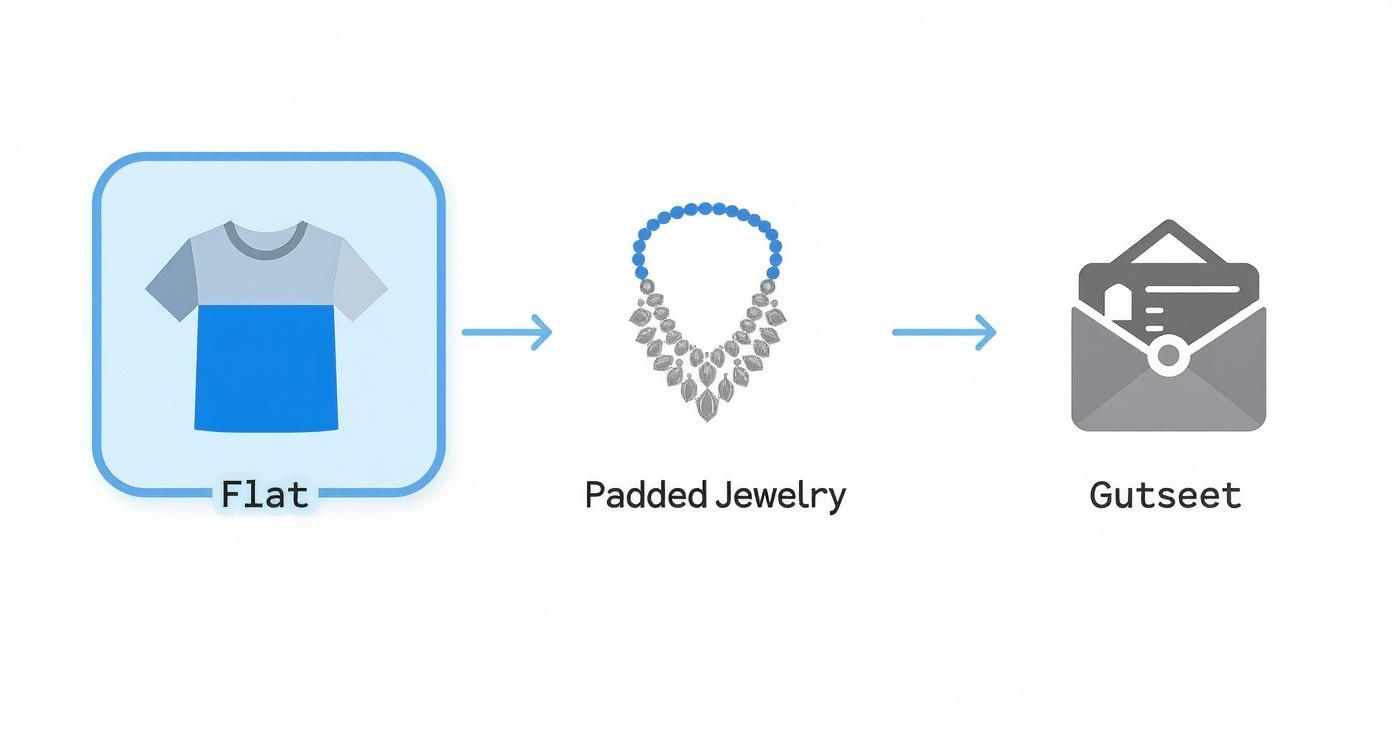
As the image shows, it's a logical progression. You can start with simple flat mailers, move up to padded ones for a little more protection, and grab gusseted mailers when you need to ship something a bit bulkier.
Branding Your Business with Custom Poly Mailers
Think about it: your packaging is the very first physical thing a customer touches from your brand. It's a huge moment. So why let it be a forgettable, plain white bag? A custom-printed poly mailer transforms that simple delivery into a powerful marketing opportunity.
You're not just shipping a product; you're delivering an experience. Your poly mailer instantly becomes a traveling billboard for your business.
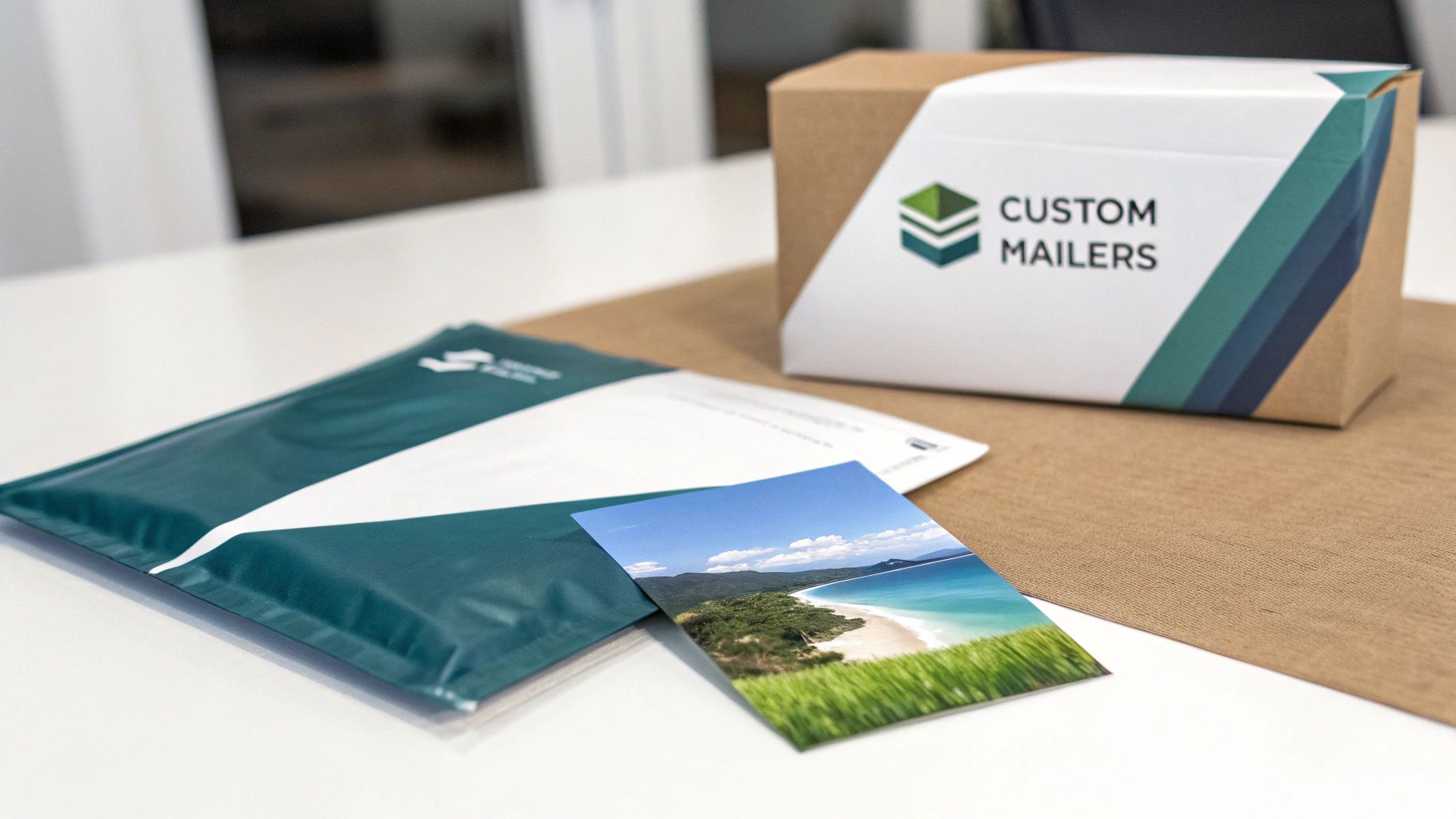
That first impression is everything. A well-designed package builds excitement before your customer even sees what's inside. It reinforces your brand's personality and can turn a routine delivery into a shareable unboxing experience on social media. Understanding the crucial role of branding in e-commerce is key to getting the most out of every single shipment.
From Simple Logos to Full-Bleed Designs
Customization isn't an all-or-nothing game. There's a whole spectrum of options that can fit your brand's style and, just as importantly, your budget.
You can go for something subtle and chic or loud and vibrant. The possibilities are wide open:
- One-Color Logo Print: This is the classic, go-to starting point. It's cost-effective and instantly makes your package look professional instead of generic. A clean logo on a crisp white or colored mailer works wonders.
- Multi-Color Designs: Ready to step it up? Using your full brand color palette allows for more detailed artwork. You can add your tagline, social media handles, or other fun design elements.
- Full-Bleed Printing: If you want to make a serious impact, this is the way to go. A full-bleed design covers the entire mailer, edge to edge. It's perfect for showing off bold patterns, cool gradients, or even photo-quality images that make your package impossible to miss.
The takeaway here is that even a simple logo turns that mailer from a piece of trash into a branded asset. It builds brand recognition from the second it lands on a customer's doorstep.
Practical Steps for Ordering Custom Mailers
Getting your own branded packaging is actually a pretty straightforward process once you know the steps. A little bit of planning upfront ensures the final product looks exactly how you envisioned it.
Once you stop thinking of mailers as a shipping expense and start seeing them as a marketing investment, everything changes. A great package can build loyalty long after the product inside has been unboxed.
Here’s a quick rundown on how to get started with your custom poly mailers:
- Get Your Design Ready: First things first, create your artwork using your logo, brand colors, and fonts. The most important thing here is to make sure your files are high-resolution. This is critical for a sharp, professional-looking print.
- Pick Your Mailer Specs: Decide on the size that best fits your products. Then, choose the base color of the mailer itself—think about how your design will pop against different backgrounds.
- Plan for Production Time: This is a big one. Custom printing takes longer than just ordering plain stock mailers. You'll want to factor in both production and shipping time so you don't run out of bags while waiting for your new ones.
- Place Your Order: Find a printing partner you can trust, like 4OVER4, that knows their way around high-quality custom poly mailers. A good partner can walk you through the entire process, from uploading your files to final delivery.
Navigating Eco-Friendly and Sustainable Mailer Options
In a world where customers care more about where their money goes, your packaging has become more than just a box or a bag. It's a clear signal of your brand's values. For many businesses, this means ditching the standard-issue poly mailers for options that are kinder to the planet and connect better with their audience.
But let's be honest, the world of "green" packaging can be a bit of a minefield. You'll see words like recyclable, biodegradable, and compostable thrown around, often as if they mean the same thing. They don't. Getting a handle on these terms is the first real step to making a choice you can stand behind.
Decoding Sustainable Mailer Terminology
To make a smart decision, you need to speak the language. Let's cut through the jargon and look at the three most common terms you’ll run into when shopping for an eco-friendly poly mailer bag.
- Recyclable: This means the material can be broken down and turned into something new. Most regular poly mailers are made from LDPE #4 plastic, which is technically recyclable, but there's a catch: you can't toss them in most curbside bins. They need to be dropped off at special collection points, usually at grocery stores, that handle plastic films.
- Compostable: These mailers are made from plant-based stuff (like cornstarch) and are built to break down into soil in a commercial composting facility. They are not recyclable and will actually mess up the plastic recycling process if they end up in the wrong place.
- Biodegradable: This one is often the most misleading. It sounds great, but many "biodegradable" plastics just have additives that make them fragment into tiny plastic bits, or microplastics, which are a serious environmental headache.
For most online stores, the sweet spot is focusing on mailers that are made from recycled content and are also recyclable. It's the most practical and genuinely impactful route.
The Power of Recycled Content
The single best way to shrink the environmental footprint of a poly mailer bag is to use one made from materials that have already been out in the world. This is where Post-Consumer Recycled (PCR) content shines.
PCR mailers are made from plastic waste that people like you and me have used, tossed out, and that has been collected and re-processed. When you choose a mailer with a high percentage of PCR, you're directly supporting a circular economy.
A circular economy is just what it sounds like: a system where we keep materials in use for as long as possible instead of using them once and throwing them away. Using PCR mailers cuts down the need for brand-new plastic, saves energy, and keeps trash out of our landfills.
When your customer gets their order in a mailer made from recycled materials, it says something powerful. It shows your brand isn't just talking the talk; you're part of the solution. You can find all sorts of eco-friendly printing and packaging options to make sure your entire shipping process reflects your commitment to sustainability.
Taking Action: Proper Disposal and Customer Education
Picking the right mailer is only half the job. The other, equally important half is making sure it gets disposed of correctly. Since most poly mailers can't just be chucked into the recycling bin at home, teaching your customers what to do is absolutely critical.
A simple, clear instruction printed right on the mailer or tucked into a packing slip can make all the difference. Nudge them to find their nearest plastic film drop-off point, which they can often find at big grocery chains and retailers. It’s a small step that helps close the loop, making sure the material from your poly mailer bag gets a chance at a new life.
Common Questions About Poly Mailer Bags
Once you start using poly mailers, you're bound to run into a few questions. Getting straight answers helps you pack with confidence, knowing your products will arrive safe and sound, keeping your customers happy. Let's tackle some of the most common things people ask about these workhorse bags.
Are Poly Mailers Waterproof?
This is probably the number one question we hear. The best way to think about them is as highly water-resistant, not completely waterproof.
A poly mailer will do a fantastic job protecting your goods from rain, snow, or any other moisture it runs into on its journey. But it's not meant to be dunked in a pool. Think of it like a good raincoat—it'll keep you perfectly dry in a downpour, but you wouldn't go for a swim in it.
Can I Ship Fragile Items in a Poly Mailer?
This is a big one for product safety. If you're shipping something truly fragile—like glass, ceramics, or delicate electronics—a standard poly mailer is not the right tool for the job. Those items need the rigid protection that only a box can provide.
But, the game completely changes when you bring in bubble-lined poly mailers. These have a built-in cushion that offers great protection for semi-fragile products. They’re the perfect middle ground for items that need a little padding but don't require the full-on defense of a cardboard box.
Think about things like:
- Jewelry (especially in small gift boxes)
- Cosmetics like lipstick tubes or eyeshadow palettes
- Small electronics like phone cases, chargers, or cables
For products like these, a bubble mailer is a smart choice, giving you solid protection while keeping shipping costs low.
How Do I Choose the Right Thickness?
When you're shopping for poly mailers, you'll see the term ‘mil’ used to describe their thickness. A mil is simply one-thousandth of an inch, and it’s your best guide to a bag's toughness.
A standard 2.5 mil mailer is the go-to for most eCommerce shops. It hits that sweet spot of strength and flexibility, perfect for shipping everyday items like clothing, fabrics, and other soft goods.
If you’re sending out heavier products or anything with slightly sharper corners (like a hardcover book), it’s a good idea to upgrade to a 3-4 mil thickness. That extra layer of plastic gives you more puncture resistance and a little extra peace of mind.
Can Poly Mailers Be Recycled?
Yes, most poly mailers can be recycled, but there's a small catch you need to know about. They are usually made from LDPE #4 plastic, which is a type of plastic film that isn't accepted in most curbside recycling bins.
To recycle them properly, you need to take them to a store drop-off location that collects plastic films. You can almost always find these collection bins near the entrance of major grocery stores and retailers. It’s one small extra step that makes a huge difference, ensuring the material gets a new life instead of just ending up in a landfill.
Ready to upgrade your shipping with packaging that’s tough, affordable, and a great canvas for your brand? At 4OVER4, we offer a huge range of custom poly mailers designed to make your business pop. Check out our high-quality printing options and create an unboxing experience your customers won’t forget by visiting us at https://4over4.com.
More from

729
Full bleed printing is a simple but game-changing technique. It's how you get your artwork—whether it’s a photo, a background color, o
 Emma Davis
Feb 3, 2026

336
Even though we live in a digital world, the humble business card is still a powerhouse networking tool. But here's something most people d
Emma Davis
Feb 2, 2026

1307
Staring at a wall of banner dimensions can feel a little overwhelming. But while there's no single "typical banner size" that wo
Emma Davis
Feb 1, 2026

397
Stretching your marketing budget doesn't mean you have to settle for flimsy, forgettable brochures. The real secret to low cost br
Emma Davis
Jan 31, 2026

387
Advertising magnets are one of those marketing tools that are so simple, you might overlook their power. They’re tangible, they last for age
Emma Davis
Jan 30, 2026

198
Tired of fighting with torn paper and sticky residue? We’ve all been there. The best way to get labels off bottles is often a simple soak in
Emma Davis
Jan 29, 2026

352
Want to know the real secret to getting a poster to stick to a wall without it peeling off in the middle of the night? It's all about what
Emma Davis
Jan 28, 2026

320
When you hear "table tent specs," what we're really talking about are the foundational details for printing them correctly: the
Emma Davis
Jan 27, 2026