



all

    Your Guide to Standard Postcard Size and Marketing Success

    user icon

    Emma Davis

    Content Writer

    Jan 2, 202681 views

    Jan 2, 202681 views

    Your Guide to Standard Postcard Size and Marketing Success

    If you've ever planned a direct mail campaign, you know one of the first questions is always about size. The most common, go-to standard postcard size is 4x6 inches. It's the sweet spot for most businesses—big enough for a solid design, but small enough to lock in the best postage rates from the USPS.

    Think of it like picking the right tool for a job. The size of your postcard directly impacts your budget, your design's real estate, and ultimately, how much of a splash it makes in the mailbox.

    Decoding the Standard Postcard Dimensions

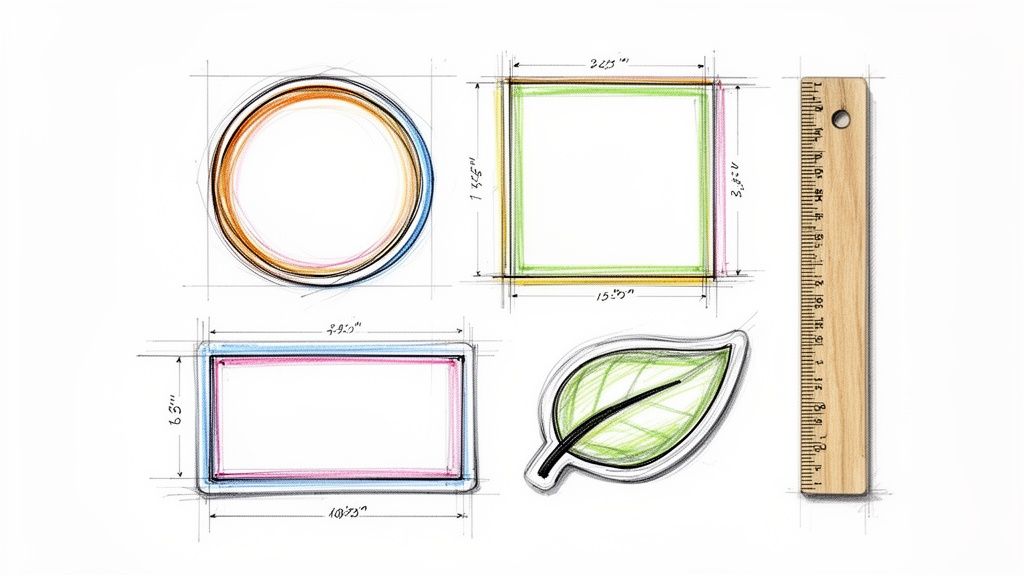
    Three postcard sizes (4x6, 5x7, 6x9 inches) shown with a ruler for accurate measurement and scale.

    While 4x6 inches might be the crowd favorite, it’s certainly not your only option. The United States Postal Service (USPS) has a whole range of approved sizes, and getting familiar with them is key to a successful campaign that doesn't blow your budget on unexpected postage fees.

    Believe it or not, the tiny 3.5 x 5.5 inch postcard was the norm for decades. The game changed when the 4 x 6 inch "Continental" size made its way to the US from Europe. By the 1970s, better printing technology and a demand for more eye-catching mail cemented it as the new standard. It's a simple marketing truth: more space means bigger, bolder designs that grab attention.

    Your Quick Guide to USPS Postcard Sizes

    Here's a quick look at the most common postcard dimensions that qualify for those coveted low mailing rates. Each size has its own strengths, depending on what you're trying to achieve.


    USPS Approved Postcard Sizes at a Glance

    This table breaks down the most popular postcard sizes that will get you the best bang for your buck with USPS. Think of it as your cheat sheet for choosing the most cost-effective option for your campaign.

    Postcard Name Dimensions (Inches) Dimensions (Millimeters) Best For
    Standard Postcard 4" x 6" 101.6 x 152.4 mm Cost-effective mailers, event reminders, thank you cards
    Large Postcard 5" x 7" 127 x 177.8 mm Product showcases, detailed announcements, invitations
    Jumbo Postcard 6" x 9" 152.4 x 228.6 mm High-impact marketing, real estate listings, standing out

    As you can see, choosing the right dimension is the very first step toward a successful campaign. A Standard Postcard (4" x 6") is the industry workhorse—plenty of room for a punchy message and a great image, all while qualifying for the lowest First-Class Mail postcard rate.

    Need a bit more visual real estate? A Large Postcard (5" x 7") is perfect for showing off detailed products or making a bigger announcement. And if you really want to stand out, a Jumbo Postcard (6" x 9") commands attention, though it mails at the higher letter rate.

    From simple event reminders to detailed real estate listings, the perfect size is waiting. You can explore a variety of postcard printing options to find the best fit for your next project.

    Getting Your Postcards Through: The Critical USPS Rules You Can't Ignore

    Illustration comparing standard postcard thickness and design to a complex, problematic alternative.

    Mailing a postcard feels like it should be the simplest thing in the world, right? But to get it delivered without blowing your budget, you have to play by the USPS rulebook. Think of it like a recipe—if one measurement is off, the whole thing can go sideways. For your direct mail campaign, that means a perfectly good marketing piece can suddenly become a lot more expensive to send.

    The USPS relies on high-speed automated sorting machines that are precisely calibrated for certain sizes and thicknesses. When a mailpiece doesn't fit those parameters, it gets pulled for manual handling or reclassified into a pricier category. This is why sticking to the approved standard postcard size isn't just a friendly suggestion; it's a critical step for keeping your budget in check.

    The Make-or-Break Thickness Rule

    One of the easiest rules to overlook—and one of the most important—is paper thickness. A postcard that’s too flimsy or too rigid will throw a wrench in the sorting equipment.

    To qualify for the best postcard rates, your mailer has to land within this strict thickness window:

    • Minimum Thickness: 0.007 inches (think of a standard index card)
    • Maximum Thickness: 0.016 inches

    Anything thinner than 0.007 inches is considered non-mailable because it will jam or tear in the machinery. On the flip side, anything thicker than 0.016 inches gets bumped up to a letter or flat rate, instantly driving up your postage. It's a tiny detail that can make a huge difference to your campaign's ROI.

    Mastering Postcard Dimensions and Shape

    Beyond thickness, the actual length and height of your postcard are just as vital. The USPS has a very specific "sweet spot" to ensure every piece zips through its automated systems without a hitch. Getting this wrong doesn't just cost you more; it can bring your entire campaign to a grinding halt.

    USPS regulations require postcard-rate mailers to be between 3.5" x 5" (the minimum) and 4.25" x 6" (the maximum). Staying within these standard postcard dimensions is what allows businesses to save over 50% on postage compared to sending a standard first-class letter. If your postcard is even a fraction of an inch outside this range, it gets reclassified, and your postage costs can easily double or triple.

    The Aspect Ratio Test: Your postcard must be rectangular. An easy way to check is to divide the length by the height. The result—your aspect ratio—has to fall somewhere between 1.3 and 2.5. A perfect square or a long, skinny mailer will fail this test and end up costing you more.

    At the end of the day, these rules are all about efficiency. By designing your postcard with these guidelines in mind from the start, you ensure your message gets delivered without any expensive surprises. If you're running a more complex campaign, using professional direct mail services can take the guesswork out of the equation, guaranteeing compliance from print to postbox.

    How Postcard History Shapes Your Marketing Today

    To really get why today's standard postcard sizes are so effective, it helps to take a quick trip back in time. The trusty, affordable postcard we all know didn't just pop into existence. It was born from a game-changing global agreement that completely reshaped how we communicate. Before that, sending mail across borders was a messy, expensive headache.

    Everything changed in the late 19th century. With the creation of the Universal Postal Union (UPU), the chaos of international mail finally got some rules. Suddenly, mail could travel from one country to another without a hitch. One of their smartest moves was setting a single, uniform size for postcards, turning them into a predictable and cheap way for anyone to send a message.

    The Birth of a Global Standard

    The big moment came in 1878. That’s when the UPU locked in the international standard postcard size of 3.5 x 5.5 inches. This one decision turned the postcard from a quirky novelty into a worldwide communication tool. For the first time, you could print a postcard in Paris and mail it to Peoria, knowing it would fit right into the local postal system.

    This consistency kicked off the "golden age" of postcards in the early 1900s, with billions flying across the globe each year. You can dive deeper into this cool history over at the Smithsonian Institution Archives. And believe it or not, that historical decision directly impacts your marketing campaigns today. The core idea—standardization equals efficiency—is the exact same reason the USPS has its own specific postcard rules.

    That 19th-century agreement on postcard dimensions paved the way for the automated, high-speed mail sorting systems that make modern direct mail both possible and profitable.

    From History to High-Speed Sorting

    Think about those original dimensions. They were chosen because they were easy for postal workers to handle and sort by hand. As technology evolved, those same standards were adapted for machines. The super-fast sorting equipment used today is fine-tuned to process specific sizes and thicknesses with pinpoint accuracy.

    So, when your 4x6 inch postcard zips through the mail system, it's really following a path that was laid out more than a century ago. The reason you save on postage is because your mailer fits perfectly into this incredibly efficient, automated process. Every time you pick a standard postcard size, you’re plugging into a legacy of logistical genius that started with a simple agreement to make the world a little smaller. And that efficiency means lower costs and a better return on your marketing investment.

    Choosing the Right Postcard Size for Your Campaign

    Picking the right standard postcard size isn’t just about aesthetics; it’s a strategic choice tied directly to your campaign’s goals, budget, and message. Think of it like choosing the right vehicle for a road trip. A zippy compact car is perfect for a quick, local errand, but you’ll need a spacious van for a cross-country haul with lots of cargo.

    In the same way, a compact 4x6 inch postcard is nimble and cost-effective, making it a fantastic choice for quick announcements like a flash sale or a simple thank-you note. But if you're a real estate agent trying to showcase a stunning property with multiple high-quality photos, a larger 6x9 inch postcard gives you the visual real estate you need to truly make an impact.

    The journey of the postcard, from its standardized origins to its modern role as a powerhouse for marketing ROI, is a fascinating one. This visual traces that evolution.

    Flowchart illustrating the historical evolution of postcards, from global mailing standards to modern marketing ROI.

    As you can see, a historical agreement on standardization paved the way for the efficient, results-driven direct mail strategies we use today.

    Aligning Size with Marketing Goals

    The golden rule is to match the postcard's canvas to your message's complexity. Trying to cram a novel's worth of information onto a small card results in a cluttered mess that your audience will likely toss without a second glance. On the flip side, using a jumbo postcard for a tiny message can feel wasteful and dilute your point.

    The most effective direct mail campaigns are those where the postcard's dimensions perfectly complement the marketing message, ensuring clarity and impact without overwhelming the recipient.

    To help you nail this decision, let's break down how different sizes serve specific business goals. This comparison will shed light on the strengths of each option, helping you align your budget with your creative vision.


    Postcard Size Comparison for Marketing Goals

    This table offers a practical look at the most popular postcard sizes, designed to help you select the best fit for your campaign objectives, design needs, and budget.

    Postcard Size (Inches) Best Use Case Design Space Postage Cost Key Advantage
    4" x 6" Quick announcements, event reminders, coupons, and thank you notes. Limited Lowest (Postcard Rate) Maximum affordability and efficiency for high-volume mailings.
    5" x 7" Product launches, detailed promotions, and formal invitations. Moderate Varies (Letter Rate) Offers a noticeable size increase without a major cost jump.
    6" x 9" Real estate listings, restaurant menus, and high-impact brand statements. Ample Higher (Letter Rate) Commands attention in the mailbox with generous space for visuals.

    Each size has its own sweet spot. The key is to pick the one that lets your message breathe and gives your design the room it needs to shine.

    Making the Strategic Choice

    Ultimately, your decision boils down to balancing three critical factors: message, budget, and impact. A small business sending out a weekly special will get the most bang for its buck with the low cost and simplicity of a 4x6 inch card. A luxury brand, however, might find the premium feel and standout presence of a larger 6x9 inch postcard is essential for upholding its image.

    Before you lock in your design, think about the entire customer experience. Will the size you pick feel substantial in their hands? Does it give you enough space to tell your story effectively? Answering these questions will guide you to the perfect postcard. For a deeper dive into effective design, explore our guide to marketing essentials for postcards and other print materials.

    Setting Up Your Design File for Flawless Printing

    Diagram illustrating print bleed, trim, and safe zone areas, with an example portrait.

    A brilliant postcard design deserves a print that does it justice. But getting from your screen to a perfectly cut piece of paper involves a mechanical process where tiny shifts are just part of the game. Prepping your design file correctly is the final, crucial step to make sure what you get back from the printer looks exactly like you imagined, with no frustrating surprises.

    Think of your postcard file like a photograph you're putting in a frame. You have the main picture, the edge of the photo, and then a tiny bit of the image that gets tucked behind the frame itself. Professional printing works the same way, using three key zones to guarantee a flawless result: the safe zone, the trim line, and the bleed area.

    Understanding these zones is the difference between a professional mailer and one that shows up with awkward white borders or, worse, text that's been sliced off. It’s all about taking control of the printing process before your file ever hits the press.

    The Three Essential Print Zones

    To sidestep common and costly printing errors, you absolutely have to set up your file with these three areas in mind. Each one has a specific job to do in creating that clean, professional finish.

    • The Safe Zone: This is the heart of your design, the innermost area. All your critical elements—text, logos, contact info, QR codes—must live inside this zone. It’s the "safe" space where nothing is at risk of being cut off during production.

    • The Trim Line: This line is where the magic happens. It represents the final, exact dimensions of your postcard. For a standard postcard size of 4x6 inches, this is the precise edge where the printer's cutter will slice the paper. Anything placed right on this line is playing with fire.

    • The Bleed Area: Think of this as your safety net. It’s an extra margin of your background image or color that extends beyond the trim line. This is the part of the picture that gets hidden by the frame, ensuring that even if the cutter shifts by a hair, you won't see any ugly white edges on your final postcard.

    A standard bleed is typically 0.125 inches (or 1/8th of an inch) on all four sides of your design. For a 4" x 6" postcard, your final file size with bleed would be 4.25" x 6.25".

    Practical Steps for a Perfect File

    Getting your file set up correctly from the start saves a world of headache, time, and money. When you're designing, make sure your background color or image stretches all the way to the outer edge of the bleed area.

    At the same time, keep all your important text and logos comfortably inside the safe zone, which is usually 0.125 inches inside the trim line. To ensure your postcard actually gets people to act, it's also important to understand what an effective Call to Action (CTA) is and how to place it safely within this zone.

    By respecting these boundaries, you create a buffer that protects your design’s integrity. Following these simple guidelines is fundamental for all marketing materials, from flyers to brochures. For more direct mail strategies, check out our postcard solutions for your business basics.

    Making Your Postcard Stand Out with Paper and Finishes

    Choosing the right standard postcard size is a huge first step, but the real magic happens the moment someone pulls your mailer from their mailbox. It's that physical experience—the weight, the texture, the sheen of the paper—that instantly signals quality and turns a simple piece of mail into something memorable.

    Think of your paper stock as the foundation. A thick, substantial card feels premium and important, right? On the other hand, a flimsy one can feel like a total afterthought. For anything going through the mail, you'll want a sturdy stock like a 14 pt. or 16 pt. Cover. This isn't just about surviving the journey; it gives your postcard a satisfying, tactile feel that makes your message seem more significant.

    Choosing the Perfect Sheen

    Once you've got that solid foundation, the finish is what makes your design pop. Each option sets a completely different mood, so it’s worth thinking about what you’re trying to achieve.

    • Glossy Finish: This high-shine coating makes colors look super vibrant and saturated. It's a fantastic choice for postcards loaded with bold photography, like a real estate listing showing off a sunny home or a restaurant featuring a mouth-watering meal.

    • Matte Finish: A matte finish gives you a smooth, non-reflective surface that just feels sophisticated and modern. It’s an excellent pick for designs heavy on text because it cuts down on glare, making things easier to read. Think service-based businesses or elegant event invitations.

    • Uncoated Stock: This paper has a natural, porous texture that’s perfect for writing on. If your postcard has a spot for a handwritten note, a coupon to fill out, or you're just going for a minimalist, organic vibe, uncoated is the way to go.

    The right finish does more than just look good—it reinforces your brand’s personality. A glossy finish shouts excitement and value, while a matte finish whispers elegance and professionalism.

    But you don't have to stop with the basics. There are countless ways to elevate your design even further. Exploring a whole world of fantastic finishes, from soft-touch lamination to eye-catching metallic foils, can create an unforgettable impression. By carefully picking your paper and finish, you make sure your postcard doesn’t just get seen; it gets felt.

    Common Questions About Standard Postcard Sizes

    Even with the best plan, a few questions always pop up right when you’re ready to hit "print." Let's walk through some of the most common ones we hear about postcard printing and mailing. Getting these details right can save you a ton of headaches down the road.

    What Happens If My Postcard Is Not a Standard Size?

    This is a big one. If your postcard doesn't fit within the USPS-approved range of 3.5" x 5" to 4.25" x 6", it won't qualify for the super-affordable postcard rate. Instead, it gets bumped up to the First-Class letter rate, which can easily jack up your postage costs by 50% or more.

    And it's not just about the cost. Funky shapes or oversized mailers can sometimes require manual sorting, which means more potential costs and even delivery delays. The easiest way to keep your campaign cost-effective and running smoothly is to stick to a standard size.

    Can I Print on Both Sides of a Standard Postcard?

    Absolutely—and you really should! Printing on both sides is the standard for a reason; it doubles your marketing real estate.

    Think of it this way: the front is your billboard. It needs a powerful image and a headline that grabs attention. The back is where you close the deal with the details—your offer, contact info, and a clear call to action.

    Just be sure to leave the right half of the back clear for the mailing address and postage. The USPS is pretty strict about that, so keep all your critical design elements on the left side to stay out of trouble.

    What Is the Best Resolution for Printing a 4x6 Postcard?

    For a crisp, clean print that looks professional, your design file needs to be 300 DPI (dots per inch). For a standard 4x6 inch postcard, that means your image dimensions should be at least 1200 x 1800 pixels.

    If you're using a bleed area (which we always recommend), your file will need to be just a tad larger to cover that extra margin. Anything less than 300 DPI is going to look blurry or pixelated when it comes off the press, and nobody wants that.


    Ready to create postcards that don't just get mailed, but get results? 4OVER4 offers a huge range of sizes, paper stocks, and premium finishes to make your vision a reality. Explore your options and start designing today.

    More from standard postcard size

    Create Outlines in Illustrator A Guide to Flawless Print-Ready Files
    story
    Create Outlines in Illustrator A Guide to Flawless Print-Ready Files

    31

    When you hear a designer talk about "creating outlines in Illustrator," they're referring to one of two things: converting live

    author avatarEmma Davis

    Jan 10, 2026

    The Difference Between Matte and Glossy Print Finishes
    story
    The Difference Between Matte and Glossy Print Finishes

    25

    The real difference between matte and glossy boils down to a single element: light. How does the paper's surface interact

    author avatarEmma Davis

    Jan 9, 2026

    Screen Print Vs Vinyl A Guide to the Best Printing Method
    story
    Screen Print Vs Vinyl A Guide to the Best Printing Method

    21

    When you're trying to decide between screen printing and vinyl, the choice really boils down to two things: volume and design. If you'

    author avatarEmma Davis

    Jan 8, 2026

    How to Print Business Cards That Actually Get Noticed
    story
    How to Print Business Cards That Actually Get Noticed

    40

    Printing a business card might seem straightforward, but a handful of small details are what separate a truly memorable card from one that get

    author avatarEmma Davis

    Jan 7, 2026

    Finding the Best Font for Flyers to Elevate Your Design
    story
    Finding the Best Font for Flyers to Elevate Your Design

    46

    When you need to make an impact fast, your font choice is everything. For flyers, you can't go wrong with timeless, readable options like

    author avatarEmma Davis

    Jan 6, 2026

    A Practical Guide to Business Card Design Online
    story
    A Practical Guide to Business Card Design Online

    47

    In a world drowning in digital pings and overflowing inboxes, the humble business card is more powerful than ever. It's a real handshake,

    author avatarEmma Davis

    Jan 5, 2026

    Your Ultimate Guide to Typical Banner Sizes
    story
    Your Ultimate Guide to Typical Banner Sizes

    43

    It's a classic question we get all the time: "What's a typical banner size?" The honest answer? There really isn't one u

    author avatarEmma Davis

    Jan 4, 2026

    Your Ultimate Guide to Every Print Poster Size
    story
    Your Ultimate Guide to Every Print Poster Size

    156

    Choosing the right size for your print poster isn't just a minor detail—it's the first real decision you make in a campaign, and it

    author avatarEmma Davis

    Jan 3, 2026

    Home
    Products
    Favorites
    Cart
    Account