Table of Contents
- Home
- content hub
- Reducing Time to Market: Strategies for Faster Product Launch
 Share and earn
Reducing Time to Market: Strategies for Faster Product Launch

Aug 14, 20252170 views
Aug 14, 20252170 views

In a competitive market, reducing your time to market isn't just a nice-to-have—it’s the one thing that can put you miles ahead of everyone else. It’s all about closing the gap between a great idea and getting that finished product into a customer's hands. Get it right, and you'll see a direct impact on revenue, market share, and how people see your brand.
Why Launch Speed Is Your New Secret Weapon
Getting to market quickly isn't just about winning a race; it's a core business strategy. When you launch fast, you're able to jump on new opportunities, adapt to what your customers are asking for, and secure that coveted first-mover advantage. It’s a position that's tough for your competitors to challenge. A faster launch also means you start earning revenue sooner, which you can then pour back into the business for even more innovation.
There's another huge benefit: an accelerated feedback loop. Launching earlier puts your product in front of real users faster. This gives you priceless, real-world data about what works and what doesn't, guiding your next steps and making sure you’re investing in features people actually value.
How Different Industries Stack Up
Launch timelines can look wildly different from one industry to another, often thanks to complexity and red tape. This chart gives you a glimpse into the average time to market across a few major sectors, highlighting the unique hurdles they face.
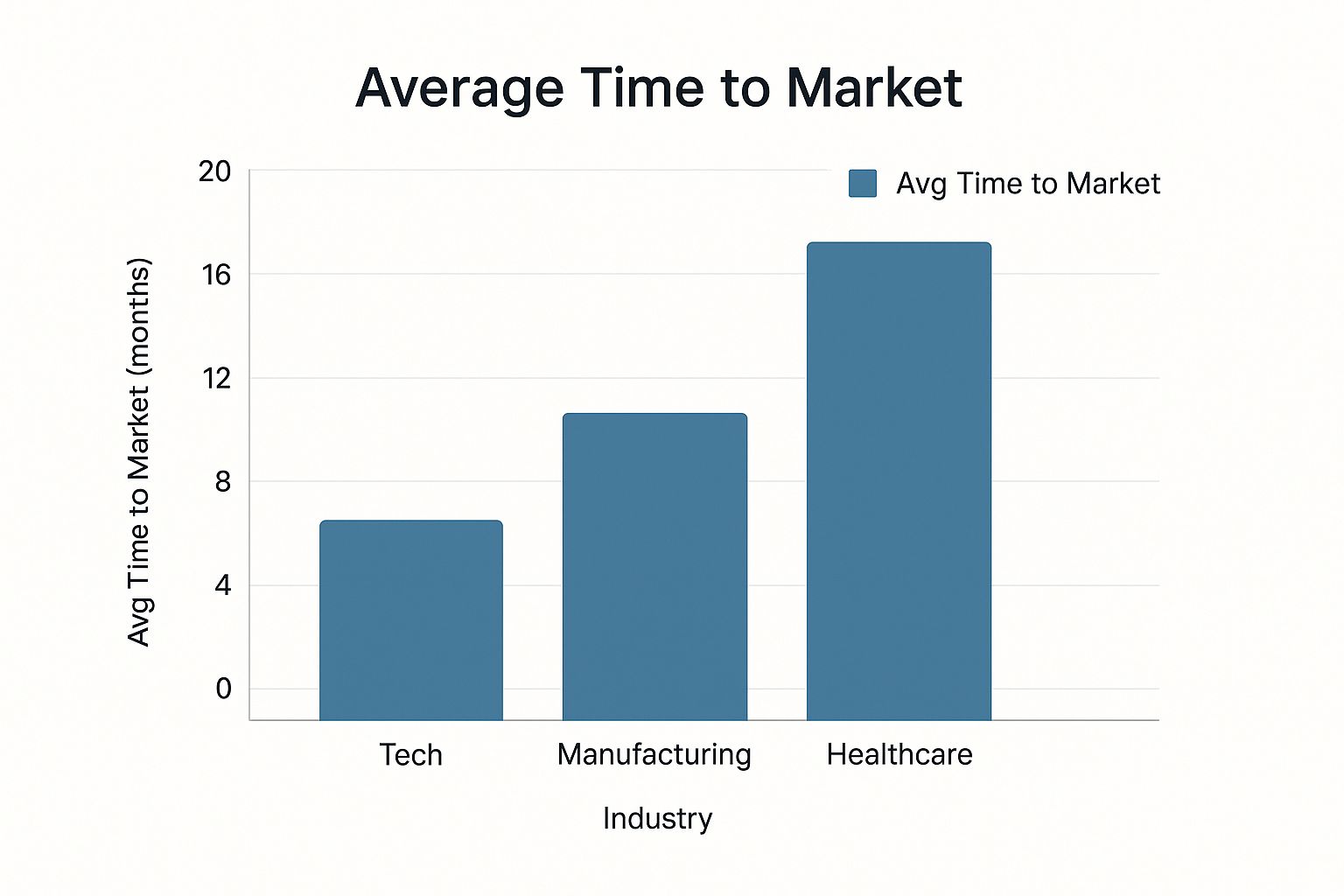
As you can see, industries with heavy regulations like healthcare naturally have much longer development cycles. For them, shaving even a little time off the process is a massive win. Meanwhile, the tech industry’s quicker cycle is a direct result of its deep reliance on agile methods to stay competitive.
The Old Way vs. The New Way of Launching
The project management style you adopt will make or break your launch speed. Old-school, rigid methods are famous for creating bottlenecks, whereas modern, agile frameworks are literally built for speed.
An agile approach does more than just shorten the timeline; it fundamentally changes how a company learns and adapts. By aiming for iterative progress instead of upfront perfection, teams can deliver real value to the market, piece by piece.
This isn't just a process change; it’s a mindset shift. It’s about building a culture that values speed, feedback, and customer-focused development above all else.
Let's look at how these two philosophies stack up in the real world. This table breaks down the key differences between a traditional "waterfall" project and a modern "agile" one, showing exactly where you gain time.
Traditional Launch vs Agile Launch Timelines
| Milestone | Traditional (Waterfall) Approach | Modern (Agile) Approach |
|---|---|---|
| Initial Planning | A massive, comprehensive plan is created upfront, a process that can take months. | High-level planning focuses on core features for an initial launch (MVP). |
| Development | Work happens in a straight line; development can't begin until the design is 100% final. | Design and development happen at the same time in iterative "sprints." |
| Feedback Loop | Feedback is only gathered after the final product is built and launched. | Continuous feedback is collected from users and stakeholders after every sprint. |
| Risk Management | Big problems are often found late in the game, leading to expensive, time-consuming fixes. | Risks are spotted and handled early and often within each cycle. |
| Market Entry | One big, high-stakes launch after a very long development period. | A much faster initial launch with a core product, followed by regular updates. |
The contrast is pretty stark. The agile model gets a working product to market significantly faster, allowing the business to start learning and earning while the traditional model is still stuck in development.
Building a Go-To-Market Strategy for Velocity

Moving fast is one thing, but launching fast without a solid plan is really just a quick way to fail. A thoughtfully constructed Go-to-Market (GTM) strategy is the roadmap that connects your product to the right audience. It ensures every ounce of effort pushes you toward a swift and successful release by forcing you to make the hard choices upfront, not when you're already behind schedule.
The heart of a speed-focused GTM strategy is the Minimum Viable Product (MVP). It's easy to get lost in a never-ending list of cool features, but the MVP approach forces you to answer one crucial question: What's the single biggest problem this product solves for a very specific user?
This intense focus is your best defense against "feature creep," which is probably the most common reason projects get delayed. It helps you build a lean but valuable product that you can get into the hands of real users quickly. Their feedback is pure gold and tells you exactly what to build next.
Pinpointing Your Launchpad
Once you’ve nailed down your MVP, it's time to figure out who you’re launching to. The answer isn't "everyone." You need a core group of early adopters who will give you the most useful feedback right out of the gate.
Imagine a software company launching a new project management tool. Instead of trying to sell it to every business on the planet, they might start by targeting small marketing agencies with 5-10 employees. This niche makes their marketing more effective and the feedback they get is much more consistent and actionable.
To keep everything moving forward, you need clear goals. They should be challenging enough to push your team but realistic enough to be achievable. Most importantly, they must be specific and measurable.
Here are a few examples of what this looks like in practice:
- Acquisition Goal: Sign up 100 new paying customers within the first 30 days.
- Engagement Goal: Hit a 40% weekly active user rate within that first group.
- Feedback Goal: Schedule and complete 20 one-on-one interviews with early users to guide the next development sprint.
A GTM strategy isn't just a document; it’s an investment in speed. When you allocate a proper budget for launch activities, you're directly investing in market penetration and early adoption, which ultimately gets you to revenue faster.
This kind of strategic planning is what separates a chaotic launch from a coordinated, effective one. Yet, recent data shows that a surprising 15.4% of companies worldwide still don't have a defined GTM strategy. On top of that, 59% of businesses admit they don't invest enough in their product launches, even though 79.5% agree that a strong launch significantly impacts revenue. You can find more GTM statistics and insights to help guide your own planning.
Getting Faster with Agile and DevOps
If you’ve ever felt like your projects are stuck in molasses, chances are departmental silos and process bottlenecks are the culprits. To get projects out the door faster, a lot of savvy teams are looking outside their own industries and borrowing some seriously effective ideas from the software world—specifically Agile and DevOps. This isn't just about throwing around buzzwords; it's a real shift in how teams work together.
The whole point is to ditch the old-school, rigid waterfall method where one team finishes their part before handing it off to the next. That’s a recipe for delays. Instead, you build small, cross-functional teams. Imagine designers, production folks, and marketers all in the same huddle, working in short, focused bursts. This constant collaboration cuts out the endless back-and-forth and crossed wires that kill momentum.
Break Big Projects into Small Sprints
One of the biggest mental shifts is moving away from the "big bang" launch. Instead of spending months trying to perfect a massive project, you break it down into smaller, iterative cycles or "sprints."
Let’s say you’re launching a new marketing campaign. The old way involved perfecting every single brochure, mailer, and poster before anything saw the light of day. With an agile approach, your team might spend a two-week sprint just getting a solid landing page and a single targeted ad live.
This gets you into the market fast. More importantly, it creates an immediate feedback loop. You see what works and what doesn't, and that real-world data shapes what you do in the next sprint. You’re no longer operating on assumptions.
A team that launches a small, targeted campaign in two weeks and learns from it is already ahead of a team that spends two months planning a perfect-on-paper campaign that might miss the mark entirely. Continuous feedback is the engine of speed.
I saw this work wonders for a retail client. Their print design team used to spend a solid month in isolation creating the entire seasonal catalog. After shifting to an agile model, they formed a small group with marketing and their print vendor. Their first sprint goal was simple: produce and test one postcard mailer for a key customer segment. The results from that single mailer directly dictated the design and copy for the next piece, slashing wasted effort and getting the full campaign to market much sooner.
Automate the Grunt Work
The other game-changer, borrowed straight from DevOps, is automation. The idea is to find all the manual, repetitive tasks that eat up time and let technology handle them. For print and creative teams, this is where a CI/CD (Continuous Integration/Continuous Delivery) mindset, adapted from software development, makes a huge difference.
Just think about all the tedious steps in a typical print production workflow that you could automate:
- Preflight Checks: Instead of someone manually checking every file for the right resolution, color profile, or bleed, software can do it instantly and flag any issues.
- Proofing and Approvals: Online proofing systems can automatically chase down stakeholders for approvals, so you’re not the one stuck sending follow-up emails.
- File Distribution: Why manually send final files to the printer, then upload them to the web team, and then archive them somewhere else? You can set up a workflow to do all of that simultaneously with one click.
When you automate these tasks, you're not just moving faster; you're also cutting down on human error. In fact, research shows teams that get automation right can shorten their product launch time by up to 40%. This frees up your brilliant team members from mind-numbing administrative work so they can focus on what they do best: being creative and strategic.
Using AI to Accelerate Product Development
Let's be clear: artificial intelligence isn't some far-off concept anymore. It's a real, practical tool that smart companies are using right now to dramatically shrink their development timelines and slash their time to market. We're talking about turning weeks of tedious work into just a few hours.
One of the biggest game-changers I've seen is in virtual prototyping. Forget building expensive, slow physical models for every single design tweak. Instead, teams can now lean on multimodal AI. This tech is incredible—it can digest all sorts of data at once, from complex CAD files and material specs to simulated stress tests, all to validate a design virtually. This creates an immediate feedback loop, letting engineers catch flaws, optimize performance, and innovate at a pace that was impossible before.
From Virtual Prototypes to Predictive Manufacturing
AI's impact doesn't stop at the design phase. It's also completely changing the game in R&D and manufacturing through predictive analytics. By digging into historical production data, AI algorithms can actually predict when a piece of machinery might fail or spot a supply chain snag before it grinds everything to a halt. It can even recommend tiny adjustments to the manufacturing process that boost efficiency and output.
This foresight also applies to market forecasting, helping your team ensure the products you're developing are what customers will actually want. The result is a development cycle that's more nimble, responsive, and grounded in hard data from start to finish.
This recent analysis from PwC really drives home the competitive edge AI delivers.

The takeaway is simple: bringing AI into your workflow isn't just a small tweak. It's a strategic move that leads to huge cost savings and radically shorter project timelines.
From my experience, adopting AI in R&D is fundamentally changing the competitive landscape. It allows for rapid iteration and pre-emptive problem-solving, which are crucial for any company looking to accelerate its market entry.
The numbers back this up. In industries like automotive and aerospace, companies that have integrated AI-driven tools are reporting up to a 50% reduction in time-to-market and a 30% decrease in associated costs. Those figures aren't just impressive; they show how essential AI has become in modern product development. You can dig deeper into how AI is reshaping R&D on PwC.com.
Unlocking AI's Full Potential
But here's a crucial point: simply buying the latest AI software won't get you there. The real magic happens when you pair powerful technology with skilled human experts. To truly get ahead, you have to invest in upskilling your engineering and design teams.
This goes way beyond basic software tutorials. Your people need a solid grounding in data science principles to understand how the AI models are thinking, to correctly interpret the results, and, most importantly, to ask the right questions in the first place.
When you invest in your team, you create a powerful synergy:
- Smarter Decisions: Your team can use AI-generated insights with confidence to make better strategic choices.
- Constant Refinement: A skilled crew can fine-tune AI models and workflows to perfectly fit your unique product development process.
- A True Moat: Any competitor can buy the same software. What they can't replicate is your team's unique expertise and their ability to apply it.
Building this internal know-how is what turns AI from just another tool into a sustainable competitive advantage, making sure you can consistently beat your competition to market for years to come.
How Cloud Computing Creates Launch Agility

Your technical infrastructure can either be a powerful accelerator or a heavy anchor holding you back. When you're trying to get a product to market faster, the cloud has become the secret weapon for speed and agility, completely changing how businesses operate and innovate.
Remember the old way of doing things? It involved a slow, expensive, and rigid process of buying and setting up physical servers. That old-school approach could easily add weeks—or even months—to a project timeline before a single design was even tested.
Cloud services have thankfully made that whole bottleneck obsolete. Now, teams can spin up development, testing, and production environments almost instantly. We're talking minutes, not months. This on-demand access is absolutely fundamental to reducing time to market.
Scale Resources Instantly
One of the most incredible things about the cloud is its elasticity. Let's say your team is prepping for a huge product launch and you need to run some serious performance tests. With traditional hardware, you’d have to over-provision servers to handle that peak load, which meant paying for a ton of capacity that would just sit idle most of the time.
The cloud completely flips this script. You can scale your resources up to handle the massive load of a pre-launch test and then, the moment you're done, scale them right back down. This "pay-as-you-go" model is not only financially smart but also gives you incredible operational flexibility.
This dynamic scaling ensures you always have precisely what you need, right when you need it. No more underpowered systems causing frustrating delays, and no more overspending on hardware that’s just collecting dust.
The ability to instantly provision and de-provision resources is a game-changer. It means startups can access the same powerful infrastructure as large enterprises, effectively leveling the playing field for global product deployment.
The massive industry shift toward cloud services is proof of its impact. Gartner forecasts that worldwide spending on public cloud services will reach a staggering $723.4 billion in 2025, a huge leap from 2024. This isn't just a trend for big corporations; small and medium-sized businesses are expected to pour over half their tech budgets into the cloud. You can dig deeper into these cloud computing trends and statistics to see the full picture.
A Real-World Scenario
Picture a design agency building an interactive digital catalog for a major retail client. In the past, hosting and testing something like that would have required a dedicated server, a complicated setup process, and a significant upfront cost.
But by using a cloud provider, the agency can move much faster:
- They can instantly create a testing environment to share with the client and get feedback in real-time.
- It's simple to scale up server capacity to simulate high traffic and make sure the catalog can handle the pressure of a real launch.
- They can deploy the final catalog across multiple geographic regions with ease, guaranteeing fast load times for customers everywhere.
This entire workflow—from initial testing to a global deployment—happens in a fraction of the time it would have taken with physical hardware. That's how you dramatically shorten a project's path to market.
Here's the rewritten section, designed to sound like an experienced human expert offering practical advice.
Your Roadmap to Launching Products Faster
Speeding up your product launch isn't about a single magic bullet. It's about fundamentally changing how your teams operate. Think of it as weaving a commitment to speed into every part of your workflow—from initial strategy and nimble execution all the way to the tech you choose to use.
All the ideas we've covered, like defining a lean MVP and adopting modern cloud-based tools, are designed to work in tandem. They close the gap between a great idea and getting it into your customers' hands. When you adopt this mindset, your teams can consistently launch products faster, which means you get that crucial real-world feedback sooner and stay a step ahead of everyone else.
The bottom line: In a competitive market, reducing your time to market is one of the most durable advantages you can build.
So, Where Do You Start?
To get the ball rolling, here are a few immediate actions you can take based on what we've discussed. Focus on these to build some quick wins and create momentum for real change.
- Nail Down Your MVP: Before a single design is sketched, get crystal clear on the one core problem your product solves and who you're solving it for. This is your best defense against the dreaded feature creep that slows so many projects down.
- Embrace Agile Sprints: Instead of tackling a massive project all at once, break it down into small, digestible cycles. This approach not only builds momentum but also creates natural checkpoints for feedback and course correction.
- Automate the Grunt Work: Use modern tools to automate those repetitive, time-consuming tasks like preflight checks or routing files for approval. This frees up your team's brainpower for what truly matters: creative and strategic work.
Your Questions, Answered
Let's tackle some of the most common questions that pop up when teams start thinking seriously about getting their products out the door faster.
What’s the Single Best Place to Start?
Before you write a single line of code or design a single screen, you need to zero in on your Minimum Viable Product (MVP). It’s easy to get carried away with a long list of amazing features, but that’s a trap.
Instead, ask yourself: What is the absolute core problem we are solving, and for whom? Answering that with brutal honesty lets you define the leanest possible version of your product that still delivers real value. This focus is your best defense against the feature creep that kills timelines.
How Does an MVP Actually Speed Things Up?
The magic of an MVP is in its simplicity. By intentionally limiting the scope to only the most critical features, you slash the time needed for development and testing. It's a direct route to a faster launch.
But the real speed advantage comes after you launch. You get your product into the hands of actual users almost immediately, and their feedback becomes your roadmap. You’re no longer guessing what they want; you're building based on real-world data.
This approach of building, measuring, and learning is fundamentally faster and way less risky than the old "big bang" launch. You avoid spending a year building something in a vacuum, only to find out you missed the mark.
Every ounce of effort your team invests is directly tied to what you know your customers actually need.
Are These Strategies a Good Fit for My Industry?
Honestly, any business can benefit from moving faster, but a few industries live and die by their launch speed.
- Software and SaaS: With new competitors popping up constantly, getting to market first is a massive advantage. Speed isn't just a goal; it's a survival tactic.
- Consumer Electronics: Think about the smartphone market. The race to release the next big thing is relentless, and launch timing can make or break a product's market share.
- Fintech: These companies have to innovate at lightning speed while navigating a minefield of regulations. Efficiency is the only way they can keep up.
That said, we're seeing these agile, tech-forward methods spill over into traditionally slower industries like manufacturing and even healthcare. They're realizing that to stay competitive and respond to market shifts, they have to learn how to launch new ideas more quickly.
Ready to bring your own projects to market faster? With state-of-the-art tools and same-day shipping on most orders, 4OVER4 has the high-quality, fast printing you need to get your brand seen. Explore our printing services and launch your next campaign with confidence.
More from

13
When you’re ready to invest in an A-frame sign, the first question you'll ask is, "What size do I need?" It usually comes down
 Emma Davis
Mar 13, 2026

113
The real secret to mastering your direct mail budget isn't complicated. It comes down to one simple fact: a standard 4" x 6&q
Emma Davis
Mar 12, 2026

62
Tear-off flyers are a classic for a reason. They’re a tangible marketing tool, designed with perforated, removable tabs at the bottom. Each
Emma Davis
Mar 11, 2026

110
Printing stickers at home is a seriously fun and rewarding project. It boils down to four main parts: designing your image, picking the right
Emma Davis
Mar 10, 2026

103
Ever seen a logo that seems to float right on the glass of a jar or bottle? That’s the work of transparent label stickers.
Emma Davis
Mar 9, 2026

59
Picture this: your product’s beautiful label gets smudged and runny during shipping, or a gorgeous event banner fades to nothing after just
Emma Davis
Mar 8, 2026

58
In a sea of options, your product's packaging and labeling are its first, and often only, chance to make a real connectio
Emma Davis
Mar 7, 2026

89
Ever tried to print a hundred high-quality flyers on your home office printer? You probably ran out of ink, dealt with paper jams, and ended u
Emma Davis
Mar 6, 2026