Table of Contents
- Home
- content hub
- Top Printing Services for Small Business | High-Quality & Affordable
 Share and earn
Top Printing Services for Small Business | High-Quality & Affordable

Oct 9, 20251635 views
Oct 9, 20251635 views
In a world overflowing with digital noise, printing services give small businesses a way to make a real, physical connection with customers. They’re the bridge that turns a design on a screen into something tangible—a sharp business card, a vibrant flyer, or an eye-catching banner. That physical touch builds trust and creates a brand experience that a screen just can't match, making professional printing a surprisingly powerful tool for growth.
Why Print Still Matters in a Digital World
Think about the difference between a personalized, handwritten note and a generic email blast. One feels special and valuable; the other is deleted in a second. In an era of fleeting digital ads, a well-designed print piece offers that same moment of genuine connection. It's something you can hold, feel, and keep. That tactile experience is exactly why print is still a core part of any smart marketing plan.
And the market reflects this. The global online printing service market was valued at around $25.3 billion and is expected to climb to $46.9 billion by 2032. This growth isn't coming from massive corporations; it's driven by small and medium-sized businesses looking for affordable ways to create professional-quality materials. If you want to dig into the numbers, you can check out the full report for more details.
Matching Print Products to Your Business Goals
Smart printing isn’t just about ordering a stack of flyers. It's about choosing the right tool for the job. Different print products are designed for specific goals, whether it’s making a killer first impression at a networking event or driving foot traffic for a weekend sale. When you match the product to the purpose, you invest your budget wisely and get results you can actually see.
To help you get started, here's a quick guide to connecting common business needs with the right print solutions.
Matching Print Products to Your Business Goals
| Business Need | Recommended Print Product | Primary Goal |
|---|---|---|
| Increase Local Awareness | Flyers & Postcards | Attract foot traffic and promote local events or offers. |
| Build Professional Credibility | Business Cards & Letterheads | Establish a polished, trustworthy brand identity. |
| Enhance Customer Experience | Custom Stickers & Branded Packaging | Create a memorable unboxing experience and foster loyalty. |
| Boost Event Engagement | Banners & Posters | Capture attention and direct attendees at trade shows or markets. |
This table is just a starting point, but it shows how a little strategic thinking can make your print marketing far more effective.
The Tangible Advantage
The biggest benefit of print is its physicality. It sticks around. A potential client might close a browser tab and forget your website, but they're much more likely to hold onto a sturdy business card or a beautifully designed brochure.
This staying power gives your message more chances to be seen. It occupies real space on a desk or a counter, acting as a quiet, constant reminder of your brand.
The right printing service acts as a silent salesperson for your brand. It communicates quality, attention to detail, and professionalism long after the initial interaction has ended.
From networking events to direct mail campaigns, having a versatile set of marketing materials allows you to connect with customers in different ways. By weaving these physical assets into your overall strategy, you build a more memorable and resilient brand that truly stands out.
How to Choose the Right Printing Partner

Picking a printing service for your small business is a lot more than just another transaction. It’s about finding a partner you can count on to bring your brand’s vision to life, every single time. Get this choice right, and it will positively impact your marketing quality, your budget, and even how smoothly your operations run. A little thought upfront can save you a world of headaches from costly reprints, blown deadlines, and brand inconsistency down the road.
The first big decision usually boils down to choosing between a local print shop and a national online printer. Your neighborhood shop often provides a personal, hands-on experience, which can be a lifesaver for really complex or custom jobs. On the flip side, online printers like 4OVER4 offer a massive product selection, competitive pricing, and ordering processes so simple you can do it in your sleep. The best fit really depends on what you need, how much you’re printing, and how you like to get things done.
Key Factors in Your Decision
It's easy to get lost in the weeds when you're comparing printing services. To keep your search on track, just focus on a few core things that truly matter for a successful partnership.
These are the elements that separate an okay printer from a great one.
- Product Catalog Diversity: Can they handle everything you might throw at them? Think business cards, flyers, big banners, and maybe even custom boxes. A printer with a deep catalog saves you the hassle of juggling multiple vendors.
- Transparent and Competitive Pricing: Look for clear, upfront costs with no sneaky fees for setup, proofs, or shipping. Being able to get an instant online quote is a huge plus.
- Customer Support and Expertise: What happens when you have a question or run into an issue? You want a responsive, knowledgeable team that’s ready to help. That kind of support is the sign of a real partner.
The demand for this kind of accessible, professional printing has sent the industry soaring. The commercial printing market was valued at around $709.2 billion and is expected to climb past $736 billion. A huge driver for this growth is the rise of online platforms that give small businesses access to top-tier materials without forcing them to place massive orders. You can dig into more of these market trends in the full industry report on GlobeNewswire.com.
Vetting Quality and Reliability
Once you have a shortlist of potential partners, it's time to do a little homework on their quality and dependability. Online reviews are a good place to start, but they don’t paint the whole picture. Look for patterns in what people are saying—are there repeated mentions of slow shipping, colors being off, or amazing customer service?
Beyond reviews, the best way to judge quality is to see it with your own eyes.
Don't be afraid to ask for a sample kit. Holding a physical product in your hands is the only way to truly assess paper stock, print clarity, and color vibrancy. A confident printer will be happy to show off their work.
Getting samples lets you directly compare different paper weights and finishes. It’s a simple step that can save you a ton of disappointment later and ensure your final product is exactly what you envisioned. A small investment of time that pays off big time.
Making the Final Choice
Your final decision should be a balance of quality, cost, and convenience. Try making a simple checklist to compare your top choices side-by-side. Think about things like turnaround times, shipping costs, and whether they offer helpful design tools or templates. An online provider might be way faster for your standard jobs, while a local shop could be the hero for a unique, intricate project.
For many small businesses, a platform that mixes a huge product range with modern, efficient technology is the perfect sweet spot. For instance, the accessibility of digital printing services lets you order small, cost-effective batches—ideal for testing out a new marketing idea. Ultimately, you want to pick a printing partner who aligns with your business’s goals, budget, and quality standards, ensuring they can support you not just today, but as your needs grow and change.
Your Essential Small Business Print Toolkit
Building a memorable brand takes more than just a slick website or a busy social media feed. Tangible, well-designed printed materials create a strategic toolkit that works together to build your identity, drive your marketing, and earn lasting customer loyalty. This isn't about just ordering a random list of items; it’s about building an arsenal where each piece has a specific, powerful role to play in your growth.
Think of it like this: your print toolkit has foundational pieces, marketing workhorses, and loyalty builders. Each category serves a distinct purpose. When you bring them all together, you create a cohesive and professional brand image that customers can see, feel, and trust.
Foundational Brand Builders
You can't run a marathon without first learning to walk. The same idea applies to your print marketing. These foundational items are the absolute non-negotiables that establish your brand's core identity and professionalism from the very first handshake.
- Business Cards: A business card is your brand in someone's hand. In just a few square inches, it needs to communicate who you are, what you do, and why someone should remember you. A well-designed card on quality paper stock speaks volumes about your competence and attention to detail long after a meeting is over. For a closer look, you can explore the different types and finishes available when designing your own professional business cards printing project.
- Letterheads and Envelopes: When you send out proposals, invoices, or any official correspondence, a custom letterhead turns a simple document into a professional statement. It reinforces your brand identity and builds a subtle but powerful sense of legitimacy with clients and partners.
These items are your brand's uniform. They make sure every official touchpoint is consistent, polished, and immediately recognizable.
Marketing and Promotional Workhorses
Once your foundation is solid, it's time to get out there and attract new customers. This is where your marketing workhorses come in. These materials are built to grab attention, communicate value, and drive specific actions—like getting someone to visit your store or use a coupon.
Flyers and brochures are the classic go-tos here. Flyers are perfect for high-impact, short-term promotions, like announcing a grand opening, a big sale, or a local event you're sponsoring. Brochures, on the other hand, give you more room for storytelling, making them ideal for showcasing your services, products, or company history in a compelling, easy-to-digest format.
The most effective promotional materials do more than just announce; they entice. They solve a problem for the reader, offer clear value, and provide a simple, direct call to action that makes the next step irresistible.
Postcards are another powerful tool, especially for direct mail campaigns. Their compact format is perfect for targeting specific neighborhoods with special offers or reminders, delivering your message directly into the hands of potential customers.
The infographic below breaks down the cost-effectiveness and brand recall rates for three popular print items every small business should consider.
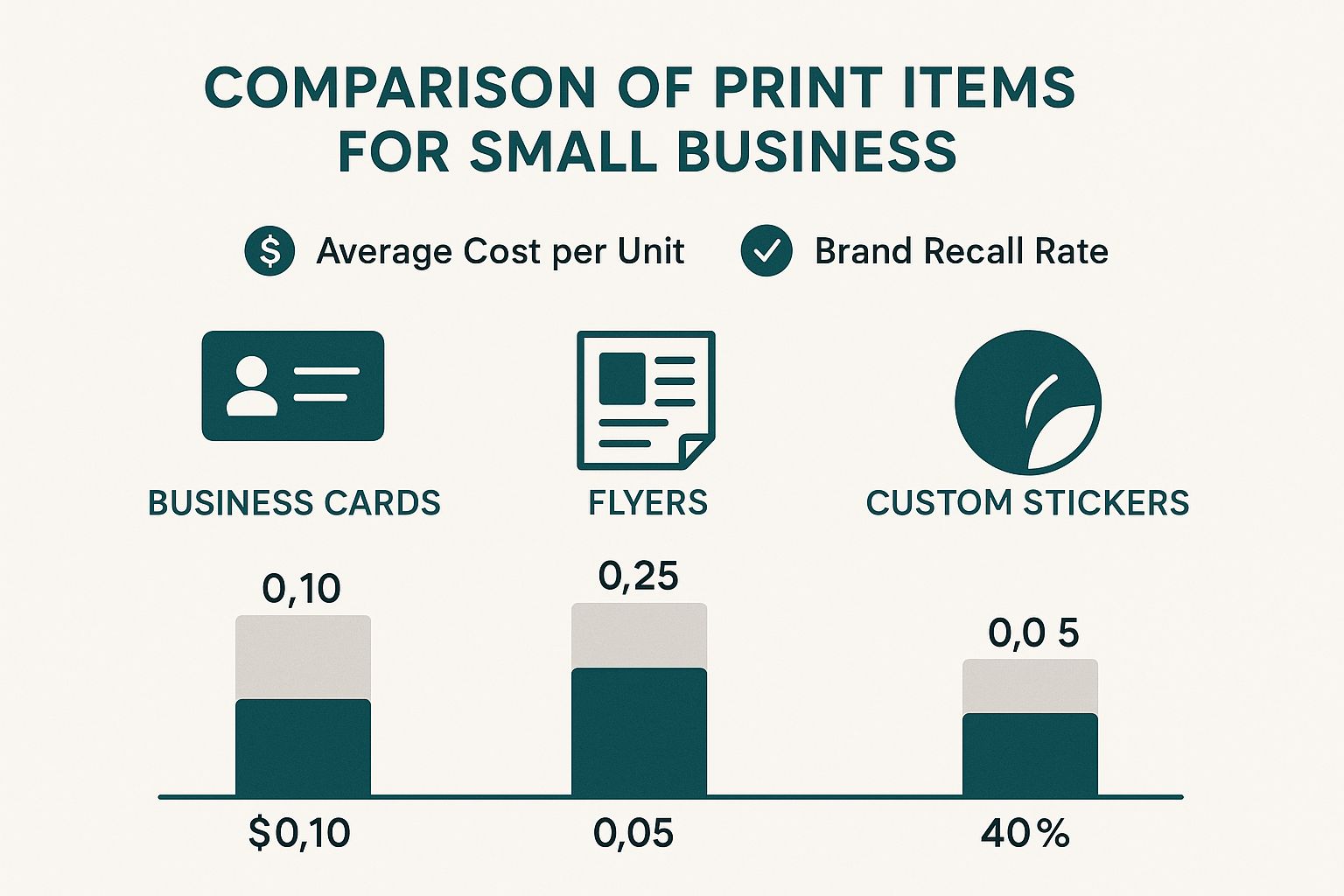
As the data shows, business cards hit a sweet spot with low cost and high brand recall, making them an incredibly efficient networking tool.
Loyalty and Experience Enhancers
Finally, the most successful businesses know that getting a customer is only half the battle. Keeping them is what really drives long-term success. Loyalty-building print materials are all about enhancing the customer experience and creating memorable moments that build a deeper connection with your brand.
- Custom Stickers: These are versatile, fun, and surprisingly effective. A branded sticker on a shopping bag, laptop, or water bottle turns your customers into walking brand ambassadors. They’re a low-cost way to add a playful touch that people genuinely enjoy.
- Branded Packaging: The unboxing experience is a huge marketing moment. Custom boxes, branded tissue paper, or even a simple thank-you note tucked into an order can elevate a routine transaction into something special and shareable.
These thoughtful details show customers you care about more than just the sale. They create a delightful experience that encourages repeat business and positive word-of-mouth, turning one-time buyers into loyal advocates for your brand. By investing in this complete toolkit, you equip your business to make a strong impression at every stage of the customer journey.
Decoding Print Jargon and Making Smart Choices
Stepping into the world of professional printing can feel a lot like learning a new language. You’ll hear terms like "offset," "GSM," and "matte finish" thrown around, and it's easy for small business owners to feel a little lost. But getting a grip on these core concepts is the secret to making smart, cost-effective decisions that make your brand look incredible.
Think of it this way: ordering prints without knowing the basics is like trying to bake a cake without knowing the difference between flour and sugar. You might end up with something, but it probably won’t be what you pictured. Nail down these fundamentals, and you’ll ensure your final product matches your vision perfectly.
Digital vs. Offset: The Two Main Printing Methods
At the heart of it all, there are really two main ways to print: digital and offset. Picking the right one boils down to your project's specific needs, especially how many you need and how fast you need them. Neither is universally "better," but one will almost always be the smarter choice for your situation.
To get the most out of your budget, a key first step is understanding the differences between digital and offset printing so you can line up your project with the right technology.
Here’s a simple way to think about it:
Digital Printing is like using a seriously high-end office printer. It’s perfect for smaller batches, quick turnarounds, and projects where every single print needs to be different (like personalized direct mailers). It's fast, with almost no setup required.
Offset Printing is more like a classic, industrial printing press. It’s a more involved process that uses custom plates. While the setup cost is higher, the price per piece plummets as you print more, making it a no-brainer for big jobs where every print needs to be identical.
Choosing Between Digital and Offset Printing
This table breaks down the core differences to help you decide which path to take for your next project.
| Factor | Digital Printing | Offset Printing |
|---|---|---|
| Best For | Small to medium quantities (e.g., 500 flyers) | Large quantities (e.g., 5,000+ brochures) |
| Turnaround Time | Fast, often available for same-day or next-day shipping | Slower due to the plate-making and setup process |
| Cost | Lower setup cost, higher cost per piece | Higher setup cost, much lower cost per piece on large runs |
| Customization | Excellent for variable data printing (e.g., names, addresses) | Not practical for personalizing individual prints |
| Color Accuracy | Very good, but can have minor variations between runs | Exceptional, with precise color matching (Pantone colors) |
So, for a startup just testing a new flyer design, digital printing is the perfect fit. But for a restaurant chain printing 10,000 identical menus, offset printing delivers unbeatable value.
Understanding Paper Weight and Finishes
Beyond how it’s printed, the actual materials you choose have a massive impact on how customers see your brand. The two most important choices you’ll make here are paper weight and finish.
Paper weight, usually measured in GSM (Grams per Square Meter), tells you how dense and thick the paper is. A higher GSM number means a heavier, more substantial paper. For instance, standard office paper is around 80 GSM, but a premium business card is usually in the 350-400 GSM range. A thick, hefty business card just feels more professional and permanent, while a flimsy one can come across as cheap.
Your choice of paper and finish is a non-verbal cue to your customers. It communicates the level of quality and professionalism they can expect from your business before they even read a single word.
Finishes add that final touch, affecting both the look and feel of your printed piece.
- Gloss: This shiny, reflective finish makes colors pop. It’s great for photo-heavy designs like postcards or catalog covers.
- Matte: A smooth, non-reflective finish that gives off a more modern and sophisticated vibe. It's perfect for designs with a lot of text because it cuts down on glare.
- Uncoated: This is paper in its natural state. It has a slightly rougher texture and is often used for things like letterheads or notepads where you need to be able to write on it easily.
By mastering these fundamental concepts, you go from being a passive buyer to an informed decision-maker. You can be confident that every dollar you spend on printing is a smart investment in your brand’s image.
Preparing Your Designs for Flawless Printing
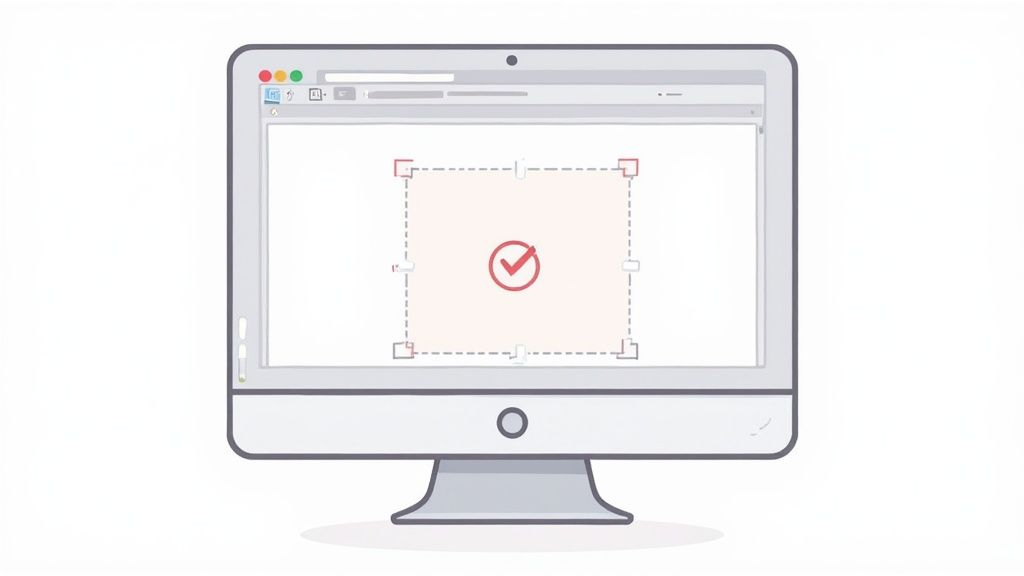
A fantastic design on your screen can quickly become a disappointing and costly mistake on paper if it isn't set up correctly. This is one of the most common hurdles small businesses face, and it often leads to frustrating delays and unexpected reprints. Think of this section as your pre-flight checklist, ensuring your creative vision makes a perfect landing every single time.
Getting these details right from the start saves you a world of headache. It empowers you to submit files to a platform like 4OVER4 with total confidence, knowing the final product will look exactly as you envisioned. So, let's walk through the essential steps to prepare a flawless, print-ready file.
Setting Up Bleed and Safe Zones
Have you ever seen a business card with a tiny, annoying sliver of white along the edge where the color should have been? That’s almost always caused by a lack of bleed. Bleed is simply extra design space you add around your artwork—typically about 1/8th of an inch (0.125")—that extends beyond the final trim line.
During the printing process, the paper can shift ever so slightly when it's being cut. By extending your background colors or images into the bleed area, you create a buffer. This guarantees that even if the cut is a millimeter off, you won't see any unprinted white edges. It’s your safety net.
On the flip side, you also need a safe zone. This is an inner margin where you should keep all your critical text, logos, and important details. Placing anything crucial too close to the edge risks it getting trimmed off entirely. Keeping everything inside that safe zone guarantees it remains intact and your design looks clean and balanced.
Why Resolution Is So Important
The crispness of your printed images comes down to one thing: resolution, which we measure in DPI (Dots Per Inch). For a website or a social media post, a resolution of 72 DPI looks perfectly fine on a screen. But print is a different beast. It requires a much higher density of ink dots to create a sharp, clear image. Submitting a low-resolution file is a surefire recipe for blurry, pixelated results.
For professional printing, the industry standard resolution is 300 DPI. This ensures every last detail in your photos and graphics is rendered with sharpness and clarity, giving your materials a polished, high-quality look.
Before you even think about saving your file, double-check the resolution of your images. If you just pulled a logo off your website, it's almost certainly not high-res enough for print. Always track down the original, high-quality source files to avoid a fuzzy outcome.
Choosing the Right File Format
Finally, the way you save your file matters immensely. While you might work in all sorts of design programs, printers need a universal format that locks in all your design elements—fonts, colors, and images—exactly as you intended them to be.
The absolute best and most universally accepted format for printing is a high-quality PDF (Portable Document Format). Here’s why it’s the top choice:
- It’s Self-Contained: A PDF embeds your fonts and images directly into the file. No more worrying about whether the printer has the right font installed.
- It Preserves Layout: Your design will look the same on any computer, ensuring what you see on your screen is exactly what the printer gets.
- It’s Reliable: PDFs are built for professional print workflows and are far less prone to errors than other formats like JPG or PNG, especially for complex layouts.
By mastering these three concepts—bleed, resolution, and file format—you take control of your printing projects. This prep work ensures that everything from a simple postcard to intricate custom shapes, which you can explore further with our die-cutting services, will be produced flawlessly.
Putting It All Together with 4OVER4
Okay, we've broken down all the pieces of the printing puzzle, from picking the right paper to getting your files ready. That's one thing. But seeing how it all clicks into place with the right partner? That’s where the magic really happens. Let’s walk through a real-world scenario to see what a truly smooth printing process looks like for a new shop owner.
Imagine "The Gilded Fern," a brand-new boutique specializing in handcrafted home goods, gearing up for its grand opening. The owner needs a whole suite of printed materials to make a splash—everything from pre-launch buzz to in-store branding and customer loyalty perks. This is where a comprehensive platform becomes a genuine business asset, not just another vendor.
A Grand Opening Blueprint
The first and most urgent need? Getting people in the door. Using 4OVER4’s online platform, the owner can manage her entire launch campaign from one central dashboard.
- Attracting Attention: First up, she orders a big, weather-resistant vinyl banner for the storefront. Then, she gets a set of vibrant flyers printed to hand out around the neighborhood.
- Building Credibility: Next on the list are premium, thick-stock business cards with a sophisticated matte finish. These are perfect for handing out at pre-launch networking events to make a solid first impression.
- Enhancing the In-Store Experience: She also needs branded touches for the shop itself, so she orders custom product tags and beautiful thank-you cards to slip into every customer's bag.
This whole process is handled in one place, which means the brand colors and quality stay perfectly consistent across wildly different products. That consistency is absolutely crucial for building a professional, trustworthy brand image right from day one.
A true printing partner doesn’t just fill orders; they give you a cohesive system that cuts through the complexity. This lets small business owners get back to what they do best, knowing their brand presentation is in expert hands.
For The Gilded Fern, this means no more wasted time juggling multiple suppliers, re-uploading logos, or stressing about whether the colors will match. It just works.
From Launch to Loyalty
Once the grand opening is a success, the focus shifts to nurturing customer relationships and bringing people back. The owner logs back into the same platform to create materials designed to build loyalty.
- Loyalty Cards: She designs simple but effective punch cards to reward her regulars, giving them a great reason to return.
- Branded Packaging: To elevate the unboxing experience, she orders custom stickers with her logo to seal the tissue paper on every purchase. It's a small detail that leaves a memorable, personal touch.
- Follow-Up Marketing: A few weeks later, she prints a batch of postcards featuring new products to mail to her growing customer list.
By using an all-in-one platform for printing services for small business, the owner of The Gilded Fern has everything she needs right at her fingertips. The platform’s huge catalog is ready to support her business as it grows from a launch-day idea into a beloved local shop. For even more ideas, 4OVER4 has dedicated resources for startups and small businesses ready to scale up. This integrated approach saves time, cuts down on stress, and makes sure every single printed piece works together to build a strong, unforgettable brand.
Common Questions About Small Business Printing
Even when you have a solid plan, a few practical questions always pop up right when you're about to hit "order." Let's be honest, navigating the world of professional printing can feel a bit overwhelming for a small business owner. But a few clear answers can make all the difference.
This section tackles the most frequent questions we hear. Think of it as your quick-reference guide to printing with confidence and avoiding those rookie mistakes that cost time and money.
How Much Should I Budget for Marketing Materials?
Budgeting for print can feel like trying to hit a moving target. A good rule of thumb for many small businesses is to set aside 1-5% of total revenue for all marketing, and then dedicate a slice of that to print. A brand new business trying to make a splash might lean closer to 5%, while an established one could comfortably sit around 1-2%.
But instead of pulling a number out of thin air, it's better to tie your budget directly to your goals.
- Goal: Attract 50 new customers at a local event.
- Need: 1,000 high-quality flyers and 200 premium business cards.
- Action: Get an instant quote for those specific items to build a realistic, project-based budget.
The most effective print budgets aren't just a line item on a spreadsheet; they're strategic investments. Start small, measure your return (like how many people used a coupon from your flyer), and then double down on what works.
What Is the Most Common Design Mistake to Avoid?
The single most common—and costly—mistake we see is submitting designs with low-resolution images. It’s an easy trap to fall into. An image that looks perfectly sharp on your screen (which is typically 72 DPI) will come out looking blurry and pixelated in print.
Professional printing demands a much higher resolution of 300 DPI to get those crisp, clear results you're after. Always, always use the original, high-quality image files. Pulling your logo from your website or a photo from social media is a recipe for a disappointing final product and an expensive reprint.
How Can I Ensure Brand Colors Are Consistent?
Keeping your brand colors consistent across different products is a huge concern for business owners, and rightfully so. Your brand's signature red should look the same on a business card as it does on a massive trade show banner.
The key is to design your files in CMYK (Cyan, Magenta, Yellow, Key/Black) color mode. This is the color model used for printing. RGB (Red, Green, Blue) is for screens, and if you send an RGB file, the colors will shift during conversion.
For absolute, perfect color accuracy, especially for your logo, use Pantone (PMS) colors. A Pantone code is like a universal recipe for a specific color, telling any printer the exact shade to use. It's the ultimate guarantee that your brand identity stays strong and recognizable everywhere it appears.
Ready to bring your brand to life with flawless, professional printing? 4OVER4 offers a massive selection of high-quality products, intuitive online tools, and expert support to make your vision a reality. Start your next project today at 4over4.com and see the difference a true printing partner can make.
More from

13
When you’re ready to invest in an A-frame sign, the first question you'll ask is, "What size do I need?" It usually comes down
 Emma Davis
Mar 13, 2026

113
The real secret to mastering your direct mail budget isn't complicated. It comes down to one simple fact: a standard 4" x 6&q
Emma Davis
Mar 12, 2026

63
Tear-off flyers are a classic for a reason. They’re a tangible marketing tool, designed with perforated, removable tabs at the bottom. Each
Emma Davis
Mar 11, 2026

110
Printing stickers at home is a seriously fun and rewarding project. It boils down to four main parts: designing your image, picking the right
Emma Davis
Mar 10, 2026

103
Ever seen a logo that seems to float right on the glass of a jar or bottle? That’s the work of transparent label stickers.
Emma Davis
Mar 9, 2026

59
Picture this: your product’s beautiful label gets smudged and runny during shipping, or a gorgeous event banner fades to nothing after just
Emma Davis
Mar 8, 2026

58
In a sea of options, your product's packaging and labeling are its first, and often only, chance to make a real connectio
Emma Davis
Mar 7, 2026

89
Ever tried to print a hundred high-quality flyers on your home office printer? You probably ran out of ink, dealt with paper jams, and ended u
Emma Davis
Mar 6, 2026