Table of Contents
- Home
- content hub
- Master Postcard Printing and Mailing for Effective Campaigns
 Share and earn
Master Postcard Printing and Mailing for Effective Campaigns

Aug 16, 2025410 views
Aug 16, 2025410 views
Look, before you even think about firing up a printer or talking to a mail house, you need a solid game plan. A pretty postcard is useless without a strategy. The campaigns that actually make money are the ones built on a clear goal, a specific audience, and an offer that’s too good to ignore. Getting this stuff right upfront is what separates a killer campaign from a pile of expensive junk mail.
Building Your Postcard Campaign Strategy
Before a single postcard gets printed, the real work happens. A winning campaign is built on a strong foundation, and this strategic planning is what keeps you from wasting a ton of money. Your goal is to move beyond just blasting a message out there. You want to create a focused effort that you can actually measure.
Define Your Primary Goal
First things first: what do you actually want people to do when they get your postcard? A vague goal like "increasing brand awareness" is nearly impossible to track and leads to a muddled design. You need something concrete.
Instead, get specific with a goal you can measure:
- Drive Online Sales: Maybe you want to push people to a special landing page. You can track this with a unique URL or a QR code. A solid goal here would be, "achieve a 2% conversion rate from everyone who gets this postcard."
- Generate Foot Traffic: The goal could be to get people into your physical store. A local cafe, for instance, might aim to "bring in 100 new customers using the postcard coupon."
- Boost Brand Recall: This is great for announcing a new service or location. A dentist opening a new office or a real estate agent farming a neighborhood would use this approach.
Identify Your Ideal Audience
Sending your postcard to everyone is a surefire way to get a terrible return on your investment. You have to be precise. Who is your ideal customer? Are they homeowners in a specific zip code? Parents with young kids? People with a certain household income?
A high-end landscaping company, for example, isn't going to waste money mailing to apartment dwellers. They'll zero in on single-family homes in affluent neighborhoods where their services are a perfect fit. The more you know about your audience, the better you can tailor your message to them.
A well-defined audience ensures your message connects instead of getting tossed in the recycling bin. It's the difference between speaking directly to a potential customer and just shouting into a crowd.
Craft an Irresistible Offer
Your offer is the engine of your campaign. It's the hook that gets people to take action. Even the most stunning postcard design will flop if the offer is weak. It needs to be valuable, simple, and easy to claim. To really nail this, you should explore proven ways to generate leads with direct mail advertising.
Here are a few classic offer types that just work:
- A straight discount: "Save 25% on your first order."
- A freebie: "Get a free appetizer with any entree purchase."
- A specific dollar amount off: "$50 off your next service call."
The secret sauce is adding a sense of urgency. A clear expiration date, like "Offer expires October 31st," pushes people to act now instead of letting the postcard get lost in a pile of mail. This kind of planning is the bedrock of any successful postcard printing and mailing effort.
Designing a Postcard That Demands Attention
Think about your own mailbox. It's usually a cluttered mix of bills, catalogs, and junk mail. Your postcard has maybe three seconds to avoid the recycling bin. That's it. A killer design is what makes someone pause, flip it over, and actually read it. This isn't about just looking nice; it's about crafting a message that's clear, persuasive, and gets people to act.
Start with Striking Visuals
Your first and best shot at grabbing attention is with the visuals. This is where utilizing high-quality imagery makes all the difference. Generic stock photos feel cheap and impersonal, and they'll water down your brand's impact instantly. If you can, always go for custom photography that tells a story or shows off your product authentically.
The main image is the hero of your postcard. If you're a restaurant, make it a vibrant, mouth-watering photo of your signature dish. A real estate agent? A stunning twilight shot of a new listing will work wonders. The goal is to spark an emotional reaction and convey value before a single word is even read.
Grab Them with a Bold Headline
Once the image has done its job, the headline needs to land the punch. Keep it short, direct, and focused on the benefit to the reader. This isn't the time to be clever or vague—just get straight to the point.
Here are a few headline angles that work well:
- The Can't-Miss Offer: "50% Off All Fall Jackets This Weekend Only!"
- The Problem-Solving Question: "Tired of Mowing Your Lawn Every Saturday?"
- The Desired Outcome: "Get Your Dream Kitchen in Just Two Weeks."
Your headline should be one of the most visible things on the card, working hand-in-hand with the main image to create a combo that's impossible to ignore.
Don't underestimate the power of physical mail. Research shows that 73% of people actually prefer getting brand communications via direct mail because it feels more personal than an email. This preference shows in the results, too. Postcards boast a response rate of around 4.4%, which crushes email's tiny 0.12%. It's no wonder that 84% of marketers say direct mail delivers the best ROI of all their channels.
Drive Action with a Clear CTA
Everything on your postcard—the image, the headline, the colors—should funnel the reader toward one specific action. Your call-to-action (CTA) is where this all comes together. It has to be impossible to miss and simple to follow.
Don't make people guess what to do next. Your CTA needs to be a direct instruction, like "Scan to Order Now" or "Visit Our Showroom Today." If they have to think about it, you've already lost them.
Make your CTA pop off the card by using a contrasting color. Putting it inside a box or a button shape helps it stand out from the other design elements. I also recommend adding a little urgency to nudge people into action. Phrases like "Offer Ends Friday" or "Limited Spots Available" work great.
Nailing the balance between these three things—powerful visuals, a bold headline, and a crystal-clear CTA—is the key to a great postcard. When you get it right, your piece isn't just another ad; it becomes a powerful driver for your entire postcard printing and mailing campaign, bringing in leads and boosting your bottom line.
Getting the Print Specs and Paper Just Right
That jump from a perfect design on your screen to a physical postcard in someone's hands? That's where a lot of great ideas fall flat. The technical side of printing can feel a bit overwhelming, but nailing just a few key details is what separates an amateur-looking mailer from a professional one that truly represents your brand.
First up, let's talk color. Your design software, whether it's Canva or something from the Adobe suite, probably defaults to RGB (Red, Green, Blue). That’s great for screens, but professional printers run on CMYK (Cyan, Magenta, Yellow, Black). If you don't design in CMYK from the start, you're in for a nasty surprise—that vibrant red you loved on screen might print as a muddy maroon. It’s a simple switch, but it's non-negotiable for getting the colors you actually expect.
Mastering the Technical Details
Beyond color, the sharpness of your images is everything. The magic number here is 300 DPI (dots per inch). Anything less, and you're heading straight for blurry, pixelated graphics that scream unprofessional. Always, always use high-resolution photos and logos to keep your design looking crisp.
Another term you'll hear a lot is bleed. Think of it as a safety margin. It's a little bit of extra design that extends past the actual trim line of the postcard. Without it, even a tiny shift when the printer's blade comes down can leave a weird, unplanned white sliver along the edge. The standard bleed is 0.125 inches on all sides, and it’s the secret to getting that clean, edge-to-edge professional look.
The whole process, from that initial digital file to the finished product, really hinges on getting these specs right from the get-go.
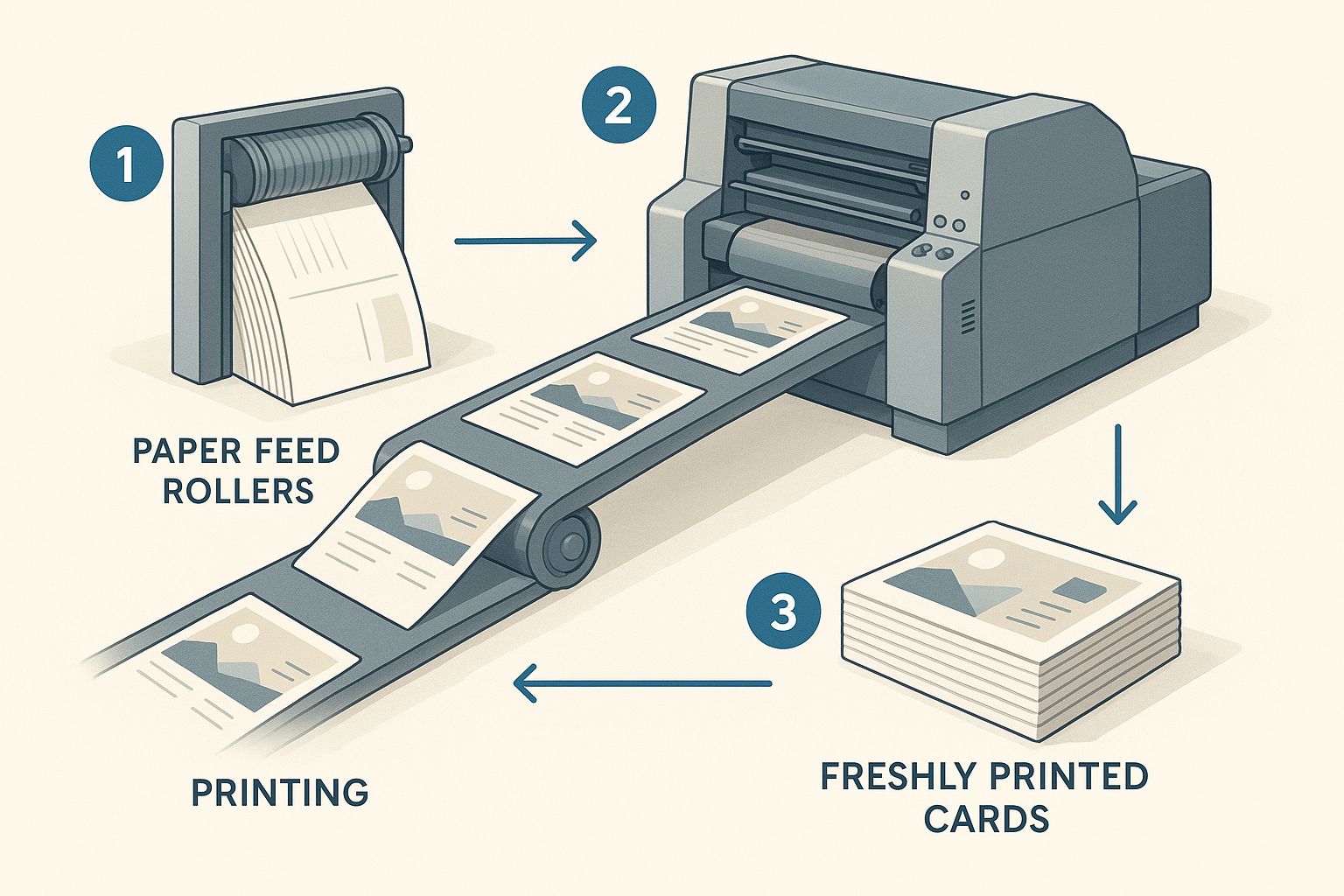
It’s these small technical details that make a huge difference in the final quality.
And this isn't just a niche concern; it's part of a massive global industry. The printing world is projected to hit around $960 billion, growing at a steady clip of about 2.5% annually. What’s really changing the game is digital printing, which now accounts for more than half the market and allows for the quick turnarounds that make postcard campaigns so effective. You can dig into more of these printing industry statistics over at WTPBiz.com.
Choosing the Right Paper Stock
The paper you pick is a huge part of your message. It's the first thing your audience will touch, and its weight and texture instantly create an impression. You'll often see thickness measured in points (pt).
Don't underestimate the feel of the paper. A thick, well-finished postcard creates a tangible connection and can leave a much stronger impression than a flimsy one. It's a subtle but powerful part of your marketing.
Here are the two most common choices you'll run into:
- 14 pt. Cardstock: This is the workhorse of the postcard world. It's sturdy, feels professional, holds up great in the mail, and won't break the bank. A solid, reliable choice for almost any campaign.
- 16 pt. Cardstock: A step up in quality. This stock has a more premium, rigid feel that adds a sense of substance and durability. If you want your brand to feel a bit more high-end, this is the way to go.
To help you decide, here's a quick look at some of the most popular paper stocks and what they're best used for.
Common Postcard Paper Stock Comparison
| Paper Stock | Typical Thickness | Finish Options | Best For |
|---|---|---|---|
| 14 pt. Cardstock | 0.014 inches | Glossy, Matte, Uncoated | All-purpose marketing, event invites, and high-volume mailings. |
| 16 pt. Cardstock | 0.016 inches | Glossy, Matte, Silk | Premium branding, luxury promotions, and pieces meant to feel substantial. |
| 100 lb. Cover | 0.010 inches | Glossy, Matte | Lighter-weight option for budget-friendly mailers or inserts. |
| Recycled Paper | Varies (e.g., 13 pt.) | Matte, Uncoated | Eco-conscious brands looking to highlight their commitment to sustainability. |
Choosing the right paper is about matching the physical feel to your brand's personality.
The finish is the final piece of the puzzle. A glossy finish is your go-to for vibrant, photo-heavy designs—it makes colors pop and grabs attention instantly. On the other hand, a matte finish offers a smooth, non-reflective surface that feels elegant and modern. It’s also much easier to write on, which is a huge plus if you plan on adding a handwritten note. Getting the paper and finish right ensures your postcard feels just as good as it looks.
Playing by the USPS Rulebook for a Smooth Mail Drop
You've designed a killer postcard and got a stack of them fresh from the printer. Now comes the crucial part: getting them into mailboxes without a hitch. This is where knowing your way around the USPS regulations can save you a world of headaches—and money.
Navigating postal rules might sound intimidating, but it's really just about understanding a few key requirements. Get these right, and you'll avoid returned mail, surprise fees, and delays that could derail your whole campaign.
First things first, let's talk size. To qualify for those super-low postcard postage rates, your mailer has to fit within a very specific dimensional window.
- Height: Between 3.5 inches and 4.25 inches.
- Length: Between 5 inches and 6 inches.
- Thickness: Between 0.007 inches and 0.016 inches.
Even a tiny bit over or under, and you’ll find yourself paying for a letter instead. That might not sound like much, but when you're mailing hundreds or thousands of pieces, that cost difference adds up fast.
First-Class vs. Marketing Mail: Speed or Savings?
With your postcard’s size locked in, your next big decision is choosing the right mailing service. The two main players are First-Class Mail and USPS Marketing Mail (which you might remember as Standard Mail). The choice really boils down to how quickly you need your postcards to arrive versus how much you want to spend.
First-Class Mail is your go-to for speed and reliability. You can count on delivery within 1-5 business days anywhere in the country. It also comes with a huge perk: forwarding and return services are included at no extra cost. This is fantastic for keeping your mailing list clean, as you'll know exactly which addresses are no longer valid.
On the other hand, USPS Marketing Mail is the workhorse for budget-conscious campaigns. It’s slower, with delivery taking anywhere from 3 to 10 business days or sometimes longer, and it doesn't include those free forwarding and return services. But the postage savings can be massive, making it the clear winner for large-scale promotions where timing isn’t mission-critical.
Honestly, the right choice completely depends on your campaign. For a time-sensitive sale or event invitation, you need the peace of mind that First-Class provides. But for a general "get our name out there" campaign, the savings from Marketing Mail let you stretch your budget to reach way more people.
Getting the Address and Postage Right
The layout of your postcard's address side is non-negotiable if you want it to fly through the USPS automated sorting machines. The rule is simple: the entire right half of the postcard's back is reserved for the delivery address, postage, and postal barcodes.
Think of an invisible line splitting the back of your card in two. All of your great design, your compelling message, and your branding? It all has to stay on the left side. Keep the right side clear for the USPS. And make sure the delivery address is printed parallel to the longest edge of the postcard, with nothing crowding it.
Don't Have a List? Try EDDM
What if you want to blanket a whole neighborhood but don't have a mailing list? That’s exactly what Every Door Direct Mail (EDDM) was made for.
EDDM is a brilliant USPS program that lets you hit every single mailbox on a specific mail carrier's route, no names or addresses required. It's a total game-changer for local businesses—think restaurants, real estate agents, or a new coffee shop—that need to make a big splash in their immediate area.
You just hop on the USPS website, pick the routes you want to target, and they handle the rest. It's an incredibly effective and affordable way to guarantee you reach every potential customer in the neighborhoods that matter most. Getting these USPS rules down is what makes your postcard printing and mailing effort a true success.
Choosing the Right Partner to Print and Mail Your Postcards
You’ve designed the perfect postcard. Now comes the moment of truth: choosing the partner who will bring it to life and get it into mailboxes. This isn’t a decision to take lightly. Your vendor directly impacts your budget, your timeline, and the quality of the final product.
Generally, you have three paths you can go down: the local print shop, a big online printer, or a full-service direct mail agency. There's no one-size-fits-all answer here. The best choice really boils down to your specific campaign needs, budget, and how hands-on you want to be.
Comparing Your Vendor Options
Let's break down what you can expect from each type of partner.
A local print shop offers a personal touch you just can't get online. You can walk in, talk to a real person, physically touch paper samples, and get expert advice on your project. This is a fantastic option if you're new to the printing world and want some guidance, but that personalized service often comes with a higher price tag and potentially longer turnaround times.
Large online printers are the polar opposite. They are machines of efficiency, built for speed and volume, which usually means lower costs. Their websites make it incredibly easy to upload your design and place an order, sometimes with next-day printing. The catch? You’re on your own. They expect a technically perfect, print-ready file, and customer support can be limited.
Then you have the full-service direct mail agency. These guys do it all. From helping you source a mailing list to design, printing, and managing the entire postcard printing and mailing process, they are your one-stop shop. It's the most hands-off and hassle-free route, but it's also the most expensive. This is typically the best fit for larger, more complex campaigns where you need an expert team managing every detail.
The postcard market itself is surprisingly healthy. Valued at $2.38 billion in 2021, it's projected to climb to $2.78 billion, proving that this classic marketing tool is here to stay. You can dig into the numbers and find out about the postcard market's trajectory on cognitivemarketresearch.com.
Essential Questions to Ask Any Potential Partner
Before you sign on the dotted line, you need to vet any potential vendor. A few smart questions upfront can save you a world of headaches later. Their answers will tell you everything you need to know about their process, expertise, and whether they're a good match for your project.
A great partner does more than just print; they act as a safety net, catching potential issues before they become costly mistakes. Asking detailed questions upfront is the best way to gauge their expertise and commitment to quality.
Here are the non-negotiables you should ask about:
- Proofing Process: How will you see a proof before the full run? Is it just a digital PDF, or can you get a physical hard-copy to approve the colors and feel of the paper? A hard-copy proof is always better for color-critical projects.
- Mailing List Capabilities: Can they handle your mailing list file? More importantly, do they offer data services like CASS certification to clean up your list, standardize addresses, and ensure you get the best postage rates?
- Data Security: How are they going to protect your customer data? This is incredibly important, especially if your list contains any sensitive information. You need to know their security protocols.
Getting solid, confident answers to these questions will help you pick a partner who not only meets your budget but also helps ensure your campaign is a success from start to finish.
Answering Your Postcard Marketing Questions
Even the most seasoned marketer has questions when a new postcard campaign is on the horizon. Getting the details right before you print and mail can be the difference between a campaign that flops and one that flies. Let's walk through some of the most common questions I hear from clients.
What’s the Most Cost-Effective Postcard Size?
This is usually the first thing people ask, and for good reason. If you're purely looking at the numbers, the 4" x 6" postcard is your most budget-friendly option. It costs less to print because we can fit more of them onto a single press sheet, and it qualifies for the lowest USPS First-Class postage rate. It's a solid choice for mass mailings where keeping the cost-per-piece down is the top priority.
But cheaper isn't always better. Think about your own mailbox—a small 4" x 6" piece can easily get overlooked. If you want to make a bigger impact or need more real estate for a compelling photo or message, upgrading to a 5" x 7" or a 5.5" x 8.5" is a smart move. That extra space can give your design the breathing room it needs to truly stand out.
What About Print Quality and Paper?
The look and feel of your postcard say a lot about your brand. People often ask for the thickest, most premium paper stock, which is typically a 16 pt. cardstock. It has a satisfying, sturdy feel that immediately signals quality and professionalism.
The finish you choose is just as important, especially if you plan on adding a personal touch.
- Uncoated or Matte: Go with one of these if you need to write on the postcards. The surface is porous and perfect for a handwritten note or signature.
- Glossy or High-Gloss UV: These are fantastic for making your colors vibrant and protecting the card during transit. Just know that they are virtually impossible to write on with a standard pen.
Your postcard’s texture is part of the experience. A flimsy card feels cheap, but a substantial one feels important. Don't underestimate the power of touch.
Do I Have to Mail Everything Myself?
Absolutely not! This is a huge one. Managing a mailing of hundreds or thousands of pieces is a logistical nightmare you don't need. Most professional printers, including us, offer direct mail services that handle everything.
It's a surprisingly simple process. You give us your design file and your mailing list—usually as an Excel (XLS, XLSX) or CSV file—and we take it from there. We handle the addressing, sorting for postal discounts, and delivering everything to the USPS. This integrated postcard printing and mailing service frees you up to focus on what really matters: tracking the response to your campaign.
Ready to launch a postcard campaign that gets results? 4OVER4 offers a full range of printing and mailing services to bring your vision to life, with premium paper stocks and expert support. Start your next project with us today!
More from

10
When you think of a yard sign, the classic 18"x24" is probably what comes to mind. It’s the industry workhorse fo
 Emma Davis
Mar 14, 2026

16
When you’re ready to invest in an A-frame sign, the first question you'll ask is, "What size do I need?" It usually comes down
Emma Davis
Mar 13, 2026

182
The real secret to mastering your direct mail budget isn't complicated. It comes down to one simple fact: a standard 4" x 6&q
Emma Davis
Mar 12, 2026

70
Tear-off flyers are a classic for a reason. They’re a tangible marketing tool, designed with perforated, removable tabs at the bottom. Each
Emma Davis
Mar 11, 2026

122
Printing stickers at home is a seriously fun and rewarding project. It boils down to four main parts: designing your image, picking the right
Emma Davis
Mar 10, 2026

109
Ever seen a logo that seems to float right on the glass of a jar or bottle? That’s the work of transparent label stickers.
Emma Davis
Mar 9, 2026

63
Picture this: your product’s beautiful label gets smudged and runny during shipping, or a gorgeous event banner fades to nothing after just
Emma Davis
Mar 8, 2026

61
In a sea of options, your product's packaging and labeling are its first, and often only, chance to make a real connectio
Emma Davis
Mar 7, 2026