

TABLE OF CONTENTS
- ‌
- ‌
- ‌
- ‌
- ‌
- ‌
- ‌
- ‌
- Home
- content hub
- How to Order Business Cards A Practical Guide
How to Order Business Cards A Practical Guide
Emma Davis
Content Writer
Nov 18, 2025274 views

TABLE OF CONTENTS
- ‌
- ‌
- ‌
- ‌
- ‌
- ‌
- ‌
- ‌
Ordering a business card really comes down to three main stages: nailing down the design and info, picking your card stock and finishes, and finally, uploading a print-ready file to an online printer. If you get these early decisions right, you’ll end up with a powerful branding tool, not just another piece of paper with your contact details.
Laying the Groundwork for Your Perfect Business Card

Before you start messing around with colors or fonts, let's pump the brakes. The very first thing to figure out is the purpose of your card. Is it just a quick way to swap contact info? A mini-portfolio for your creative work? Or maybe a functional appointment reminder?
Your answer here is going to shape every single choice you make from this point on. A freelance graphic designer, for instance, needs a card that screams creativity, while a financial advisor should aim for a look that feels clean, trustworthy, and professional. This initial thinking phase is all about getting your essential brand assets in order—it’s the foundation of your card's entire message.
Assemble Your Core Information
Think of this as your pre-flight checklist. Having everything ready to go will save you from frustrating delays and last-minute panic.
Here’s what you absolutely need:
- A High-Resolution Logo: This is completely non-negotiable. A blurry, pixelated logo makes your brand look cheap, period. Make sure you have a vector file (like an AI, EPS, or SVG) or, at the very least, a high-resolution PNG or JPG that's 300 DPI.
- Essential Contact Details: Don't just stop at your name. Include your title, company name, phone number, email address, and website.
- Social Media Handles: Be selective. A B2B consultant should probably feature their LinkedIn profile, while a retail brand would get more mileage out of Instagram.
Define Your Target Audience
Who are you actually trying to connect with? A business card designed for a corporate lawyer is going to have a wildly different feel than one for an Etsy shop owner selling handmade jewelry. Before you get attached to any design elements, you have to understand your audience. A great first step is to create effective buyer personas that truly capture your ideal client. This insight dictates everything, from the tone of your text to the feel of the paper.
Key Takeaway: Your business card is a conversation starter. It needs to speak directly to the person receiving it, making them feel like you get their world.
Choose the Right Size and Shape
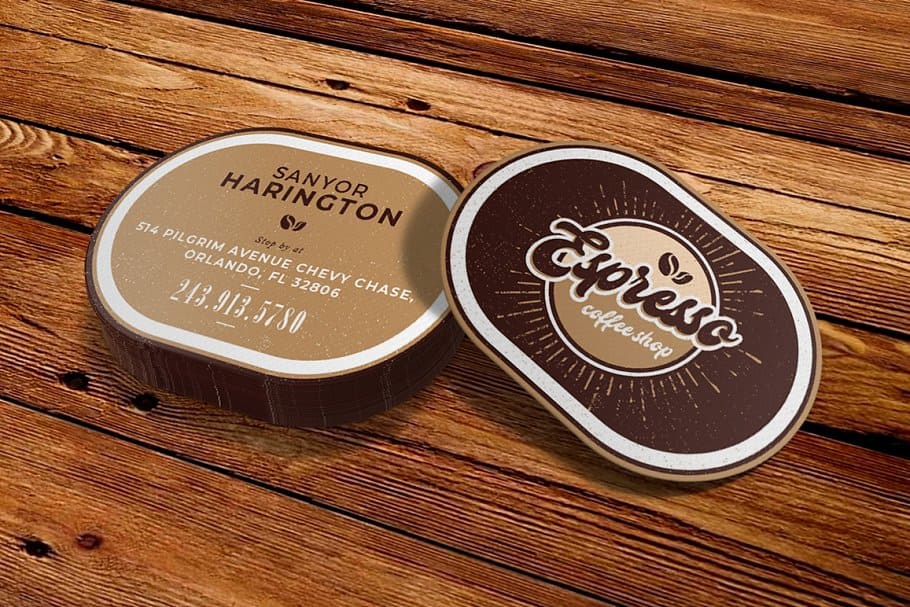
Sure, the standard US size (3.5" x 2") is a safe, universally recognized choice. It fits perfectly in any wallet. But don't be afraid to think outside the box if it fits your brand. A square card can feel modern and creative, and a mini card is often a unique, memorable option that people hang onto.
If you're looking for inspiration for classic and effective designs, browsing a printer's business basics collection can be a great starting point.
Getting these fundamentals locked in before you jump into the design makes the whole process so much smoother. It turns a simple printing order into a strategic branding exercise, ensuring the final card is something you're genuinely proud to hand out.
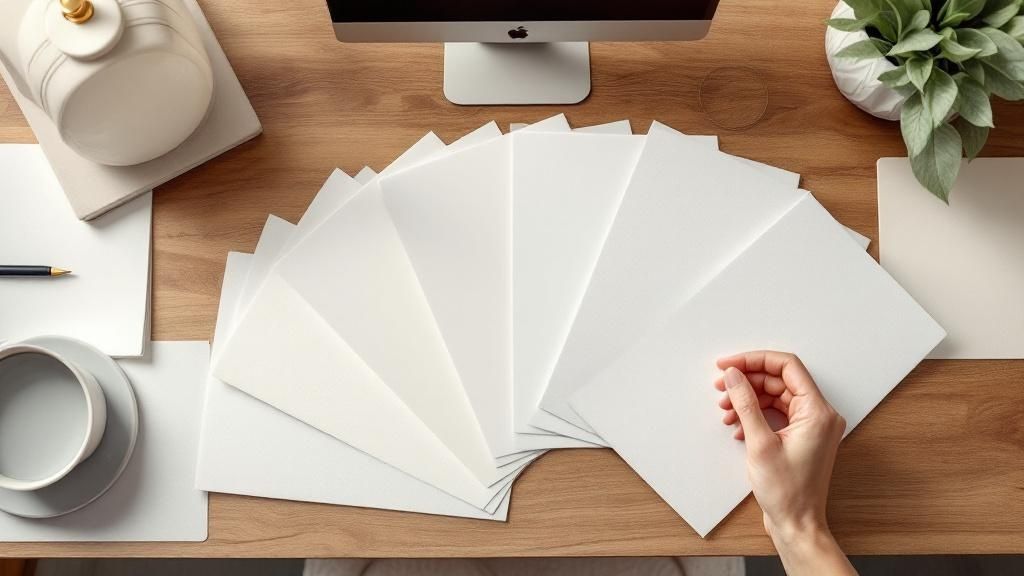
Choosing the Right Paper and Card Stock
The moment you hand someone your business card, the conversation becomes tactile. The weight, texture, and overall feel of that card says something about your brand long before they even read your name. Honestly, getting this physical part right is just as critical as your logo or color palette.

When you're new to ordering business cards, the jargon around paper can feel a little overwhelming. Let's start with the most important factor: paper weight.
Understanding Paper Weight and Thickness
Paper weight is measured in points (pt), where one point equals one-thousandth of an inch. Simply put, a higher point value means a thicker, sturdier card. This isn't just a technical spec; it's a statement.
- 14pt Card Stock: This is your professional-grade workhorse. It’s solid, durable, and a far cry from flimsy, making it a reliable choice for everyday networking or stocking up for a big event.
- 16pt Card Stock: You can feel the difference here. This slightly thicker stock adds a premium touch, suggesting stability and a commitment to quality without a huge jump in cost.
- 32pt and Thicker: Now you’re in luxury territory. A card this thick is impossible to ignore. It feels substantial and important, which is perfect for executives, high-end consultants, or anyone aiming to make a seriously powerful first impression. You can check out a variety of ultra-thick card options to find a style that really commands attention.
Think about it: a flimsy card can subconsciously signal a brand that cuts corners. A card with a satisfying heft, on the other hand, tells a story of durability and confidence.
Coated Versus Uncoated Stocks
After thickness, your next big decision is the paper's finish. This choice impacts both how your card looks and how it can be used.
A coated stock has a sealant that gives it a smooth, finished surface. It can be glossy—which makes colors pop and images look incredibly sharp—or it can have a more subtle satin/silk finish. Glossy cards are a fantastic choice for photographers or any brand with a vibrant, image-heavy design.
On the flip side, an uncoated stock has a natural, porous paper feel. It doesn't have that reflective shine, giving it a more understated, organic, and elegant look. The big practical advantage? It's super easy to write on, making it the go-to for appointment cards or for anyone who likes to add a personal note.
Pro Tip: If your brand identity is minimalist, earthy, or sophisticated, an uncoated or matte stock is often the perfect match. For brands that are bold, loud, and energetic, a glossy finish can really amplify that vibe.
Exploring Specialty and Eco-Friendly Papers
Beyond the basics, specialty papers can add a whole new layer of character. Textured linen stock, for example, has a classic, woven feel that’s perfect for traditional professions like law or finance. Kraft paper gives off a rustic, handmade vibe that’s ideal for artisans and eco-conscious brands.
Speaking of sustainability, it's easier than ever to make an environmentally friendly choice. The global online business card printing market, valued at around $280 million in 2023, has seen a major shift. Now, 42% of online printers offer recycled paper and sustainable inks as standard options. Choosing a recycled stock isn't just a paper choice; it's a silent communicator of your company's values.
Nailing the Design and Adding Special Finishes
Once you have the perfect paper picked out, it's time for the fun part: bringing your brand's personality to life. This is where your business card goes from an idea to something tangible someone can hold in their hand. Whether you’re customizing a template or uploading your own artwork, the goal is a clean, memorable design that instantly shows people what you’re all about.
The basics of good design are everything here. Think about visual hierarchy—what's the very first thing you want someone to see? It should probably be your logo, then your name, and then your contact info. Use size, color, and smart spacing to guide their eye naturally. Whatever you do, avoid clutter. A card crammed with too much text or too many graphics is just overwhelming and won't get a second look.
Taking Your Design to the Next Level with Special Finishes
A great design is the foundation, but special finishes are what make a business card truly unforgettable. These are the tactile and visual upgrades that add a layer of sophistication that plain ink just can't match. They turn a simple piece of paper into a memorable experience with your brand.
Let’s get into some of the most popular options that can elevate your card from standard to standout.
- Spot UV Coating: This finish adds a super high-gloss varnish to specific parts of your card, creating a beautiful contrast against a matte background. Picture your logo catching the light while the rest of the card has an elegant, muted finish. It’s subtle, but it's a powerful way to add depth and draw attention right where you want it.
- Embossing and Debossing: Embossing raises a design element—like your logo or initials—up from the card's surface. Debossing presses it in. Both create this really cool three-dimensional texture that just begs to be touched. This tactile feel makes a card feel more premium and works wonders for minimalist designs where the texture does all the talking.
The Wow Factor of Metallic Foil Stamping
For a touch of pure luxury, nothing beats metallic foil. Foil stamping is a process where a heated die presses a super-thin sheet of metallic foil onto the paper. The result is a crisp, opaque, and seriously reflective design. It’s the go-to choice for high-end brands, creatives, and anyone who wants to make a bold, confident statement.
This technique is also incredibly versatile. A real estate agent might use gold foil for their name on a thick, black card to project success and prestige. A graphic designer could go with a vibrant holographic foil to show off their creative, modern style. The possibilities are endless, and you can explore all the different colors and ways to use foil stamping services to find the perfect fit for your vision.
Real-World Scenario: Imagine a new tech startup that wants to look both innovative and trustworthy. They go with a thick, 32pt matte card stock in a deep navy blue. They have their logo stamped in a sharp silver foil, and their tagline is subtly highlighted with a spot UV finish. The final card feels modern, substantial, and incredibly professional—it makes an impression before they even say a word.
Combining Finishes for Maximum Impact
Here's a pro tip: you don’t have to pick just one. The real magic happens when you thoughtfully combine different finishes. A card can easily feature an embossed logo and a foil-stamped name, creating multiple layers of texture and visual appeal that work together.
Think about a wedding planner whose brand is all about elegance and fine details. They might choose a soft, cotton-textured paper. Their name could be debossed into the card for a subtle, letterpress feel, while the little wedding bells in their logo are accented with a delicate rose gold foil. This combination tells a compelling story about their brand's quality and style before a single word is even read.
When you're deciding on finishes, always bring it back to your brand identity. Is your look minimalist? A single, subtle enhancement might be all you need. If your brand is more lavish or creative, you can definitely handle more complex combinations. The key is making sure the finishes support your design, not overpower it. By carefully choosing these details, you can create a business card that does more than just share your info—it leaves a lasting, positive impression.
Getting Your Artwork Ready for a Flawless Print
A brilliant design can totally fall flat if the digital file isn't set up correctly for a commercial press. Think of your artwork file as the blueprint for your business card; any mistake in that blueprint is going to show up in the final product. Nailing just a few key technical details is the secret to making sure what you see on your screen is exactly what you get in your hands.
This little bit of prep work prevents some of the most common—and costly—mistakes, like seeing your phone number get trimmed right off the edge. It all starts with understanding your card's "safe zone."
Setting Up Your Bleed, Trim, and Safety Margins
Every professional print job has three invisible lines that are absolutely crucial for your design file, even though only one of them—the trim line—will actually be on the finished card.
- Trim Line: This is simple: it's the actual edge where your business card will be cut. For a standard card, that’s the 3.5" x 2" perimeter.
- Bleed Area: This is a 1/8th inch (0.125") border that goes beyond the trim line. If you have a background color or an image that's meant to go right to the edge, it absolutely must extend all the way into this bleed area. It gives the cutting machine a tiny bit of wiggle room and prevents those ugly little white slivers from showing up if the cut is a hair off.
- Safety Margin: This is an area 1/8th inch (0.125") inside the trim line. All your critical info—your logo, name, phone number, and email—has to stay tucked safely inside this zone. Anything you place outside of it is flirting with disaster and risks getting chopped off.
Even if you're getting creative with custom shapes, these principles still apply. If you're thinking about a unique shape, check out some die cutting services for inspiration. You'll see how you can make a design stand out while still playing by the print-safe rules.
This infographic breaks down how to prep your files for special finishes to get that clean, professional look.

As you can see, a well-organized layout is the foundation you need before you can start adding stunning touches like Spot UV or foil stamping.
Mastering Your Colors and Resolution
Here's something a lot of people don't realize: your computer screen and a printing press speak two completely different color languages. Getting them to translate correctly is absolutely essential for your branding.
Screens create color by mixing Red, Green, and Blue light, which is known as RGB. It's perfect for looking at things on a screen, but it’s useless for ink on paper. Printers use a different model called CMYK, which stands for Cyan, Magenta, Yellow, and Key (black). If you send a file in RGB, the printer’s software has to guess at the conversion, and that can lead to some seriously disappointing color shifts. Always, always, always design and export your final print file in CMYK mode from the very beginning.
Key Takeaway: To stop your brand's vibrant blue from turning into a sad, dull purple, set your design software's color mode to CMYK before you even place the first element on the artboard.
Image quality is the other non-negotiable. For any photos or logos on your card to look sharp and professional, they must have a resolution of at least 300 DPI (dots per inch). Anything lower is going to look blurry or pixelated when it's printed, and that instantly cheapens the entire feel of your card.
Prepping Your Files for Print
Before you hit "export," let's go over a checklist of the final technical details. Getting these right is the difference between a smooth process and a frustrating back-and-forth with your printer.
This table breaks down exactly what you need to check.
Print-Ready File Checklist
| Checklist Item | Specification | Why It's Important |
|---|---|---|
| Color Mode | CMYK | Ensures the colors on paper match what you intended on screen, avoiding unexpected shifts. |
| Resolution | 300 DPI | Guarantees that all images and logos will print sharp and clear, not blurry or pixelated. |
| File Format | High-Quality PDF | The industry standard that embeds all fonts, images, and vectors into a single reliable file. |
| Bleed | 0.125" on all sides | Prevents white edges on your final card by giving the cutter a margin of error. |
| Safety Margin | 0.125" from trim | Protects all your important text and logos from being accidentally trimmed off. |
| Fonts | Outlined (Converted to Curves) | Turns text into vector shapes, so your typography prints perfectly even if the printer doesn't have your font. |
Paying attention to these details might seem tedious, but it's what separates an amateur-looking card from a truly professional one. It ensures a fast, error-free printing process and a final product you'll be proud to hand out.
Finalizing Your Order and Choosing Shipping
You've done the hard work—navigating the design, picking the perfect paper, and adding those killer finishes. Now you're at the final checkpoint before your cards hit the press. This last stage is all about a careful review and making smart logistical choices to get your finished product in hand, looking perfect and arriving on time.
The first thing you’ll get from the printer is a digital proof. Don't just give it a quick glance. Seriously, this is your last chance to catch any mistakes. Treat it like a final exam, and check every single detail before you hit "approve." A tiny error that seems insignificant on a screen can become a massive headache on a stack of 500 printed cards.
The Art of the Proofing Process
When that proof lands in your inbox, zoom in and get critical. It's so easy to get "design blindness" after staring at the same file for hours, so a methodical check is your best friend here.
Here’s a quick mental checklist I run through:
- Typos and Grammar: Read every single word out loud. I can't stress this enough—triple-check names, titles, phone numbers, and email addresses.
- Element Alignment: Make sure your logo, text blocks, and social icons are perfectly lined up and aren't hugging the safety margins too closely.
- Color Consistency: Remember, the colors you see on screen (RGB) often look a bit different when printed (CMYK). This proof is your closest preview of that final CMYK output.
- Image Resolution: Give all your images and logos a close look. They should be crisp and sharp, with no pixelation in sight.
Your digital proof is basically your contract with the printer. When you approve it, you're saying, "Yes, this is 100% correct." Take your time, and if anything looks even slightly off, ask for a revision right away.
Deciding on Your Order Quantity
So, how many cards should you actually get? This is a balancing act between what you need right now and what will save you money in the long run. With most online printers, the cost-per-card drops significantly as your order size goes up. Ordering 1,000 cards is almost always cheaper per piece than ordering four separate batches of 250.
Think about your specific situation. An Etsy seller who slips a card into every package might find it smart to order 2,500 to last the year. On the other hand, if you're a consultant who might get a promotion and a new title soon, sticking with a smaller run of 500 is the safer bet to avoid waste.
Navigating Turnaround and Shipping Options
The last piece of the puzzle is getting the cards from the print shop to your doorstep. This involves two different timelines you need to understand: production turnaround and shipping speed.
Production turnaround is simply how long it takes to print, cut, and finish your order. A standard timeline might be 3-5 business days, but you can usually find an expedited "rush" option that gets it done in 24 hours for an extra fee.
Once they're printed, you'll pick a shipping method. This choice is key. If you want to get a better handle on delivery logistics in general, it can be helpful to read up on selecting a cost-effective courier service for other shipping needs. This will help you weigh options like standard ground shipping versus overnight delivery based on your budget and deadline. And while you're at it, make sure all your packages look professional with custom shipping and mailing labels.
Should You Consider a Digital Business Card?
In a world where connections happen in an instant, the classic paper business card is getting a tech-savvy counterpart. The digital business card, usually shared with a quick QR code scan or a tap of a phone, is definitely picking up steam as a serious networking tool. But does that mean it's right for you?
This isn't really an "either/or" situation. It's less about ditching your beautifully printed cards and more about seeing a digital card as a powerful sidekick to your physical ones. It offers a different kind of flexibility and immediacy that can be a game-changer for tech-forward professionals, regular conference-goers, or anyone who wants a more dynamic way to share their info.
The shift is happening faster than you might think. Back in 2020, only about 12% of businesses globally were using them. Fast forward to 2024, and that number has shot up to 37%, with North America leading the charge. If you want to dive deeper into the numbers, digitalbusinesscard.com has some great insights on this trend.
The Upside of Going Digital
Digital cards have some compelling perks that traditional cards just can't touch. The biggest wins are convenience and the ability to adapt on the fly.
- Instant Sharing, No Typos: A simple QR scan or NFC tap beams your entire contact profile straight to someone's phone. No more fumbling with manual entry or realizing later you typed a number wrong.
- A Greener Footprint: It’s a small thing, but going digital cuts down on paper waste, which can subtly align your brand with more sustainable practices.
- Always Up-to-Date: Just got a promotion or a new phone number? You can update your digital card in seconds, making sure everyone you connect with has your latest, most accurate information.
Think of it this way: a digital card is always working for you. It can link directly to your portfolio, your booking calendar, or your latest project, turning a simple contact exchange into a genuinely interactive experience with your brand.
The Drawbacks to Keep in Mind
Of course, it's not a perfect system. The biggest hurdle with the digital approach is its total reliance on technology. If someone's phone is dead, they're in a poor service area, or they just aren't comfortable scanning QR codes, the exchange can grind to a halt.
There's also something to be said for the tangible quality of a well-designed physical card. You lose that memorable, tactile moment—the feel of a unique paper stock or the flash of a foil finish. For many, handing over a physical card still feels more personal and makes a more lasting impression.
Ultimately, the smartest strategy for most modern professionals is probably a hybrid one. Carry your stunning physical cards for those high-impact, personal connections, but have your digital card ready to go for quick, efficient sharing in any situation.
A Few Final Questions Before You Order
Even after you've nailed down the big picture for your new business cards, a few specific questions always seem to pop up right at the finish line. Getting these details sorted helps you click "order" with total confidence, knowing you’re getting exactly what you envisioned. Let’s walk through some of the most common questions we hear from clients.
What’s the Real Difference Between 14pt and 16pt Card Stock?
The "pt" (or point) is simply a measure of the paper's thickness. While a 14pt stock is a solid, professional standard you can't go wrong with, upgrading to 16pt gives your card a noticeably more rigid and substantial feel.
It's a subtle difference, but it's one people feel the moment they take your card. If you want to communicate durability and a premium quality without saying a word, that extra thickness of a 16pt stock is a small investment that makes a big impact. It just feels more impressive.
Should I Go with a Glossy or a Matte Finish?
This really comes down to your brand's personality and how you plan to use the cards.
A glossy finish makes colors pop. It’s vibrant, eye-catching, and perfect for designs that are heavy on photography or bold graphics. If your brand is energetic and visual, gloss is a fantastic choice. The only trade-off is that it can show fingerprints and has a bit of a glare.
On the other hand, a matte finish has a smooth, non-reflective surface that feels modern and sophisticated. It’s the go-to for minimalist designs, elegant branding, and any card you might want to write on—think appointment cards or a spot to jot down a personal note.
What Exactly Is a Bleed, and Do I Actually Need It?
A bleed is absolutely essential for a professional-looking card. It’s a small border—usually 1/8th of an inch—that extends your background design beyond the final trim line of the card.
Think about it: printers cut massive stacks of cards all at once, and even with the best equipment, tiny shifts are inevitable.
That bleed acts as a safety net. It ensures that even if the cut is a hair off-center, you won't get a jarring and unprofessional white sliver along the edge. Your background color or image will go perfectly from edge to edge, every time.
How Many Business Cards Should I Really Order?
This is a classic "it depends" situation, but we can break it down. If you're a new founder or your contact info might change in the near future, starting with a smaller run of 250 or 500 is the smart play. It keeps you flexible and avoids waste.
But if you're hitting trade shows, running a retail store, or constantly networking, ordering 1,000 or more is where you’ll see serious savings. The cost-per-card drops dramatically with larger quantities. An Etsy seller including a card with every shipment might need 2,500 a year, while a consultant might only go through 400. Take a quick look at your own business habits to find that perfect balance between bulk pricing and practicality.
Ready to create a business card that feels just right? At 4OVER4, we offer a huge selection of paper stocks, special finishes, and design tools to bring your vision to life. Order your custom business cards today
More from
729
Full bleed printing is a simple but game-changing technique. It's how you get your artwork—whether it’s a photo, a background color, o
Emma Davis
Feb 3, 2026
336
Even though we live in a digital world, the humble business card is still a powerhouse networking tool. But here's something most people d
Emma Davis
Feb 2, 2026
1307
Staring at a wall of banner dimensions can feel a little overwhelming. But while there's no single "typical banner size" that wo
Emma Davis
Feb 1, 2026
397
Stretching your marketing budget doesn't mean you have to settle for flimsy, forgettable brochures. The real secret to low cost br
Emma Davis
Jan 31, 2026
387
Advertising magnets are one of those marketing tools that are so simple, you might overlook their power. They’re tangible, they last for age
Emma Davis
Jan 30, 2026
198
Tired of fighting with torn paper and sticky residue? We’ve all been there. The best way to get labels off bottles is often a simple soak in
Emma Davis
Jan 29, 2026
352
Want to know the real secret to getting a poster to stick to a wall without it peeling off in the middle of the night? It's all about what
Emma Davis
Jan 28, 2026
320
When you hear "table tent specs," what we're really talking about are the foundational details for printing them correctly: the
Emma Davis
Jan 27, 2026