Table of Contents
- Home
- content hub
- How to Build Brand Awareness from Scratch
 Share and earn
How to Build Brand Awareness from Scratch

Sep 28, 2025351 views
Sep 28, 2025351 views

Building brand awareness is about making your name stick in people’s minds. It sets the stage for every campaign that follows, whether it’s a flashy ad or a detailed guide. Show up consistently, tell your story with authenticity, and earn trust one interaction at a time.
Why Brand Awareness Is Your Ultimate Growth Engine

Forget the buzzwords. Recognizing a brand goes beyond a cool logo or slogan—it’s the bedrock of steady growth. People tend to stick with names they know, even if there’s a cheaper option next door.
Think about your last coffee run. Most of us head straight for a familiar cup. That split-second choice? It’s brand awareness in action.
Turning Recognition Into Revenue
When your audience already knows who you are, every marketing dollar stretches further. Brand awareness isn’t just a vanity metric; it’s a real asset that can boost sales and lift company value.
In fact, the 2025 Kantar BrandZ report pegs the world’s top 100 brands at $10.7 trillion, with Apple alone at $1.3 trillion. Even newer players like Nvidia and Spotify saw their values jump by over 100%. Discover more insights from the 2025 Kantar BrandZ report
When you invest in awareness, you're not just buying ads; you're building a mental footprint in the minds of your customers. This footprint creates preference, commands loyalty, and ultimately drives sales without you having to fight for every single click.
The Ripple Effect Of A Strong Brand
A well-known name does more than lift revenue. It turns customers into advocates and gives you a cushion when things don’t go perfectly.
Key benefits include:
- Improved Marketing Efficiency: Ads resonate more with audiences who already recognize you
- Higher Customer Loyalty: Familiar faces build trust, leading to repeat business
- Attraction Of Top Talent: A respected brand naturally draws skilled professionals
Building brand awareness is a marathon, not a sprint. Invest in that initial spark, and you’ll create a thriving, go-to presence in your industry.
Defining Your Unforgettable Brand Identity
Before you can show the world who you are, you have to know it yourself. This is the bedrock of any solid brand awareness strategy. Without a clear identity, your marketing efforts will feel disconnected and, frankly, they just won't work.
Think of your brand as a person. What does it believe in? How does it talk? What makes it stand out in a crowd? Nailing down the answers to these questions is the first real step to building a presence people remember.
Pinpoint Your Mission And Core Values
First things first: what's your "why?" Your mission is the reason you exist beyond just turning a profit. Your values are the principles that guide every decision you make. These two things are the heart and soul of your brand.
For instance, a local coffee shop’s mission might be "to create a welcoming space for community connection." Their values could be sustainability, quality craftsmanship, and inclusivity. This isn't just corporate jargon; it drives everything they do, from how they source their beans to what they post on Instagram.
On the other hand, a B2B software company might have a mission to "simplify complex data for growing businesses," with values like efficiency, reliability, and customer success. This identity shapes their product roadmap, their support style, and the kind of content they create.
To get to the core of your own brand, ask yourself:
- What problem are we genuinely solving for our customers?
- What impact do we want to make in our industry or community?
- What are the non-negotiable principles that steer our business?
Craft A Unique Brand Voice And Personality
Once you know what you stand for, you can figure out how you'll say it. Your brand voice is the specific tone you use across all your communications, whether it's on your website or in a quick tweet. It’s how your brand’s personality comes to life.
Are you the witty expert? The friendly, approachable guide? Or the formal, trusted authority? A consistent voice is what builds familiarity and trust over time. In fact, consistent brand presentation has been shown to increase revenue by 33%.
Your brand's voice has to be authentic to your values and connect with your target audience. Trying to be something you're not is a fast track to losing credibility. The goal is a personality that people feel they know and can count on.
This consistency is non-negotiable. Imagine if that quirky, friendly coffee shop suddenly started sending out stuffy, corporate-sounding emails. It would feel completely off and break the trust they’ve worked to build.
Develop A Cohesive Visual Style
Long before they read a single word, people see your visuals. Your logo, colors, fonts, and images all team up to create an instant impression. A powerful visual identity makes your brand recognizable in a split second, whether it’s on a billboard or a social media feed.
Think about the iconic Tiffany Blue box or the simple, clean aesthetic of Apple. These visual cues are so strong they communicate the brand’s entire vibe without any text at all. Your visual style needs to be a direct reflection of your brand’s personality and values.
This is where brand guidelines become absolutely essential. You can learn how to create comprehensive brand guidelines to keep everyone on the same page. This document is your rulebook, ensuring that every single creative asset—from a business card to a website banner—is reinforcing the same, unified identity. By getting this foundation right, you’re setting the stage for a brand awareness strategy that is coherent, memorable, and built to last.
Building Your Omnichannel Awareness Plan
Once you’ve nailed down your brand identity, the real work begins: getting noticed. An omnichannel plan isn't about shouting from every rooftop; it's about being in the right places at the right times, creating a seamless experience for your audience, whether they stumble upon you online or in the real world.
This is where your digital strategy shake hands with your physical marketing. The ultimate goal? To make your brand feel familiar and reliable, no matter where a customer bumps into it. A well-designed postcard can be a fantastic driver of website traffic, just as a sharp social media ad can pack the house for a local event.
Unifying Digital and Physical Touchpoints
The most effective awareness strategies simply erase the line between the online and offline worlds. Your audience moves fluidly from their phone to a storefront, and your brand needs to do the same. This creates a cohesive story that constantly reminds them of who you are.
Think about a local clothing boutique. They could put QR codes on their in-store price tags. A quick scan could take a shopper to a page showing three different ways to style that exact item, featuring photos from other customers on Instagram. It’s a simple touch, but it brilliantly connects a physical shopping trip to the brand's vibrant online community.
Or consider a B2B company at a trade show. Instead of just handing out flyers that will end up in the trash, they can use their booth to sign people up for an exclusive webinar. After the event, they can send a personalized LinkedIn message, followed by a beautifully printed recap of the show's key insights. Every touchpoint builds on the last, creating a layered impression that’s hard to forget.
The real magic of an omnichannel approach is in the connections. It’s not about running a print campaign and a digital campaign in separate silos. It’s about designing them to feed each other, creating a brand experience that's far greater than the sum of its parts.
This integrated method is crucial for getting your brand to stick. It’s a well-known marketing truth that brands need at least 6 to 7 impressions before a consumer even starts to recognize them. Social media is a huge piece of this puzzle, as 77% of consumers say they prefer buying from brands they follow. You can dig deeper into the power of repeated touchpoints with these branding statistics on shapo.io.
To help you visualize how these different channels work together, here’s a quick comparison of some common tactics.
Digital vs. Print Awareness Tactics: A Strategic Comparison
This table breaks down some popular digital and print tactics, showing where each one shines and how you can measure its success.
| Tactic | Primary Goal | Best For Audience | Key Measurement Metric |
|---|---|---|---|
| SEO-Driven Blog Content | Attract organic traffic; build authority | Actively searching for solutions | Organic keyword rankings; website traffic; time on page |
| Social Media Campaigns | Build community; drive engagement | Browsing and looking for inspiration | Follower growth; engagement rate; social media reach |
| Direct Mail (Postcards/Flyers) | Drive local traffic; announce offers | Geographically targeted; existing customers | Redemption rates (with codes); direct website visits |
| Trade Show/Event Sponsorship | Generate qualified leads; build relationships | Niche industry professionals; local community | Booth visitors; leads collected; post-event follow-up rate |
Choosing the right mix depends entirely on your specific goals and who you're trying to reach.
Content and SEO: Your Inbound Engine
Think of your content as the fuel for all your digital awareness efforts. By creating genuinely helpful, problem-solving content, you naturally attract an audience that's already looking for the answers you provide. This isn't just shouting into the void; it's building brand awareness with people who are ready to listen.
And don’t just stick to blog posts. Mix it up!
- In-depth Guides: Position yourself as the go-to expert on a key topic in your industry.
- Video Tutorials: Show, don’t just tell. Walk people through a process and make complex ideas feel easy.
- Case Studies: Nothing beats a good story. Show potential customers the real-world results you’ve delivered.
SEO is what makes sure all this great content actually gets discovered. By targeting the keywords your audience is typing into Google, you put your brand directly in their path right when they need you most. A great sign that your awareness efforts are working? When people start searching for your brand by name.
Using Social Media to Build a Community
Social media is not a megaphone; it’s a community center. It’s the perfect place to let your brand’s personality shine, have real conversations, and build genuine connections. The trick is to show up on the platforms where your target audience actually hangs out.
This image shows how you can think of your social channels as extensions of your core brand, each with its own role to play.
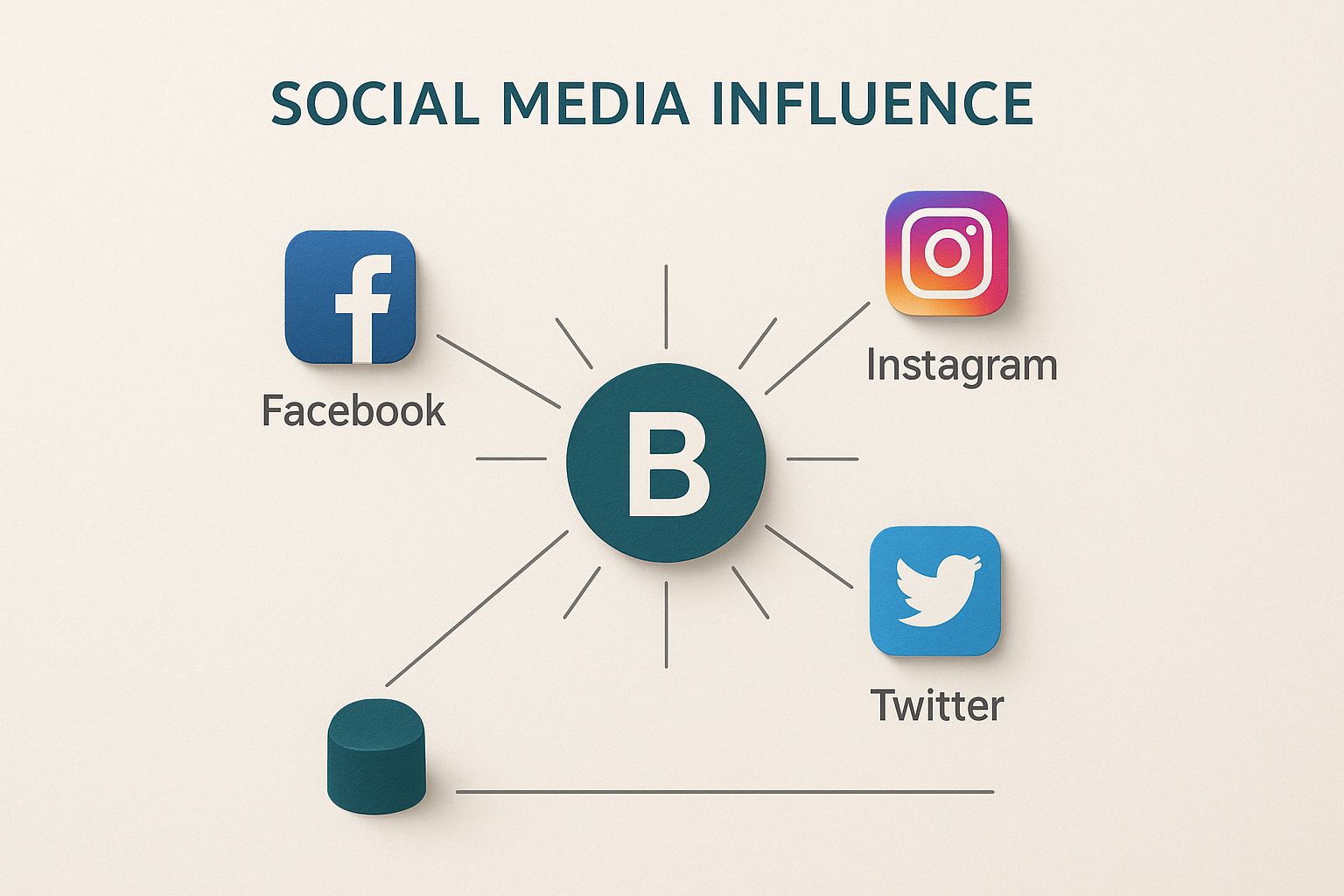
As you can see, a strong strategy ensures every platform connects back to a central, consistent brand identity.
Instead of just blasting out promotions, focus on sharing things that are interesting, helpful, or entertaining. A local bakery, for example, could share behind-the-scenes chaos on Instagram Stories, run a Facebook poll to name a new cupcake, or share quick baking tips on TikTok. This is how you turn passive followers into a passionate community of advocates.
The Strategic Role of Print and Events
In a world overflowing with digital noise, something you can physically hold can make a huge impression. High-quality business cards, brochures, or even custom-printed packaging create a tangible connection that a digital ad just can't match. They’re a lasting, physical reminder of your brand.
Local events and sponsorships are another powerhouse for awareness. Sponsoring a community 5K or setting up a booth at a farmers market puts you right in front of a relevant audience. It's a chance to have real, face-to-face conversations and create positive memories that build brand loyalty for the long haul.
Executing Tactics That Build Real Trust
A brilliant strategy on paper means nothing if it doesn't actually connect with people. This is where we shift from planning to doing, focusing on tactics that don't just get you noticed—they earn genuine trust. Real brand awareness isn't about being the loudest voice in the room. It’s about becoming a reliable, helpful presence people can count on.
The secret is to stop thinking like a seller and start acting like a solver. Every blog post, every social media reply, every partnership you form should be designed to provide real, tangible value. That's how you build a reputation that speaks for itself.
Create Content That Actually Helps People
Your audience is swimming in a sea of marketing messages. The fastest way to stand out is to stop selling and start helping. Creating genuinely useful content is, without a doubt, the most powerful way to show what you know and build credibility over the long haul.
Instead of another flashy ad, what if you created a detailed guide that solves a common frustration for your ideal customer? Imagine you've just launched an e-commerce store for sustainable home goods. You could publish a blog post like "5 Simple Swaps for a Zero-Waste Kitchen." Suddenly, you’re not just another shop—you're a helpful resource.
To make this work, you need to think beyond the blog post:
- How-To Videos: Show your product in action or teach a related skill. A local hardware store could post quick videos on fixing a leaky faucet. Simple. Effective.
- In-Depth Guides: Own a topic. A financial advisor could publish the ultimate guide to retirement planning for freelancers, becoming the go-to source.
- Customer Stories: Let your customers do the talking. Showcasing how real people use your product gives you powerful social proof and makes your brand feel much more human.
Engage in Authentic Social Conversations
Social media isn't a billboard; it's a conversation. Building trust here means showing up, listening, and participating like a real person. Ditch the automated responses and corporate-speak.
Let's go back to that sustainable home goods store. Instead of just posting product pics, they could ask followers to share their favorite eco-friendly life hacks. They could then feature the best tips in their Instagram Stories, which fosters a real sense of community.
This is also where you can turn a negative into a positive. When someone has a bad experience, a quick, empathetic, and public response can build more trust than a dozen glowing reviews. It shows you're paying attention and that you actually care.
Forge Partnerships That Boost Credibility
You don’t have to do this alone. Teaming up with other trusted voices in your industry can give you a massive credibility boost and extend your reach almost overnight. This could mean collaborating with other businesses, influencers, or even local community groups.
The most important thing here is alignment. Your partners have to share your values and talk to a similar audience. For our e-commerce brand, a perfect partner might be a popular zero-waste blogger or the local farmers' market.
These partnerships can come in a few different flavors:
- Co-Hosted Webinars or Workshops: Partner with a complementary business to teach your shared audience something valuable.
- Influencer Collaborations: Find micro-influencers who genuinely love what you do. Their authentic perspective is far more powerful than a paid celebrity endorsement.
- Community Sponsorships: Supporting a local event or charity shows that your brand is invested in the community it serves.
Building trust is the bedrock that turns simple brand recognition into unshakable loyalty. Without it, even the most visible brand will fail to turn eyeballs into customers.
This isn't just a hunch; the data backs it up. Trust is a make-or-break factor for modern consumers. A staggering 81% of consumers say they need to trust a brand before they'll even consider buying from it. And it's not just about the company—65% of consumers say their perception of a brand's people influences their purchasing decisions. You can read the full research about these brand awareness findings.
To truly connect with your audience, you might even consider the power of experiential marketing. Creating memorable, real-world experiences can forge an emotional bond that digital-only interactions often struggle to match. These efforts show you’re willing to invest in the relationship, building a foundation of trust that will pay off for years.
How to Actually Measure Brand Awareness
Brand awareness often feels like a fuzzy, hard-to-pin-down goal. It's not a sales figure you can neatly slot into a spreadsheet. But just because it’s abstract doesn't mean you can't measure it. If you don't track your progress, you're just guessing at what works.
The trick is to look at a combination of direct and indirect signals. Some numbers you can pull right from your analytics, while other clues give you a broader sense of your brand’s footprint. When you put them together, you get a surprisingly clear picture of your growing influence.
Checking Your Direct Website Traffic
One of the cleanest ways to see if your brand is sticking in people's minds is to look at who comes directly to your website. When people really know you, they stop relying on Google; they come straight to the source.
Dive into your website analytics and look for the Direct Traffic channel. This number represents visitors who typed your URL right into their browser or used a bookmark. A steady climb here is a fantastic sign that your brand name is becoming memorable.
Direct traffic is the purest measure of brand recall you can get online. It's the digital equivalent of someone walking into your physical store because they already know your name. When this number goes up, you know you're doing something right.
While you're there, keep an eye on your Organic Search Traffic, but get specific. Look at the actual search queries people are using. A growing number of searches for your exact brand name—what we call "branded search"—means people are actively looking for you, not just a solution you offer.
Using Social Media Metrics
Your social media accounts are a goldmine for awareness data. Likes and follows are nice ego boosts, but the real value is in the metrics that show how far your message is traveling and how people are reacting to it.
Here’s what I always recommend tracking:
- Reach and Impressions: Think of reach as the number of unique people who saw your post, and impressions as the total number of times it was shown. If your reach is growing, you're successfully breaking out of your bubble and finding new audiences.
- Engagement Rate: This is the big one—it covers likes, comments, shares, and saves. High engagement proves your content is connecting, not just passing by on a screen. Shares are especially powerful; they’re a direct endorsement from a fan.
- Audience Growth: A consistent increase in followers shows your brand is not just attracting people, but also holding their interest over time.
For example, imagine a local print shop posts a quick video showing how they create a complex foil-stamped invitation. If that video gets shared hundreds of times, its reach explodes far beyond their current customer base, introducing their craft to thousands of potential new clients. That's brand awareness in action, and it's completely measurable.
Monitoring Your Share of Voice
It’s one thing to see your own numbers grow, but it’s another to know how you stack up against the competition. You need to understand how much of the conversation in your industry you actually own. This is called your Share of Voice (SoV).
Think of the entire online conversation about "custom business cards" as a pie. Your SoV is the size of your slice compared to everyone else's.
To figure this out, you’ll need a social listening tool to track mentions of your brand, your products, and key industry terms across the web.
I suggest setting up alerts for:
- Your brand name
- Your top competitors' names
- Key industry hashtags
- Important product or service categories
By tracking this over time, you can see if your presence is growing relative to the competition. If your slice of the pie is getting bigger month over month, you can be confident your brand awareness strategy is paying off. There are plenty of tools that can automate this, giving you a dashboard to monitor your market position and jump on new opportunities.
Answering Your Toughest Brand-Building Questions
Alright, so you've got the strategies. But as you start to put them into action, you're going to hit some real-world snags. This is completely normal—it's the part where theory bumps up against reality.
Let's walk through some of the most common questions and hurdles I see business owners face when they’re trying to get their brand off the ground.
How Much Should I Actually Budget for Brand Awareness?
This is the million-dollar question, isn't it? While there’s no single magic number, a solid rule of thumb for most small to medium-sized businesses is to set aside 10-20% of your total marketing budget for brand awareness. This is your top-of-funnel money, dedicated purely to getting your name out there.
But honestly, the exact dollar amount isn't what matters most. Consistency is king. It's far better to spend a smaller, steady amount every month on content, social media, or local print ads than to blow your budget on one splashy campaign that's over in a week.
Think of it like this: A consistent trickle of water helps a plant build deep, strong roots. Drenching it once and then ignoring it for months is a recipe for disaster. Once you see which channels are actually working, you can confidently start turning up the dial on your spending.
Seriously, How Long Until I See Real Results?
I get it. You're putting in the work, and you want to see a payoff. Building a brand that people recognize and trust is a marathon, not a sprint. You might see some encouraging blips on the radar within the first 3 to 6 months—a little jump in website traffic, a few more social media followers.
But for most businesses, achieving that coveted "top-of-mind" status in your market takes real dedication. We're usually talking 12 to 18 months of consistent, focused effort. Patience is your most valuable tool here. It’s so easy to get frustrated when you don't become a household name overnight.
Here's a pro tip: Keep your eye on the leading indicators. Are people starting to search for your brand by name? Are you getting more organic mentions on social media? These are the small wins that prove your strategy is on the right track, long before the major results roll in.
Don’t give up if it feels slow. Every blog post you write, every helpful comment you leave, every positive customer interaction—it’s all a brick in the foundation of your brand. Just keep building.
My Industry Is So Crowded. How Do I Even Stand Out?
In a noisy market, shouting louder rarely works. You have to be different. The biggest mistake I see is trying to appeal to everyone. That’s a surefire way to be invisible. The most effective thing you can do is find your specific niche and own it completely.
Your unique angle could be built on almost anything:
- Ridiculously Good Customer Service: Be the company everyone raves about.
- An Unbeatable Product Feature: Offer one thing nobody else can.
- A Powerful Mission: Rally a community around a cause that matters.
- A Fearless Personality: Ditch the corporate-speak and talk like a real person.
Get in there and really analyze what your competitors are doing. Even more important, find out what they’re not doing. Is there an underserved audience they're ignoring? A conversation they’re too scared to start? That gap in the market? That's your sweet spot.
When you stop trying to compete on volume and start connecting with people on shared values, you build a brand that not only gets noticed but actually means something.
Ready to bring your brand to life with stunning print materials? At 4OVER4, we provide high-quality, customizable printing solutions that make your brand unforgettable. From business cards to banners, let us help you make a lasting impression. Start creating with 4OVER4 today!
More from

13
When you’re ready to invest in an A-frame sign, the first question you'll ask is, "What size do I need?" It usually comes down
 Emma Davis
Mar 13, 2026

113
The real secret to mastering your direct mail budget isn't complicated. It comes down to one simple fact: a standard 4" x 6&q
Emma Davis
Mar 12, 2026

63
Tear-off flyers are a classic for a reason. They’re a tangible marketing tool, designed with perforated, removable tabs at the bottom. Each
Emma Davis
Mar 11, 2026

110
Printing stickers at home is a seriously fun and rewarding project. It boils down to four main parts: designing your image, picking the right
Emma Davis
Mar 10, 2026

103
Ever seen a logo that seems to float right on the glass of a jar or bottle? That’s the work of transparent label stickers.
Emma Davis
Mar 9, 2026

59
Picture this: your product’s beautiful label gets smudged and runny during shipping, or a gorgeous event banner fades to nothing after just
Emma Davis
Mar 8, 2026

58
In a sea of options, your product's packaging and labeling are its first, and often only, chance to make a real connectio
Emma Davis
Mar 7, 2026

89
Ever tried to print a hundred high-quality flyers on your home office printer? You probably ran out of ink, dealt with paper jams, and ended u
Emma Davis
Mar 6, 2026