




- Home
- content hub
- Winning with Direct Mail Postcards
Winning with Direct Mail Postcards
Emma Davis
Content Writer
Jul 18, 2025763 views

In a world where every company is fighting for a sliver of screen time, it’s easy to assume digital is the only way to go. But what happens when your customer’s inbox is overflowing and their social media feed is a blur of paid ads? They tune it all out.
This is exactly where a well-timed, high-quality postcard doesn't just compete—it wins. It offers something surprisingly refreshing: a tangible, physical connection to your brand that cuts right through the digital noise.
Why Postcards Still Win in a Digital World
Let's be real: most digital marketing is gone in a flash. An email gets deleted without a second thought, and a social ad is scrolled past in the blink of an eye. This is where direct mail postcards have a distinct, almost unfair advantage. They’re not just another notification to be swiped away; they are a physical object that someone has to hold and look at, even if just for a moment.
That physical interaction does something powerful in our brains. Holding a nicely designed postcard engages the sense of touch, which is proven to boost memory and brand recall. It feels more personal, more substantial, and frankly, more valuable than a digital message that costs fractions of a penny to send.
Cutting Through the Clutter
Digital fatigue isn't just a buzzword; it's a real barrier for marketers. People are so bombarded with online ads that they've become masters at ignoring them. A postcard showing up in the mailbox? That’s a welcome change of pace, a break from the screen. It doesn't need to outsmart a pop-up blocker or a spam filter to get seen.
The numbers back this up in a big way. While email is a critical tool, it often fights an uphill battle for visibility. In stark contrast, direct mail boasts an incredible 90% open rate. Think about that. Nearly everyone you send a postcard to will actually see your message. If you want to dive deeper into the data, check out the latest direct mail trends and statistics on lettrlabs.com.
The simple act of getting physical mail triggers an emotional response. It taps into a sense of nostalgia and personal connection that most digital marketing just can't replicate, leading to stronger brand loyalty and much better response rates.
To put this into perspective, let's look at how postcards stack up against some common digital channels.
Postcard Performance vs Digital Channels
This table gives a quick comparison of where direct mail postcards often shine compared to standard digital marketing channels.
| Metric | Direct Mail Postcards | Email Marketing | Social Media Ads |
|---|---|---|---|
| Open/View Rate | ~90% (read rate) | ~21% (average open rate) | Varies (impression-based) |
| Response Rate | 5-9% (average) | ~2.6% (average click-through) | ~1.3% (average click-through) |
| Audience Trust | High (perceived as more credible) | Moderate (spam concerns) | Low (ad fatigue, skepticism) |
| Lifespan | Days to weeks (on a fridge/desk) | Seconds to minutes | Seconds |
While digital channels are essential for frequency and retargeting, the initial impact and trust generated by a physical piece of mail are hard to beat.
Building Trust and Driving Action
Sending a postcard is a confident marketing move. It shows you’ve invested real money and effort to reach a customer, which inherently builds more trust than a mass email blast. That trust is gold when you're asking someone to take the next step.
Plus, a postcard has staying power. It can be pinned to a fridge, left on a desk, or tucked into a bag, keeping your brand and offer top-of-mind for days or even weeks.
Imagine these scenarios:
- A local restaurant sends a postcard with a mouth-watering photo of their weekly special. It gets stuck right on the fridge, becoming a constant reminder for Friday night dinner plans.
- A software company mails a postcard to a curated list of businesses with a QR code for a free trial. The physical card gets passed from a manager to the right person on their team—something that almost never happens with a promotional email.
This isn't about ditching digital. It's about creating a smarter, more resilient marketing strategy by adding a powerful physical touchpoint. When you combine the strengths of both, you reach customers wherever they are, building a brand that feels both modern and real.
Building Your Campaign Strategy From the Ground Up

A great postcard design is only as good as the strategy behind it. I’ve seen it time and time again: people get excited and jump straight into picking colors and fonts without a solid plan. That’s like setting sail without a map—you might end up somewhere, but it’s rarely where you intended.
A truly successful direct mail postcard campaign begins with a clear, strategic foundation. This means getting serious about your goals, digging deep to understand your audience, and setting a budget that makes sense.
Before you even think about strategy, it's worth remembering what successful direct mail marketing is all about. At its core, you're sending a physical piece of mail to a specific person to get them to do something. That simple definition holds all the clues you need to build your plan.
Setting Clear and Measurable Goals
The first question you have to ask is brutally simple: "What, exactly, do we want to achieve with this campaign?" A vague goal like "get more business" just won't cut it. Your objectives need to be specific and, crucially, measurable. This clarity will be your North Star for every decision that follows, from the words you write to the call to action you choose.
Most campaign goals will fall into one of these buckets:
- Driving Online Action: Are you trying to funnel traffic to a specific landing page? Boost sign-ups for a webinar? Get more downloads of your latest whitepaper?
- Generating Leads: Is the main point to fill your sales team's pipeline with qualified leads? This could mean encouraging phone calls or getting people to fill out a form.
- Promoting In-Store Visits: If you have a brick-and-mortar location, the goal might be as simple as driving foot traffic with an exclusive in-store offer or an event announcement.
- Building Brand Awareness: This one's a bit harder to measure, but you can track things like branded search queries or social media mentions right after your mailers drop.
Let's say a new local coffee shop wants to get its name out there. A great goal would be to get 200 people to redeem a "free espresso" coupon in the first month. It’s specific, measurable, achievable, relevant, and time-bound (SMART). That’s a goal you can build a campaign around.
Defining and Segmenting Your Audience
Once you know what you want to achieve, you need to figure out who you’re talking to. Blasting a generic message to a massive, undefined audience is one of the fastest ways to burn through your marketing budget. The real magic of direct mail postcards lies in precision targeting.
Go beyond the basic demographics like age and gender. Start thinking about detailed customer personas based on real behaviors and interests. For a B2B software company, that could mean targeting businesses of a certain size, in a specific industry, that recently posted a job for a particular role. For a consumer brand, it might be households that have bought complementary products in the last year.
A well-segmented list is the key to making sure your message actually connects. Here are a few ways I like to slice it:
- Geographic: Target specific neighborhoods, ZIP codes, or even carrier routes. This is a no-brainer for local service businesses or new store openings.
- Demographic: Use data like income level, household size, or homeownership status to zero in on your most likely customers.
- Psychographic: This is where it gets interesting. Focus on lifestyle, values, and interests. A travel agency could target households known for booking international trips.
- Behavioral: Target people based on what they’ve done in the past. For example, sending a "we miss you" offer to customers who haven't purchased in six months can be incredibly effective.
Budgeting for Your Postcard Campaign
Your budget is the final, crucial piece of the strategy puzzle. A classic mistake is to only factor in the cost of printing. You have to remember all the other essential components that make up the total investment. A complete budget means no nasty surprises and a clear path to calculating your true return on investment (ROI).
Your total campaign cost will generally have three main components:
| Budget Component | Description | Key Considerations |
|---|---|---|
| List Acquisition | The cost of renting or buying a mailing list. | The more targeted your list, the higher the cost per name, but it almost always leads to a better ROI. |
| Printing & Creative | The cost of designing and printing the postcards. | Prices vary based on quantity, paper stock, and size. You can explore high-quality marketing materials on 4over4.com to see the range of options. |
| Postage | The cost to mail each postcard via the postal service. | Postage rates are determined by postcard size and mailing class. Don't forget, bulk mail discounts can offer huge savings. |
As a rule of thumb, you can expect an all-in cost somewhere in the range of $0.50 to $2.00 per piece. Planning your budget around this gives you a realistic idea of what you can accomplish.
With your goals, audience, and budget locked in, you have the solid foundation you need. Now you’re ready for the fun part: designing a postcard that truly connects and converts.
Designing a Postcard That Drives Action

You have about three seconds. That's the window of opportunity you get when someone pulls your postcard from their mailbox. In that blink of an eye, your design needs to do some serious heavy lifting. It has to grab their attention, instantly communicate value, and push them to act—all before it ends up in the recycling bin.
This is where art and science really have to work together. Designing a direct mail postcard that gets results isn't just about making something look good; it's about strategic communication designed to get a specific response. Every single element, from your headline to your color choices, has to guide the recipient straight to your goal.
Crafting a Magnetic Headline
Your headline is, without a doubt, the most important piece of copy on your postcard. It’s the very first thing people will read and your only real shot to stop them from tossing it aside. It has to speak directly to a problem, a need, or a desire your audience is feeling right now.
A truly great headline isn’t about you or your company; it's all about the customer. Think benefit-driven, concise, and compelling. Instead of "Smith Landscaping's Spring Services," try something like, "Tired of Weeds? Get a Perfect Lawn in One Weekend." The second one hits a real pain point and promises a clear solution, making it instantly more powerful.
Key Takeaway: Your headline absolutely must answer the recipient's unspoken question: "What's in this for me?" If it doesn't, you've already lost them. Focus on the end result or the feeling your customer desperately wants to achieve.
Choosing Visuals That Tell a Story
Here's a stat that always blows my mind: people process images 60,000 times faster than text. That means your visuals are doing a massive amount of communication before anyone even reads your main copy. The right image can instantly convey emotion, quality, and the core benefit of your offer.
Please, avoid generic stock photos at all costs. They feel completely inauthentic and can cheapen your brand in a heartbeat. Instead, invest in high-quality, professional photography that shows your product or service in action.
- For a restaurant: A vibrant, mouth-watering shot of your signature dish is way more effective than a picture of your building.
- For a B2B service: Show someone who looks like your ideal customer looking relieved or successful while using your software.
- For a retail store: Display your products in an aspirational lifestyle setting that helps people imagine themselves using them.
The goal is to forge an emotional connection and make your offer feel tangible and desirable. This is also where you can get creative with unique finishes. To make your visuals truly pop, explore options in our specialty printing collection, like raised foil or spot UV, which add a tactile element that just begs to be touched.
Making an Irresistible Offer
The offer is the engine of your direct mail postcard. It’s the compelling reason for someone to act now instead of putting it off. A weak offer will always lead to a weak response, no matter how beautiful your design is.
Your offer needs to be clear, valuable, and dead simple to understand. Complexity is the enemy of conversion. Think in terms of powerful, straightforward incentives like "20% Off Your First Order," "Buy One, Get One Free," or a "Free Consultation." Kicking it up a notch with a sense of urgency or scarcity—think "Offer Ends Friday" or "Limited to First 50 Customers"—can dramatically boost your response rates.
There’s a reason postcard marketing remains one of the most effective direct mail formats. It’s used by about 66% of direct mail marketers and preferred by 73% of consumers for brand communications because it feels personal. This format boasts a high average response rate of 4.4%, which absolutely dwarfs email’s 0.12%. Plus, 82% of millennials find direct mail postcards trustworthy, showing its incredible cross-generational appeal.
The All-Important Call to Action
Finally, every great postcard needs a crystal-clear Call to Action (CTA). You have to tell people exactly what you want them to do next. Don't ever assume they'll figure it out on their own.
Your CTA should be impossible to miss and use strong, action-oriented language.
Weak CTAs vs. Strong CTAs
| Weak CTA Example | Strong CTA Example |
|---|---|
| "Learn more on our website." | "Visit YourWebsite.com/Offer to Claim Your 20% Discount" |
| "Contact us for details." | "Call 555-123-4567 for Your Free, No-Obligation Quote" |
| "Available in stores." | "Scan This QR Code to Find Your Nearest Store" |
Make it easy to do and impossible to ignore. A prominent QR code, a bolded phone number, or a simple URL leading to a dedicated landing page are all fantastic ways to bridge the gap between your physical mailer and the next step in their journey. When you combine a magnetic headline, compelling visuals, a strong offer, and a clear CTA, you transform a simple piece of paper into a powerful tool for driving real business results.
Bringing Your Postcards to Life: Printing and Mailing Logistics
Alright, you’ve got a killer design ready to go. Now comes the nuts and bolts part of the operation: actually getting your postcards printed and into mailboxes. This is where your brilliant creative concept becomes a tangible piece of marketing.
Don't get bogged down by the details here. Making the right choices is actually pretty straightforward, but they have a huge impact on your budget and how people perceive your brand.
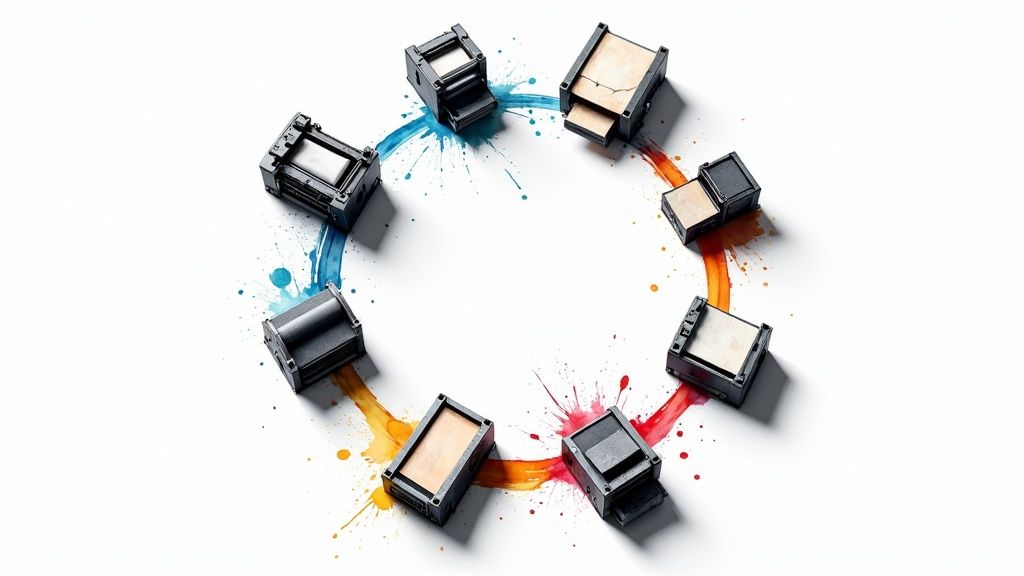
The journey from a digital file to a physical mailbox really just boils down to a few key decisions. It's a simple flow from your artwork, through production, and finally to your customer's door.

As you can see, it's a linear path: you create the art, it gets printed and addressed, and then it's sent out. Nailing the printing and distribution steps is what ensures your campaign runs smoothly and doesn't break the bank.
Choosing Your Printing Method
First up, you need to decide between digital and offset printing. They both produce beautiful, high-quality postcards, but they're built for very different jobs. Understanding the difference is your first step to managing costs like a pro.
Digital Printing: Think of this as a super-advanced, industrial-strength version of a desktop printer. It’s perfect for smaller runs—I'm talking anything under 1,000 pieces—because the setup is minimal. This method is also a rockstar for Variable Data Printing (VDP). VDP lets you personalize each postcard with a recipient's name or a unique offer without slowing anything down.
Offset Printing: This is the old-school workhorse of the printing industry. It uses custom metal plates and massive presses. The setup is definitely more involved and costs more upfront, but your cost-per-postcard plummets as the quantity goes up. If you're running a big campaign of several thousand pieces or more, offset is almost always the smarter financial move.
So, a local gym testing a new offer with 500 postcards would be a perfect candidate for digital printing. On the flip side, a national retailer blanketing a region with 50,000 mailers for a seasonal sale would save a ton of money by going with offset.
Selecting the Right Paper and Size
The physical feel of your postcard sends an immediate message about your brand. A thin, flimsy card can make your business feel cheap. But a thick, substantial card? That feels premium and important.
Most direct mail postcards are printed on 14 pt. or 16 pt. cardstock. It’s sturdy enough to survive the journey through the postal system without looking like it went through a blender. You'll also need to pick a finish:
- Glossy (UV Coating): This high-shine finish makes colors and images pop right off the card. It's eye-catching and adds a layer of durability.
- Matte: A matte finish gives you a smooth, non-reflective surface that feels modern and sophisticated. It’s also much easier to write on, which is a great bonus if you want customers to fill something out.
Size is another huge factor. Standard sizes like 4"x6" are cheap to mail, but larger formats like 6"x9" or 6"x11" command more attention in a stack of mail and give you more room to get creative.
The most crucial thing is making sure your postcard size qualifies for USPS First-Class or Marketing Mail rates. If your card is an odd, non-standard size, you could get hit with much higher "letter" or "flat" postage rates that can completely blow up your budget.
Understanding Your Mailing Options
Once your postcards are hot off the press, they need to get mailed. You've got two main ways to handle distribution, and the right choice depends entirely on how specific your target audience is.
Broad-Reach vs. Hyper-Targeted Mailing
| Mailing Option | Best For | Key Characteristic |
|---|---|---|
| Every Door Direct Mail (EDDM) | Local businesses—think restaurants, salons, or real estate agents—aiming for total geographic coverage. | Mails to every single address on a specific USPS carrier route. You don't need a mailing list, which makes it super cost-effective for local campaigns. |
| Targeted Mailing Lists | Businesses with a very specific customer profile, like B2B companies or niche e-commerce brands. | Uses a purchased or rented list based on demographics, buying behavior, or other data points to reach exact individuals. |
For a lot of businesses, wrestling with list processing, mail sorting, and all the postal regulations is a major headache. It’s why so many choose to work with partners who specialize in end-to-end direct mail services.
These full-service providers can handle everything from printing to mailing, making sure your campaign is executed perfectly while you focus on what really matters: the results. By thinking through your printing and mailing logistics upfront, you’re setting your campaign up for a smooth, successful launch.
Measuring Success and Integrating with Digital
A successful direct mail postcard campaign doesn't end when it hits the mailbox. Far from it. That's actually just the beginning. The real power move is to treat your postcards not as a standalone effort, but as a bridge connecting your physical marketing directly to your digital world. This is how you shift from just hoping for results to actively measuring and multiplying them.
Think of it this way: you want to create a seamless journey that guides someone from their mailbox to your website, making it incredibly easy and intuitive for them to take that next step. This isn't some niche tactic anymore; it's quickly becoming the standard for smart marketers.
The global direct mail advertising market is projected to hit around $59.31 billion by 2025, and a huge reason for that growth is this digital fusion. It's expected that by then, about 82% of direct mail campaigns will include digital touchpoints like retargeting ads and email follow-ups.
Creating the Digital Bridge
To actually track your postcard campaign, you have to give people a clear, unique path to follow. This is non-negotiable. If you don't, you'll have no way of knowing if your website visitors, leads, or sales came from that mailer. Generic instructions like "visit our website" are a black hole for data.
Here are the must-have tools for building this digital bridge:
- QR Codes: These are everywhere now and people know exactly what to do with them. A quick scan with a smartphone can whisk a user straight to a specific landing page, a product video, or even a pre-filled contact form.
- Vanity URLs: This is just a short, memorable web address made just for your campaign (think
YourBrand.com/SpringSale). It's simple for people to type in and super easy for you to track in your analytics. - Personalized URLs (PURLs): For the most personal touch, PURLs actually include the recipient's name or a unique code (like
YourBrand.com/Jane-Doe). This creates a powerful one-to-one connection and allows for incredibly granular tracking. To really nail this, you'll want to explore using variable data printing for personalized campaigns.
For example, a real estate agent could send postcards with a QR code that opens a virtual tour of a specific home. It provides instant value and lets the agent see exactly who is engaging with their listings and how.
Tracking and Measuring Your Campaign ROI
Once your digital bridges are in place, the real fun begins. You can start gathering data and calculating a true return on investment (ROI). The days of guessing whether your mailers worked are over. Now, you can measure it all with precision.
The first step is to get your analytics tools (like Google Analytics) set up to monitor the traffic coming from your unique URLs. You'll want to track a few key performance indicators (KPIs) to really understand what's working.
Essential Metrics to Track
| Metric | What It Measures | Why It's Important |
|---|---|---|
| Response Rate | The percentage of people who took the desired action (e.g., scanned the QR code, visited your URL). | This is your top-level look at how well your offer and design caught their attention. |
| Conversion Rate | The percentage of landing page visitors who completed your goal (e.g., bought something, filled out a form). | This shows you how effective your landing page and offer are at turning initial interest into real action. |
| Cost Per Lead (CPL) | The total campaign cost divided by the number of leads you generated. | This metric is critical for understanding if your campaign is an efficient way to find new customers. |
A common mistake is getting fixated only on the response rate. I've seen campaigns with a lower response rate but a much higher conversion rate and customer lifetime value end up being far more profitable. Always look at the complete picture, not just one metric.
Amplifying Your Message with Retargeting
The integration doesn't stop after someone visits your website. Now you can use digital retargeting to keep the conversation going. By placing a tracking pixel (a tiny snippet of code) on your campaign's landing page, you can serve digital ads to people who visited but didn't convert.
This creates a powerful, multi-channel cycle:
- Initial Touchpoint: The recipient gets your physical postcard in the mail.
- Digital Visit: They scan the QR code and land on your website.
- Reinforcement: Later, they start seeing your display or social media ads, reminding them of your brand and offer.
This kind of cohesive strategy turns a single postcard into a sustained marketing conversation. To make sure your direct mail plays nicely with your online presence, it's worth brushing up on creating an effective omnichannel customer experience. When done right, it makes your marketing feel less like a series of one-off ads and more like a helpful, ongoing dialogue with your customer.
Your Postcard Marketing Questions, Answered

Even with the best game plan, you're bound to have questions. We get it. We’ve been there. This guide tackles the most common queries we hear about getting a direct mail postcard campaign off the ground.
Think of this as your go-to reference for clearing up any confusion about costs, results, and what not to do.
How Much Does a Direct Mail Postcard Campaign Cost?
This is always the first question, and the most honest answer is: it depends. The final investment hinges on a few key variables—your design, list source, postcard size, print volume, and postage.
A small, hyper-local campaign targeting a few specific streets might only cost a few hundred dollars. On the flip side, a nationwide send can easily run into the tens of thousands. The big-ticket items that will shape your budget are:
- Printing: The price per postcard drops dramatically as you increase your order quantity.
- Mailing List: Renting a laser-focused list costs more than using a broader, more general one.
- Postage: The postcard's size and the mail class you select will determine this cost.
As a realistic starting point for your budget, plan for somewhere between $0.50 and $2.00 per piece, all-in. This range gives you a solid foundation for forecasting your total spend and setting achievable ROI goals.
For businesses aiming to blanket entire neighborhoods without buying a list, a service like Every Door Direct Mail (EDDM) can be an incredibly smart play. You can dive deeper into how EDDM can maximize local reach and what it requires.
What Is a Good Response Rate for Postcards?
Defining a "good" response rate is tricky because it's so dependent on your industry, offer, and audience. That said, industry benchmarks give us a useful measuring stick. The general average for direct mail floats around 4.4%, a number that blows most digital channels out of the water.
When you're mailing to a house list—people who are already your customers—an excellent response rate is anywhere from 5% to 9%. These folks already know and trust you, so they're much more likely to engage.
For a prospect list, where you're reaching out to people who haven't heard of you, hitting a 2% to 5% response rate is a fantastic result.
But remember, a "response" isn't just a sale. It could be a QR code scan, a visit to your special landing page, or a phone call. The true measure of success isn't just the response rate; it's your final return on investment (ROI).
What Are the Most Common Mistakes to Avoid?
It’s tough to see a campaign fizzle out, but it almost always comes down to a few common, and totally avoidable, missteps. If you can sidestep these classic blunders, you’ll dramatically boost your odds of hitting a home run with your direct mail postcards.
Here are the top five pitfalls we see time and time again:
- A Weak or Nonexistent Offer: You absolutely have to give people a compelling reason to take action right now. A vague or boring offer is a one-way ticket to the recycling bin.
- A Cluttered, Confusing Design: Too much text, competing images, or a chaotic layout just overwhelms people. Your design should be clean, focused, and easy to digest in three seconds flat.
- An Unclear Call to Action (CTA): Don't make people guess what to do next. Tell them exactly what step to take with clear, direct, and action-oriented language.
- Poor Audience Targeting: Sending the world's greatest postcard to the wrong people is a complete waste of money. Your mailing list is your most valuable asset—make sure it’s well-defined and segmented.
- Forgetting to Track Results: If you don’t build in a way to track responses (like QR codes or custom URLs), you’ll have no idea what your ROI is. More importantly, you won't know how to make your next campaign even better.
Getting these fundamentals right is everything. By nailing the offer, design, CTA, list, and tracking, you put your direct mail postcards on the fast track to success.
Ready to create postcards that get noticed and drive real results? At 4OVER4, we offer a huge range of sizes, paper stocks, and high-quality printing options to bring your vision to life. Design your next winning campaign with us today at https://4over4.com.
More from direct mail postcards
8
Advertising magnets are one of those marketing tools that are so simple, you might overlook their power. They’re tangible, they last for age
Emma Davis
Jan 30, 2026
14
Tired of fighting with torn paper and sticky residue? We’ve all been there. The best way to get labels off bottles is often a simple soak in
Emma Davis
Jan 29, 2026
35
Want to know the real secret to getting a poster to stick to a wall without it peeling off in the middle of the night? It's all about what
Emma Davis
Jan 28, 2026
46
When you hear "table tent specs," what we're really talking about are the foundational details for printing them correctly: the
Emma Davis
Jan 27, 2026
177
When you're ready to print a poster, one of the first questions you'll face is, "What size should it be?" The industry has a
Emma Davis
Jan 26, 2026
164
Picture this: you're at a networking event, and someone hands you their business card. You do the usual glance—name, title, company—an
Emma Davis
Jan 25, 2026
145
Believe it or not, figuring out how to make a card in Word is surprisingly easy. You can knock out everything from slick, professional busines
Emma Davis
Jan 24, 2026
129
Printing on packaging takes a simple container and turns it into one of your most powerful marketing tools. It’s the very first physical int
Emma Davis
Jan 23, 2026