Table of Contents
- Home
- content hub
- Unlocking Events With Custom Event Badges
 Share and earn
Unlocking Events With Custom Event Badges

Jun 27, 2025840 views
Jun 27, 2025840 views
Think about the last event you attended. What was the first physical item you received? Chances are, it was your event badge. This isn't just a name tag—it's the first real handshake between your event and your attendee, a tangible piece of your brand that everyone holds and wears.
Custom event badges do far more than just identify people. They set the entire tone for the experience from the moment someone checks in.
Your Event's First Impression
Consider your badge as your event's business card, a conversation starter, and a security checkpoint all rolled into one powerful package. A generic, flimsy badge might suggest the event was an afterthought, but a high-quality, thoughtfully designed badge immediately communicates professionalism and meticulous attention to detail.
This first physical touchpoint is absolutely crucial for shaping how attendees perceive your event's value. It’s an opportunity you can’t afford to miss.
More Than Just a Name
A modern event badge has evolved way beyond simple identification. It's now an active tool that directly contributes to your event's success by driving engagement and streamlining management. When you invest in a quality badge, you're really investing in the entire attendee journey.
But what exactly does a modern badge do? It's a surprisingly versatile tool.
In essence, today's badges are multifunctional assets that elevate an event from a simple gathering to a cohesive, branded, and secure experience. They are central to how your event operates and how it's perceived by everyone involved.
Let's break down the core functions that a badge performs.
Core Functions of a Modern Event Badge
| Function | Impact on Your Event |
|---|---|
| Brand Reinforcement | Your badge acts as a mini-billboard. It constantly displays your logo, colors, and theme, keeping your brand top-of-mind. |
| Effortless Networking | Clear names, companies, and color-coded roles (like Speaker or VIP) break down social barriers and make it easy for people to connect. |
| Enhanced Security | Badges are your first line of defense, allowing staff to quickly spot authorized individuals and control access to restricted zones. |
| Sponsorship Value | The badge offers prime real estate for sponsor logos, giving them constant visibility and increasing the value of their partnership. |
These roles show how the badge has become integral to both the operational flow and the perceived value of an event. It’s a strategic asset, not just a logistical checkbox.
A study revealed that 49% of event marketers see participant engagement as the single most important factor for a successful event. A custom badge is one of the very first tools you have to spark that engagement.
The Badge as a Strategic Asset
The design choices and materials you select for your badge speak volumes. A durable, well-printed badge instantly suggests a high-value event, while a poorly made one can cheapen the entire experience. This small piece of printed material is directly linked to an attendee's perception of quality.
Likewise, the information on the badge dictates how useful it is. When a badge integrates smoothly with other event elements, like ticketing, it creates a seamless and professional experience. You can even coordinate your badge design with other printed materials to build a powerful and consistent brand identity.
If you're looking for inspiration, explore options for custom event tickets printing that can align perfectly with your badge design.
Ultimately, a well-crafted badge transforms from a simple credential into a key player in your event's success story. It helps create a memorable, professional experience that stays with attendees long after the final session has ended.
Choosing the Right Badge Material and Style
Long before an attendee shakes a hand or listens to a speaker, they interact with your brand through their event badge. Think of it like a first impression—the material you choose says a lot about your event's quality and attention to detail. A flimsy, cheap-feeling badge can subtly undermine an otherwise premium experience.
This decision is about more than just looks. It directly impacts your budget, how well the badge holds up over a multi-day conference, and the overall vibe you want to create. Getting it right means aligning the material with your event’s core message. A high-tech summit and a rustic-themed retreat have very different needs, and the badge should reflect that.
This diagram breaks down the hierarchy of badge design, showing why the material is the first and most important domino to fall.
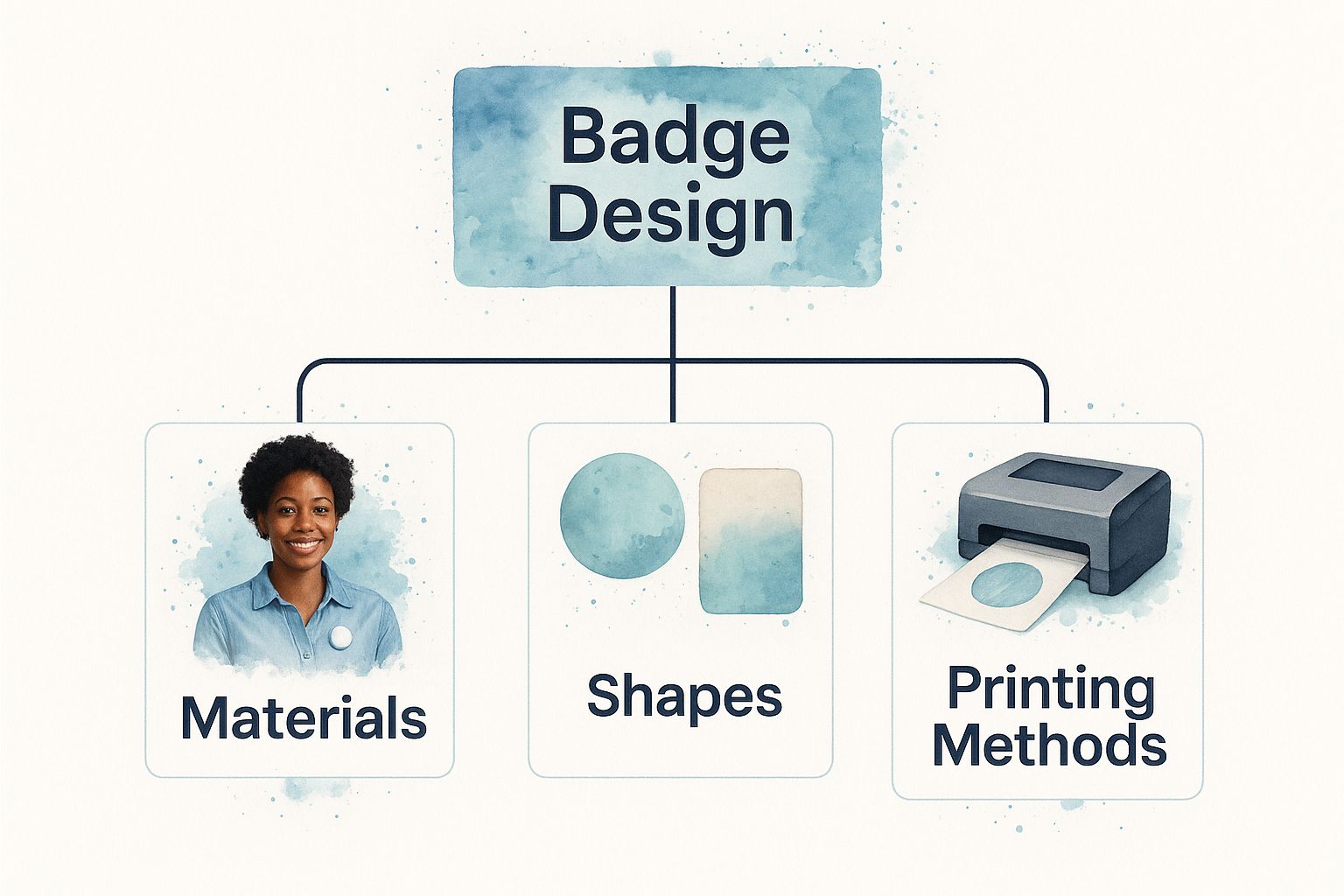
As you can see, picking your material sets the stage for every other choice you'll make, from printing techniques to the final design.
Traditional and Durable Badge Materials
For most events, you need a badge that can take a beating. Attendees will wear them, stuff them in bags, and scan them repeatedly for hours, if not days. This is where the workhorse materials come in, offering a solid blend of resilience and professionalism without breaking the bank.
- PVC (Polyvinyl Chloride): There's a reason PVC is the industry go-to. These badges are tough, waterproof, and rigid, giving them a substantial, professional feel, much like a credit card. They’re perfect for multi-day conferences where durability is non-negotiable.
- Teslin: If you want something a bit more flexible than PVC but just as tough, Teslin is a fantastic choice. It's a synthetic paper that’s incredibly tear-resistant and waterproof, so it can easily withstand the chaos of a busy event.
When you need credentials that won't bend, fade, or tear after a few hours of use, exploring durable plastic card printing options is the best place to start. These materials get the job done reliably.
High-Impact and Premium Materials
Sometimes, a standard badge just won't cut it. For VIPs, keynote speakers, or exclusive, high-end events, the badge itself needs to make a statement. Moving beyond plastic creates a memorable tactile experience that screams quality and importance.
You can create a real "wow" moment with materials like these:
- Acrylic: With its sleek, glass-like finish, an acrylic badge feels modern and luxurious. It's rigid and can be laser-cut into just about any custom shape you can imagine, offering a truly high-end feel.
- Wood: For events centered around craftsmanship, nature, or sustainability, an engraved wooden badge is a home run. They have a unique, warm feel and are an instant conversation piece.
- Metal: Nothing says "exclusive" quite like a brushed or polished metal badge. It has a satisfying weight and a cool touch, feeling more like a permanent keepsake than a temporary credential.
These premium choices transform a simple identifier into a piece of event memorabilia—something your most important guests will actually want to hold onto.
A badge is more than a name tag; it’s a physical touchpoint that reflects the quality and values of your event. Choosing a material that resonates with your brand identity can significantly elevate the attendee experience.
The Rise of Sustainable Badge Options
More and more, event organizers are looking for ways to reduce their environmental footprint. Opting for an eco-friendly badge material is a simple but powerful way to show your attendees that you care about sustainability.
This isn't just a fleeting trend. The production of plastic name badges contributes to roughly 0.5% of total plastic waste. While that might sound small, it’s a significant amount that the event industry can actively help reduce. This has led to a major push for greener materials and reusable badge systems. You can dive deeper into the industry's shift toward event badge reusability and sustainability to see how it's changing the game.
Here are a few popular eco-friendly alternatives:
- Bamboo: As a fast-growing and renewable resource, bamboo offers a beautiful, natural look similar to wood but is often lighter and more budget-friendly.
- Recycled Plastics (PET): Made from materials like old water bottles, these badges give you the durability of plastic without the environmental cost of creating it from scratch.
- Seed Paper: A wonderfully creative option for single-day events. Once the event is over, attendees can plant their badge, and it will biodegrade and sprout into flowers or herbs.
When you choose a sustainable material, you're sending a clear message that your organization’s values are woven into every last detail of the event.
Designing Badges That People Actually Want to Wear
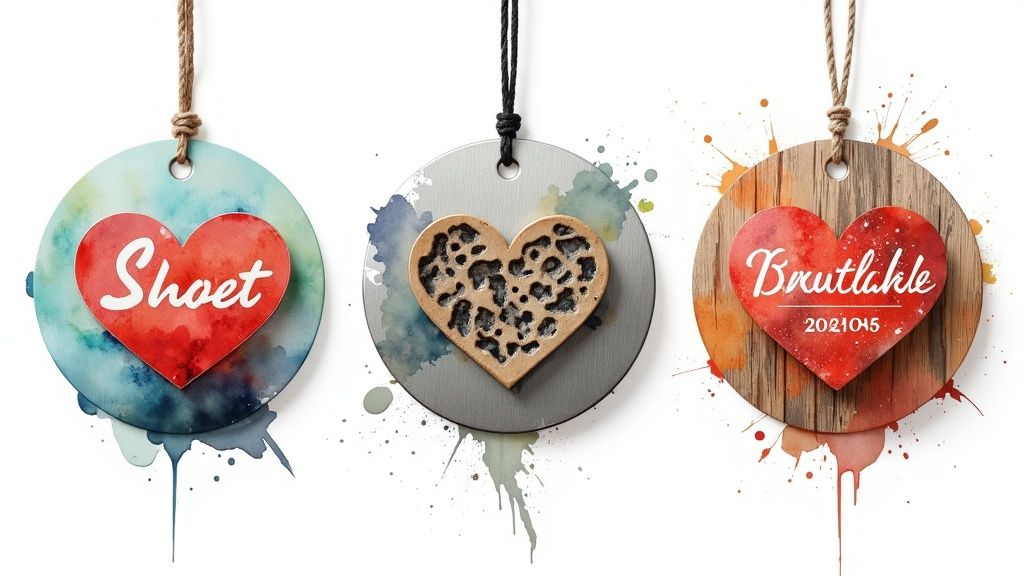
Let's be honest, a bad event badge is more than just an eyesore—it's a failure of function. We've all seen them: cluttered, impossible to read, and destined for the trash can the second the event ends. An effective badge, on the other hand, is a masterpiece of practical design. It’s less of a nametag and more of a user interface for your entire event.
The real goal is to create custom event badges that are so useful, attendees feel lost without them. They should deliver key information at a glance, make networking easier, and subtly reinforce your brand. This isn't just about aesthetics; it's about engineering a mini-billboard that genuinely improves the attendee experience from start to finish.
Mastering Visual Hierarchy and Readability
The single most important job of a badge is to identify the person wearing it. This means you need a rock-solid visual hierarchy—a fancy way of saying the most important info needs to be the most obvious. An attendee's name should be instantly legible from a normal conversational distance, which is about five or six feet.
- First Name First: Make the attendee's first name the biggest, boldest thing on the badge. It's what people scan for during introductions.
- Company Second: The person's organization is the next piece of the puzzle. Keep it prominent, but noticeably smaller than the first name.
- Title Third: While useful for context, the job title is the least critical of the three. It can be the smallest text on the badge.
Think about someone scanning a crowded reception. Their eyes should immediately lock onto names, not a confusing jumble of logos and titles. This simple approach turns a passive piece of plastic into an active networking tool.
A well-designed badge is a natural icebreaker. When you make names and companies easy to see, you lower the social hurdles to starting a conversation. That directly fuels networking, which is a top reason people come to events in the first place.
Using Color for Instant Recognition
Color is one of the most powerful—and often overlooked—tools in your badge design arsenal. A smart color-coding system is a visual shortcut, letting staff and attendees instantly identify different groups without reading a single word. This is a game-changer for both security and networking.
For instance, a simple color strategy might look like this:
- Blue: General Attendees
- Green: Speakers
- Red: Event Staff
- Gold: VIPs or Sponsors
This system makes access control practically effortless. A staff member can spot from across a huge hall if someone is trying to get into a speakers-only lounge. It also helps attendees find who they're looking for, whether it's an event organizer for help or a VIP they've been hoping to meet.
Balancing Branding and Functionality
Your badge is prime real estate for branding, but it's incredibly easy to go overboard. A badge that's plastered with logos becomes a cluttered mess, completely undermining its main job. The secret is finding that sweet spot between brand presence and pure, simple usability.
Think of your badge's surface area like a tiny billboard. You want your brand seen, but not at the expense of the core information.
Design Do's and Don'ts:
| Do | Don't |
|---|---|
| Place your main event logo clearly at the top. | Let sponsor logos compete with the attendee's name. |
| Use plenty of negative space to avoid a cluttered feel. | Shrink fonts just to cram in more information. |
| Stick QR codes in a corner, out of the main eyeline. | Use more than two or three primary colors. |
The best badges weave branding in gracefully. This also means thinking beyond the badge itself. For a truly professional look, consider pairing your design with custom lanyards that match the color scheme and style. When the whole credential works together, it becomes a unified, polished statement piece that enhances your event's professionalism instead of just adding to the noise.
Integrating Smart Tech Into Your Badges
Modern custom event badges are so much more than a simple name tag. When you look closer, you'll see they can be powerful data tools, cleverly disguised as simple credentials. By embedding technology directly into the badge, you can turn a passive identifier into an active part of your event's ecosystem, improving everything from networking to your operational flow.
And this kind of tech isn't just for massive, high-budget conferences anymore. There are plenty of accessible and scalable options out there for events of all sizes. The real secret is understanding what each technology does best and matching it to what you want to achieve with your event.
The Accessible Power of QR Codes
The most straightforward entry point into smart badge technology is the humble Quick Response (QR) code. Just think of it as a digital doorway printed right onto the badge. When someone scans it with their smartphone, it can trigger a specific action, which makes it incredibly versatile.
Each attendee's badge can have its own unique QR code, unlocking a world of personalized interactions. This is a core function of modern event management, and you can get a better handle on how printers make this happen in our guide on variable data printing.
Here are a few common ways QR codes are used on badges:
- Effortless Session Check-in: Forget about clipboards and manual headcounts. A quick scan at the door instantly registers an attendee for a session.
- Seamless Lead Retrieval: Exhibitors can scan an attendee's badge to instantly capture their contact info, which means no more fumbling for business cards or tedious manual data entry.
- Instant Information Access: Link a QR code to a speaker's bio, a session schedule, or a sponsor's website. It puts relevant content right at your attendees' fingertips.
Frictionless Networking with NFC Technology
Taking a step up the tech ladder, we find Near Field Communication (NFC). This is the exact same technology that powers tap-to-pay services like Apple Pay. NFC allows for the wireless transfer of information between two devices that are super close to each other—usually just a few centimeters apart.
Imagine this: Instead of awkwardly exchanging business cards, two attendees simply tap their badges together. Instantly, their contact information is swapped and saved to their phones. This is the power of NFC.
This "tap-to-connect" feature removes all the friction from networking. It’s faster, feels more modern, and creates a memorable "wow" moment that your attendees will talk about. Because it requires intentional closeness, it's a fantastic tool for one-on-one interactions without the privacy worries that come with broader tracking technologies.
Gaining Deeper Insights with RFID
For organizers who need to see the big picture of how attendees move through a space, Radio-Frequency Identification (RFID) is the ultimate tool. Unlike QR codes or NFC, RFID works passively and from a distance. Small RFID chips are embedded in the custom event badges and can be read by sensors you place strategically around your venue.
This setup allows for anonymous, real-time tracking of crowd flow and engagement. You can see, live on a dashboard:
- Which sessions are packed and which ones are under-attended.
- High-traffic "hotspots" on your exhibition floor.
- How long people linger in certain zones, like networking lounges or sponsor booths.
- Foot traffic bottlenecks that you need to address.
This kind of data is invaluable for measuring your event's success and proving ROI. You stop guessing what worked and you start knowing. The insights you can gather from RFID are a perfect example of how the Internet of Things (IoT) is changing live events. For a deeper dive into the broader applications of connected devices, it's worth reading about how IoT can enhance user experience across different industries.
The move toward tech-enabled badges mirrors a much larger trend. The global digital badges market was valued at around $0.2 billion in 2023 and is projected to hit $0.5 billion by 2028, growing at a compound annual growth rate of 16.5%. This growth, which you can read more about in this market growth report on marketsandmarkets.com, points to a clear demand for smarter, data-driven event solutions.
Ultimately, integrating smart tech turns your badges from a simple cost center into a strategic asset. It boosts security, personalizes the attendee journey, and provides a clear, measurable return on your investment.
Turning Badge Scans Into Actionable Insights
Let’s be honest: your custom event badges are much more than just a name and a title. They’re data powerhouses just waiting to be switched on. Every time an attendee gets their badge scanned—whether it’s entering a workshop, visiting an exhibitor, or chilling in a networking lounge—they leave behind a digital breadcrumb. When you start connecting these dots, you get a crystal-clear picture of what people are actually doing at your event.
Think of every scan as a vote. A scan at a session door tells you that topic is a winner. A scan at a sponsor’s booth is a vote of confidence in their brand. By tracking these interactions, you stop relying on gut feelings and start making decisions based on cold, hard facts.
This is where custom badges truly shine, transforming from simple identifiers into sophisticated tools for event attendance tracking and giving you a direct line into attendee engagement.
Key Metrics to Track and Analyze
Having a mountain of data is useless if you don't know what you're looking for. To turn all those scans into real intelligence, you need to focus on the metrics that actually tell a story. Ignoring this data is like trying to navigate a ship in a storm without a compass—you might eventually get somewhere, but you won't know how or be able to repeat it.
Here are the essential numbers you should be watching:
- Session Popularity: See which keynotes and workshops are packed and which ones are empty. This is your roadmap for planning next year's agenda.
- Dwell Time: How long are people hanging out in the expo hall or at the coffee bar? Longer times mean higher engagement, and that’s a big win.
- Lead Capture Rates: For your exhibitors, this is everything. The number of badge scans at their booth is a direct line to their ROI and tells them exactly how many leads they walked away with.
- Attendee Flow: Pinpoint the traffic jams and the ghost towns in your venue. This information is gold for optimizing the layout and creating a better, smoother experience for everyone.
This data-driven mindset is quickly becoming the industry standard. As noted in an article about the data behind event badges on crowdcomms.com, organizers are increasingly using scan data to understand attendee behavior, which in turn helps them build more effective and enjoyable events.
Using Insights to Prove ROI and Refine Strategy
Collecting the data is just step one. The real magic happens when you use it to sharpen your event strategy and, just as importantly, prove its value. This information gives you undeniable proof of your event's success, which makes those budget and stakeholder conversations a whole lot easier.
When you can walk into a meeting with hard numbers on session attendance and sponsor interactions, you're no longer talking about feelings or feedback. You're showing objective proof of performance and demonstrating the event's tangible impact.
This analytical approach lets you fine-tune every part of your event. You can swap out underperforming sessions, double down on popular topics, and tweak the venue layout to eliminate bottlenecks. By turning simple badge scans into actionable insights, you're not just guessing what worked—you're building a repeatable formula for success that makes every future event even better.
Your Badge Ordering and Logistics Checklist
Ordering custom event badges shouldn't be a last-minute fire drill. With a solid game plan, you can glide through the whole process, from that first spark of an idea to handing them out on-site. A structured approach is your best defense against common mistakes, missed deadlines, and those dreaded rush fees.
Think of it like building a critical piece of equipment for your event. You wouldn't start construction without a blueprint, right? Ordering badges is no different. The trick is to break the process down into simple, manageable stages and know which questions to ask.
Define Your Needs and Budget
First things first: what do you actually need these badges to do? Are they simple name tags for identification, or are you looking for something more advanced with QR codes for lead capture? Knowing their job will steer you toward the right materials and design, which in turn sets your budget. Before you even start browsing vendors, lock in a realistic cost-per-badge you're comfortable with.
Nailing this down from the start keeps your project on track and ensures the final product meets your event's goals without blowing up your budget.
Vendor Selection and Critical Timelines
Choosing the right printing partner is a huge piece of the puzzle. Don't let price be your only guide; look into their reputation, the quality of their past work, and how they handle customer service. Once you've got a shortlist, it's time to dig into the details.
A classic mistake is underestimating how long production and shipping really take. For standard badges, a lead time of 4-6 weeks is a safe bet. If you're eyeing designs with built-in tech or specialty materials, you should be starting this conversation at least 8 weeks before your event.
To make sure you and your supplier are on the same page, get clear answers to these questions:
- Proofing Process: How many rounds of digital proofs do I get? Is it possible to get a physical sample before you print the whole batch?
- Data Security: How do you manage and protect the attendee data file we send you?
- Shipping and Handling: What are the shipping costs and what are the guaranteed delivery dates? Can you split the shipment if needed?
Plan for On-Site Logistics
Your work isn't done just because the boxes of badges have arrived. Now you need a rock-solid plan for getting them into your attendees' hands. Will you organize badges alphabetically for a quick and easy pickup? What's your game plan for those last-minute, on-site registrations? Setting up a dedicated station with a reliable printer for new arrivals can be a real lifesaver.
A smooth, organized check-in process sets a fantastic tone for the rest of the event. And remember, your badges are just one part of your event's branding. To create a truly professional and memorable experience, think about how they'll look alongside your other essential trade show products. A cohesive look ties everything together beautifully.
Got Questions About Custom Event Badges? We’ve Got Answers.
Even the most seasoned event planners have a few lingering questions when it’s time to order custom event badges. Getting those last-minute details ironed out is the key to making a confident decision that fits your event's vibe and budget. Let's walk through some of the most common questions we hear from organizers.
Think of this as your final checklist to make sure you've covered all the bases before you hit "order."
How Much Time Should I Actually Budget for Ordering?
This is a big one. Underestimating the production timeline is one of the easiest traps to fall into, and it often leads to rushed decisions, quality compromises, or surprise rush fees. Nobody needs that stress. The best advice is always to plan ahead.
As a rule of thumb, give yourself a 4-6 week lead time before your event. This buffer is perfect for handling design tweaks, choosing your materials, submitting attendee data, production, and standard shipping. If you're going for something more complex, like badges with RFID chips or unique materials like wood or metal, do yourself a favor and extend that to at least 8 weeks.
Sticking to these timelines means you can breathe easy and enjoy a smooth, panic-free process from start to finish.
How Can I Make Our Badges More Sustainable?
Sustainability isn't just a buzzword anymore; it's a core consideration for events that want to make a positive impact. The good news is, you can make your badges eco-friendly without sacrificing quality or style.
Here are a few practical ideas:
- Pick Greener Materials: Look for materials with a smaller environmental footprint. Bamboo is a fantastic, fast-growing option, as are recycled paper stocks or PET plastic, which is made from recycled materials.
- Design Them for Reuse: Think timeless. If you leave specific dates off the design, attendees are more likely to keep them as mementos. Or, you can collect them at the end of the event to use again next year.
- Set Up a Recycling Program: Work with your venue or printer to create dedicated collection bins for badges as attendees leave. This ensures they get recycled properly instead of ending up in the trash.
What’s the Most Important Information to Put on a Badge?
A badge’s main job is to communicate key information at a glance. For this to work, you need a clear visual hierarchy that tells people what to look at first. The goal is simple: readability from a normal conversational distance.
Here’s what to prioritize on the badge, in order of importance:
- Attendee's First Name: This needs to be the biggest, boldest thing on the badge. No squinting allowed.
- Company or Organization: Keep it easy to read, but noticeably smaller than the first name.
- Attendee Type: A splash of color-coding or a simple label (like "Speaker" or "VIP") makes for instant identification.
- Tech Indicator: If you’re using QR codes or NFC, add a small icon. It’s a simple visual cue that lets people know the badge is interactive.
Ready to create custom event badges that people will actually want to keep? At 4OVER4, we offer a huge range of materials, tech options, and design support to bring your vision to life. Explore our high-quality printing solutions and start designing today at 4over4.com.
More from

15
When you think of a yard sign, the classic 18"x24" is probably what comes to mind. It’s the industry workhorse fo
 Emma Davis
Mar 14, 2026

28
When you’re ready to invest in an A-frame sign, the first question you'll ask is, "What size do I need?" It usually comes down
Emma Davis
Mar 13, 2026

255
The real secret to mastering your direct mail budget isn't complicated. It comes down to one simple fact: a standard 4" x 6&q
Emma Davis
Mar 12, 2026

73
Tear-off flyers are a classic for a reason. They’re a tangible marketing tool, designed with perforated, removable tabs at the bottom. Each
Emma Davis
Mar 11, 2026

125
Printing stickers at home is a seriously fun and rewarding project. It boils down to four main parts: designing your image, picking the right
Emma Davis
Mar 10, 2026

114
Ever seen a logo that seems to float right on the glass of a jar or bottle? That’s the work of transparent label stickers.
Emma Davis
Mar 9, 2026

74
Picture this: your product’s beautiful label gets smudged and runny during shipping, or a gorgeous event banner fades to nothing after just
Emma Davis
Mar 8, 2026

66
In a sea of options, your product's packaging and labeling are its first, and often only, chance to make a real connectio
Emma Davis
Mar 7, 2026