Table of Contents
- Home
- content hub
- Effective Business Marketing Materials That Build Brands
 Share and earn
Effective Business Marketing Materials That Build Brands

Oct 18, 2025503 views
Oct 18, 2025503 views
Think of your business marketing materials as your brand’s silent sales team. They're out there 24/7, working tirelessly to tell your story. These materials are all the tangible and digital touchpoints—from a classic business card you hand someone to the polished look of your social media profile—that communicate your value and build a lasting impression. Getting them right is absolutely essential for creating a brand identity that feels cohesive and trustworthy.
Building Your Brand's First Impression
Your marketing materials are so much more than just promotional tools; they are the fundamental building blocks of your brand's reputation. The moment a potential client holds your business card or scrolls through your Instagram feed, they are forming an immediate opinion about your company’s professionalism, quality, and attention to detail. That first interaction really sets the tone for the entire customer relationship.
A well-crafted set of materials ensures brand consistency across the board, which is the key to building recognition and trust. When your logo, color scheme, and messaging are uniform everywhere, it creates a seamless and memorable experience for your audience. This kind of consistency signals reliability and makes your brand feel established and credible from the get-go.
Tangible Connections and Digital Reach
The real power of business marketing materials lies in their ability to connect with customers both physically and digitally. Each format serves a unique purpose in your overall strategy, and they work best when they work together.
- Tangible Materials: Items like brochures and business cards create a physical, lasting connection. A high-quality business card, for example, can make a significant impact during a networking event, leaving a tangible reminder of your conversation. For more ideas on making that first handshake count, you can explore various options for business cards printing.
- Digital Assets: Your online presence, including your social media graphics and email signatures, builds brand recognition in a very crowded digital space. These assets allow for wide reach and consistent engagement, keeping your brand top-of-mind with your audience.
This chart visualizes how both tangible and digital materials contribute to your overall brand impression.
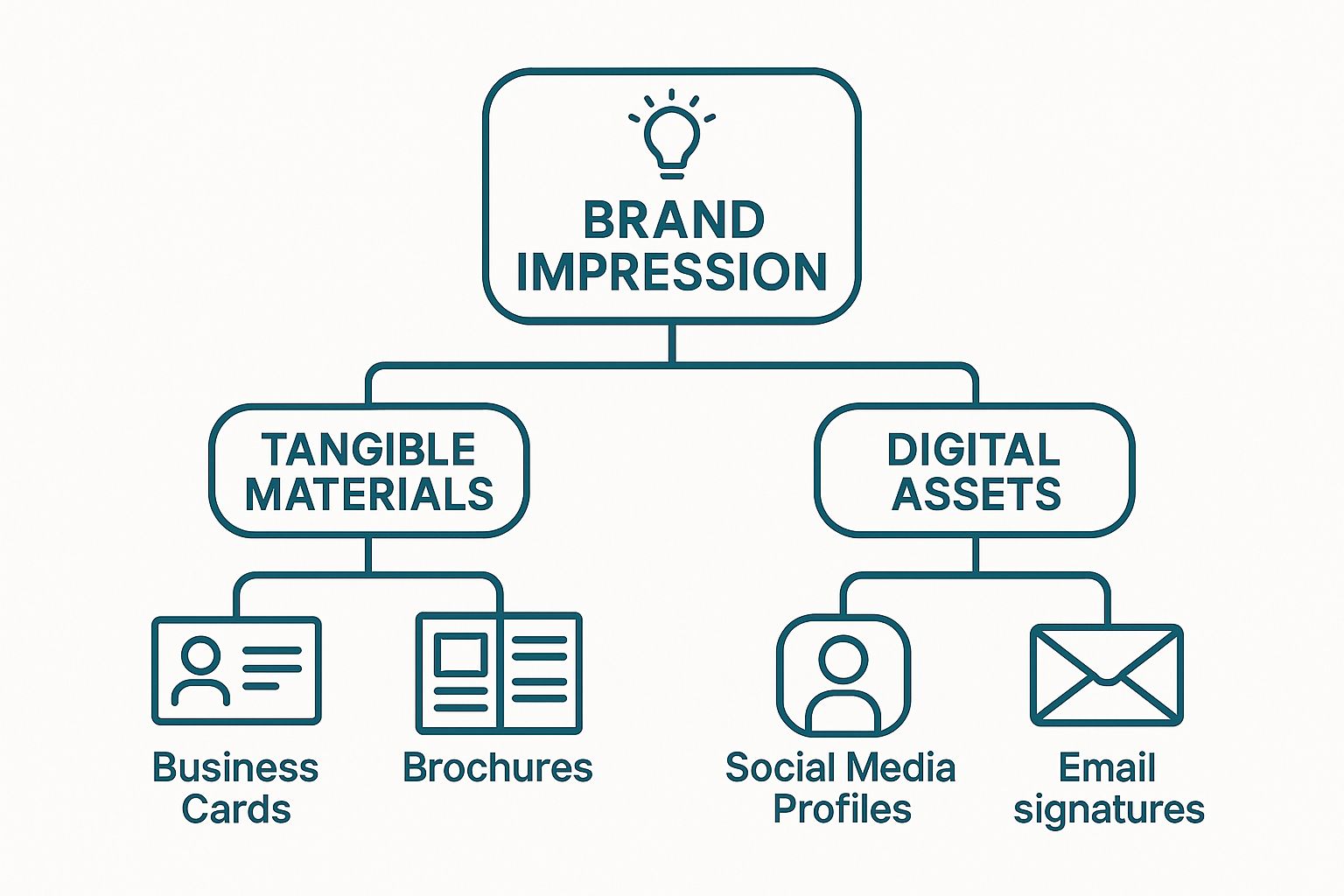
As the diagram shows, a strong brand impression requires a balanced approach. It’s all about leveraging both physical and online assets to tell a cohesive story. Ultimately, a strategic investment in these materials doesn't just promote your services—it actively builds your reputation and opens doors to new opportunities.
Choosing Your Essential Print Marketing Materials
Even in a world saturated with digital ads, there’s something powerful about a physical piece of marketing. A well-designed print item—whether it’s a business card, a brochure, or a flyer—can cut right through the online noise and create a tangible connection with your audience. Think of these as fundamental, high-impact assets for any solid marketing plan, each built for a specific job.
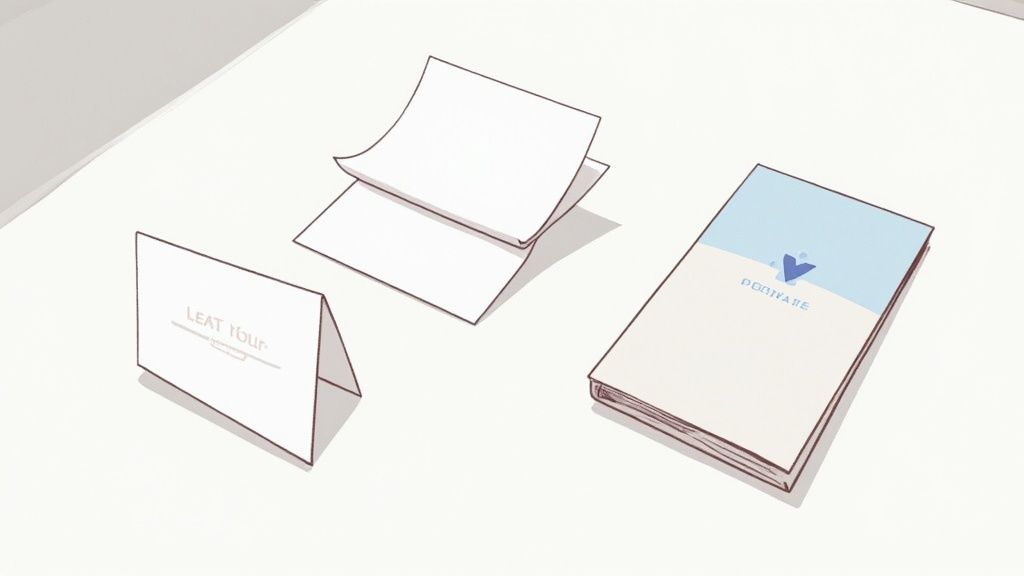
It helps to see these materials as specialized tools. A business card is your professional handshake. A brochure is your detailed storyteller. A flyer is your town crier. They all represent your company, but you wouldn’t use a hammer to saw a board. Picking the right one boils down to what you need to accomplish right now.
The Power of the Business Card
More often than not, a business card is the very first piece of business marketing materials a potential client will ever get from you. Its main job? To land a strong, memorable first impression. A flimsy, poorly designed card quietly suggests a lack of care, while a premium, well-thought-out card radiates professionalism and confidence from the get-go.
Great business card design is all about clarity and impact. It has to feature the essentials—name, title, company, phone, email, and website—all presented in a clean, easy-to-read font. Your logo should be a focal point, and the whole vibe must sync up with your brand’s look and feel.
A business card isn't just a contact tool; it's a micro-brochure for your personal brand. The texture of the paper, the crispness of the font, and the creativity of the design all communicate who you are before a word is spoken.
Structuring a Compelling Brochure
When you have more of a story to tell, the brochure is your best friend. Unlike the quick hit of a business card, a brochure is designed to educate and persuade. It’s your chance to really dig into your services, show off your products, or explain your company’s mission in a structured and engaging way.
A killer brochure leads the reader on a journey. You want to kick things off with a hook—an engaging headline and a solid intro. From there, break down your offerings into digestible sections, pairing benefit-driven text with high-quality images. Always, always end with a strong call to action that tells the reader exactly what to do next.
Designing Flyers That Grab Attention
Flyers are all about speed and immediate action. They’re built to announce a specific event, a can’t-miss promotion, or a new launch to as many people as possible. Since they’re usually competing for eyeballs in busy places, the design has to be bold, straight to the point, and impossible to ignore.
To make a flyer that actually gets results, stick to these rules:
- Lead with a Striking Headline: Your main message needs to be big, clear, and grab attention in a split second.
- Make Key Info Pop: Bold the date, time, location, and the offer. Use bullet points so people can scan it effortlessly.
- Go Big on Visuals: A single powerful image or graphic will always beat a wall of text.
- Include a Clear Call to Action: Use punchy, action-focused phrases like "Visit Us Today!" or "Scan to RSVP."
To help you decide which tool is right for the job, here's a quick cheat sheet.
Matching Print Materials to Your Marketing Goals
This table is a quick reference guide to help you choose the most effective print asset for specific business objectives.
| Marketing Material | Primary Goal | Key Design Focus | Ideal For |
|---|---|---|---|
| Business Card | Networking & First Impressions | Brand Identity, Clarity, Quality | Conferences, Meetings, Sales Calls |
| Brochure | Education & Detailed Storytelling | Logical Flow, High-Quality Imagery | Trade Shows, Welcome Packets, Lobbies |
| Flyer | Announcing & Driving Action | Bold Headline, Urgency, Visuals | Events, Promotions, Local Outreach |
| Poster | Brand Awareness & Visibility | High-Impact Graphics, Minimal Text | Storefronts, Community Boards, Events |
Picking the right material is half the battle. The other half is execution.
Choosing the right paper stock and finish is that final, crucial touch that can make or break your print assets. A glossy finish makes colors leap off a flyer, while a thick, matte cardstock gives a business card that premium, substantial feel. To see how all these pieces come together, check out the wide range of professional marketing materials that really showcase what quality and brand consistency look like in the real world.
Mastering Your Digital Marketing Assets
While a printed piece creates a tangible connection, your digital assets are the real workhorses. They're out there building your brand's online presence, 24/7. These are the critical pieces of your business marketing materials—from a sharp email signature to a cohesive set of social media graphics—that shape how people experience your brand in the virtual world.
Think of it this way: each digital platform is a different room in your house. You wouldn't decorate your kitchen the same way you decorate your living room, right? In the same vein, a LinkedIn banner has totally different dimensions and a much more professional vibe than a vibrant, fast-paced Instagram story. Optimizing your designs for each specific platform isn't just a "nice-to-have," it's absolutely essential to look professional and actually connect with users.
This focus on platform-specific detail has never been more important. The explosive growth in digital marketing is tied directly to the massive increase in internet and mobile phone use. By 2025, global internet penetration hit an incredible 5.56 billion people, which massively expanded the potential audience for any brand online. As a result, companies now pour 72.7% of all global advertising spend into digital channels, a clear pivot from traditional media.
Creating a Unified Digital Identity
Consistency is the absolute cornerstone of a strong digital brand. Your visual identity—that means your logo, color palette, and fonts—needs to be instantly recognizable no matter where someone finds you. This is how you build a seamless and trustworthy experience for your followers, clients, and potential customers.
A unified identity is more than just looking the part; it’s about crafting a predictable and reliable brand personality. To pull this off, you need to dial in a few key areas:
- Social Media Graphics: Create a set of templates for your posts, stories, and cover photos. This ensures that whether someone stumbles upon your brand on Facebook, X, or Instagram, the look and feel are immediately familiar.
- Email Signatures: Every single email your company sends is a marketing opportunity. A professional, branded email signature reinforces who you are and provides crucial contact info and links.
- Downloadable PDFs: Assets like e-books, whitepapers, or case studies must carry your brand's visual DNA. Consistent formatting makes them feel more credible and authoritative.
To get a better handle on bringing all your online efforts together, it’s worth checking out some digital marketing strategy examples to see how others leverage their assets.
Your digital assets are like a uniform for your brand. A consistent uniform tells the world you're part of the same team, dedicated to the same mission and level of quality.
Using Templates for Efficiency and Consistency
Let's be realistic—creating a unique, from-scratch graphic for every single social post or email is a recipe for burnout and brand confusion. This is where templates become your most powerful ally for maintaining consistency at scale. By using pre-designed layouts, you guarantee every piece of content aligns with your brand guidelines without having to reinvent the wheel every time.
This approach saves an incredible amount of time and empowers your entire team—not just the designers—to create on-brand materials with ease. It also ensures that even your less-visible assets, like the digital files used for printing high-quality online posters, maintain that all-important brand consistency. The goal is simple: use these digital materials to expand your reach and build a strong, recognizable brand in the virtual world.
Making an Impact with Large Format Materials
When your brand needs to do more than just speak—when it needs to shout from across the room or down the street—it's time to think big. Large format materials are the heavyweights of your marketing toolkit. We're talking about banners, posters, and trade show displays designed to do one thing exceptionally well: grab attention and make a bold statement in even the most crowded spaces.
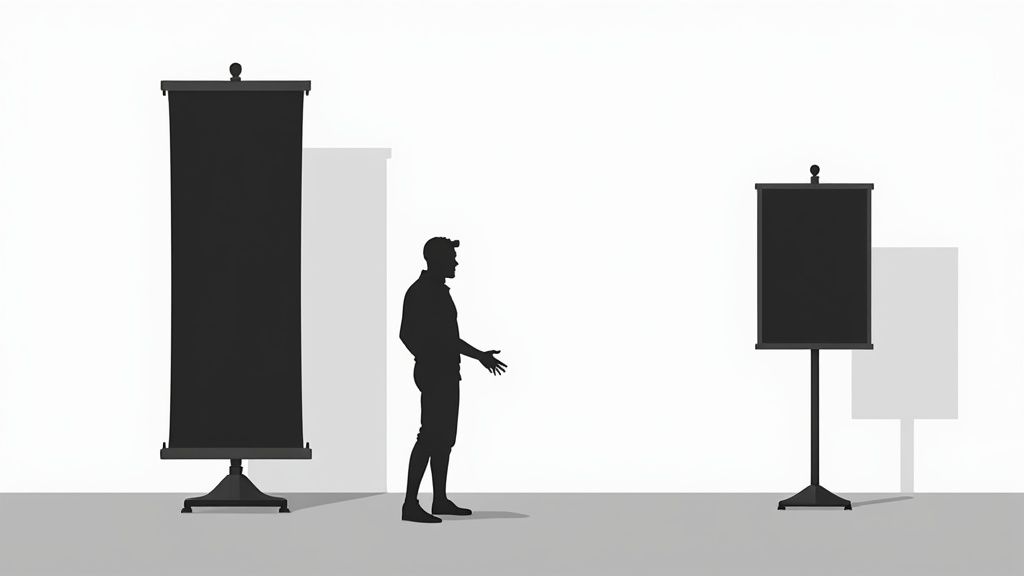
Unlike a business card passed in a quiet, one-on-one conversation, these assets are built for mass exposure. Picture a stunning retail sign that practically pulls shoppers in off the sidewalk, or a trade show booth so dynamic it becomes the talk of the entire event. Their sheer size gives them an immediate authority and visibility that smaller materials just can't compete with.
But designing for a giant canvas is a whole different ballgame. It comes with its own set of rules.
Designing for Distance and Durability
The number one rule of large format design is clarity from afar. What looks perfectly crisp on your monitor can easily turn into a pixelated, unreadable mess when it’s blown up to the size of a wall. To get it right, you have to nail a few key elements that ensure your message connects, no matter how far away your audience is.
To make sure your investment really pays off, you’ll want to focus on these critical points:
- High-Resolution Imagery: Nothing screams "amateur" faster than blurry, pixelated graphics. Always, always use vector files or high-resolution photos to keep your visuals sharp and professional when they're scaled up.
- Bold, Legible Typography: Your font needs to be readable from across a busy street or a packed convention hall. Stick to clean, bold typefaces and make sure you have plenty of contrast between your text and the background.
- A Clear, Concise Message: Let's be honest, you only have a few seconds to get your point across. You need a single, powerful headline and just enough supporting text to communicate your main idea instantly.
Think of your large format material like a billboard. You’ve got about three seconds to hook someone’s attention and deliver a clear message before they move on. Every single second counts.
Beyond the visuals, the physical material itself plays a huge role in how long your sign or banner will last and how good it looks.
Choosing the Right Materials for the Job
The material you print on directly impacts the durability and overall look of your large format piece. An indoor banner made of flimsy paper won’t survive a weekend at an outdoor festival, and a standard poster will fade in a hurry if it’s sitting in direct sunlight. Knowing your options is key to making a smart choice.
Here are a few of the most common materials to consider:
- Vinyl: This is the go-to for a reason. It's incredibly versatile and durable, making it perfect for both indoor and outdoor banners that need to stand up to the weather.
- Fabric: Often used for trade show backdrops and high-end displays, fabric gives you a premium, non-glare finish that looks fantastic in photos.
- Rigid Materials: Substrates like foam board or PVC are the perfect choice when you need sturdy, freestanding signage for presentations or point-of-sale displays.
Choosing the right material ensures your marketing pieces look professional and hold up through multiple events or seasons. For a closer look at all the possibilities, exploring options for online large format print can give you a much clearer idea of what will work for your specific needs. When you match a great design with the right material, you create a powerful brand presence that truly stands out from the crowd.
Using Promotional Products to Build Loyalty
Beyond the immediate pop of a banner or the detailed story in a brochure, some of the most powerful business marketing materials work their magic on a much more personal level. I'm talking about branded merchandise, or as most of us call it, "swag." When it’s done right, this can be an incredibly effective way to build real, lasting relationships with your customers.
This isn’t just about slapping your logo on the cheapest pen you can find. It’s about creating a tangible connection that quietly builds brand loyalty. There’s a bit of psychology at play here, rooted in the principle of reciprocity. When you give someone a gift, even a small one, it sparks a natural desire to give something back—often, that "something" is their business. The numbers don't lie: a staggering 85% of consumers who get a promotional item end up doing business with the company that gave it to them.
Choosing Swag That Actually Works
The secret to making promotional products work for you is to ditch the generic junk. The best items are the ones that not only reflect your brand's personality but are genuinely useful to the people you're giving them to. A high-quality, practical item keeps your brand in front of them every single time they use it. To get a better sense of how businesses turn gifts into stronger connections, it's worth exploring different corporate gifting strategies that focus on making a truly memorable impact.
Think about what your audience would actually appreciate. Here are a few ideas to get you started:
- Practical Office Gear: We're talking branded notebooks, smooth-writing pens, or portable chargers. These are the things people reach for every day, putting your brand right at their fingertips.
- Lifestyle Accessories: Items like tote bags, insulated water bottles, or even funky branded socks can connect with your audience outside of a work context, making your brand a part of their daily life.
- Innovative Tech Gadgets: Little things like webcam covers or phone stands are modern, incredibly practical, and show that your brand is in touch with today's needs.
Thoughtful swag is more than just an item; it's a tangible "thank you." It turns a simple transaction into a genuine relationship by showing your customers you see them as more than just a sale. That small gesture can make a massive difference in keeping them around for the long haul.
At the end of the day, you want to pick items your customers will actually want to keep and use. A well-chosen promotional product becomes a bridge connecting your brand to their everyday life. It's a constant, positive reminder of who you are, reinforcing their loyalty every time they use it. When you're ready to find the perfect items that will click with your audience, you can browse a huge variety of high-quality promotional products designed to leave a great impression.
Making Your Marketing Personal for Better Results
Gone are the days of one-size-fits-all messaging. If you want your business marketing materials to actually work, they need to speak directly to the individual. This creates a genuine connection that builds trust and, more importantly, gets people to act. It's all about making your audience feel seen and understood.
Think of it like a real conversation. Blasting the same generic message at everyone is like shouting into a crowded room. Personalization, on the other hand, is like pulling someone aside for a meaningful, one-on-one chat. This simple shift turns your marketing from a monologue into a dialogue, and that’s when engagement really takes off.
Tailoring Both Digital and Print Experiences
Personalization isn't just for emails; it makes both your digital and physical marketing materials far more effective. Each format gives you a unique chance to create a tailored experience that sticks with your customers.
For your digital assets, this could look like:
- Targeted Email Campaigns: Sending emails that greet a subscriber by name and suggest products based on things they’ve actually looked at before.
- Dynamic Website Content: Showing a different headline or offer on your homepage depending on whether someone is a new visitor or a returning customer.
And for print, modern tech has opened up some incredible possibilities:
- Variable Data Printing (VDP): This is a game-changer. VDP lets you customize direct mail pieces at a huge scale. Imagine every single mailer going out with the recipient's name, a unique offer, or even images tailored to their interests.
When you create marketing materials that feel uniquely relevant to each person, you're doing more than just promoting a product. You're starting a relationship. You're showing your audience that you get their specific needs and you're the one to solve them.
This move toward personalization isn't just a hunch; it’s where the industry is putting its money. Brands that nail these tailored experiences are the ones blowing past their revenue goals. In fact, by 2025, about 56% of marketing leaders are actively investing in personalization tech, and they’re expected to triple their spending on unifying customer data to make it happen. You can dig deeper into these trends in this detailed 2025 marketing report. Thankfully, today's tools are making sophisticated personalization accessible, allowing businesses of any size to connect with customers on a much more human level.
Got Questions? We've Got Answers
Stepping into the world of marketing materials can feel like learning a new language, especially when you’re focused on making every dollar work for you. It’s only natural to have a few questions. We hear a lot of the same ones from business owners, so let's clear up some of the most common points of confusion.
What Is the Difference Between Marketing and Promotional Materials?
Think of it like this: "marketing materials" is the giant umbrella that covers everything you use to get your brand’s message out there. That includes your business cards, brochures, website, and even your social media posts. It's the whole toolkit.
"Promotional materials" are just one specific tool under that umbrella. These are usually the tangible, branded items you give away—think pens, tote bags, or t-shirts. Their main job is to keep your brand top-of-mind and build a little goodwill.
So, while a branded water bottle is a marketing material, a brochure isn't really a "promotional product." One reminds, the other educates. Simple as that.
How Much Should a Small Business Budget for Marketing Materials?
There's no magic number here, but a good starting point is to set aside 5-10% of your total revenue for your entire marketing budget. The slice of that pie dedicated to physical and digital materials really depends on your business and who you're trying to reach.
For example, a new B2B consultant might go all-in on high-end business cards and a slick, professional website to build credibility. On the other hand, a local coffee shop will likely see a better return from flyers, in-store posters, and eye-catching social media graphics that get people through the door.
The smartest way to start is small. Focus on the absolute essentials first—the things that will make the biggest impact. Then, watch to see what brings in leads or sales and double down on what works.
Can I Design My Own Business Marketing Materials?
You absolutely can, but it’s a path you should walk carefully. Tools today make it incredibly easy to jump in and start designing. The big risk? Consistency and quality. A pro designer doesn't just make things look pretty; they ensure every piece fits your brand, is set up perfectly for printing, and has a polished feel that builds trust.
If the budget is tight, using professionally designed templates is a great middle ground to keep things consistent. But as your business grows, hiring a graphic designer for your core materials is one of the best investments you'll ever make for your brand's future.
Ready to create marketing materials that people will actually remember? 4OVER4 has a massive range of top-quality, customizable printing options to bring any idea to life. From unforgettable business cards to banners that stop people in their tracks, we’ve got what you need to build a brand that gets noticed. Explore our products and start creating at https://4over4.com.
More from

10
When you’re launching a product, your bottle label is often the first thing a customer sees. Think of it as your silent salesperson
 Emma Davis
Mar 16, 2026

27
When you're brainstorming ideas for landscaping business cards, it helps to think beyond just contact information. Your c
Emma Davis
Mar 15, 2026

87
When you think of a yard sign, the classic 18"x24" is probably what comes to mind. It’s the industry workhorse fo
Emma Davis
Mar 14, 2026

55
When you’re ready to invest in an A-frame sign, the first question you'll ask is, "What size do I need?" It usually comes down
Emma Davis
Mar 13, 2026

574
The real secret to mastering your direct mail budget isn't complicated. It comes down to one simple fact: a standard 4" x 6&q
Emma Davis
Mar 12, 2026

112
Tear-off flyers are a classic for a reason. They’re a tangible marketing tool, designed with perforated, removable tabs at the bottom. Each
Emma Davis
Mar 11, 2026

167
Printing stickers at home is a seriously fun and rewarding project. It boils down to four main parts: designing your image, picking the right
Emma Davis
Mar 10, 2026

123
Ever seen a logo that seems to float right on the glass of a jar or bottle? That’s the work of transparent label stickers.
Emma Davis
Mar 9, 2026