Table of Contents
- Home
- content hub
- Your Guide to Business Card Dimensions in CM
 Share and earn
Your Guide to Business Card Dimensions in CM

Nov 2, 20252228 views
Nov 2, 20252228 views
When you’re designing a business card, the first question is always about size. While creativity is key, there are some established standards you’ll want to stick to. In North America, the go-to dimension is 8.9 cm x 5.1 cm, while in Europe, it’s a slightly different 8.5 cm x 5.5 cm.
These sizes aren't arbitrary; they’re designed to be practical. Think about it—they fit perfectly into standard wallets and cardholders, making it easy for your contacts to keep your information handy. Nailing these basic standards is the first step to creating a card that’s both memorable and functional.
Quick Guide to Standard Business Card Dimensions
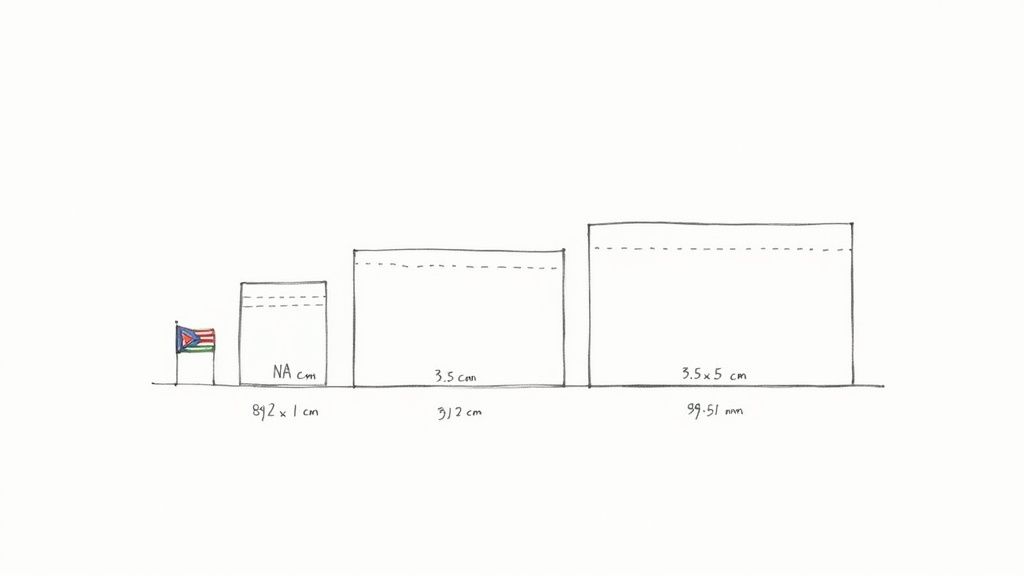
Before you get lost in creative shapes or regional quirks, it’s smart to have a quick reference for the most common sizes. These dimensions are the bedrock of professional networking, influencing everything from your layout and text placement to the overall visual balance of your card.
Getting the size right ensures your card works for the person receiving it. It’s not just about looking good; it's about being practical. To make things easy, I’ve put together a simple comparison table so you can find the exact measurements you need, whether you’re working in centimeters, inches, or millimeters.
And once you’ve got your dimensions sorted, you can start exploring the exciting part: bringing your design to life with professional business cards printing services.
Standard Business Card Sizes at a Glance
Here’s a quick-reference table that breaks down the most common business card dimensions across major regions. It's a handy tool for comparing sizes in centimeters, inches, and millimeters at a glance.
| Region | Dimensions (cm) | Dimensions (inches) | Dimensions (mm) |
|---|---|---|---|
| North America (US/Canada) | 8.9 cm x 5.1 cm | 3.5" x 2.0" | 89 mm x 51 mm |
| Europe & ISO Standard | 8.5 cm x 5.5 cm | 3.35" x 2.17" | 85 mm x 55 mm |
This table covers the big players, giving you a solid starting point for almost any project you're working on. Keep these numbers in your back pocket, and you'll always have the right foundation for your design.
Understanding North American Card Sizes
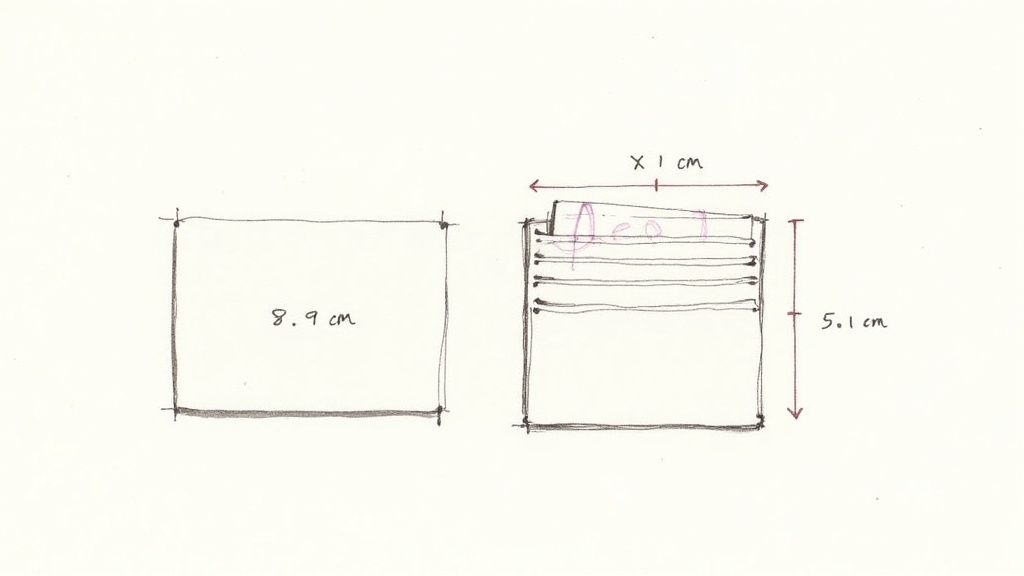
Here in North America—specifically the US and Canada—one size has been the gold standard for business cards for ages. The standard, go-to dimension is 8.9 cm by 5.1 cm (or 3.5 inches by 2 inches). There's a brilliant, practical reason this size became the norm: it was designed to slip perfectly into wallets and cardholders, right next to credit cards.
That consistency is a huge advantage. When you hand someone your card, they instinctively know where it's going to live. This simple fact dramatically increases the chances your details get kept instead of tossed. It's a familiar, comfortable fit.
For designers, this compact canvas is everything. Your entire layout—from where the logo sits to the font size you choose—is dictated by these dimensions. It’s a delicate balance between making a visual splash and keeping all the critical information clean, legible, and uncluttered. You have to make every millimeter count.
A well-executed card using the standard North American dimensions feels instantly professional. It's a safe and effective choice for any networking situation.
Key Design Considerations
When you're working within that 8.9 cm x 5.1 cm space, a few key principles will make or break your design's effectiveness.
- Visual Hierarchy: You need to guide the viewer’s eye. Make your name and company the first things they see by giving them the most visual weight.
- Font Readability: This is non-negotiable. Stick to clean, legible fonts and never go smaller than 7 or 8 points. Anything less becomes a struggle to read.
- Information Density: Less is almost always more. Be ruthless about what information you include. Stick to the absolute essentials to avoid a cluttered, unprofessional look.
Hop across the Atlantic, and you'll find business card sizes shift just enough to matter. In Europe, the go-to standard is 8.5 cm x 5.5 cm, which makes for a card that’s a touch shorter and wider than what you'd typically find in North America. It’s a subtle difference, but one that definitely changes the feel and the design possibilities.
This European sizing isn't just a random regional quirk; it's closely aligned with a global standard. The ISO 7810 ID-1 format—the very same one used for credit cards and driver's licenses all over the world—is practically identical. That global consistency means a European business card feels right at home in any wallet, anywhere.
The Impact on Design
That slightly wider, shorter canvas of the 8.5 cm x 5.5 cm card really lends itself to different design choices. You get more horizontal real estate to play with, which is perfect for brands with wider logos or for laying out contact info side-by-side instead of stacking it.
It also changes how you can guide the viewer's eye. Key information, like a name or logo, can really pop across the wider layout. This dimension is very similar to the ISO 7810 ID-1 standard for credit cards. You can dig deeper into these standard business card sizes to see just how much regional norms shape the final design.
That link to a global standard is a huge plus for anyone doing business internationally. A card designed to European specs will feel professional and practical no matter where you hand it out, eliminating any awkwardness about whether it will fit in someone's cardholder.
A Global Reference for Business Card Sizes
When your business operates on a global scale, the little details matter. While the North American and European standards will get you by in many places, knowing the specific business card dimensions in cm for other key markets shows you’ve done your homework. It’s more than just a practical choice; it’s a sign of cultural awareness and respect that can make a real difference in professional relationships.
For example, in Japan, the exchange of business cards—or 'Meishi'—is a serious ritual. Handing over a card that matches their standard size of 9.1 cm x 5.5 cm is a subtle but powerful gesture. Other regions have their own distinct preferences, too. In China, you'll commonly see cards measuring 9.0 cm x 5.4 cm, and if you’re heading down under, Australia and New Zealand share a standard of 9.0 cm x 5.5 cm. For more regional specifics, you can dig into details like the NZ standard business card dimensions.
Key International Size Variations
Understanding these subtle differences is crucial for anyone networking internationally. A few millimeters might not seem like much, but it can affect how your card fits in a wallet and the overall impression you leave.
To make things easier, here’s a quick reference table covering the standard business card dimensions for several key international regions.
International Business Card Dimensions (cm)
| Country/Region | Standard Dimensions (cm) | Common Variations |
|---|---|---|
| Japan (Meishi) | 9.1 cm x 5.5 cm | Slightly larger than most |
| China | 9.0 cm x 5.4 cm | A unique regional size |
| Australia/New Zealand | 9.0 cm x 5.5 cm | Wider than the EU standard |
| South America | 9.0 cm x 5.0 cm | Close to North American size |
As you can see, there are minor but important variations from one place to the next.
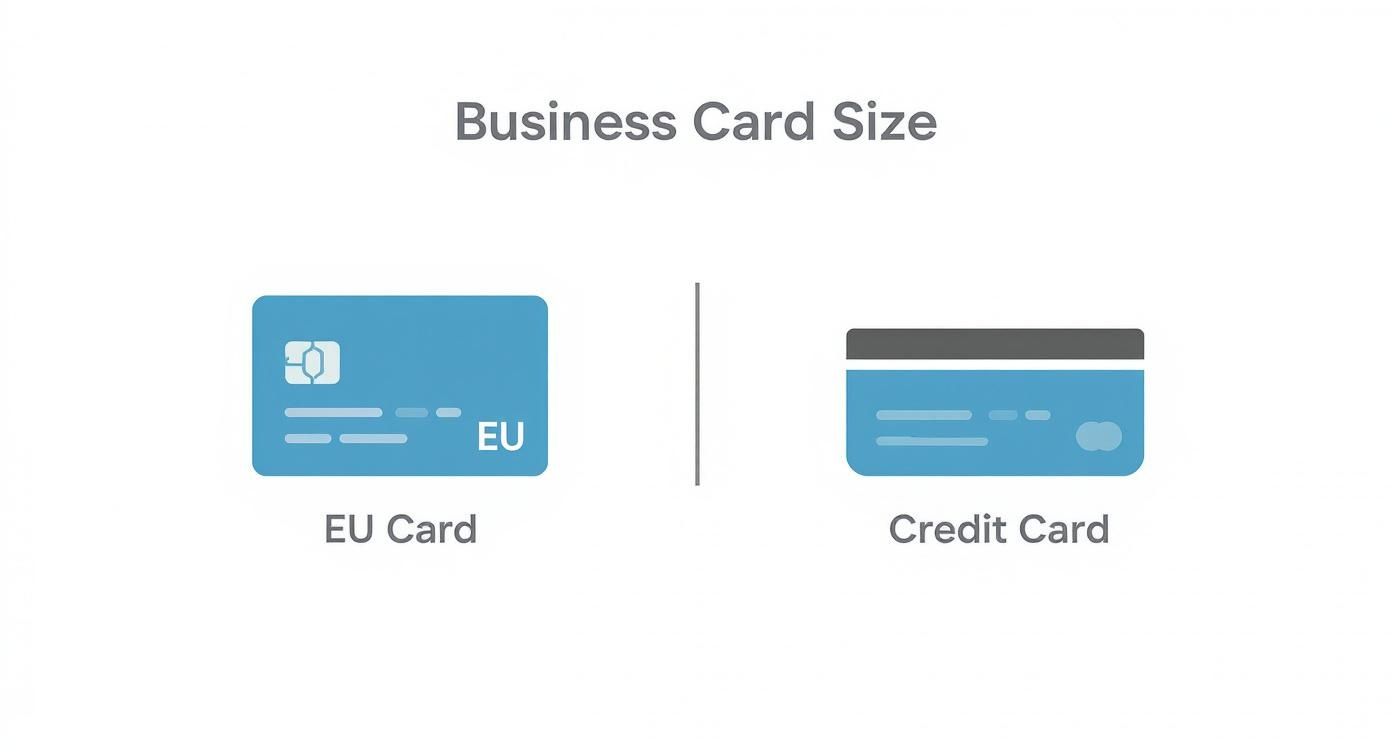
This alignment is why the European size is often considered a safe bet for international use, fitting universally into wallets. When you're ready to create cards tailored for any region, exploring a standard collection of printing options can provide the flexibility you need.
Getting Your Design Ready for Print
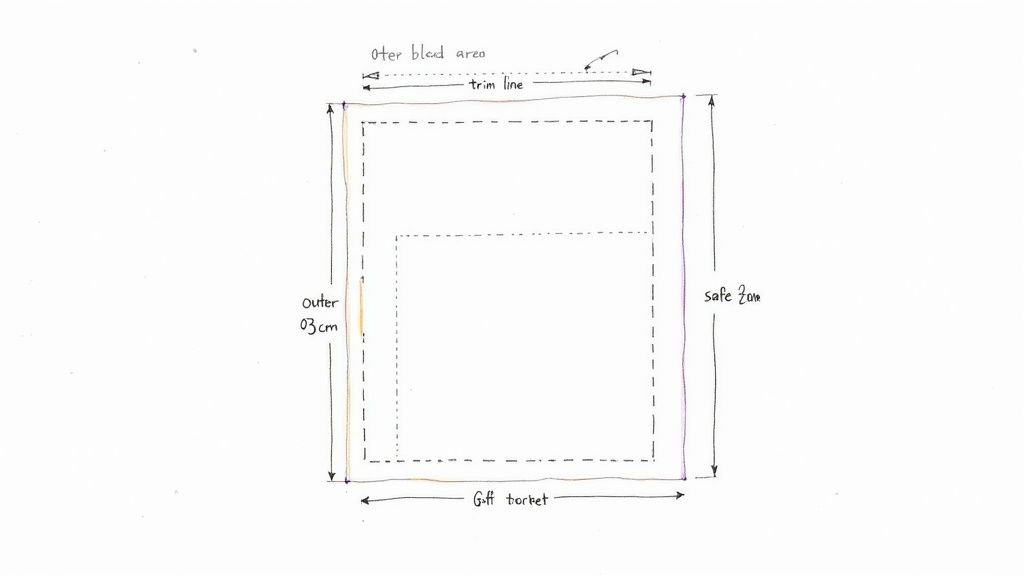
To get a truly professional print, you have to speak the printer’s language. While knowing your final business card dimensions in cm is a great start, a few other terms are just as important: bleed, trim, and safe area. Trust me, getting these wrong is a recipe for crooked prints, weird white borders, and expensive do-overs.
Think of these terms as a set of boundaries for your design file. They create a buffer zone around your core content, giving the printing and cutting machines a little wiggle room. After all, this is a physical process, and small shifts can happen.
Understanding the Print Boundaries
So, why does your design file need to be a bit bigger than the final card? It's all about ensuring a perfect cut every single time. This extra margin is managed using three key zones.
- Bleed Area: This is the outermost edge of your design, and it extends past the line where the card will actually be cut. If you have a background color or an image that goes right to the edge, it needs to stretch all the way into this bleed area. This simple step prevents any ugly white slivers from showing up if the cut is off by a hair. A standard bleed is 0.3 cm (or 3 mm) on every side.
- Trim Line: This is exactly what it sounds like—the line where the printer’s guillotine will slice the paper to create the final business card. If you ordered a standard 8.9 cm x 5.1 cm card, this line marks that exact dimension.
- Safe Area: Also called the safety margin, this is the inner box where all your crucial elements must live. We're talking logos, names, phone numbers, and email addresses. Keeping everything inside this zone guarantees that nothing important will get chopped off during trimming.
Setting up your file with the right bleed and safe area from the start is the best way to make sure the final product looks just as good in your hand as it does on your screen.
If you’re thinking about something more creative than a standard rectangle, you can also explore techniques like custom die-cutting to create unique shapes that really stand out. https://www.4over4.com/printing/category/die-cutting. Just remember that the goal is for your card to align with your company's identity, which is where comprehensive branding services can help tie everything together.
Choosing Your Card Orientation and Shape
Beyond the standard business card dimensions in cm, the orientation and shape you pick are huge opportunities to show off your brand's personality. The classic horizontal (landscape) layout is still king for a reason—it feels familiar, professional, and works great for established brands or those with longer logos. Plus, it's practical, fitting perfectly into any standard cardholder.
Lately, though, vertical (portrait) cards have been gaining serious traction, especially with tech startups, creative agencies, and designers. This format just feels more modern and unconventional. It's a natural fit for vertically stacked logos and can guide the eye downward, letting you play with a unique flow of information.
Exploring Custom Shapes and Finishes
While orientation is a big decision, you don't have to stick with a rectangle at all. Custom shapes can make your card unforgettable, but it's always a balancing act between creativity and practicality.
- Square Cards: These have a clean, modern vibe that really stands out. A popular size is 6.5 cm x 6.5 cm, which gives you a unique canvas for minimalist, bold designs.
- Die-Cut Shapes: A custom shape, like one that traces the outline of your logo, is a guaranteed way to get noticed. Just keep in mind that really unusual shapes might be a pain for people to tuck into their wallets.
- Rounded Corners: This is a subtle tweak that makes a big difference. Rounded corners soften the card’s whole look, adding a touch of modern elegance. You can find all sorts of options for rounded corner business cards to see how this small change can really elevate a design.
At the end of the day, your choice needs to be both impactful and convenient. A creative card is great, but only if your new contact can actually hold onto it.
Common Questions About Business Card Sizes
Diving into the world of business card dimensions can bring up a few questions, especially when you're getting files ready for print. To feel confident in your final design, you need to be sure about the details, from international standards to the nitty-gritty of print requirements. This section has clear answers to the most common questions we hear about business card sizes.
Getting these details right is the key to a final product that looks professional, feels practical, and perfectly represents your brand. Let's clear up any lingering doubts so you can move forward.
What Is the Most Universally Accepted Business Card Size in cm?
While there isn't one single size that's officially "universal," the European standard of 8.5 cm x 5.5 cm is about as close as it gets. Why? Its dimensions are almost identical to the ISO 7810 ID-1 international standard, which is the size used for credit cards. This makes it a perfect fit for wallets and cardholders around the globe.
If your goal is to have one go-to card for networking anywhere in the world, this size is a smart, practical choice. It’s so widely recognized that it will feel familiar and fit conveniently for anyone you hand it to, no matter the country.
For professionals who travel a lot, sticking with the European standard can eliminate all the guesswork. It's a safe, reliable option that maintains a professional look wherever your business takes you.
How Much Bleed Should I Add to My Design?
Great question. Most professional printers will ask for a bleed of 0.3 cm (or 3 mm) on all four sides of your artwork. This extra margin is there to ensure no awkward white edges show up after the cards are trimmed down to their final size. It just means your design file needs to be slightly larger than the finished card.
For instance, if you're designing a standard North American card (8.9 cm x 5.1 cm), your file with the bleed included should be 9.5 cm x 5.7 cm. That little bit of extra space is absolutely crucial for a clean, professional, edge-to-edge finish. This is especially important if you're using special finishes; learn more about prepping your designs for techniques like foil stamping to make an even bigger impact.
Does the Thickness of the Card Matter?
Yes, it absolutely does. Card thickness, or stock, has a huge impact on how people perceive the quality and durability of your brand. It's measured in either grams per square meter (gsm) or points (pt). A standard business card usually lands somewhere around 300-350 gsm (which is about 14-16 pt).
Thicker card stocks, like 400 gsm (18 pt) or even heavier, feel much more substantial and premium in hand. They might cost a bit more to produce, but that added weight can seriously elevate your brand’s image and leave a much more memorable impression.
More from

13
When you’re ready to invest in an A-frame sign, the first question you'll ask is, "What size do I need?" It usually comes down
 Emma Davis
Mar 13, 2026

113
The real secret to mastering your direct mail budget isn't complicated. It comes down to one simple fact: a standard 4" x 6&q
Emma Davis
Mar 12, 2026

63
Tear-off flyers are a classic for a reason. They’re a tangible marketing tool, designed with perforated, removable tabs at the bottom. Each
Emma Davis
Mar 11, 2026

112
Printing stickers at home is a seriously fun and rewarding project. It boils down to four main parts: designing your image, picking the right
Emma Davis
Mar 10, 2026

103
Ever seen a logo that seems to float right on the glass of a jar or bottle? That’s the work of transparent label stickers.
Emma Davis
Mar 9, 2026

59
Picture this: your product’s beautiful label gets smudged and runny during shipping, or a gorgeous event banner fades to nothing after just
Emma Davis
Mar 8, 2026

58
In a sea of options, your product's packaging and labeling are its first, and often only, chance to make a real connectio
Emma Davis
Mar 7, 2026

89
Ever tried to print a hundred high-quality flyers on your home office printer? You probably ran out of ink, dealt with paper jams, and ended u
Emma Davis
Mar 6, 2026