Paper Weight for Flyers - What You Need to Know Right Now
The best paper weight for flyers is 100 lb Gloss Text, which sits around 150 GSM. It's the sweet spot - thick enough to feel professional in someone's hand, light enough to keep costs down on large print runs. 4OVER4.COM offers 60+ paper types so you can dial in exactly the right weight and finish for your project. With 25+ years in the printing game, we've helped businesses nail this decision thousands of times.
Why Flyer Paper Weight Matters More Than You Think
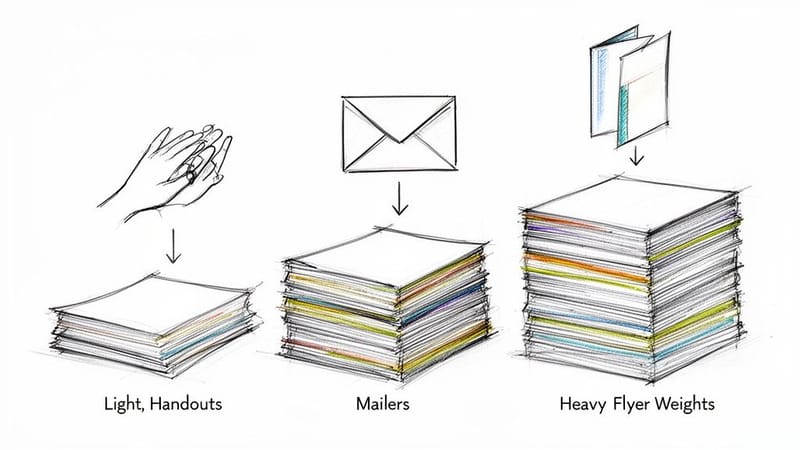
Pick the wrong paper weight and your flyer ends up in the trash before anyone reads it. Pick the right one and people actually hold onto it. That's the difference paper weight makes for flyers - it's the first thing someone feels, and it shapes their opinion of your brand in about two seconds flat.
| Quantity | Price Per Unit |
|---|---|
| 50 | $1.14 |
| 800 | $0.21 |
| 7,000 | $0.06 |
| 25,000 | $0.04 |
Ink Color
Finish
Folding
Scoring
Perforation
Proof Options
This guide breaks down every common flyer paper weight, what each one is good for, and how to match your choice to your budget and goals. Whether you're printing 200 flyers for a local event or 20,000 for a direct mail campaign, you'll walk away knowing exactly what to order. Check out our Showcase for real examples of what different paper weights look like in finished projects. And if you're ready to print, don't miss our Daily Deals for current pricing on flyer orders.
Ink Color
Finish
Die Cutting
Proof Options
4OVER4.COM prints on 60+ paper stocks, so you're not locked into one or two choices. Let's find the right one for you.
Ink Color
Finish
Scoring
Rounded Corners
Total Sets
Proof Options
How Paper Weight Works - GSM, Pounds, and Points Explained
Paper weight gets confusing fast because the industry uses three different measurement systems. Let's clear that up before we go any further.
GSM (grams per square meter) is the universal standard. It measures the actual density of the paper. Higher GSM means thicker, heavier paper. Simple.
Pound weight (lb) is the U.S. system, and here's where it gets tricky. "80 lb text" and "80 lb cover" are completely different thicknesses. Text weight is thinner and more flexible. Cover weight is rigid, almost like cardstock. Always check whether you're looking at text or cover weight.
Point (pt) measures thickness directly in thousandths of an inch. A 10pt sheet is 0.010 inches thick. You'll see this more with cardstock and business cards than with standard flyers.
For most flyers, you're working in the text weight range - somewhere between 70 lb text (100 GSM) and 100 lb text (150 GSM). If you want something closer to a postcard, you'd jump to cover weight. Our How To Make Flyers guide walks through the full design process from start to finish.
The Go-To Range: 80 lb to 100 lb Text Weight
Here's where most flyers live. 80 lb text (120 GSM) is your everyday workhorse - think restaurant menus, event announcements, and promotional handouts. It's noticeably better than copy paper but won't break the bank on large orders.
100 lb text (150 GSM) is the sweet spot for the best paper weight for flyers. It feels big. People notice the difference when they pick it up. It says "this business cares about quality" without saying "this business spent too much on paper."
For anything you're handing directly to potential customers - trade show flyers, real estate open house sheets, salon promotions - 100 lb text is the move. It holds up to handling, doesn't wrinkle easily, and prints beautifully with vivid color reproduction.
Lightweight Flyers: 60 lb to 70 lb Text
Going lighter makes sense in specific situations. 60 lb text (90 GSM) is close to premium copy paper. It's thin. Flexible. And cheap to print in bulk.
When does lightweight work? Mass mailings. If you're stuffing 10,000 envelopes, every gram matters for postage costs. Newspaper inserts. Door-to-door distribution where volume matters more than perceived quality. Internal company communications where nobody's judging the paper.
The trade-off is obvious. Lighter paper feels less professional. It can curl, wrinkle, and show through if you're printing double-sided. If your flyer is the first impression someone has of your business, think twice before going this light. For tips on related print projects, check out our guide on How To Make Envelopes - especially if you're pairing flyers with a direct mail campaign.
Choosing Paper Weight Based on Your Flyer's Purpose
Don't start with the paper. Start with the job. What is this flyer supposed to do? Where will people encounter it? How long should it last?
Event Promotion and Handouts
Handing flyers to people at a concert, festival, or trade show? Go with 100 lb gloss text. The glossy finish catches light and makes colors pop. The weight feels intentional - not like something someone printed at home. People are more likely to keep it, tuck it in a pocket, or snap a photo of it later.
"We printed 5,000 flyers on 100 lb gloss for our food truck festival. They looked amazing and held up even in the heat. People were actually reading them instead of tossing them." - Derek L., Event Coordinator
Direct Mail Campaigns
Mailing flyers changes the equation. You need to factor in postage weight, how the paper feeds through automated sorting machines, and whether it'll survive the journey without looking beat up.
80 lb text is usually the right call for direct mail. It's light enough to keep postage costs manageable but sturdy enough to arrive looking crisp. Matte finishes tend to work better here - they don't show fingerprints or scuff marks from handling. If you're folding your flyers for mailing, our How To Fold A Brochure guide covers fold techniques that apply to flyers too.
Retail and In-Store Displays
Flyers sitting in a countertop holder or pinned to a bulletin board need to hold their shape. Floppy paper looks terrible in a display rack. 100 lb text or even 80 lb cover (216 GSM) gives you that extra rigidity.
Think about it from the customer's perspective. They're browsing, they spot your flyer, they pull it out. If it bends and flops, it feels cheap. If it holds its shape with a slight stiffness, it feels like something worth reading.
Premium and Luxury Flyers
Launching a high-end product? Promoting a luxury service? Go heavy. 100 lb cover (270 GSM) or even 14pt cardstock turns a flyer into a keepsake. Add a soft-touch matte finish and people won't want to throw it away.
This approach costs more per piece, obviously. But if you're printing 500 flyers for an exclusive product launch instead of 10,000 for a pizza deal, the per-unit cost matters less than the impression you make.
Gloss vs. Matte vs. Uncoated - How Finish Affects the Feel
Paper weight is only half the equation. The finish changes how the flyer feels, how it looks, and even how readable it is.
Gloss reflects light and makes colors look saturated and vivid. Great for photo-heavy flyers, food photography, and anything where visual impact is the priority. Downside: it can create glare under bright lights and fingerprints show.
Matte absorbs light for a smooth, non-reflective surface. Text is easier to read. It feels more sophisticated and modern. Works well for text-heavy flyers and anything with a minimalist design aesthetic.
Uncoated has a natural, textured feel. Think craft brewery vibes, organic food brands, artisan businesses. It's writable - people can jot notes on it with a pen. But colors won't pop as much, and it absorbs ink differently.
4OVER4.COM offers all three finishes across multiple paper weights. You can browse real printed examples in our Showcase to see how different combinations look. And if you want to feel the paper before committing to a full order, grab our Free Samples kit.
Paper Weight and Double-Sided Printing
Planning to print on both sides? Paper weight matters even more. With lighter stocks (60-70 lb text), ink from one side can show through to the other. This is called "show-through" and it makes your flyer look cheap and hard to read.
80 lb text is the minimum for clean double-sided printing. At this weight, show-through is minimal with standard CMYK printing. If your design uses heavy ink coverage - dark backgrounds, full-bleed photos - bump up to 100 lb text to be safe.
Coated papers (gloss and matte) handle double-sided printing better than uncoated stocks because the coating prevents ink from soaking through the fibers. Keep that in mind if you're on the fence between coated and uncoated for a two-sided flyer.
Cost Considerations When Picking Flyer Paper Weight
Heavier paper costs more. That's just how it works. But the difference isn't as dramatic as you might expect.
Moving from 80 lb text to 100 lb text typically adds a small percentage to your total order cost. On a run of 1,000 flyers, you might be looking at a few extra dollars. That's a tiny investment for a noticeable quality upgrade.
Where costs jump more a lot is the leap from text weight to cover weight. Going from 100 lb text to 80 lb cover can increase your per-piece cost by 30-50% depending on quantity. Worth it for premium applications, but overkill for everyday distribution.
The smartest approach? Order a small test batch first. Print 100 flyers on two different weights, hand them out, and see which one gets a better response. For more printing tips and resources, visit our Faq Hub. And if you're working on other print projects alongside your flyers, our guides on How To Clean Rubber Stamps and Custom Magnets Faq are worth a look.
"I tested 80 lb and 100 lb text for our gym's membership drive flyers. The 100 lb version got way more people asking about sign-ups. That small upgrade in paper weight made a real difference." - Tanya R., Fitness Studio Owner
Here are some real examples from 4OVER4.COM customers who chose the right paper weight for their flyer projects.
Ready to design your own flyers? Start with one of these professionally designed templates.
Want to see how different paper weights look in practice? Here are some blank template options to experiment with.
Blank Templates
Flyer Paper Weight Mistakes That Cost You Money
Picking the best paper weight for flyers isn't complicated, but people make the same mistakes over and over. Here are the big ones.
Going too light to save money. Printing 5,000 flyers on 60 lb text saves you a few bucks. But if nobody keeps them because they feel like junk mail, you just wasted your entire print budget. The "savings" cost you more than the upgrade would have.
Going too heavy for the wrong application. Printing a weekly specials flyer on 14pt cardstock is like wearing a tuxedo to a barbecue. It's not wrong, exactly. It's just weird and expensive for no reason.
Ignoring show-through on double-sided designs. Designers love dark backgrounds. But if you're printing both sides on lightweight paper, that dark background bleeds through and ruins the other side. Always match your design's ink coverage to an appropriate paper weight.
Not ordering samples first. Paper feels different in person than it looks on a screen. 4OVER4.COM offers sample kits so you can touch the actual stock before committing to a full run. Use them.
Forgetting about the finish. A 100 lb gloss text and a 100 lb matte text weigh the same but feel completely different. The finish changes the entire experience of holding your flyer.
Your Flyer Paper Weight Questions, Answered
What GSM is best for flyers?
For most flyers, 150 GSM (100 lb text) is the best choice. It feels professional and holds up to handling without being too heavy or expensive. If you're doing a mass mailing where postage matters, 120 GSM (80 lb text) works well. For premium or display flyers, consider 200+ GSM cover stocks.
Is 80 lb text too thin for flyers?
Not at all. 80 lb text (120 GSM) is a solid mid-range option for flyers. It's noticeably thicker than copy paper and works great for direct mail, door hangers, and general distribution. It only feels "thin" when compared directly to 100 lb text or cover stocks.
Should I use gloss or matte paper for flyers?
Gloss is better for photo-heavy, colorful flyer designs - it makes images pop. Matte works better for text-heavy flyers and gives a more modern, sophisticated feel. Both finishes are available across all standard flyer paper weights at 4OVER4.COM.
Can I print double-sided on lightweight flyer paper?
You can, but use 80 lb text as your minimum for double-sided flyer printing. Anything lighter risks show-through, especially with dark backgrounds or heavy ink coverage. Coated papers (gloss or matte) handle double-sided printing better than uncoated stocks.
What paper weight do professional printers recommend for flyers?
Most professional printers recommend 100 lb gloss text (150 GSM) as the standard for flyers. It's the industry default because it balances quality, cost, and versatility. 4OVER4.COM prints thousands of flyer orders on this stock every month.
How does paper weight affect flyer mailing costs?
Heavier paper means heavier mail pieces, which can push you into a higher postage bracket. For large direct mail campaigns, sticking with 80 lb text keeps individual flyers under common weight thresholds. The savings on postage across thousands of pieces can be big.
What's the difference between text weight and cover weight for flyers?
Text weight paper is thinner and more flexible, ideal for standard flyers you hand out or mail. Cover weight is thicker and more rigid, closer to cardstock. An "80 lb text" flyer is much thinner than an "80 lb cover" flyer despite sharing the same number. Always confirm which type you're ordering.