What You Need to Know About Color Profiles Before Printing
CMYK is the best color profile for printing - period. RGB looks great on screens but falls flat on paper. Every print file should be converted to CMYK before submission. 4OVER4.COM has printed 10 billion+ cards and knows that color profile mistakes are the number one cause of disappointing results. Getting this right from the start saves you time, money, and reprints.
Why Your Color Profile Choice Determines Print Quality
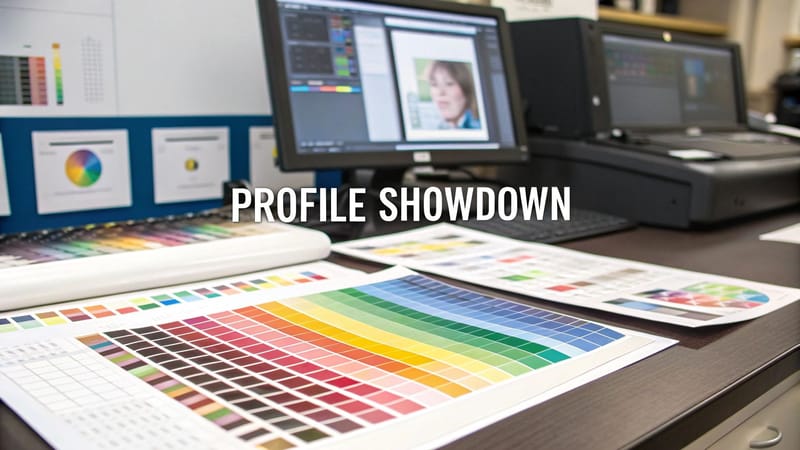
Color profiles act as translators between your screen and the printing press. Your monitor displays color using light (RGB). A printer lays down ink (CMYK). Without the right translation, that electric blue on your screen prints as a muddy purple. That neon green? It comes out olive.
This best color profile for printing guide walks you through exactly which profile to use, when to use it, and how to set it up in your design software. Whether you're building files in the Online Designer or working in Photoshop, the principles stay the same. With 10,000+ reviews backing up 4OVER4.COM's print quality, you can trust that proper file setup leads to sharp, accurate results.
If you're working on other print projects, you might also find our guide on How To Clean Rubber Stamps helpful. And for quick design work, the Online Designer handles color conversion automatically.
Color Profiles Explained - RGB vs. CMYK vs. Pantone
What Is a Color Profile?
A color profile is a set of data that tells devices how to interpret and reproduce color. Think of it like a recipe. Your screen follows one recipe (RGB) to mix light and create colors. Your printer follows a different recipe (CMYK) to mix inks. If you hand a printer the wrong recipe, the dish comes out wrong.
The International Color Consortium (ICC) created standardized profiles so different devices can "agree" on what a specific color looks like. When you embed an ICC profile in your file, you're giving the printer exact instructions. Skip this step, and the printer guesses. Guessing leads to color shifts.
RGB - Built for Screens, Not Paper
RGB stands for Red, Green, Blue. These three colors of light combine to create every color you see on monitors, phones, and tablets. RGB can produce roughly 16.7 million color combinations. That's a massive range - far wider than what any ink-on-paper process can replicate.
Here's the problem. RGB includes colors like electric neon green and vivid cyan that physically cannot be reproduced with printing ink. When you send an RGB file to a printer, the software force-converts those out-of-range colors to the nearest CMYK equivalent. The result? Dull, shifted, disappointing color.
Use RGB for anything staying on screen: websites, social media graphics, email headers, digital presentations. If you're learning How To Make Flyers for digital distribution only, RGB works fine. The moment that file hits paper, switch to CMYK.
CMYK - The Standard for Print
CMYK stands for Cyan, Magenta, Yellow, and Key (Black). These four inks combine on paper to create the full spectrum of printed color. Every commercial offset and digital press uses CMYK. Every one.
CMYK's color range (called a "gamut") is smaller than RGB. It can reproduce around 16,000 colors compared to RGB's millions. That sounds like a limitation, but it's actually a strength for print work. When you design in CMYK from the start, what you see in your software closely matches what comes off the press. No surprises.
The specific CMYK profile matters too. For most commercial printing in North America, use US Web Coated (SWOP) v2. This profile is calibrated for coated paper stocks - the glossy and semi-gloss finishes most business cards, brochures, and postcards use. For uncoated paper, use US Web Uncoated v2. Colors on uncoated stock absorb more ink and appear slightly muted, and this profile accounts for that.
4OVER4.COM recommends US Web Coated (SWOP) v2 as the default for most print jobs. It's the industry standard and produces the most predictable results across their 60+ paper types.
"I switched my brochure files from RGB to CMYK before uploading to 4OVER4.COM, and the difference was night and day. Colors matched my screen almost perfectly. Wish I'd done this years ago."
- Marcus L., ★★★★★
Pantone (PMS) - When Exact Color Matching Is Non-Negotiable
Pantone Matching System (PMS) uses pre-mixed spot colors. Instead of combining four inks to approximate a color, a Pantone color is a single, specific ink formula. This guarantees consistency across every print run, every printer, every time.
Brands like Coca-Cola, Tiffany, and UPS use Pantone colors for their logos. If your brand guidelines specify a Pantone number, use it for logo elements. For everything else on the page - photos, backgrounds, gradients - CMYK handles the job. Most commercial print jobs combine Pantone spot colors with CMYK process printing.
Not every project needs Pantone. It adds cost because the printer mixes a custom ink. For business cards, postcards, and marketing materials where brand-exact color isn't critical, CMYK alone delivers strong results. Check the Faq Hub for more details on when spot colors make sense.
How to Set Up the Right Color Profile in Your Design Software
Adobe Photoshop Setup
Go to Edit > Color Settings. Under Working Spaces, set CMYK to "U.S. Web Coated (SWOP) v2." Set RGB to sRGB IEC61966-2.1 (this ensures your screen preview is accurate). Under Color Management Policies, set CMYK to "Preserve Embedded Profiles." Click OK.
When creating a new document for print, go to File > New, and select CMYK Color as the Color Mode. Set resolution to 300 DPI. This combination - CMYK mode at 300 DPI - is the foundation of every print-ready file.
Adobe Illustrator Setup
Same path: Edit > Color Settings. Match the CMYK working space to U.S. Web Coated (SWOP) v2. When creating new documents, choose Print from the profile presets. Illustrator will automatically set CMYK and the correct resolution.
If you're designing items like envelopes or custom magnets, the same profile applies. Our guides on How To Make Envelopes and Custom Magnets Faq cover file setup in detail.
Adobe InDesign Setup
Go to Edit > Color Settings. Select "North America Prepress 2" from the Settings dropdown. This automatically configures CMYK to SWOP v2 and RGB to Adobe RGB (1998). When exporting to PDF, use the PDF/X-1a preset - it flattens transparency and embeds the CMYK profile.
Canva and Free Design Tools
Canva Pro lets you download files in CMYK. Go to Share > Download, select PDF Print, and check "Flatten PDF" and "CMYK color profile." The free version of Canva only exports in RGB. If you're using free Canva, you'll need to convert the file afterward using a tool like Adobe Acrobat or an online converter.
4OVER4.COM's Online Designer handles color conversion on the backend, so you don't need to worry about manual profile setup when designing directly on the platform.
Converting RGB Files to CMYK Without Destroying Colors
Already designed in RGB? Don't panic. You can convert - but do it carefully.
In Photoshop, go to Image > Mode > CMYK Color. Photoshop will convert using your working space profile. Some colors will shift. Bright blues tend to get duller. Vivid greens lose saturation. This is normal. The RGB colors were outside CMYK's printable range.
After converting, review every element. Adjust saturation and brightness where needed. Pay special attention to:
- Blues and purples - these shift the most during conversion, often appearing more muted or slightly red
- Bright greens - neon and lime greens have no CMYK equivalent and will appear darker
- Gradients - smooth RGB gradients can show banding in CMYK, so add slight noise to prevent this
- Photographs - usually convert well, but skin tones may need minor correction
- Brand logos - compare against your brand guidelines after conversion to ensure accuracy
A pro tip: design in CMYK from the start. Converting after the fact always involves compromise. When you begin in CMYK, you're working within the printable range from minute one.
Color Profile Settings for Specific Print Products
Different print products have different needs. Business cards on coated 30Mil Clear Plastic Cards need different consideration than a tri-fold brochure on uncoated stock.
For coated papers (gloss, semi-gloss, silk, spot UV), use US Web Coated (SWOP) v2. Colors appear more vivid on coated stock because ink sits on top of the surface rather than absorbing into fibers.
For uncoated and textured papers (kraft, linen, cotton), use US Web Uncoated v2. Expect colors to appear 10-15% less saturated than on coated stock. Bump up saturation slightly in your design to compensate.
For brochures with folds, check out How To Fold A Brochure for layout tips that work hand-in-hand with proper color profile setup.
Resolution and Color Depth - The Other Half of the Equation
300 DPI is the minimum for print. Anything lower and you'll see pixelation, soft edges, and fuzzy text. Your color profile can be perfect, but if your resolution is 72 DPI (screen resolution), the print will look terrible.
Color depth matters too. Work in 8-bit color for most print projects. 16-bit gives you more editing flexibility in Photoshop but produces larger files. When you export your final print-ready PDF, 8-bit CMYK at 300 DPI is the sweet spot.
"I run a bakery and needed menus that looked as rich as our pastries. 4OVER4.COM's team told me to switch my files to CMYK before uploading. The printed colors were spot-on - warm golds and deep browns exactly as designed."
- Priya K., ★★★★★
Below you'll find blank templates that can help you start your next print project with the correct color profile already configured:
Blank Templates
Color Profile Mistakes That Ruin Print Jobs
Even experienced designers slip up with color profiles. Here are the most common mistakes 4OVER4.COM sees across thousands of daily print orders:
- Designing in RGB and never converting. This is the number one file error. Your screen looks perfect. Your print looks washed out. Always check your color mode before exporting.
- Using the wrong CMYK profile. There are dozens of CMYK profiles. Using a European profile (like Fogra39) for a North American press produces different results. Stick with US Web Coated (SWOP) v2 unless told otherwise.
- Setting black as RGB (0,0,0) instead of rich black. In CMYK, use C:40 M:30 Y:30 K:100 for deep, rich black on large areas. Pure K:100 can look washed out or show streaks.
- Ignoring soft proofing. Most design apps let you preview how CMYK will look on screen. Use View > Proof Colors in Photoshop to catch issues before ordering.
- Forgetting to embed the profile in the exported PDF. An untagged PDF forces the printer's software to guess your color intent. Always embed.
Following this best color profile for printing guide eliminates these errors. 4OVER4.COM delivers 99.8% on-time delivery - but color accuracy starts with your file.
Print Products Where Color Profiles Matter Most
Once your color profile is locked in, the real fun begins - picking the right product. 4OVER4.COM offers 1,000+ products across dozens of categories, and proper CMYK setup makes every one of them look sharper.
Want to test your new color profile skills without risk? Start with Free Business Cards from 4OVER4.COM. It's the fastest way to see how CMYK translates to paper. You can also grab Free Business Cards to compare different paper stocks and see how the same CMYK values look on coated versus uncoated finishes.
Here's a breakdown of recommended color profiles by product type and paper finish:
| Print Application | Quality Score | Cost Efficiency | Best Use Case | Limitations |
|---|---|---|---|---|
| Business Cards | High (8/10) | High | Large print runs, brand consistency | Can struggle with highly saturated colors |
| Brochures & Flyers | High (9/10) | High | Mass marketing, event promotion | Some color limitations, especially with photographic images |
| Magazines | Medium (7/10) | Medium | High-volume print, image-heavy content | Requires careful image preparation for optimal color reproduction |
| Posters | Medium (6/10) | Medium | Large format advertising | Vibrant colors may appear less saturated |
| Art Prints (Limited Edition) | Low (5/10) | Low | Not generally recommended for fine art | Limited color gamut restricts accurate reproduction of original artwork |
| Profile Type | Primary Application | Setup Cost | Accuracy Benefit | Industry Usage |
|---|---|---|---|---|
| Custom ICC Profile | Textile Printing | High | Highest | Fashion, Apparel |
| Custom ICC Profile | Packaging Printing | High | High | Consumer Goods, Food Packaging |
| Optimized Profile for UV Inks | UV Inkjet Printing | Moderate | High | Signage, Promotional Products |
| Optimized Profile for Latex Inks | Latex Printing | Moderate | Moderate | Wide Format Graphics, Vehicle Wraps |
| Standard CMYK with Workarounds | General Commercial Printing | Low | Low-Moderate | Brochures, Flyers, Posters |
- Strategically use Pantone for key brand elements (like logos) while using CMYK for other design elements. This approach delivers visually appealing results without breaking the bank. Online label printing often utilizes this combined approach effectively.
"Ordered postcards for my photography business after reading 4OVER4.COM's color profile tips. Converted everything to CMYK SWOP v2, and the prints were gorgeous. Skin tones, landscapes - all accurate."
- Devon R., ★★★★☆
Common Questions About Choosing Color Profiles for Print
What is the best color profile for printing business cards?
Use US Web Coated (SWOP) v2 for business cards on coated stock, which covers most finishes like gloss, matte, and silk. For uncoated or textured paper like kraft or cotton, switch to US Web Uncoated v2. Set your file to CMYK mode at 300 DPI before exporting. Visit the Help Center for file setup guides specific to each product.
Can I print an RGB file, or do I have to convert to CMYK?
You can submit an RGB file, and the press will auto-convert it. But you won't control how colors shift during that conversion. Bright blues, greens, and purples lose vibrancy. Converting to CMYK yourself lets you adjust colors before printing so the final product matches your vision.
Why do my prints look different from my screen?
Screens use light (RGB) to display color. Printers use ink (CMYK). These two systems have different color ranges. A calibrated monitor helps, but the best solution is designing in CMYK from the start and using soft proofing in your design software to preview how colors will print.
What's the difference between US Web Coated SWOP v2 and other CMYK profiles?
SWOP v2 is calibrated for web offset printing on coated paper in North America. Other profiles like Fogra39 are European standards, and GRACoL is optimized for commercial sheetfed presses. For most 4OVER4.COM products, SWOP v2 produces the most accurate and consistent results.
Do I need Pantone colors for my print project?
Only if your brand guidelines require exact color matching across every print run. Pantone uses pre-mixed spot inks for guaranteed consistency. For most marketing materials like flyers, postcards, and business cards, CMYK delivers strong color accuracy without the added cost of spot color printing.
What resolution should I use alongside my color profile?
300 DPI minimum for all print files. This applies regardless of whether you're using CMYK or converting from RGB. Lower resolutions cause blurry text and pixelated images, even with the correct color profile. Export as PDF/X-1a for the most reliable print results.