Table of Contents
- Home
- content hub
- Brilling Branding for Startups to Build Your Legacy
 Share and earn
Brilling Branding for Startups to Build Your Legacy

Jul 24, 2025771 views
Jul 24, 2025771 views

So, you’re building a startup. Your mind is probably racing with product development, fundraising, and go-to-market strategies. But what about your brand? Too often, founders think of branding as just a logo and a color palette—something to figure out later. That's a huge mistake.
Your brand is the soul of your company. It’s the gut feeling people have when they hear your name. It's the story you tell, the promises you keep, and the reputation you earn. A powerful brand is the one thing your competitors can’t copy.
Why Your Brand Is More Than Just a Logo
Many founders get caught up in the visual identity first. While a great logo is definitely important, it's just the tip of the iceberg. Real branding is about creating a unified experience that shapes how people see your startup at every single touchpoint—from your website copy to your customer support emails.
It all starts with your story. What’s the "why" behind your business? When you can connect with customers on an emotional level, they don't just feel like consumers; they feel like they’re part of a movement.
A brand that’s all style and no substance is like a beautiful but empty box. It might catch someone's eye, but it won’t build the deep, lasting relationships you need to thrive. Think of your brand as your company's DNA—it should guide every decision you make.
Building Trust Through a Cohesive Story
In a sea of competitors, trust is your most valuable currency. When customers trust you, they’ll choose you, stick with you, and tell their friends about you. You don't build this kind of trust overnight; you earn it by consistently living up to your promises.
Think about how your brand story connects to real-world trust. If you claim to be innovative, your product better deliver on that. If you promise world-class service, every single customer interaction needs to reflect it. Any gap between what you say and what you do will break that trust in an instant.
"Your brand is what other people say about you when you're not in the room." - Jeff Bezos, Founder of Amazon
This quote nails it. Your brand isn't what you claim to be; it's the reputation you build through your actions, day in and day out.
The Tangible Impact of Brand Perception
A strong brand isn't just a fluffy concept; it directly impacts your revenue. Trust is the bridge that turns curious prospects into loyal customers. The numbers don't lie: a staggering 81% of consumers say they need to trust a brand before they'll even think about buying from it.
And it’s not just about the company as a faceless entity. Research shows 65% of consumers are influenced by the public image of a brand’s CEO and its team. To get a feel for how major companies build this trust visually, it’s worth exploring the symbolism behind popular brand logos and seeing how they telegraph their core values.
For any founder, these statistics point to some clear takeaways:
- First impressions count. Your visual identity is often the first handshake. Make it professional and consistent.
- You are the brand. How founders and employees behave in public directly reflects on the company.
- Community builds credibility. A strong social media presence isn't just for marketing; it's for building a community and showcasing your brand's personality, which reinforces trust.
Building a strong brand identity from the ground up is not just an expense. It is a core investment in an asset that will drive growth for years.
The table below summarizes the key pillars you'll need to focus on as you get started.
Core Components of Startup Branding
| Component | Why It Matters for Startups |
|---|---|
| Brand Story & Mission | This is your "why." It attracts the right customers and team members who believe in what you're doing. |
| Target Audience | You can't be everything to everyone. Defining your ideal customer ensures your message resonates deeply. |
| Visual Identity | Your logo, colors, and fonts are the visual shorthand for your brand. They must be consistent and memorable. |
| Brand Voice & Tone | How you communicate—from witty and casual to formal and authoritative—shapes your brand's personality. |
| Customer Experience | Every interaction is a chance to reinforce your brand promise. This is where trust is truly built or broken. |
By thoughtfully developing each of these components, you move beyond just having a business and start building a brand that people connect with, trust, and champion.
Building Your Brand's Strategic Foundation

Before you even think about logos or color palettes, the real work of branding begins. This is the discovery phase—the deep, foundational stuff where you define the soul of your startup. It’s less about how your brand looks and all about what it is.
Think of this strategy as your startup's North Star. It’s the compass that will keep you on track as you grow, make tough decisions, and evolve. Skipping this step is like trying to build a house without a blueprint. Sure, you can throw some walls up, but it won't be long before the cracks start to show.
What Do You Stand For? Defining Your Core Identity
Your brand’s identity rests on three key pillars: your mission, vision, and values. These aren't just fluffy words to stick on your careers page; they are the active, guiding principles behind every single thing you do.
Your Mission: This is your "what" and "how." It's a straightforward statement about what your company does, who you do it for, and the problem you solve. A meal-kit startup's mission could be, "To make healthy, home-cooked meals accessible to busy families everywhere." Simple and clear.
Your Vision: This is your big, audacious "why." It's the future you're trying to create and the inspiration that fuels your team. For that same meal-kit company, the vision might be, "A world where every family meal is a moment of connection and nourishment." It’s aspirational.
Your Core Values: These are the non-negotiables—the 3-5 beliefs that shape your culture and decisions. Think "Simplicity in Everything," "Customer Obsession," or "Sustainable Sourcing." These values will dictate who you hire, how you build your product, and the way you handle customer service.
A brand without a strong foundation of purpose is just a pretty facade. Real connection with customers comes from authenticity, and that starts with knowing exactly who you are and what you believe in.
This internal clarity is the bedrock of any brand that lasts. It ensures every piece of marketing, every product feature, and every customer email feels genuine and connected.
Getting to Know Your People
Once you know who you are, you need to get crystal clear on who you're for. One of the most common mistakes I see startups make is trying to be everything to everyone. You can't. Great branding is about connecting deeply with a specific group of people, which is why creating detailed customer personas is so important.
A persona is more than just a demographic like "women, 25-40." It's a vivid, semi-fictional character based on real research who represents your ideal customer. Give them a name, a job, hopes, and frustrations.
For example, let's invent "Sustainable Sarah." She's a 32-year-old graphic designer who frequents farmers' markets, feels a twinge of guilt about her carbon footprint, and actively seeks out eco-friendly brands. When you're marketing to Sarah, you know to highlight your recycled packaging and ethical sourcing—not just your price point. That level of detail is what makes your brand feel like it gets her.
Carving Out Your Niche
No startup exists in a bubble. A solid competitive analysis is your map to finding a unique spot in the market. Don’t just make a list of your competitors; really dig in.
- What’s their core message?
- Who are they talking to?
- What does their visual brand and tone of voice feel like?
- More importantly, where are their weaknesses? What gaps have they left open?
This isn't about copying what others are doing. It's about finding an opportunity to be different. Maybe all your competitors are super serious and corporate. That's your opening to be the friendly, down-to-earth alternative. Finding that gap is how you go from being just another option to being the only option for your target audience.
This strategic groundwork is essential for building a brand that connects with people today. Authenticity isn't optional anymore; customers expect brands' actions to line up with their stated values. From Patagonia's famous "Don't Buy This Jacket" campaign to local startups that put ethical practices first, having a clear purpose is what separates memorable brands from forgettable ones. You can learn more about this by exploring the evolving branding landscape and its trends.
Crafting a Memorable Visual Identity
With your strategy locked in, it’s time for the fun part: giving your brand a face. This is where you translate all that foundational work—your mission, values, and personality—into the colors, fonts, and imagery that people will recognize instantly.
This isn’t about chasing the latest design trend on Instagram. It’s about building a visual system that’s a direct, tangible expression of who you are. Get this right, and your look will feel timeless.
Think of it this way: your brand strategy is the script, and your visual identity is the actor. If you’ve written a bold, disruptive character, you can't have them whispering their lines in a monotone. A startup claiming to be a game-changer can't afford to look like a stuffy, old-school corporation. This is where consistency becomes your greatest ally, building the kind of recognition that fosters real trust.
The Psychology of Color
Color is visceral. Long before someone reads a single word of your copy, they’ve already had an emotional reaction to your color palette. It speaks a universal, subconscious language. The right colors don't just look good; they make your brand feel right. In fact, research shows that a signature color can boost brand recognition by a staggering 80%.
- Reds and Oranges: These are high-energy colors. They shout passion, urgency, and excitement. It’s no accident that brands like Netflix and Coca-Cola use red to grab your attention.
- Blues and Greens: These cooler tones project stability, trust, and calm. This is why so many financial institutions and tech companies lean on blue to seem reliable. Greens, naturally, are a favorite for brands in the wellness and sustainability spaces.
- Yellows: Think optimism and warmth. Yellow is friendly, approachable, and radiates a cheerful vibe. It's a great choice for brands that want to feel accessible and positive.
The key is to move beyond your personal favorites. Instead, think about your ideal customer. If you're targeting "Sustainable Sarah," she's more likely to connect with earthy greens and calming blues that mirror her values, not loud, flashy neons.
Choosing Your Brand’s Typography
If color sets the emotional tone, typography is your brand’s voice. The fonts you select have a personality all their own, adding a subtle but critical layer to your message. Your goal is to find typefaces that are not only easy to read but also a perfect match for the brand voice you’ve defined.
You'll mainly be working with two font families:
- Serif Fonts: These classic fonts have small decorative lines (serifs) on the ends of the letters. They tend to feel traditional, elegant, and authoritative. Think of legacy publications like The New York Times or high-end luxury brands.
- Sans-Serif Fonts: "Sans" means "without," so these fonts lack those little lines. The result is a look that’s modern, clean, and direct. They are a staple for tech startups aiming for a minimalist, user-friendly feel.
I see so many startups make this one mistake: they use way too many fonts. A good rule of thumb is to stick to just two—one for your headlines and a complementary one for body text. This creates a clean, professional hierarchy that guides the reader’s eye without causing confusion.
The infographic below breaks down how these core visual elements come together.
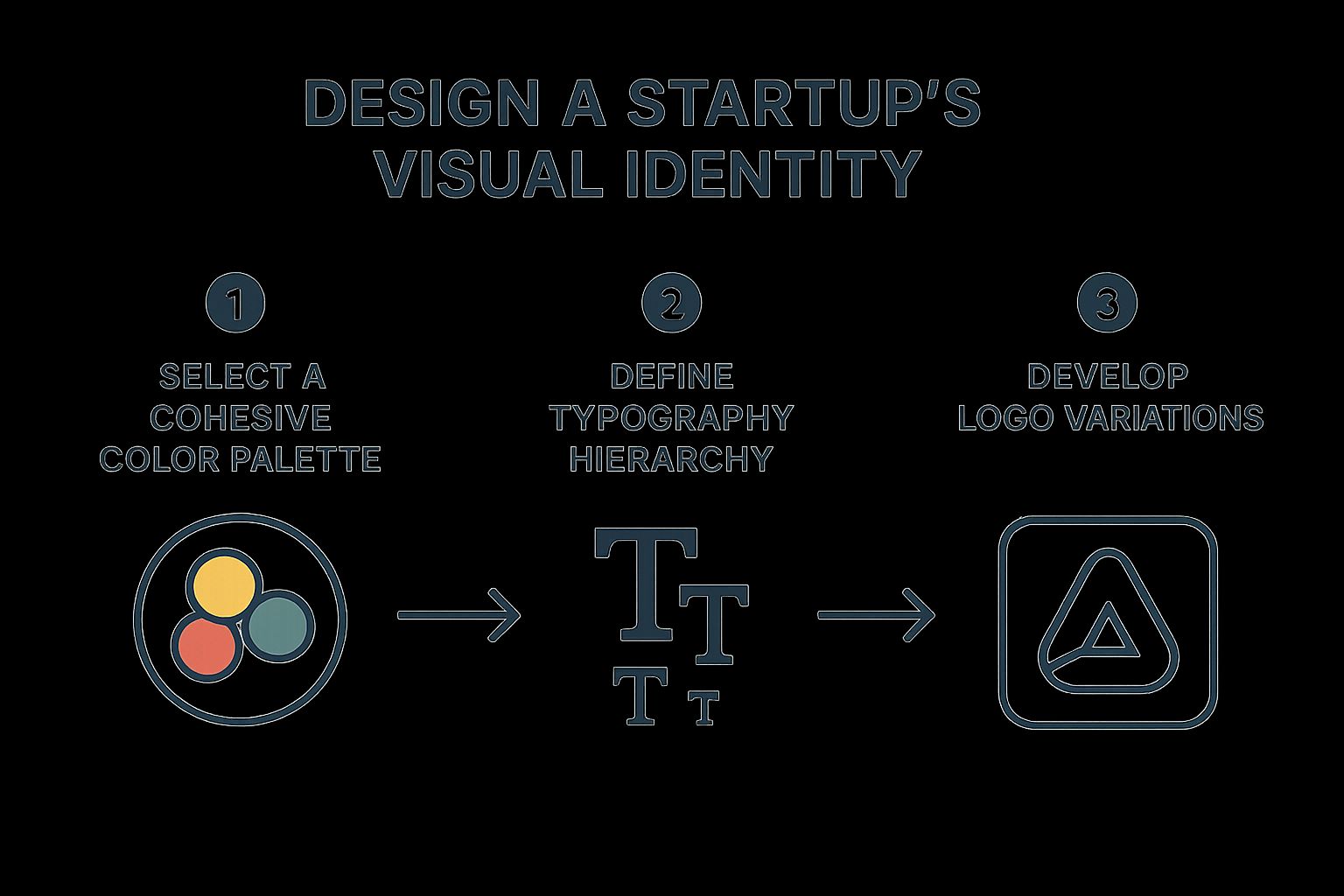
This visual flow shows how building a strong identity is a sequential process. Each decision informs the next, leading to a cohesive and powerful brand presence.
Designing a Logo That Lasts
Your logo is the cornerstone of your visual identity—the single most important graphic you'll create. It's the visual shortcut to your brand, appearing on everything from your website and app to your business cards and social media icons. A great logo is three things: simple, memorable, and incredibly versatile.
For startups, a couple of logo types are particularly effective:
- Wordmarks: These are font-based logos that showcase the company’s name. Think Google or Visa. This is a smart move if you have a unique name you want people to remember.
- Lettermarks (Monograms): These use the company’s initials, like HBO (Home Box Office) or NASA. This is a practical solution for businesses with long or hard-to-pronounce names.
The absolute non-negotiable for any logo is scalability. It has to look just as crisp and clear on a giant billboard as it does as a tiny favicon in a browser tab. This means you have to resist the temptation to create something overly complex with tons of colors or fine details that will turn into a smudge when shrunk down.
To ensure you have all your bases covered when building your visual identity, use this checklist.
Visual Identity Elements Checklist
| Element | Key Consideration | Purpose |
|---|---|---|
| Logo | Is it simple, memorable, and scalable? | Your brand's primary visual identifier. |
| Color Palette | Does it evoke the right emotion for your audience? | Sets the mood and drives brand recognition. |
| Typography | Is it readable and tonally aligned with your brand voice? | Gives your brand a consistent "voice" in text. |
| Imagery/Photography | Does it reflect your brand's personality and values? | Shows your brand in action and connects with users. |
| Iconography | Are the icons simple, clear, and part of a cohesive set? | Provides quick visual cues on your website and app. |
| Brand Patterns/Textures | Can these be used as backgrounds to add depth? | Adds a unique visual layer to branding materials. |
Having these elements defined and ready to go is what separates an amateur brand from a professional one.
The Power of a Brand Style Guide
Finally, you need to document all this hard work. This is where a brand style guide comes in. Think of it as your brand's official rulebook—a living document that details exactly how to use your logo, color palette, typography, and every other visual asset. It is absolutely essential for maintaining consistency.
This guide empowers everyone—from your marketing team to a freelance designer—to create materials that are instantly recognizable as yours. It removes the guesswork and prevents the brand dilution that inevitably happens when people start making their own creative calls. For any startup serious about its image, a style guide ensures your branding for startups efforts remain coherent and powerful as you grow.
Finding Your Authentic Brand Voice
 If your visual identity is how your brand looks, then your brand voice is how it speaks. It's the unique personality that shines through in every piece of communication, from your website copy to your social media replies.
A lot of startups get this wrong. They think a brand voice needs to be witty, clever, or funny. The truth? It just needs to be authentic and consistent. Your voice should be a direct reflection of your company's mission and values, building a connection that feels genuine and trustworthy.
This goes way beyond just the words you pick. It’s the distinct personality behind them. Is your brand an encouraging mentor, a quirky best friend, or a seasoned expert? Nailing this down is what makes people feel like they actually know your brand.
Clarifying Voice Versus Tone
I see founders mix this up all the time: voice versus tone. Here’s a simple way to think about it. Your voice is your core personality—it’s fixed. Your tone, on the other hand, is your mood, and it absolutely should change depending on the situation.
For instance, you wouldn't use the same tone to celebrate a customer's big win on X (formerly Twitter) as you would to explain a service outage. The first scenario calls for enthusiasm, while the second requires a serious, apologetic tone. But both responses should still feel like they're coming from the same brand personality.
- Voice (Personality): Who you fundamentally are. It's constant. Examples: Playful, Authoritative, Empathetic, Edgy.
- Tone (Mood): How you express your voice in a specific context. It's situational. Examples: Humorous, Formal, Concerned, Casual.
Mastering this distinction is how your brand becomes both recognizable and emotionally intelligent. A rigid, unchanging tone makes a startup feel robotic and completely out of touch.
Building Your Core Messaging Pillars
Your messaging pillars are the 3-5 central themes your brand will own. Think of them as the big ideas you want to be known for—the concepts that directly link your product to what your customers actually need and aspire to.
Let’s imagine a sustainable fashion startup. Their pillars might look something like this:
- Ethical Production: Telling the story of the people and fair practices behind the clothing.
- Timeless Style: Designing pieces that outlast fast-fashion trends.
- Conscious Consumerism: Giving customers the knowledge to make better buying decisions.
These pillars become your North Star for content. Every blog post, ad, and social update should connect back to at least one of them. This is how your branding for startups efforts create a powerful, coherent story over time, instead of just random noise.
“People are more likely to engage with other people, not brands. An authentic product demo from the founder in a Loom video can be just as effective (if not more!) than expensive animated illustrations as long as the problem, solution, and differentiation are clearly articulated.”
This piece of wisdom from the marketing experts at Olivine hits the nail on the head. A genuine, unpolished voice connects on a much deeper level than a slick but soulless corporate message. Your messaging pillars provide the substance you need to speak with that kind of authentic authority.
From Elevator Pitch to Powerful Storytelling
Once your voice is defined and your pillars are set, it's time to craft the actual messages that bring your brand to life.
Start with your value proposition. This is the single, most concise expression of your brand’s promise. It answers the question, "What do you do, and why should I care?" This needs to be impossible to miss on your homepage. Remember Slack’s classic value prop? "Be less busy." It was brilliant—simple, benefit-driven, and crystal clear.
From there, you can build out your elevator pitch. This is the 30-60 second conversational version you’ll use at networking events or when someone asks what you do. The goal isn’t to list features; it’s to spark genuine curiosity.
Finally, weave storytelling into everything you do. Don't just describe your product; share the story of why you built it. Turn customer testimonials into compelling mini-case studies. Talk about the "aha!" moment that led to a new feature. These stories are what transform basic copy into an emotional hook, making your brand impossible to forget.
Bringing Your Brand into the Physical World
Even if your startup is a digital-first company, don’t ever discount the power of having something real for people to touch and hold. Think about it: a well-designed business card, a beautifully crafted product box, or even a simple thank-you note creates a tangible connection that a screen just can't match. It’s the difference between looking at a photo of a coffee and actually smelling the rich aroma.
This is where you translate all that hard work on your brand identity into the real world. Every single printed item is a new chance to show off your commitment to quality and leave a genuine, physical impression. You're turning your brand from pixels into something your customers can actually feel.
Choosing Your First Print Materials
Let's be realistic—you don't need to print a thousand of everything on day one. Start smart. Focus on a few high-impact pieces that directly support your immediate business goals. For most startups I've worked with, this is the essential starting lineup:
Business Cards: They are far from dead; they’ve just gotten a promotion. A premium business card, maybe with a unique finish or on a seriously thick paper stock, does more than just share your contact details. It's a statement. It communicates quality and shows you care about the little things. Often, it's the very first physical piece of your brand anyone will ever touch.
Packaging: If you sell a physical product, the unboxing experience is a huge part of your brand’s story. Don't let it be an afterthought. Branded boxes, custom tissue paper, or even a well-placed sticker can transform a routine delivery into a memorable moment that people want to share.
Marketing Collateral: Things like flyers, brochures, and postcards are your ground game. They're perfect for trade shows, direct mail campaigns, or for leaving with potential partners. They give you a physical, easy-to-digest way to tell your story and point people back to your digital home base.
As you start using physical marketing to generate local buzz, you absolutely have to make sure your online presence can capture that new attention. It’s crucial that when someone gets your flyer and searches for you, they find you. It pays to be prepared by optimizing your local digital presence so your online and offline efforts work together, not against each other.
Platforms like 4OVER4 are built to make this whole process easier for founders. They cut through the noise and offer a massive range of products and customizations.
Just look at their homepage—it immediately shows you everything from business cards to banners. What I love about this is how accessible it is. You can find exactly what you need without needing a degree in print production.
Getting the Technical Details Right
To make sure your printed materials look as sharp in person as they do on your screen, you need to get a handle on a few technical basics. Nailing these details is what separates a professional, polished look from a costly, amateurish mistake.
The most common trip-up I see is color management. Your computer screen uses an RGB (Red, Green, Blue) color model. It's designed to project light. But professional printers use a CMYK (Cyan, Magenta, Yellow, Key/Black) model, which is all about how ink absorbs light on paper.
Key Takeaway: If you send an RGB file to a pro printer, the colors will shift when they convert it to CMYK. They’ll often look duller or just off. Always, always convert your design files to the CMYK color space before you export them for printing.
Another deal-breaker is image resolution. For printing that looks crisp and clean, every single image and graphic needs to have a resolution of at least 300 DPI (dots per inch). Those images you pull from a website? They're usually 72 DPI. That looks perfectly fine on a screen, but it will come out looking pixelated and blurry on paper. Always start with high-resolution source files.
Choosing Finishes That Match Your Brand Vibe
Finally, it’s time for the fun part: picking the paper and finishes that feel like your brand. These tactile details are powerful because they communicate value and personality without saying a word.
Here are a few popular choices to get you thinking:
Paper Stock: A thicker, heavier paper (like a 16 pt. cardstock) just feels more substantial and premium. An uncoated or recycled stock can give off an earthy, eco-friendly vibe, while a glossy finish feels more modern and high-energy.
Special Finishes: This is where you can really make an impression. Things like spot UV (a glossy coating on specific areas), foil stamping (adding metallic details), or embossing (creating a raised, 3D texture) can turn a simple design into something truly special and memorable.
Go back to your brand personality. Is your startup a sleek, minimalist tech company? You might go for a clean, matte finish on a thick, uncoated cardstock. Are you a luxury fashion brand? Maybe you’ll use gold foil and a soft-touch laminate to communicate pure elegance. These little choices make a massive impact and reinforce the very story you've been working so hard to build.
Your Top Startup Branding Questions, Answered
Even with a solid plan, building a brand from scratch is bound to bring up some tough questions. It's a journey filled with specific, tricky hurdles. This is where we tackle the most common challenges founders run into, offering straight-up, actionable answers to help you move forward with confidence. Think of this as your go-to guide for those "what now?" branding moments.
How Much Should a Startup Budget for Branding?
There's no magic number here—it really boils down to your stage and resources. A bootstrapped, pre-revenue startup might scrape together a few hundred dollars for a solid logo from a freelancer. On the other hand, a venture-backed company could easily invest tens of thousands with a full-service agency.
For most early-stage founders, a smart approach is to carve out a specific piece of your initial marketing budget just for brand development. Don't try to boil the ocean.
Focus your initial funds on the absolute must-haves:
- A professionally designed, versatile logo.
- A basic brand style guide that covers your colors, fonts, and how to use your logo.
- A clean, functional website that actually looks and feels like your brand.
Remember, a simple brand executed with excellence is far more powerful than an ambitious one done poorly. You can always invest more as you find product-market fit and start to scale.
When Is the Right Time to Rebrand a Startup?
Let's be clear: a rebrand is major surgery for your company, not a simple haircut. It should be a strategic move driven by a fundamental shift in your business—never just because you're bored with your current look.
So, what are the real triggers? Here are a few that signal it might be time:
- A Major Business Pivot: Your original brand no longer tells the story of what your company actually does.
- A Shift in Target Audience: You're trying to connect with a completely different type of customer now.
- A Brand Disconnect: There’s a widening gap between your internal culture and how the public sees you.
- Losing to Competitors: You're consistently being outshined by better-branded rivals in your space.
It’s crucial to know the difference between a rebrand (a new name, logo, and core message) and a refresh (just updating colors or fonts). Any big change has to be tied to a clear business goal.
Can I Build a Strong Brand Myself, or Do I Need an Agency?
You can absolutely DIY the early stages of your brand, especially if you have a crystal-clear vision. The risk, however, is significant. Nothing tanks credibility faster than a brand that looks amateurish, and that can sink you before you even get started.
Often, a hybrid approach works best for startups. As the founder, you are the heart of the company. You're the one who can best define the mission, vision, and core values. Nobody knows the "why" better than you.
"People are more likely to engage with other people, not brands... An authentic product demo from the founder in a Loom video can be just as effective (if not more!) than expensive animated illustrations as long as the problem, solution, and differentiation are clearly articulated."
This idea gets to the core of it—founder-led authenticity is incredibly powerful. Once you’ve laid that strategic groundwork, consider hiring a talented freelancer or a small agency. They can take your vision and translate it into a polished, professional visual identity that gives you a real competitive edge.
How Do I Measure the ROI of My Branding Efforts?
Measuring the return on branding isn't as straightforward as tracking ad clicks, but it's far from impossible. The impact is a long-term play, so you need to look at a mix of qualitative and quantitative signs over time.
First, track metrics that point to brand awareness. Keep an eye on direct traffic to your website, the number of branded search queries (people Googling your company name), and mentions on social media.
Next, you need to measure brand perception. You can do this with customer satisfaction surveys or by tracking your Net Promoter Score (NPS). Are customers turning into passionate fans? That's a huge sign your brand is connecting on a deeper level. Ultimately, a strong brand should lead to real business results, like a higher customer lifetime value (LTV) and lower customer acquisition costs (CAC), because your reputation starts doing some of the selling for you.
Ready to bring your startup’s brand into the physical world with stunning, high-quality printed materials? From premium business cards to custom packaging that wows, 4OVER4 has everything you need to make a lasting impression. Explore our vast selection and create materials that truly reflect your brand’s quality.
More from

25
If you've ever wondered about the standard gift card dimensions, there’s one number you need to know: CR80
 Emma Davis
Mar 17, 2026

32
When you’re launching a product, your bottle label is often the first thing a customer sees. Think of it as your silent salesperson
Emma Davis
Mar 16, 2026

77
When you're brainstorming ideas for landscaping business cards, it helps to think beyond just contact information. Your c
Emma Davis
Mar 15, 2026

200
When you think of a yard sign, the classic 18"x24" is probably what comes to mind. It’s the industry workhorse fo
Emma Davis
Mar 14, 2026

125
When you’re ready to invest in an A-frame sign, the first question you'll ask is, "What size do I need?" It usually comes down
Emma Davis
Mar 13, 2026

1155
The real secret to mastering your direct mail budget isn't complicated. It comes down to one simple fact: a standard 4" x 6&q
Emma Davis
Mar 12, 2026

155
Tear-off flyers are a classic for a reason. They’re a tangible marketing tool, designed with perforated, removable tabs at the bottom. Each
Emma Davis
Mar 11, 2026

276
Printing stickers at home is a seriously fun and rewarding project. It boils down to four main parts: designing your image, picking the right
Emma Davis
Mar 10, 2026