Table of Contents
- Home
- content hub
- 10 Budget-Friendly Small Business Advertising Ideas for 2025
 Share and earn
10 Budget-Friendly Small Business Advertising Ideas for 2025

Jul 29, 20252548 views
Jul 29, 20252548 views
In today's competitive market, small businesses need more than just a great product or service; they need a powerful, consistent voice. The primary challenge isn't a lack of ambition but finding effective, budget-friendly ways to reach the right audience. Many entrepreneurs feel stuck between the high costs of traditional ads and the often overwhelming world of digital marketing. This guide is designed to cut through that noise and offer a clear path forward.
We have compiled 10 powerful small business advertising ideas that are both actionable and affordable, engineered to deliver tangible results without draining your resources. Whether you run a local brick-and-mortar shop or a growing online brand, these strategies provide a practical roadmap to amplify your message, connect with customers, and drive sustainable growth. For businesses in niche sectors like custom apparel, understanding specific industry trends can also inform advertising strategies and growth paths; for instance, a deep dive into DTF Printing Trends for Small Businesses in 2025 can reveal new product opportunities. From leveraging free digital tools to building powerful community partnerships, let's explore how you can make your marketing budget work smarter, not harder.
1. Social Media Marketing and Content Creation
Social media marketing is a powerful tool for small businesses to connect directly with their target audience, build brand loyalty, and drive sales with a minimal budget. This approach focuses on creating and sharing valuable, relevant, and consistent content to attract and retain a clearly defined audience. It's about building a community, not just broadcasting advertisements. By using platforms like Instagram, Facebook, TikTok, and LinkedIn, you can tell your brand’s story, showcase your products, and engage in real-time conversations with customers.
How to Implement This Strategy
Successful social media marketing hinges on consistency and authenticity. Start by identifying which platforms your target customers use most. A local restaurant might thrive on Instagram's visual-first format, using Stories for daily specials, while a B2B consulting firm would find more value in sharing industry insights on LinkedIn.
Key tactics include:
- Post Consistently: Aim for a regular schedule during peak audience activity times. To stay organized and avoid last-minute scrambling, consider building a content bank to plan your posts in advance.
- Engage Authentically: Respond to comments and messages promptly. Ask questions and run polls to encourage interaction.
- Use Platform-Specific Features: Leverage tools like Instagram Reels, TikTok videos, and Facebook Live to create dynamic and engaging content that algorithms favor.
- Humanize Your Brand: Share behind-the-scenes content, employee spotlights, and user-generated content to build trust and relatability.
This quick reference summarizes the core components of a social media content strategy.
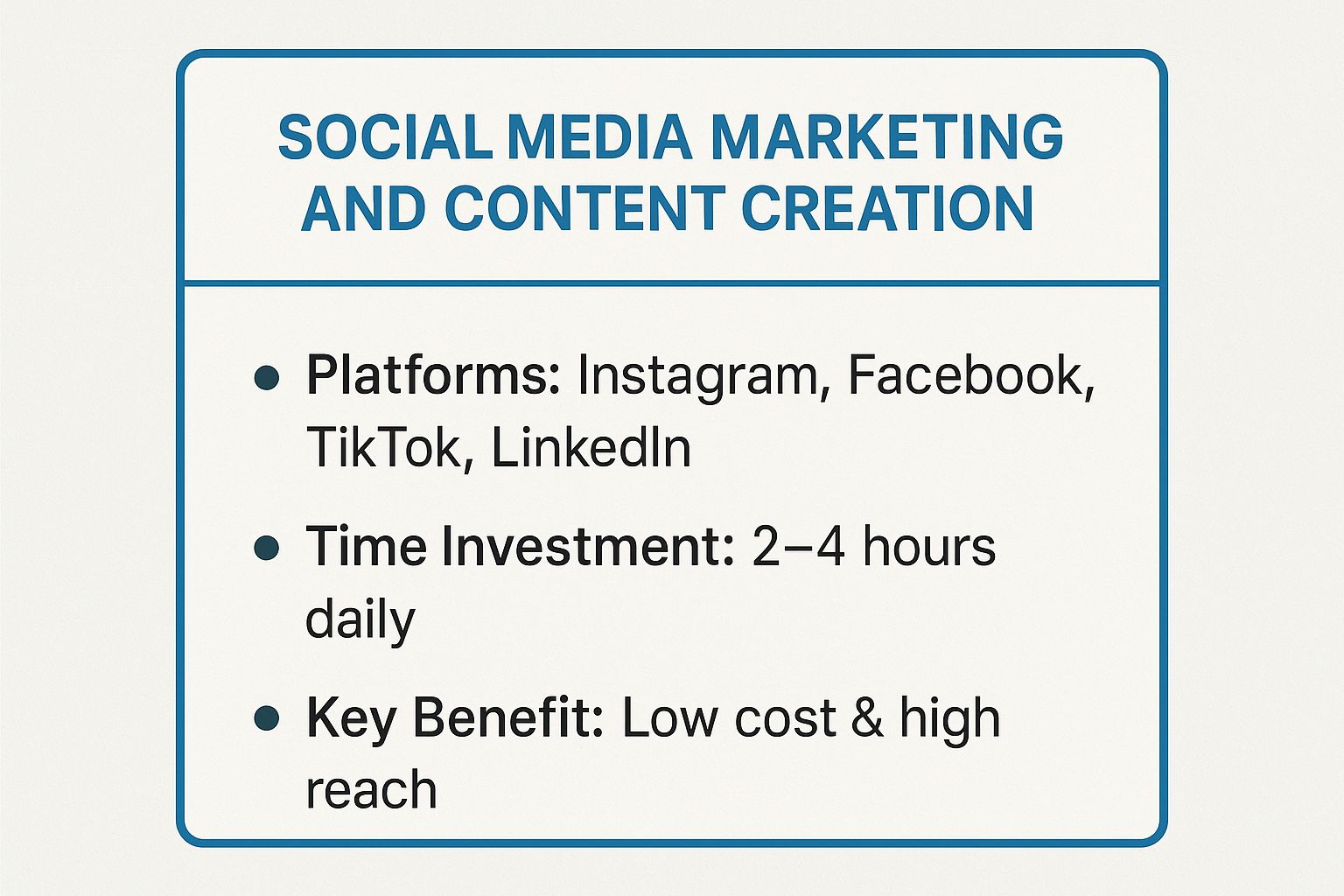
The data highlights how a consistent time investment on the right platforms can yield significant reach at a low cost, making it an essential small business advertising idea. Even with a strong digital presence, you can amplify your reach by integrating offline materials. Consider using flyer printing to promote your social media handles and special online-only offers at local events or in-store.
2. Google My Business Optimization and Local SEO
Google My Business (GMB), now known as Google Business Profile, is a critical, free tool for businesses aiming to attract local customers. This location-based marketing strategy optimizes your presence in Google search results and on Google Maps, making it significantly easier for nearby customers to find, contact, and choose your business over competitors. It involves managing your online information, responding to reviews, and posting updates to build credibility and visibility for "near me" searches.

How to Implement This Strategy
A fully optimized Google Business Profile acts as a digital storefront, often providing the first impression a potential customer has of your brand. The goal is to provide Google with accurate, comprehensive, and engaging information so it can confidently recommend your business to relevant searchers. For instance, a local plumber can generate direct leads from their profile, while a retail store can use posts to drive foot traffic for a weekend sale.
Key tactics include:
- Complete Every Section: Fill out 100% of your profile, including services, hours, photos, and attributes. The more information you provide, the better.
- Manage Reviews Actively: Respond to all reviews, both positive and negative, in a professional and timely manner. This shows you value customer feedback.
- Post Regular Updates: Use Google Posts to share weekly updates about offers, events, new products, or company news to keep your profile active.
- Encourage Customer Reviews: Proactively ask satisfied customers to leave a review. More positive reviews boost your ranking and build social proof.
This approach is one of the most cost-effective small business advertising ideas for driving targeted, high-intent local traffic. To complement your strong online presence, you can use physical media to bridge the gap. Consider adding a QR code to your custom business cards that links directly to your GMB review page, making it effortless for happy customers to share their positive experiences.
3. Email Marketing and Newsletter Campaigns
Email marketing is a highly effective, direct communication channel that allows small businesses to build and nurture customer relationships. Unlike social media, you own your email list, giving you a direct line to your audience without fighting algorithms. This strategy focuses on delivering valuable, personalized content through newsletters, promotions, and automated sequences, which helps build a loyal customer base with a high lifetime value. Brands like Morning Brew have demonstrated this power, growing to millions of subscribers by delivering engaging daily newsletters.
How to Implement This Strategy
A successful email marketing program is built on trust and value, not spam. The first step is to build your list organically by offering a compelling reason for people to subscribe, such as a discount, a helpful guide, or exclusive content. From there, consistency and relevance are paramount. A local gym, for instance, could use automated email sequences to onboard new members and share weekly fitness tips to improve retention.
Key tactics include:
- Offer a Valuable Lead Magnet: Provide a free resource like an ebook, checklist, or webinar to entice sign-ups.
- Send Consistently, Not Excessively: Aim for a regular schedule, typically 1-2 times per week, to stay top-of-mind without overwhelming subscribers.
- Personalize Your Content: Use subscriber data to personalize subject lines and content, making your audience feel seen and valued.
- Optimize for Mobile: A significant portion of emails are opened on mobile devices, so ensure your templates are responsive and easy to read on a small screen.
- Test and Analyze: Experiment with different send times, subject lines, and content formats to see what resonates best with your audience.
Email marketing remains one of the most cost-effective small business advertising ideas, offering a high return on investment. For businesses looking to create professionally designed and impactful campaigns, exploring options for custom email newsletters can elevate your brand's presentation and engagement rates.
4. Referral and Word-of-Mouth Programs
A referral program is a powerful customer acquisition strategy that leverages your existing satisfied customers to bring in new business. This approach recognizes that people trust recommendations from friends and family far more than traditional advertising, turning your happy clients into a volunteer marketing team. It’s a sustainable growth engine that rewards loyalty and generates high-quality leads, making it one of the most cost-effective small business advertising ideas available. By incentivizing word-of-mouth, you create a cycle of trust and growth.
How to Implement This Strategy
The success of a referral program hinges on making it simple, rewarding, and visible. Start by defining a clear incentive that benefits both the referrer and the new customer, like a discount, store credit, or a free product. Dropbox famously drove explosive growth by offering extra storage space, a reward directly tied to their service's value. Your program should be easy to find and even easier to use, ideally with one-click sharing options.
Key tactics include:
- Keep It Simple: Design a straightforward referral process. A customer should be able to share a unique link or code in seconds.
- Offer Mutual Value: Reward both the person referring and the new customer to maximize participation. A 20% discount for each is a classic win-win.
- Time Your Ask: Prompt customers to refer right after a positive experience, such as a 5-star review, a repeat purchase, or positive feedback.
- Promote Everywhere: Feature your referral program on your website, in email signatures, on order confirmation pages, and through social media.
You can also integrate offline methods to boost awareness. Consider using professionally designed postcards for your business included in customer packages, which clearly explain the referral program and provide a shareable code. This tactic ensures your program reaches customers directly and gives them a tangible reminder to share their positive experience with others.
5. Strategic Partnerships and Cross-Promotion
Strategic partnerships offer a powerful way for small businesses to expand their reach by tapping into an established, relevant audience. This collaborative marketing approach involves teaming up with a non-competing business that shares a similar customer base. By cross-promoting each other's products or services, both partners gain exposure and credibility, achieving mutual growth that would be more costly and difficult to attain alone. It’s a classic win-win, turning shared resources into shared success.
How to Implement This Strategy
The key to a successful partnership is finding the right fit and establishing clear expectations from the start. Look for businesses that complement what you do. For instance, a local gym could partner with a nearby health food store for a joint wellness promotion, or a wedding photographer could team up with a florist and a venue to offer a bundled package. This adds value for the customer while funneling new business to all partners involved.
Key tactics include:
- Identify Complementary Partners: Seek businesses with similar quality standards and target demographics but different offerings.
- Establish a Clear Agreement: Outline roles, responsibilities, promotion schedules, and how success will be measured in a formal agreement.
- Co-Create Valuable Offers: Develop joint promotions, bundled services, or co-hosted events that benefit both customer bases.
- Promote Across All Channels: Announce the partnership on social media, in email newsletters, and with in-store signage to maximize reach.
This collaborative approach is one of the most effective small business advertising ideas for generating warm leads. As you meet potential partners at networking events, having professional materials on hand is crucial. Exchanging high-quality business cards is the first step in building a lasting and profitable relationship.
6. Content Marketing and Blogging
Content marketing is a long-term strategic approach focused on creating and distributing valuable, relevant content to attract and engage a target audience. Instead of directly pitching your products or services, you provide genuinely useful information that builds trust and positions your business as an industry authority. This method naturally drives traffic, leads, and sales through educational, entertaining, and problem-solving content like blog posts, guides, and case studies.
How to Implement This Strategy
Effective content marketing requires understanding your audience's pain points and providing solutions. By consistently producing high-quality content, you create a powerful asset that draws in potential customers. For example, a local accounting firm could generate significant leads by blogging about small business tax tips, while a software company like HubSpot built its entire brand on providing expert marketing advice.
Key tactics include:
- Solve Specific Problems: Create content that directly answers the questions your ideal customers are searching for online.
- Optimize for Search: Research relevant keywords and understand search intent to ensure your content is discoverable on search engines like Google.
- Repurpose Your Content: Turn a single blog post into a video, an infographic, a series of social media posts, or a podcast episode to maximize its reach.
- Include Clear Calls-to-Action (CTAs): Guide your readers on what to do next, whether it's downloading a guide, subscribing to your newsletter, or contacting you for a quote.
This strategy is one of the most sustainable small business advertising ideas for building lasting brand equity and a loyal customer base.
7. Community Event Sponsorship and Participation
Engaging directly with your local community through event sponsorship and participation is a powerful way to build brand awareness and foster genuine relationships. This boots-on-the-ground strategy moves beyond digital ads to create face-to-face connections, demonstrating your business's commitment to the community's well-being. It positions your brand as a neighborhood partner, not just a faceless entity, building trust and local loyalty that money can't easily buy. Whether sponsoring a youth sports team or setting up a booth at a town festival, this approach makes your brand a visible and active part of local life.
How to Implement This Strategy
Success in community marketing relies on authentic engagement and strategic alignment. Choose events that naturally attract your target customers. A financial advisor might host a free retirement planning workshop at a community center, while a local boutique could gain significant traction by participating in a downtown arts and crafts festival. The key is to be present and add value.
Key tactics include:
- Choose Relevant Events: Select sponsorships and events where your target demographic is likely to be. A pet store sponsoring a local dog park adoption day is a perfect match.
- Create a Memorable Presence: Don’t just show up. Design an interactive booth or experience. Offer a game, a free sample, or a helpful demonstration to draw people in and make a lasting impression.
- Bring Valuable Giveaways: Offer branded items that people will actually use, like tote bags, water bottles, or phone grips. This keeps your brand visible long after the event ends.
- Volunteer Genuinely: Show you care by contributing more than just money. Volunteering your time and effort builds goodwill and creates authentic connections with attendees and other local leaders.
This method is one of the most effective small business advertising ideas for building a loyal local customer base. To maximize your visibility at these events, make sure your booth stands out with professionally designed materials. Investing in high-quality, weather-resistant vinyl banners can help you attract attention from across a crowded field or sports complex, clearly communicating your brand and support.
8. Customer Testimonials and Case Study Marketing
Leveraging customer testimonials and case studies is a trust-building strategy that uses authentic customer experiences to attract new business. This approach provides powerful social proof by showcasing real-world success stories, transforming satisfied customers into your most credible advocates. Instead of you telling prospects how great your product is, your customers do it for you, adding a layer of authenticity that traditional advertising can't match. This is one of the most effective small business advertising ideas for building credibility and demonstrating tangible value.
How to Implement This Strategy
The key to successful testimonial marketing is making it easy for happy customers to share their stories and then placing those stories where potential buyers will see them. A software company might showcase a case study detailing a client's ROI, while a home contractor could feature a before-and-after video testimonial. The goal is to present a relatable problem and a clear, desirable solution provided by your business.
Key tactics include:
- Time Your Ask: Request a testimonial or review immediately following a positive interaction or successful project completion when the customer's satisfaction is highest.
- Simplify the Process: Provide customers with simple templates or guiding questions to help them structure their feedback, making it less of a chore.
- Maximize Visibility: Feature your best testimonials prominently on your website's homepage, product pages, and in marketing materials like brochures and email campaigns.
- Embrace Video: Whenever possible, capture video testimonials. They are more engaging and impactful than text, conveying emotion and authenticity more effectively.
9. Targeted Pay-Per-Click (PPC) Advertising
Pay-Per-Click (PPC) advertising is a digital marketing model where you pay a fee each time one of your ads is clicked. This strategy allows small businesses to place ads directly in front of customers actively searching for their products or services on platforms like Google or scrolling through their feeds on Facebook. Instead of earning visibility organically, you buy it, gaining immediate access to highly targeted audiences based on demographics, search keywords, interests, and online behaviors. The primary advantage is its measurability and control; you set a budget and only pay for tangible engagement.
How to Implement This Strategy
Effective PPC requires a focus on precision and optimization. This isn't a "set it and forget it" tactic; it demands continuous monitoring to ensure your ad spend delivers a positive return on investment. For instance, a local plumber can use Google Ads to capture urgent "plumber near me" searches, while an e-commerce store can use Facebook Ads to retarget users who abandoned their shopping carts with a special discount.
Key tactics include:
- Start Small and Scale: Begin with a modest daily budget to test different ad sets and audiences. Once you identify what works, you can strategically increase your investment in the most profitable campaigns.
- Utilize Negative Keywords: Prevent your ads from showing for irrelevant searches by adding negative keywords. This stops wasted clicks and focuses your budget on qualified leads.
- Write Compelling Ad Copy: Your ad should speak directly to a customer's problem and offer a clear solution. Focus on benefits over features and include a strong call to action.
- Optimize Landing Pages: Ensure the page users land on after clicking your ad is directly relevant and designed for conversion. A seamless experience from ad to landing page is crucial.
10. Guerrilla Marketing and Creative Stunts
Guerrilla marketing is an unconventional advertising approach that relies on creativity, surprise, and innovation to create memorable brand experiences on a tight budget. Popularized by Jay Conrad Levinson's book series, this strategy focuses on generating significant buzz through unexpected, high-impact public interactions rather than traditional media buys. For small businesses, it offers a powerful way to stand out from larger competitors by creating viral moments and building a strong brand identity.

How to Implement This Strategy
The core of guerrilla marketing is creating an unforgettable moment that people feel compelled to share. This could be anything from a creative chalk art installation on a busy sidewalk to a flash mob promoting a local event. The key is to be imaginative and connect the stunt directly to your brand's message in a way that feels authentic and clever, not just disruptive. A famous example is Dollar Shave Club's viral launch video, which used humor and a low-budget feel to disrupt a massive industry.
Key tactics include:
- Align with Brand Values: Ensure your stunt clearly reflects what your brand stands for. A playful, edgy stunt might not fit a conservative financial advisory firm.
- Document Everything: The real value often comes after the event. Have cameras ready to capture photos and videos for social media, your website, and future content marketing.
- Assess Legal and Safety Risks: Before you launch, research local ordinances and potential safety concerns. You want attention for the right reasons, not for breaking rules or creating hazards.
- Plan for the Aftermath: Have a clear plan to engage with the attention you generate. Prepare social media responses, a landing page for interested visitors, and a way to convert buzz into leads or sales.
By being creative and bold, you can implement one of the most cost-effective small business advertising ideas that generates massive reach. To further amplify your guerrilla efforts, consider directing onlookers to your digital platforms. You can use affordable marketing materials like custom stickers with QR codes at your stunt's location to bridge the offline experience with your online community.
Small Business Advertising Ideas Comparison
| Strategy | Implementation Complexity 🔄 | Resource Requirements ⚡ | Expected Outcomes 📊 | Ideal Use Cases 💡 | Key Advantages ⭐ |
|---|---|---|---|---|---|
| Social Media Marketing and Content Creation | Moderate to High (consistent daily effort) | Time-intensive (2-4 hrs daily), creative skills | Builds brand awareness and engagement over months | Brands seeking organic growth and community building | Low cost, direct customer communication, viral potential |
| Google My Business Optimization and Local SEO | Low to Moderate (ongoing updates needed) | Time for profile maintenance and review management | 25-50% increase in local search visibility within 3 months | Local businesses targeting nearby customers | Free setup, increases trust via reviews, mobile-friendly |
| Email Marketing and Newsletter Campaigns | Moderate (list building and automation) | Requires email platform and content creation | High ROI ($42 per $1 spent), builds long-term loyalty | Businesses with existing audience or ecommerce | Highly measurable, direct communication, cost-effective |
| Referral and Word-of-Mouth Programs | Moderate to High (setup and management) | Development of reward system and tracking tools | 3-5% customers refer, 16% higher lifetime value | Customer-focused businesses with quality products | Low acquisition cost, high conversion, viral growth |
| Strategic Partnerships and Cross-Promotion | High (coordination and agreements needed) | Shared resources and joint efforts | Mutual customer acquisition and expanded reach | Businesses with complementary offerings | Access new audiences, shared costs, enhanced credibility |
| Content Marketing and Blogging | High (consistent quality content creation) | Significant time investment, SEO knowledge | 3x leads more than paid search, long-term traffic | Businesses aiming for thought leadership and organic growth | Lasting value, cost-efficient lead generation |
| Community Event Sponsorship and Participation | Moderate (event planning and sponsorship) | Financial investment ($500-$5,000 per event), time | Builds local trust and immediate sales opportunities | Local businesses focused on community engagement | Strong local brand recognition, personal connections |
| Customer Testimonials and Case Study Marketing | Moderate (collection and production effort) | Time to collect and produce quality content | Up to 34% boost in conversions | Service and B2B companies building trust | Authentic social proof, cost-effective content |
| Targeted Pay-Per-Click (PPC) Advertising | High (campaign setup and optimization) | Budget ($500-1000+ monthly), ongoing management | Immediate traffic and measurable ROI | Businesses needing instant visibility and leads | Precise targeting, budget control, A/B testing |
| Guerrilla Marketing and Creative Stunts | High (creative concepts and execution) | Low budget but requires creativity/legal prep | High impact, viral potential but unpredictable | Brands wanting buzz and differentiation | High memorability, earned media, authentic engagement |
Putting Your Plan into Action: The Path Forward
Navigating the world of advertising can feel overwhelming, but as we've explored, you have a powerful arsenal of effective and budget-friendly strategies at your disposal. This collection of small business advertising ideas isn't meant to be a checklist to complete all at once. Instead, view it as a diverse menu of opportunities, allowing you to select the tactics that best resonate with your unique brand, your target audience, and your specific business goals. The true power lies not in doing everything, but in doing a few things exceptionally well.
The common thread weaving through every successful strategy, from a meticulously optimized Google My Business profile to a clever guerrilla marketing campaign, is a deep understanding of your customer. Your path forward begins with this fundamental insight. Who are you trying to reach? Where do they spend their time, both online and offline? What problems can you solve for them? Answering these questions will illuminate which advertising channels hold the most promise for your business.
From Ideas to Impact: Your Actionable Next Steps
The journey from inspiration to implementation is where growth happens. To avoid analysis paralysis, commit to a focused, methodical approach. Here’s a simple framework to get you started:
- Select and Prioritize: Choose just one or two advertising ideas from this list to implement first. A great starting point for many is a combination of a digital tactic, like enhancing your local SEO, and a community-based one, like pursuing a strategic partnership with a neighboring business. This creates a balanced, multi-channel effect.
- Set Measurable Goals: Define what success looks like before you begin. Is it a 15% increase in website traffic from your content marketing efforts? Or perhaps 25 new leads generated from your next email campaign? Clear, quantifiable goals are essential for tracking progress and proving your return on investment.
- Execute with Consistency: Sporadic efforts yield sporadic results. Whether you commit to posting on social media three times a week, sending out a monthly newsletter, or sponsoring one community event per quarter, consistency builds momentum and brand recognition.
- Track, Analyze, and Adapt: Use the tools at your disposal, like Google Analytics, social media insights, and email marketing reports, to monitor your performance. Don't be afraid to pivot if a strategy isn't delivering. The data will tell you what's working, allowing you to double down on effective tactics and refine your approach over time.
Mastering these advertising concepts is more than just a marketing exercise; it's a direct investment in the longevity and vitality of your business. Each new customer you reach, each positive review you earn, and each community connection you forge strengthens your foundation. By blending innovative digital strategies with the timeless power of print and community engagement, you create a resilient and dynamic marketing engine. Your brand's story is waiting to be told, and with a smart, strategic plan, you have everything you need to ensure it's heard loud and clear.
Ready to bring your advertising ideas to life with tangible, high-quality materials? From eye-catching flyers and direct mail postcards that support your local campaigns to professional banners for your next event, 4OVER4 provides the premium printing services your small business needs to make a lasting impression. Explore our wide range of customizable products at 4OVER4 and start creating marketing assets that get noticed.
More from

15
To design your own flyers effectively, you need to focus on a few key things: a strong visual hierarchy, a call-to-action that people can'
 Emma Davis
Mar 24, 2026

37
Let’s get one thing straight about CMYK and RGB: one is for screens, the other is for print. Your monitor mixes red, green,
Emma Davis
Mar 23, 2026

26
Printing a high-quality business envelope is simpler than you might think. It all starts with a solid design file using CMYK color settings, y
Emma Davis
Mar 22, 2026

93
You might think sending an email or a text is all that matters these days, but don't underestimate the power of physical mail. It carries
Emma Davis
Mar 21, 2026

89
Picture this: your business has a silent, tireless salesperson working for you 24/7 on the busiest street in town. That’s t
Emma Davis
Mar 20, 2026

66
Printing on ribbon is the art of transferring your custom design, logo, or text onto a roll of fabric. It’s what transforms a simple decorat
Emma Davis
Mar 19, 2026

169
If you've ever wondered about the standard gift card dimensions, there’s one number you need to know: CR80
Emma Davis
Mar 17, 2026

69
When you’re launching a product, your bottle label is often the first thing a customer sees. Think of it as your silent salesperson
Emma Davis
Mar 16, 2026