
TABLE OF CONTENTS
- Home
- content hub
- Your Guide to Winning Business Loyalty Cards
 Share and earn
Your Guide to Winning Business Loyalty Cards

Mar 3, 202611 views
Mar 3, 202611 views
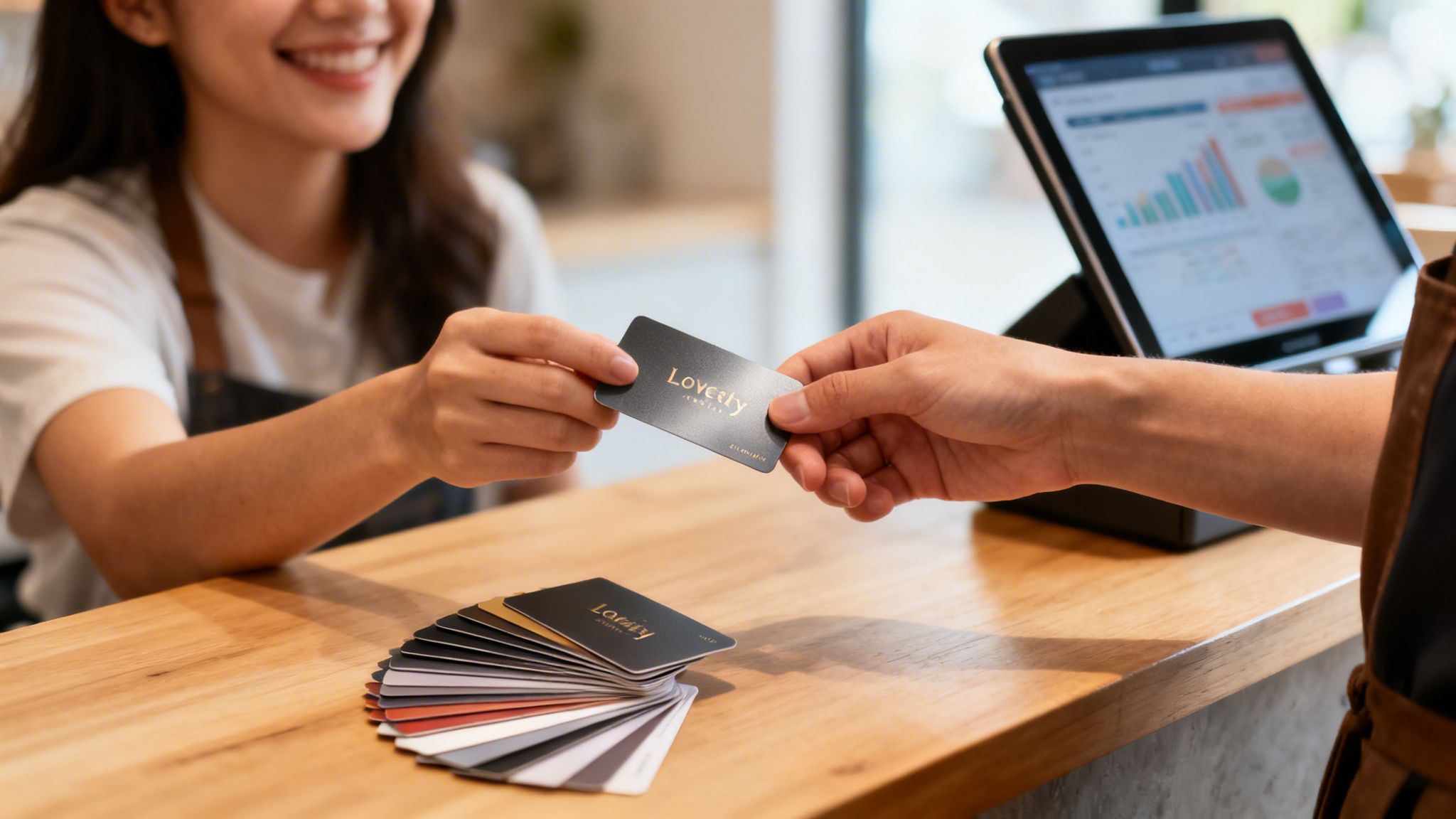
Business loyalty cards are a classic for a reason. They're more than just a marketing gimmick; they're a powerful way to reward repeat customers with perks and discounts, keeping them coming back for more. Think of them as tangible tools that help you build real relationships, turning one-time buyers into genuine fans of your brand.
Why Loyalty Cards Are a Small Business Superpower

Keeping your existing customers happy is the lifeblood of any small business. While finding new customers is always on the to-do list, the real growth happens when you nail retention. This is exactly where loyalty cards come in, helping transform casual shoppers into a reliable base of regulars.
At their core, loyalty cards tackle the challenge of how to improve client retention by tapping into simple human psychology. We all get a little satisfaction from making progress toward a goal. Each stamp or scan on that card feels like a small win, motivating customers to return, fill it up, and claim their reward.
The Financial Impact of Fostering Loyalty
The numbers don't lie. Investing in the customers you already have almost always delivers a better return than constantly chasing new ones. Loyal customers tend to spend more over time and are less sensitive to price because they already trust the value you provide.
To see just how effective loyalty programs can be, take a look at these powerful statistics. They paint a clear picture of the financial and engagement benefits.
Loyalty Program Impact at a Glance
| Metric | Statistic |
|---|---|
| Budget Allocation | Marketers now devote an average of 51.5% of their total budgets to loyalty and CRM. |
| Program ROI | An impressive 92.7% of program owners report a positive return on their investment. |
| Average Return | The average return on investment for a loyalty program is a staggering 5.3x. |
These figures show that businesses are not just spending on loyalty—they're seeing incredible, measurable results from it.
For a small business, that means every dollar you put into a loyalty program could bring back more than five dollars in revenue. It's one of the most efficient growth strategies out there.
More Than Just Discounts
Beyond the direct boost to your bottom line, loyalty cards create a genuine sense of connection and appreciation. A well-designed card acts as a physical reminder of your brand, keeping you top-of-mind every time a customer opens their wallet.
This tangible connection helps you stand out from the competition. When a customer has to choose between two similar businesses, the one where they're "just a few stamps away" from a free coffee almost always wins. It builds a habit and a preference that purely digital marketing often struggles to replicate.
These programs also have other great benefits:
- Encourage word-of-mouth marketing: Happy, rewarded members often become your best brand advocates, telling friends and family about their great experiences.
- Provide valuable customer data: By tracking redemptions, you can gain insights into what your customers are buying and which products are most popular.
- Show genuine appreciation: A simple reward is a powerful way to say "thank you" for choosing to support your business.
For new businesses trying to build a solid foundation, creating a memorable experience is everything. You can find more tips tailored for new companies in our resources for startups and SMBs. In the end, a loyalty card is a small but mighty tool for building the relationships that drive long-term success.
Designing a Loyalty Program That Actually Works
Before you order a single business loyalty card, we need to talk strategy. A great loyalty program isn't just about handing out freebies; it's a carefully crafted plan that clicks with your customers and drives your business goals. Get this foundation right, and everything else falls into place.
First, what does "success" actually look like for you? Are you trying to get your regulars to pop in more often, or are you hoping to see them spend more each time they visit? A coffee shop might be aiming for more daily visits, while a high-end boutique is likely focused on boosting that average purchase value.
A lot of businesses I've worked with find it incredibly helpful to map out their customer's entire experience from start to finish. Using a process like Customer Journey Mapping helps you see where a loyalty program can make the biggest impact and feel most natural to your customers.
Choosing the Right Program Model
Once you know your destination, you can pick the vehicle. There’s no one-size-fits-all answer here; the best loyalty model is deeply tied to what you sell and who you sell it to.
Here are a few of the most common structures I've seen work wonders:
The Simple Punch Card: Think about your local bakery or that car wash down the street. The classic "Buy 9, Get the 10th Free" is perfect for businesses built on frequent, smaller purchases. It’s dead simple for customers to understand and gives them a clear, satisfying goal to work toward.
The Tiered System: This is a fantastic model for growing brands that want to give their best customers the VIP treatment. An online store could have a "Silver" tier for everyone, a "Gold" tier for customers who spend over $500 a year, and an exclusive "Platinum" tier for the absolute top spenders. Each level unlocks better perks, giving people a real incentive to climb the ladder.
The Paid Membership (VIP Club): If you're a service-based business or have a really strong brand community, a paid program can be a game-changer. For a small annual fee, members might get exclusive product drops, a permanent 10% discount, or priority booking. This not only creates a predictable revenue stream but also fosters an incredible sense of belonging.
Crafting Rewards That Motivate and Pay Off
The rewards are the real engine of your program. They have to be compelling enough to actually change how people shop, but they also need to be financially sustainable for you. I've seen too many programs fail because the rewards were either impossible to earn or just not very exciting.
Here's a crucial insight: while 7 in 10 consumers join loyalty programs to save money, it's the emotional connection that truly builds loyalty. In fact, that connection can drive 65% more repeat purchases compared to programs that only focus on points. It's a delicate balance between offering real value and making your customers feel genuinely appreciated.
When brainstorming rewards, aim for a mix that appeals to different types of customers.
Reward Ideas to Consider:
- Monetary Rewards: The classics, like a discount ($5 off your next purchase), cashback, or a completely free product.
- Service-Based Perks: Think outside the box. Offer a free consultation, complimentary gift wrapping, or an express checkout lane. These small touches can make a huge difference in the customer experience at your retail and point-of-sale locations.
- Experiential Rewards: These are all about making people feel special. Offer early access to sales, an invitation to a members-only event, or a surprise birthday gift.
Ultimately, you want to build a program that feels less like a transaction and more like a sincere "thank you." By aligning your goals, picking the right model, and offering rewards people actually want, you'll create a system that doesn't just work—it builds a stronger, more lasting bond with your customers.
Creating Loyalty Cards People Want to Keep

Think of your loyalty card as a pocket-sized brand ambassador. It's a physical piece of your business that a customer chooses to carry around, and its design can be the difference between daily use and being forgotten in a junk drawer. Let's focus on creating something memorable, valuable, and genuinely worth holding onto.
The look and feel of your business loyalty cards communicate a lot about your brand. A flimsy, poorly designed card hints at a program that's just an afterthought. On the other hand, a high-quality, thoughtfully designed card instantly signals value and makes your customer feel appreciated from the moment they get it.
Choosing Materials That Match Your Brand
The material you choose is the foundation of the card's entire feel. It's not just about being durable; it's about projecting the right brand identity. What message are you trying to send?
Classic Cardstock: This is the workhorse for businesses like coffee shops and delis. It's affordable, perfect for stamping, and has a warm, approachable feel. I always recommend a thicker, uncoated stock—think 14pt or 16pt—so stamp ink doesn't bleed and the card feels substantial in hand.
Durable Plastic: When you need a card to last for months or even years, plastic is a fantastic investment. It feels premium, almost like a credit card, making it ideal for salons, spas, or retail stores with more complex, tiered programs. Plus, they won't fray or get ruined by an accidental coffee spill.
Eco-Friendly Options: If sustainability is one of your core values, your card should reflect that. Cards made from recycled paper or kraft stock send a clear, powerful message. The natural, earthy texture is a perfect match for an organic cafe, a local farm shop, or an artisan craft store.
The goal is to create a card that feels like an extension of your business. A luxury boutique’s loyalty card should feel luxurious, while a quirky indie bookstore’s card should feel creative and unique. The material sets that initial tone.
Standing Out with Finishes and Shapes
In a wallet packed with generic rectangles, how do you make your card the one that catches the eye? This is where specialty printing finishes make all the difference. They add a tactile and visual "wow" factor that elevates your card from a marketing tool to a special keepsake.
For example, foil stamping adds a touch of metallic shine to your logo, instantly giving the card an upscale feel. An embossed logo that’s raised from the surface practically begs to be touched, adding a sophisticated, three-dimensional quality. You can explore a whole range of fantastic finishes to see what really clicks with your brand's personality.
And don't be afraid to think beyond the rectangle. A die-cut card in a unique shape—like a coffee cup for a cafe or a book for a bookstore—is almost guaranteed to start a conversation and is far less likely to be tossed aside.
Nailing the Design Essentials
A beautiful card is useless if it's not also functional. When it comes to design, clarity is everything. Your customer should be able to look at the card and understand how your program works in about three seconds flat.
Key Design Elements:
- Clear Branding: Your logo and brand colors must be front and center. It has to be instantly recognizable as yours.
- Simple Instructions: Don't cram the card with tiny, dense text. A simple, bold headline like "Buy 6 Coffees, Get 1 Free!" is all you need.
- Easy-to-Track Progress: Use clearly defined boxes or circles for stamps or punches. Seeing the progress is what motivates people. Just make sure there’s enough space for the actual stamp!
- Essential Information: Don't forget to include your business address, website, or social media handle. This little detail turns your loyalty card into a business card, too.
Remember, a truly great loyalty card is a perfect blend of art and science. It needs to look fantastic, feel valuable in hand, and be incredibly simple to use. Get that combination right, and you'll have built a powerful tool for keeping your best customers coming back again and again.
Alright, let's get those loyalty card printing instructions sounding like they came straight from a seasoned pro. Here is the rewritten section, designed to be more natural, conversational, and packed with practical, expert advice.
How to Print Your Loyalty Cards Without Headaches
Going from a digital design to a stack of physical business loyalty cards can feel like a minefield if you’re new to professional printing. But it doesn't have to be. Once you know the lingo and a few key steps, the process is actually pretty straightforward.
Let's walk through the technical side of things so you can place your order with total confidence. A little prep work here saves you from those classic, costly mistakes that can tank your launch or leave you with a box of cards that just don't look right.
Getting Your Design File Print-Ready
Before you even think about hitting that "order" button, your design file has to be dialed in. This is probably the single most important step for avoiding printing headaches. Printers have specific requirements for a reason—they ensure your design comes out looking sharp, not blurry or cut off.
Here’s a quick checklist I run through every time:
Set the Correct Color Mode: Your screen uses RGB (Red, Green, Blue) to show color, but printing presses run on CMYK (Cyan, Magenta, Yellow, Black). You must convert your file to CMYK. If you don't, that vibrant blue on your monitor could show up as a disappointing dull purple on the final card.
Use High-Resolution Images: Any logos, photos, or graphics on your card need to be at least 300 DPI (dots per inch). Anything less will look pixelated and amateurish when printed. This is a non-negotiable for a crisp, professional look.
Outline Your Fonts: This is a pro-tip that saves so much trouble. To make sure your typography prints exactly as you designed it, convert all your text to outlines (or "paths"). This basically turns the letters into vector shapes, so the printer doesn't need to have your specific font installed. It's a tiny step that prevents major font substitution errors.
Understanding Bleed and Safe Zone
These two terms are responsible for more printing mishaps than almost anything else. Nail this, and you’re way ahead of the game.
The bleed is a small extra margin—usually about 1/8th of an inch—of your design that extends past the final trim edge. Since cutting machines aren't perfect down to the micrometer, the bleed ensures you won't get a dreaded sliver of white along the edge if the cut is a tiny bit off.
Think of it as a safety net for your background. By extending your background color or image into the bleed area, you guarantee your design covers the entire card, from edge to perfect edge.
The safe zone, on the other hand, is an area inside the trim line. This is where all your critical information—like text, QR codes, and logos—should live. Keeping important elements away from the edges protects them from being accidentally chopped off during the final cutting process.
Placing Your Order and Choosing Options
Once your file is prepped and ready, it's time to order. Picking the right quantity is a bit of a balancing act. Sure, ordering in bulk drops the price per card significantly, but you also don’t want to be stuck with thousands of cards if you decide to tweak your program in a few months.
For a brand-new loyalty program, starting with 250 or 500 cards is usually a smart bet. It gives you enough to get started without a massive commitment.
As you select your options, you'll see the various card stocks and finishes we talked about earlier. If you're leaning toward a more durable card that can handle being in a wallet for years, you’ll definitely want to explore the different types of plastic card printing available.
Finally, always request and review the digital proof before you approve the order. This is your last chance to spot a typo, a weird alignment issue, or a color problem. Taking five extra minutes to double-check the proof can save you the massive headache and expense of reprinting your entire batch.
A beautifully designed loyalty program is a great start, but its true value is only realized once customers actually start using it. A strong launch and consistent management are what separate a forgotten stack of cards from a real growth driver for your business. The initial rollout is everything—it sets the stage for the entire program, so it’s worth making it feel like an event.
Your employees are your program's most important ambassadors. If they aren't genuinely bought in and know the program inside and out, you can't expect your customers to be. Before you go live, hold a dedicated training session. Give them a simple script, walk them through the benefits, and maybe even start a little friendly competition for who signs up the most members in the first week.
An enthusiastic cashier who says, "Hey, let me get you started with our new loyalty card—you're just a few visits away from a free coffee!" is your single most effective marketing tool. Their genuine endorsement at the point of sale is more persuasive than any poster or email.
Spreading the Word Beyond Your Walls
While promoting the program in-store is a must, you also have to meet customers where they are. Using multiple channels gives you the best shot at getting people excited before they even step foot inside. Think of it as creating a "surround sound" effect for your launch.
Effective Promotional Channels:
- Email Marketing: Send a targeted email to your customer list announcing the new program. Frame it as an exclusive, first-look opportunity.
- Social Media: Create some eye-catching posts for Instagram, Facebook, or whichever platforms your audience loves. A short video showing how the card works or a carousel post breaking down the perks can generate a lot of buzz.
- In-Store Signage: Don't go overboard, but place small, well-designed signs at the checkout counter, on tables, or in your window. Keep the message simple and direct, like "Ask Us About Our New Rewards Card!"
Getting your cards printed and ready for launch is a straightforward process. This simple flow shows how you get from a design concept to the finished product in hand.

This simple three-part process—design, check, and order—helps you sidestep common mistakes and ensures you get a final product that looks exactly how you envisioned.
Tracking Performance and Driving Engagement
Launching your business loyalty cards is just the beginning. The real challenge is keeping the momentum going and making sure the program stays compelling. In a world where the average consumer belongs to 19 loyalty programs but only actively uses 9, making your card one of the chosen few is crucial. Engaged members drive massive returns—at Sephora, for example, they account for 80% of all sales.
Tracking is how you figure out what’s actually working. For basic punch cards, you can do this manually. Just have your staff keep a simple tally sheet each day counting new cards distributed and rewards redeemed. You'd be surprised how much insight this low-tech method can give you on participation.
For a more data-driven strategy, adding a unique QR code to each card is a game-changer. When a customer scans it, they can register their card through a simple online form. This opens up a whole new channel for connection, letting you send targeted offers and reminders straight to their inbox.
Imagine your coffee shop is having a slow Tuesday afternoon. You could send a quick email to registered members: "Double stamps today from 2-4 PM!" That kind of targeted promotion can drive immediate foot traffic. You can also look into options like direct mail services to send special offers to your most loyal local customers, giving them a tangible reminder of how much you appreciate them.
Over time, this data helps you answer the important questions. Are customers actually redeeming their rewards? Is the program leading to more frequent visits? Use this information to fine-tune your offerings. If you see a certain reward isn't getting much love, swap it out for something more exciting. A loyalty program should be a living, breathing part of your business, constantly adapting to keep your customers happy, engaged, and always coming back for more.
Common Questions About Business Loyalty Cards
You’ve got the vision for your loyalty program, but now the real-world questions start bubbling up. It’s totally normal. Any time you’re investing in a new marketing channel, practical concerns about budget, tech, and what not to do are always top of mind.
I’ve heard these same questions from countless business owners over the years. Let’s walk through them so you can build a program that actually works for you and your customers.
How Much Should I Spend on My Loyalty Card Program?
This is almost always the first thing people ask, and for good reason—every dollar counts. Your total investment really boils down to two key areas: the cost of the rewards you give away and the cost of printing the cards themselves.
When it comes to rewards, a great rule of thumb is to keep the cost of that freebie or discount between 10% and 20% of the total customer spend required to earn it. If someone has to spend $100 to unlock a reward, make sure that reward costs your business between $10 and $20. This keeps the whole system profitable.
As for the cards, the costs can vary quite a bit. You could get a stack of 250 simple, standard cardstock loyalty cards for less than $50—a perfect way to test the waters. On the flip side, an order of 1,000 premium plastic cards with a special foil finish might set you back several hundred dollars.
Your budget should really just be a reflection of your brand. A high-end salon gets a lot of mileage from a premium, luxurious-feeling card, while a friendly neighborhood coffee shop can inspire incredible loyalty with a simple, thoughtfully designed paper card.
Don’t forget the bigger picture here. Loyalty program owners report an average return on investment of 5.3x. That means a small upfront investment in quality cards can pay for itself many times over by dramatically increasing your customer lifetime value.
Should I Use a Physical Card, a Digital App, or Both?
The physical versus digital debate is always a big one, but the truth is, the right answer is all about your customers and how your business runs. There's no one-size-fits-all solution, only what's best for you.
Physical cards have a real, tangible presence. They live in a customer's wallet, serving as a constant reminder of your brand. They’re also incredibly easy to use—no tech-savviness required—which makes them perfect for businesses with a primary point-of-sale interaction, like a café, bookstore, or salon.
Digital apps, on the other hand, offer powerful data-tracking tools. You can monitor customer behavior, send out personalized offers, and use push notifications to bring people back in. The downside? "App fatigue" is real. Customers can be reluctant to download yet another app.
For many small businesses, the sweet spot is a hybrid approach.
The Hybrid Strategy:
- Start with a high-quality physical card. It's the simple, familiar tool everyone knows how to use.
- Add a QR code to the card's design. This acts as a simple bridge to your digital side.
- Give customers a choice. They can stick with the basic stamp card, or they can scan the QR code to create an optional digital account, which can unlock more personalized rewards.
This strategy gives you the best of both worlds: the universal appeal and simplicity of a physical card, plus the rich data you can get from a digital system for your most engaged customers.
What’s the Biggest Mistake to Avoid with Loyalty Cards?
Without a doubt, the single most damaging mistake is making the rewards feel impossible to achieve or just plain uninspiring. A successful loyalty program is all about building momentum.
If a customer has to buy 20 lattes to get one free, they're going to lose interest long before they get anywhere close. A "buy 5, get 1 free" model is far more powerful from a psychological standpoint because the reward feels within reach from day one.
Another massive pitfall is not training your staff properly. Your employees are the ambassadors for your program. If they aren’t sure how it works or don’t seem enthusiastic when they offer it, your sign-up rate will be dismal. Your team has to be your program's biggest cheerleaders.
Finally, don't just set it and forget it. A loyalty program isn't a slow cooker; you need to check in on it. Are people signing up? Are they actually redeeming rewards? Is it driving more frequent visits? Use your tracking data and customer feedback to tweak and improve the program over time.
Ready to turn these insights into stunning, high-quality loyalty cards that your customers will love? At 4OVER4, we specialize in printing custom business loyalty cards that make a lasting impression. From premium cardstocks to durable plastics and eye-catching finishes, we have everything you need to launch a program that drives results. Design your perfect cards today and start building stronger customer relationships.
More from

28
The best business cards for a construction company nail three things: they feel durable, just like your work; they’re
 Emma Davis
Mar 2, 2026

35
Placing bulk sticker orders is one of the smartest investments a growing business can make. It’s a move that dramatically c
Emma Davis
Mar 1, 2026

31
Your car wash business cards aren't just little rectangles with your phone number on them. Think of them as a physical ha
Emma Davis
Feb 28, 2026

78
Let's get straight to it. The standard A7 envelope comes in at 5.25 x 7.25 inches, which translates to 133.35 x 1
Emma Davis
Feb 27, 2026

70
When you're trying to figure out the right door hanger size, the classic 4.25" x 11" is pretty
Emma Davis
Feb 25, 2026

47
When it comes to table tents, the industry workhorses are the 4" x 6" and 5" x 7" sizes.
Emma Davis
Feb 24, 2026

68
Figuring out whether to go with vinyl or screen printing really boils down to your project's size, the complexity of your design, and what
Emma Davis
Feb 23, 2026

74
Bringing a trading card to life is a fascinating mix of creative brainstorming, smart material choices, and precision printing. The journey st
Emma Davis
Feb 22, 2026