
TABLE OF CONTENTS
- Home
- content hub
- A Complete Guide to Business Cards Spot UV Printing
 Share and earn
A Complete Guide to Business Cards Spot UV Printing

Jan 12, 2026411 views
Jan 12, 2026411 views

Imagine you have two photographs side-by-side. One is a standard matte print, and the other has a selective, high-gloss finish on just the most important details—a drop of water, a piece of jewelry. That targeted shine is exactly what Spot UV brings to a business card. It’s a printing technique where a clear, glossy coating is applied to specific areas, creating a stunning contrast against a silk or matte background.
What Are Spot UV Business Cards and Why Do They Matter?
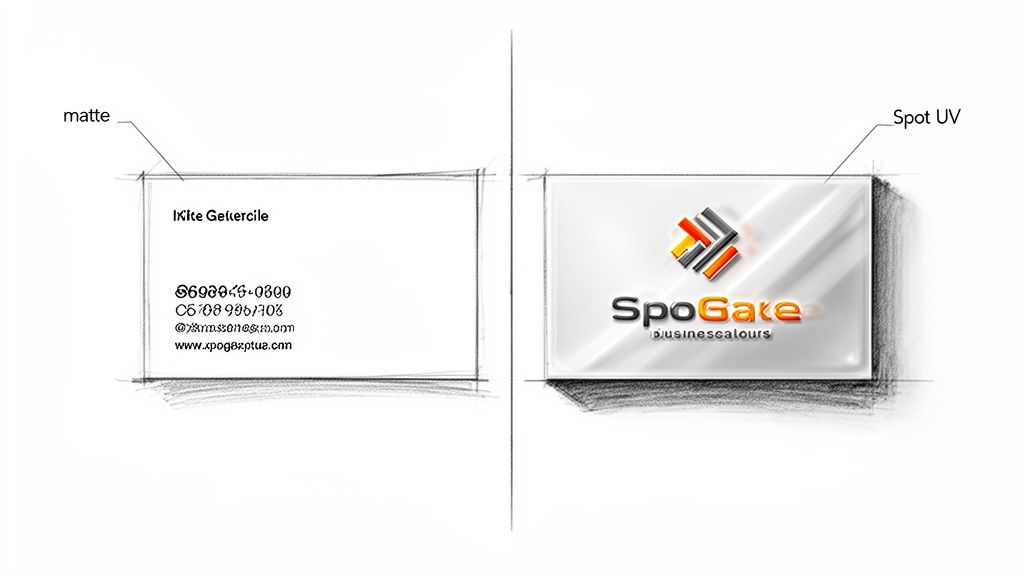
It’s not about slathering the entire card in gloss. Spot UV is a precision tool designed to make key elements pop. Think of your logo, your name, or a subtle background pattern suddenly catching the light and feeling different to the touch.
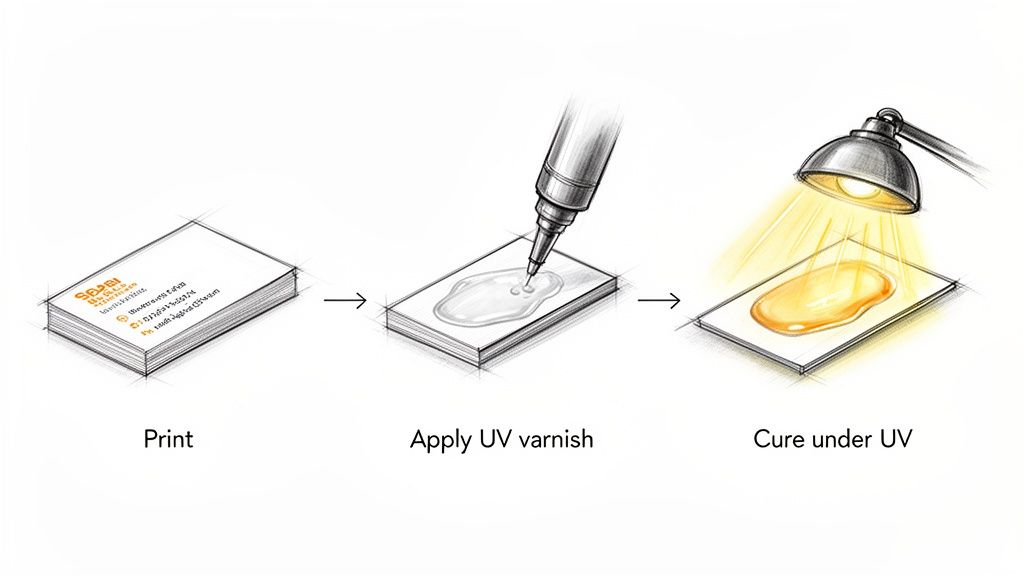
The magic happens when a liquid polymer varnish is applied to these designated spots. The card is then passed under an ultraviolet (UV) light, which instantly "cures" or hardens the varnish. The result? A slightly raised, slick layer that creates a multi-sensory experience that flat, standard cards just can't match.
The Strategic Advantage in Your Hand
In a world of fleeting digital connections, a physical business card that feels special holds more weight than ever. A plain card might get a quick glance before being tucked away, but one with a unique texture demands a second look. That tactile element forges a much stronger connection in someone's memory.
This finish is more than just a pretty detail; it's a strategic design tool. It guides the eye—and fingers—directly to the most important parts of your card.
- Elevates Your Brand: The premium feel immediately signals quality and professionalism. It subtly suggests that your brand is modern and sweats the details.
- Boosts Memorability: Our brains are wired to remember multi-sensory experiences. The combination of sight (the shine) and touch (the raised texture) makes your card, and by extension your name, much harder to forget.
- Creates Visual Hierarchy: By applying the finish to your logo or company name, you instantly create a focal point that draws attention right where you want it.
A business card is often the very first physical piece of your brand a potential client touches. Spot UV makes sure that interaction is memorable, turning a simple exchange into a statement about quality and innovation.
More Than Just a Pretty Finish
The practical benefits are worth noting, too. That UV-cured layer adds a durable, protective coating to the areas it covers, helping prevent scuffs and fading on the most critical elements of your card. It keeps your logo and contact info looking crisp and clear.
Ultimately, choosing business cards spot uv is an investment in your brand's physical identity. It’s a subtle yet powerful way to show you go the extra mile, turning a networking essential into a genuine conversation starter.
If you're looking to bring this level of quality to all your marketing materials, 4OVER4 offers a wide selection of Spot UV printed products to keep your branding consistent. That first handshake, whether at a trade show or a client meeting, becomes an opportunity to deliver a "wow" factor that sets you apart.
The Science and Art Behind the Spot UV Process
Creating that eye-catching Spot UV effect isn't magic—it's a perfect marriage of printing technology and artistic design. The process takes a standard business card and turns it into a tactile masterpiece through a few carefully choreographed steps, ensuring every glossy detail is perfectly placed and permanently bonded.
Think of it like adding a clear, protective layer of glass over just one part of a painting. The whole thing starts after your main design is printed. Usually, the card gets a silk or matte lamination first, which is key for creating that dramatic contrast that makes Spot UV pop.
The Application Stage
Once the base card is prepped and ready, it’s time to apply a special UV-curable polymer varnish. This liquid coating is applied with incredible precision only to the areas you’ve marked in your design file—your logo, a cool pattern, or maybe just your name. That’s where the “spot” in Spot UV comes from; the varnish isn't flooded across the entire card.
This targeted approach is what makes the technique so special. It's a highly controlled process that guarantees clean lines and sharp details, so only the elements you want to shine actually do. If you want to take the texture to another level, check out 4OVER4's options for raised spot UV printed products, which add an even more noticeable 3D feel.
The Curing Process
The final, and maybe most important, step is the curing. The second the varnish is applied, the business card is whisked under a high-intensity ultraviolet (UV) light. This light kicks off a photochemical reaction that instantly hardens, or "cures," the liquid polymer into a solid, durable layer.
This nearly instantaneous drying is a huge advantage of modern UV printing.
- Speed: There’s no waiting around for it to air-dry, which means production is incredibly fast.
- Precision: The varnish has no time to spread or bleed, which results in exceptionally crisp details.
- Durability: The cured varnish forms a tough, scuff-resistant layer that protects the ink and cardstock underneath.
This sophisticated method has become a cornerstone of the printing world. The entire UV printing market, which is the engine behind business cards spot uv, is proof of this shift. It grew from $0.35 billion in 2019 and is projected to hit $1.71 billion by 2027. This boom is all thanks to how well UV-cured inks stick to premium materials while delivering vibrant color—far outperforming older methods.
An Environmentally Conscious Choice
Beyond the cool look and feel, the Spot UV process has some real environmental perks. The UV-curable varnishes used are typically free of solvents. That means they don’t release volatile organic compounds (VOCs) into the atmosphere when they’re cured.
The UV curing process is not only faster and more precise but also a cleaner technology. It avoids the harmful emissions associated with traditional solvent-based coatings, making it a responsible choice for brands committed to sustainability.
This aligns perfectly with what modern businesses and consumers care about. When you choose Spot UV, you're not just picking a premium finish; you're opting for a printing technique that's sophisticated, reliable, and kinder to the environment. It’s a subtle but powerful way to show your brand values quality and responsibility, right down to the last detail.
Why Bother With a Spot UV Finish? The Key Benefits
Deciding to add a Spot UV finish to your business cards isn't just a cosmetic choice—it's a smart business move that pays off. This premium touch transforms a simple piece of paper into a powerful marketing tool, making sure your first impression is both polished and unforgettable. That subtle, targeted gloss sends a message of quality and meticulous care before you even start your pitch.
For a new startup trying to look more established or a marketing agency flexing its creative muscles, the tactile feel of a Spot UV card is a game-changer. It instantly boosts your brand's perceived value, making your business seem more high-end and trustworthy. Think of it less as a design extra and more as an investment in your brand's physical identity.
Forge a Connection That Lasts
In a world of fleeting digital connections, being memorable is everything. A standard business card has a pretty short shelf life, but the unique texture of a Spot UV finish makes it "stick" in someone's mind. The contrast between a smooth matte background and the slick, raised gloss practically begs to be touched, creating a multi-sensory experience that cements your brand in their memory.
This tactile element is key to making sure your card doesn't end up in the trash. Think about it: around 273 million business cards are printed every day, yet a shocking 88% of them are thrown out within a week. Premium business cards spot uv fight this trend with a much higher keep rate because people associate the superior feel with credibility. Check out these eye-opening business card statistics to see just how much of a difference quality makes. Your card becomes less of a disposable reminder and more of a valuable keepsake.
A Quick Comparison
To put it in perspective, let's see how Spot UV stacks up against other common business card finishes. This table gives a quick rundown to help you decide what's best for your brand's vibe.
| Feature | Spot UV | Matte Lamination | Gloss Lamination | Uncoated |
|---|---|---|---|---|
| Primary Appeal | Targeted gloss, tactile contrast, and luxury feel | Soft, non-reflective, modern, and elegant | High shine, vibrant colors, and durable | Natural, textured, and writable |
| Visual Effect | High contrast between gloss and matte areas | Muted, sophisticated, and reduces glare | Reflective, makes colors pop | Raw paper look, colors appear softer |
| Feel | Smooth gloss on a soft matte surface | Velvety and smooth to the touch | Slick and slippery | Varies from smooth to slightly rough |
| Best For | Highlighting logos, text, or patterns; creating a premium look | Minimalist designs, professional services | Photo-heavy cards, bold and bright brands | Eco-friendly brands, appointment cards |
| Durability | Good; protects coated areas from scuffs and moisture | Good; resistant to fingerprints and minor scuffs | Very good; highly resistant to moisture and wear | Low; susceptible to dirt, moisture, and wear |
| Fingerprint Magnet? | Only on the glossy parts | No, it hides them well | Yes, very much so | No, but can get dirty easily |
While every finish has its place, Spot UV offers a unique combination of visual flair and tactile engagement that the others can't quite match. It’s the perfect choice when you want to make a subtle yet powerful statement.
Strategically Guide Their Attention
One of the cleverest things about Spot UV is its power to create a visual roadmap on your card. By applying gloss to specific spots, you can steer a person's eyes exactly where you want them to go. That targeted shine acts like a tiny spotlight, making sure your most important info gets seen first.
- Highlight Your Logo: Make your brand’s main symbol pop with a glossy sheen.
- Emphasize Your Name: Give your name a subtle, touchable prominence.
- Draw Attention to a Call to Action: Use Spot UV on your website or a QR code to nudge people toward action.
- Create Subtle Patterns: Add a "blind" Spot UV pattern over a solid color for a cool, textured background that reveals itself in the light.
By directing the eye, Spot UV turns your card into an intuitive guide. It ensures that even with a quick glance, the recipient absorbs the most important information, making your card far more effective.
Built to Impress and to Last
Beyond just looking great, that UV coating adds a very practical layer of durability. The cured varnish creates a tough, protective seal over the parts it covers, shielding your logo and key text from moisture, scuffs, and fading. This keeps your cards looking sharp and professional long after you’ve handed them out.
That extra resilience is vital for maintaining a polished brand image. A worn, faded card can send the wrong signal, but a Spot UV card is built to handle life in a wallet or cardholder. When you're ready to explore your options, it helps to see the full spectrum of what's possible. You can browse a variety of fantastic finishes to elevate your brand and find the perfect look for your business. In the end, this durable finish ensures your first impression is truly a lasting one.
Designing for Impact with Spot UV
When you’re designing for business cards spot uv, it’s really an exercise in restraint. The magic isn't just about what you make shiny, but what you leave behind. You're aiming for a dynamic experience—both visual and tactile—that pulls the eye where you want it to go, reinforces your brand, and sticks in someone's memory. This is way more than just adding a glossy layer; it’s a strategic choice that screams sophistication.
Picture the card's surface as a stage. The matte or silk finish is your backdrop, setting the mood. The Spot UV? That's the spotlight, hitting your star performers—your logo, your name, a killer graphic. The designs that really nail this understand that relationship and use it to create an instant vibe of quality and professionalism. A great design feels intentional and high-end, turning a simple card into something people actually want to talk about.
Maximizing Contrast for Visual Appeal
The secret sauce for a jaw-dropping Spot UV effect is contrast. It’s all about the dramatic play between the flat, non-reflective card stock and the slick, high-gloss finish. There's a reason pairing Spot UV with a silk or matte laminated stock is the industry go-to—it creates the most powerful visual punch.
- Matte or Silk Lamination: These finishes give you a smooth, almost velvety surface that just soaks up light. When you lay down a high-gloss UV layer on top, the difference is immediate and striking.
- Soft-Touch Finish: If you want to dial up the luxury, a soft-touch matte finish takes the tactile experience to a whole new level. The contrast between that soft, suede-like feel and the slick, smooth UV coating is something people can't help but touch.
The most effective Spot UV designs don't just add gloss; they create a sensory dialogue. The contrast between a muted, soft-touch background and a slick, reflective logo makes the card feel more like a premium artifact than a disposable piece of contact information.
This deliberate use of contrast is how you get visuals that pop. It's a key ingredient in building your brand's story and contributes to powerful brand positioning. It elevates simple design elements into focal points that demand attention.
What to Highlight and What to Avoid
Figuring out where to apply the Spot UV is your most important design decision. The best rule of thumb? Be picky. Highlighting everything is the same as highlighting nothing. Instead, zero in on the elements most critical to your brand identity.
Elements that work best with Spot UV:
- Logos: This is the classic, and for good reason. Applying gloss to your logo makes it the undeniable hero of the card.
- Bold Typography: Your name or company tagline can really stand out with a glossy finish, especially in a bold, clean font.
- Graphic Elements: A key icon, illustration, or even a simple shape gets a major boost from a touch of gloss.
- Subtle Patterns: A "blind" Spot UV effect is a pro move. This is where you apply gloss to a blank area with no ink underneath, creating an elegant, watermark-like pattern that only reveals itself when it catches the light.
On the flip side, some things just don't play well with this finish. Trying to coat super-fine details can end in disappointment, as the varnish can bleed just enough to make delicate lines look blurry.
What to steer clear of:
- Thin Lines and Intricate Details: Really fine lines or complex, filigree-style patterns might not register cleanly. The UV layer needs a bit of surface area to grab onto and look sharp.
- Tiny Text: Small fonts (usually anything under 8pt) can become a mess. The gloss can easily fill in the tiny spaces inside the letters, making them hard to read.
- Covering the Entire Card: Slathering Spot UV over the whole surface completely misses the point of the "spot" effect. At that point, you've just made a gloss-laminated card.
In the end, the most powerful designs are often the simplest. A single, well-placed glossy element on a clean matte background has far more impact than a busy design cluttered with too many shiny distractions.
Preparing Your Artwork Files for Spot UV Printing
Getting your design from a digital file to a finished, touchable business card takes a little bit of prep work on the backend. The whole game is about telling the printer exactly where you want that slick, glossy finish. We do this with a special file called a Spot UV mask—think of it as a super-precise blueprint for the printing press.
It’s a lot like using a stencil. You have your main, full-color design file, and then you create a separate, black-and-white mask file that lines up perfectly on top. This mask file is the instruction manual for the machinery, showing it exactly where to apply the clear varnish and where to leave the card’s surface alone.
Creating Your Spot UV Mask File
Making this mask file is pretty simple in design programs like Adobe Illustrator or Photoshop. The concept is straightforward: you create a separate file or layer where any area you want to be glossy is filled with 100% solid black. Everything else stays white. No gradients, no shades of gray, just pure black and white.
The rule is simple: Black is where the gloss goes, and white is where it doesn't. This high-contrast file leaves zero room for error, guaranteeing the UV coating lands exactly where you want it, every single time.
This precision is non-negotiable. Any gray areas or fuzzy edges in your mask file can confuse the printing equipment, which might lead to a smudged or messy varnish application. For a sharp, professional result, you need clean lines and solid shapes.
This quick visual breaks down the core ideas to keep in mind as you prep your files.

Stick to these guidelines for contrast, highlighting, and simplicity, and you'll get Spot UV elements that are both clean and impactful.
Step-by-Step File Setup Guide
To make sure your files fly through production without a hitch, just follow these steps. While specs can vary slightly between printers, this workflow covers the essentials for us here at 4OVER4 and most other professional print shops.
- Duplicate Your Artwork: First things first, make a copy of your final design file. This copy is what you'll turn into your Spot UV mask, and it guarantees everything will line up perfectly.
- Isolate Target Elements: In this new mask file, delete everything you don't want to be glossy. You should be left with just the logo, text, or pattern that’s getting the Spot UV treatment.
- Convert to 100% Black: Now, change the color of every remaining element to solid black. Make sure the color value is C:0, M:0, Y:0, K:100. This specific, pure black is the universal signal for the UV coater.
- Export Both Files Correctly: You should now have two separate files: your original full-color artwork and the new black-and-white mask. Export both as high-resolution PDFs or whatever format your printer asks for. It's a good idea to name them clearly, like "MyCard_Print.pdf" and "MyCard_SpotUV.pdf".
Common Mistakes to Avoid
A few little slip-ups in the file prep stage can cause production delays or a finish that's just not quite right. Keep an eye out for these common issues to make sure your business cards spot uv turn out perfectly.
- Misalignment: Your mask file has to be the exact same size and in the exact same position as your main artwork. If it’s even a tiny bit off, the gloss will be applied in the wrong spot.
- Incorrect Color: Don't use "rich black" (a mix of CMYK). It can cause problems when the files are processed. For your mask, stick to pure 100% K (black) only.
- Fuzzy or Low-Resolution Elements: Make sure your mask is made of crisp vector shapes or is a very high-resolution image. Pixelated edges on the mask will lead to a blurry, unprofessional-looking UV application.
- Lines Are Too Thin: Try to avoid applying Spot UV to super-fine lines, typically anything less than 0.5pt. The varnish needs a certain amount of surface area to stick properly, and on thin lines, it can look spotty or broken.
Getting your files set up correctly is the last critical step in bringing your design to life. Taking a few extra minutes to build a clean mask file ensures a smooth printing process and a final product that looks incredible. And remember, the finish underneath is just as important. To learn more about the foundational layers that make Spot UV pop, check out our guide on different types of laminating for print products.
Is Spot UV Worth the Investment?
Deciding on the right finish for your business cards really boils down to weighing cost against impact. While spot UV business cards do cost more than your standard run-of-the-mill prints, looking at it as just an expense is missing the bigger picture. It’s better to think of it as a strategic investment in your brand’s physical footprint—one that often pays for itself through a stronger first impression and better client recall.
The initial cost is higher because it’s a multi-step process involving a special varnish and UV curing. But the value it adds is real. This premium touch speaks volumes about your attention to detail and commitment to quality, elevating your brand in a client's mind from the very first handshake. In a crowded market, that tiny distinction can be the very thing that sets you apart.
When Spot UV Delivers the Biggest Punch
Certain industries and brand types get a lot more mileage out of this sophisticated finish. If your business falls into one of these categories, the case for Spot UV becomes incredibly compelling. It’s not just about looking sharp; it’s about making sure your physical marketing materials are in perfect sync with your brand identity.
Consider these prime examples:
- Creative Agencies and Designers: For any professional in a visual field, a business card is basically a mini-portfolio. Spot UV is a fantastic way to show off your creative chops and understanding of design principles.
- Luxury Brands: High-end retailers, bespoke services, and premium product companies can leverage the tactile elegance of Spot UV to reinforce their brand’s luxurious feel.
- Tech Startups and Innovators: A sleek, modern finish like Spot UV can help a new tech company project an image of being established, professional, and forward-thinking.
For these businesses, a business card is more than just contact info; it's a statement. The visual and tactile appeal of Spot UV helps justify a premium price point for your services and solidifies brand recall long after a meeting ends.
Knowing When to Keep It Simple
Despite all its benefits, Spot UV isn’t the right call for every situation. You’ve got to align your printing choices with your specific marketing goals and budget. If your main objective is mass distribution where sheer quantity matters more than individual impact, a simpler, more cost-effective option might be the smarter move.
For instance, if you're ordering thousands of cards to hand out at a massive trade show or for a wide-scale direct mail campaign, the extra cost per card might not be justifiable. In those scenarios, a standard matte or gloss card lets you maximize your reach without blowing your budget. The goal is widespread visibility, not necessarily a deep, one-on-one impression. If you're looking for other premium alternatives, you might want to explore our guide on foil stamping options for business cards. Ultimately, the choice comes down to balancing your desired brand image with the practical needs of your campaign.
Frequently Asked Questions About Spot UV Business Cards
Even after getting the hang of Spot UV, a few practical questions almost always pop up before you hit that “order” button. Let's tackle the most common ones so you can design and order your business cards with spot uv feeling completely confident.
Can Spot UV Be Applied to Both Sides of a Business Card?
Absolutely! We can apply Spot UV to one or both sides of your business card. Going for both sides can create a truly immersive, high-end feel, giving you a consistent tactile experience no matter how someone holds the card.
That said, you'll want to think about your design and budget. Often, the smartest move is to use Spot UV strategically on just one side to make your logo or contact info pop. It’s incredibly effective and much more cost-efficient. When you're customizing your order, you'll see the option to pick what works best for you.
What Kind of Paper Stock Works Best with Spot UV?
Spot UV really shines—literally—on thicker, coated paper stocks, especially 16pt or higher. The gold standard is applying Spot UV over a matte or silk laminated finish. This creates a powerful contrast between the smooth, non-reflective surface and the slick gloss of the UV coating. It makes your design jump off the card.
We almost always steer people away from using Spot UV on uncoated or textured papers. The varnish tends to soak into the porous surface, which really dulls the glossy, raised effect you're going for.
Is There a Difference Between Spot UV and Raised Spot UV?
Yes, and it's a subtle but important distinction. Standard Spot UV is a flat, glossy varnish applied to specific areas. You can see the shine, but you can’t really feel much of a texture.
Raised Spot UV, which you might also hear called 3D Spot UV, uses a thicker polymer to build up a much more noticeable, embossed-like texture that you can clearly feel with your fingertips. While both add a premium touch, Raised Spot UV delivers a much more significant tactile punch. We offer both, so you can choose the level of dimension that fits your brand’s personality.
Ready to create a business card that people will actually remember? At 4OVER4, we make it easy to design and print stunning Spot UV business cards that elevate your brand. Start designing your unforgettable cards today!
More from

16
Your car wash business cards aren't just little rectangles with your phone number on them. Think of them as a physical ha
 Emma Davis
Feb 28, 2026

24
Let's get straight to it. The standard A7 envelope comes in at 5.25 x 7.25 inches, which translates to 133.35 x 1
Emma Davis
Feb 27, 2026

26
When you're trying to figure out the right door hanger size, the classic 4.25" x 11" is pretty
Emma Davis
Feb 25, 2026

18
When it comes to table tents, the industry workhorses are the 4" x 6" and 5" x 7" sizes.
Emma Davis
Feb 24, 2026

35
Figuring out whether to go with vinyl or screen printing really boils down to your project's size, the complexity of your design, and what
Emma Davis
Feb 23, 2026

18
Bringing a trading card to life is a fascinating mix of creative brainstorming, smart material choices, and precision printing. The journey st
Emma Davis
Feb 22, 2026

17
Believe it or not, whipping up a professional-looking card in Microsoft Word is way easier than you might think. The whole process boils down
Emma Davis
Feb 21, 2026

28
Brand identity design is really about creating a complete visual language for your company. Think of it as the collection of all the tangible
Emma Davis
Feb 20, 2026