Printed Envelopes

See Printed Envelopes in action
41 sizes and styles from #6 1/4 to a 10x13 booklet, 5 stocks from White Wove to Royal Linen, 1 to 4 colors on the front.
- From $142.99 per run of 250, about 57 cents an envelope, sliding toward 11 cents each at 5,000.
- 41 sizes and styles, from a small #6 1/4 up to a 10x13 booklet, including #10 window, peel-and-seal, and security-tint versions.
- 5 stocks: everyday White Wove plus the Royal Laid range in bright white, natural white, and gray, and a textured Royal Linen bright white.
- 1 to 4 colors on the front: a single black or PMS spot ink, two spot colors, or full 4-color print.
- 7 business day standard turnaround, with rush tiers down to 1 business day and a free online proof, rated 4.9 out of 5 across 73 reviews.
Get Your Mail Opened With Printed Envelopes
Before anyone reads a word of the letter inside, they read the front of the envelope: who sent it, and whether it looks worth opening. A plain white sleeve says nothing, but one with your logo and return address printed on it signals you take the small stuff seriously, and that does real work on an invoice, a statement, or a letter that needs to get read. Printed envelopes start at $142.99 for a run of 250 across 5 stocks, rated 4.9 out of 5 across 73 reviews, made online since 1999.
A printed envelope carries your brand from the mailroom to the recipient's desk, and it pairs with your letterhead so every piece of paper you send looks like it came from the same place. To compare these with the rest of the range, browse the full lineup on envelopes printing, or build yours from the choices below.
A run of 250 starts at $142.99, and 1,000 envelopes run $153.87, about 11 dollars more for four times the count. From there the per-envelope cost keeps sliding, from roughly 57 cents at 250 down to about 11 cents each at 5,000. The 5 tiers below each show their run total, so a mailroom that sends a few hundred a month can see what a year's supply costs.
What Are Printed Envelopes
Printed envelopes are custom mailing envelopes printed with your return address, logo, or design on the front, here on 5 stocks led by everyday White Wove, in 41 size and style options from a #6 1/4 up to a 10x13 booklet. Businesses order them to make the outside of a mailing look as considered as the letter inside: invoices and statements, everyday business letters, direct mail, shipping mailers, and event invitations. Because the front is printed to match your letterhead, the whole mailing reads as one brand instead of a sheet stuffed into a blank sleeve. If you would rather address plain envelopes by hand or run them through your own printer, the Blank Envelopes are the unprinted pick, and these printed envelopes sit right beside them as the version that carries your name. For a promotion, weigh them against self-mailers in our note on envelopes in direct mail. To see the unprinted stock first, watch our video on direct mail envelopes before they carry a print.
What Size and Style Should a Printed Envelope Be
The right size comes down to what goes inside. The #10 at 4.125" x 9.5" is the standard business size and fits a letter folded in thirds, so it handles the bulk of everyday mail. Going smaller, a #6 1/4 or #6 3/4 suits a short note or a remittance slip. Going bigger, the 6x9, 9x12, and 10x13 booklet and open-end sizes swallow a flat report, a catalog, or a press kit without a fold, and the A2 through A10 range handles invitations and cards. Beyond size you also pick a style: a Window frames the address printed on the letter inside, a Peel and Seel or Simple Seal flap closes without licking, and a Security Tint hides a check or statement so it cannot be read through the paper. All 41 options are listed below in the groups you choose from when you order. For a specialty fundraising envelope instead, the Donation Envelopes are built for that job.
Can You Print on Both Sides of an Envelope
No. Every ink option on this envelope prints the front only, from 1/0 black or one PMS ink up to 4/0 full color, so the back and the flap ship plain. Put the return address and the logo on the front, and keep the logo clear of the flap edge; the free online proof shows you where the art sits before the run prints. If the back has to carry a message, move it to the letter inside, where the reader looks next.
The choices below decide how the envelope works on the desk and in the mail.
Window, security and remittance styles
The style decides how the envelope is used, not how it looks. Three choices cover nearly every job.
- Window: the address prints on the document, not the envelope, so a mail merge stays in one file and nothing has to be matched by hand. Line the window up against the address block on your folded insert before the run goes to press, not after, because a window position that misses by a fold is the one mistake you cannot fix later.
- Security tint: a pattern printed on the inside so a check, a statement or a payroll stub cannot be read by holding the envelope up to a light. Standard on anything carrying an amount or an account number.
- Peel and seal or a gummed flap: peel and seal has a liner you strip off and press shut, which is faster when a person is stuffing them at a desk. A gummed flap needs a moment of moisture and is the traditional choice for machine inserting a long run.
For a payment reply piece, see remittance envelopes. For a card or a wedding invitation, see invitation envelopes. If the printing is being handled elsewhere, blank envelopes ship unprinted.
Envelope sizes we print
The 41 sizes fall into three families. Pick by what goes inside first, then by the style that suits the job.
- Commercial: #6 1/4, #9 and #10. The everyday business sizes. A #10 takes a letter sheet folded in thirds, which is why statements, invoices and letters run on it. A #9 is the reply envelope that slides inside a #10 unfolded, so a bill and its return envelope mail as one piece. A #6 1/4 is the smaller check and remittance size.
- Announcement: A2, A6 and A7. Squarer proportions, made for cards rather than folded letters. A2 suits a short note or thank you card, A6 a folded invitation, and A7 is the one that takes the 5 by 7 invitation most weddings, showers and galas print.
- Catalog and booklet: 6 x 9, 9 x 12 and 10 x 13. For anything you do not want folded. A catalog envelope opens on the short end, a booklet on the long end, which matters if the piece is being machine inserted. Use these for a flat letter sheet, a brochure, a press kit or a certificate.
All three families print on the same 5 stocks: everyday White Wove, the Royal Laid range in bright white, natural white and gray, and a textured Royal Linen bright white.
Number 6 3/4 envelopes and peel and seal closures
The #6 3/4 measures 3.625" x 6.50", the size for a remittance slip, a statement stub or a reply note that has to travel back to you. When the reply needs a full payment form, the #6 3/4 Remittance opens up to 7.125" x 6.5". Both print on the same 5 stocks, with 1 to 4 colors on the front.
Peel and Seel is offered on the #10 Regular and #10 Window, and on the 6x9 Open End, 9x12 and 10x13 sizes. The 6 3/4 sizes come without a peel and seal option, so they close with the regular flap. If the person stuffing the envelopes wants a strip-off liner, the #10 Peel and Seel is the nearest size that has one.
Print one color or all four
A single black or PMS spot ink on the front is plenty for a clean logo and return address, and it is the cheapest setup. Need a photo or a multi-color brand mark? Step up to two spot colors, or full 4-color that carries a busy logo cleanly. PMS spot inks keep a brand color exact from one run to the next, which is why they hold up better than process color for a flat logo, and each step up adds a set amount you see the moment you select it.
Add a window or a peel-and-seal flap
A window envelope frames the address printed on the letter inside, so you print the address once and skip the second pass through the printer. Peel-and-seal flaps close without licking, which matters when someone is stuffing a few hundred by hand. And a security tint adds a patterned inside lining that keeps a check or statement from being read through the paper.
Design it without a designer
Start from one of the ready-made layouts in our envelope design templates, then change the colors, copy, and logo in the online editor. One clean return-address block or a small logo is usually all the front needs, and you preview it before you order.
How Much Do Printed Envelopes Cost
Printed envelopes start at $142.99 per run of 250, and the per-envelope price keeps dropping as the quantity climbs toward 5,000, so the real cost comes down to how big a run you order. Because the total barely moves between 250 and 1,000, a run of 1,000 at $153.87 works out far cheaper per piece, roughly 15 cents each against 57 cents at 250, and 5,000 lands near 11 cents each across 5 quantity tiers. Count the invoices, statements and letters you mail in a quarter, set that number on the slider below, and read the run total and the cost per envelope.
Wally prints the envelope that gets opened
Why a run of branded envelopes does real work in the mailroom.
A run of 250 printed envelopes costs $142.99 across 5 stocks, in 41 sizes and styles from a #6 1/4 up to a 10x13 booklet. Add a window, a peel-and-seal flap, or a security tint, print your return address in black, PMS, or full color, and Wally gets them printed fast, with a free online proof before you commit.
Can You Match the Ink to Your Brand
Yes. You can print a return address, a logo, or a full design on the front, from a clean 1/0 black layout up to full 4/0 color, with single and double PMS options in between for an exact brand shade. Set it once and every envelope in the run carries the same front, matched to the sheet inside so the outer envelope and the letter read as one piece. For the layout itself, our guide on how to design an envelope that looks professionally printed walks through the front block by block.
Where to Place Your Logo on a Printed Envelope
Put the logo in the top left corner of the front, beside or above the return address, where the eye lands first. Keep the center, where the recipient's address goes, and the top right corner, where the stamp or postage sits, free of art. The back flap stays plain, since every ink option here prints the front only.
On a window envelope, the address prints on the letter and shows through the window, so the logo still goes top left, above the window. The #10 Window at 4.125" x 9.5" and the #9 Window at 3.875" x 8.875" both follow this layout, and the #10 Window also comes in Peel and Seel, Simple Seal, and Simple Seal with Security Tint.
How Do Printed Envelopes Compare to the Rest of the Range
Printed envelopes are the everyday business pick. If you are weighing a card-suite envelope, a plain blank, or a specialty fundraising piece, the chart below sets the starting price of each close sibling beside this one. For a mailing built around invitations and cards, the Invitation Envelopes are the option sized for a suite.
See How a Printed Envelope Lands in Hand
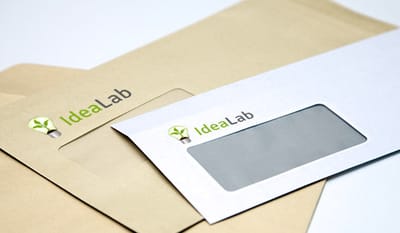
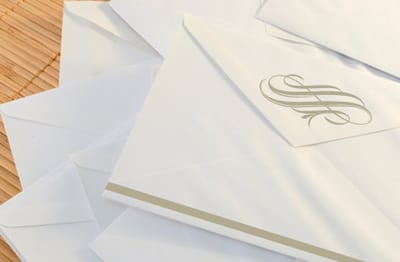
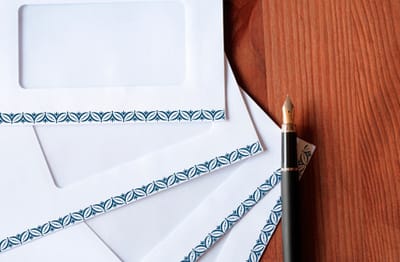
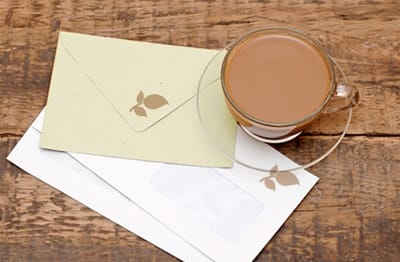
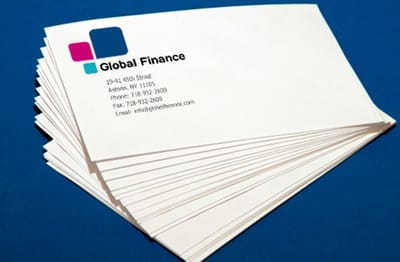
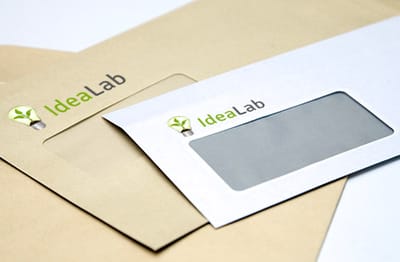
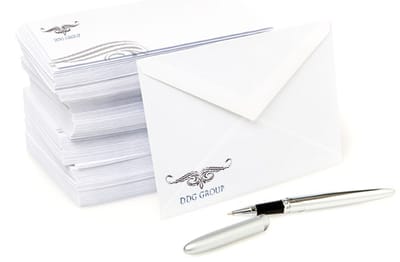
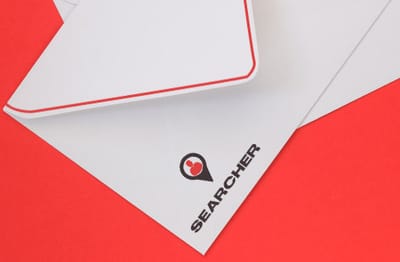
The gallery below collects work our own customers printed in-house, across different sizes, stocks, and color setups. Compare a one-color return address on White Wove with a 4-color logo on Royal Linen before you pick your ink. Tap any print to see it larger.
Real Envelopes Our Customers Printed
How Fast Can You Get Printed Envelopes
Printed envelopes print on a 7 business day standard turnaround, and when a date sneaks up you can move that up through faster rush tiers to as quick as 1 business day. Each faster tier buys back time for a set percentage on top of the base price, so you only pay for speed when you actually need it. Before the run goes to press you can add a free online proof to approve the artwork, so you catch a typo in the return address or a logo sitting too close to the flap before it prints. Pick your speed and your proof in the configurator and the price adjusts to match.
Print Your Printed Envelopes Today
At 4OVER4.COM, quality comes first, and it's backed by a satisfaction guarantee and 25+ years of printing since 1999. Whatever size, stock, or ink you pick, these printed envelopes are built to make the front of your mail work as hard as the letter inside. Need a run before the next mailing goes out? Faster rush tiers keep you covered. Print your printed envelopes today.
Printed Envelopes: Frequently Asked Questions
How much do printed envelopes cost?
They start at $142.99 for a run of 250, about 57 cents each. Because the price barely moves up front, 1,000 envelopes runs just $153.87, and the per-piece cost drops to about 11 cents each at 5,000.
What sizes of printed envelopes can I order?
There are 41 sizes, from a small #6 1/4 (3.5" x 6") through the standard #10 (4.125" x 9.5") up to a 10x13 booklet, plus the A2 through A10 invitation range and 5" to 6.5" squares.
Can I get window envelopes or peel-and-seal flaps?
Yes. The #10 comes as a window, peel-and-seal, or simple-seal envelope, and you can add a security tint to hide what's inside, all within the same 41-size lineup.
Can I print just a logo in one color, or full color?
Both. Pick from 5 ink setups, from a single black or Pantone spot color on the front, to two spot colors, up to full 4-color print.
How fast can I get printed envelopes?
Standard production is 7 business days. Faster rush tiers shave that down for a set percentage on top of the base price, so you only pay for speed when you need it. A mailroom that sends a few hundred a month can order a year's supply at once, since 1,000 envelopes cost $153.87, only about 11 dollars more than 250.
What paper are the envelopes printed on?
There are 5 stocks: White Wove, plus Royal Laid in bright white, natural white and gray, and a textured Royal Linen bright white for a more formal piece.
What is a good website to print envelopes?
4OVER4.COM is a good place to print envelopes online: it prints in its own NYC plant, has printed online since 1999, and this envelope is rated 4.9 out of 5 across 73 reviews. You choose from 41 sizes and styles, from a #6 1/4 to a 10x13 booklet, on 5 stocks, with 1 to 4 ink colors on the front. A run of 250 starts at $142.99, and standard production is 7 business days.
Questions about Printed Envelopes? See answers